The last place my mother wanted to be buried was next to her mother and father in the city cemetery of Winchester, TN. I think it had something to do with her being an only child and what that might look like. Her mother who lived to be 99 knew mom’s feelings on this. Nevertheless she insisted on buying a third plot to go with her and grandpa’s grave. His remains have been there since 1972.
“Well, I’m gonna get you this plot. You don’t know what might happen. You need a place to be buried,” granma said with that ending note of finality that she was famous for.
It must have been sometime after my parent’s divorce that she decided on this course. My grandmother was not one to be dissuaded by what people wanted. She was ruled by practicality. The third cemetery plot was a theme repeated by Flora less often than commentary on the weather but on par with the importance of church.
Mom never asked for a memorial stone either. Nevertheless, when mom died I got together with Uncle John to purchase a small 6 x 12 inch granite memorial which he placed on the property of his house on the Tennessee River. (Linda and John are really mom’s first cousins, but felt like siblings to mom.)
John’s river house was a cherished meeting place for the cousins and other family for over a decade. Now most of those people are gone and John recently sold the property and removed mom’s memorial along with several other stones he had placed there. Tomorrow, on my way to my birthplace I will stop in Jasper, TN to pick up the memorial stone Uncle John has stored in a barn.
————
I guess there is something to be said for the power of reflective writing. Before I began this journal entry today I had planned on placing mom’s stone in the city cemetery in Winchester next to her parents. Somehow it seemed appropriate. I couldn’t be accused of going against her wishes. If you remember, I scattered her remains in the Tennessee River—the flakes of white bone sparkling in the sunlight amidst a milky way cloud of ash. So technically she wouldn’t be buried next to her parents. Furthermore, though she had an adversarial relationship with her mother it was also a fidelitous bond of love. Surely she wouldn’t be opposed to having a marker there.
Now I’m rethinking the whole thing. Mom would have shot down my technicality defense. How many dying wishes of my mother can I deny?
It was also her deathbed wish that I take care of her partner Marrietta. I ignored that. Marrietta and I’d had the verbal equivalent of a knock-down, drag-out fight a week before my mom finally succumbed to lung cancer in 2010. I hadn’t spoken to her since.
Mom kept secret a large part of her life from her mother. When she had a lobe of her lung removed in 2005 I was instructed to run interference from California and tell granma that mom had severe laryngitis and could not talk. But granma knew something was up.
About mom’s homosexuality she said, “I know what they are doing.” That is the extent of any conversation I ever had with her regarding my mother’s 14-year relationship with Marrietta. Granma knew Marrietta, who was often present during visits. But whatever mom and Marrietta’s relationship was, it wasn’t discussed.
Three years ago I learned on Facebook that Marrietta had died a few months earlier. I thought it had been a lingering illness. A few days ago I learned that she’d fallen backwards off a porch and had not been discovered for a few hours, yelling for help with a broken back. So much for looking after her. I still don’t know the whole story.
Now, at the very least, I need to do some follow up work. If there is a way to show mom and Marrietta’s relationship in death, I need to do that. Whatever my own difficulties were with Marrietta, my mother had a partner she loved.
I’m hoping to enlist my nephew Anthony on a little investigative work to Clyde, North Carolina where Marrietta died. It’s an extra task in this trip and I’ll have the extra weight of a twenty-five pound rock, but at least I can mark off tracking down a Mr. Napper, the Head of Public Works in Winchester. He is the person with the cemetery map and would know which side, granma’s or granpa’s, that third plot would be on.
—————
Driving through the Oakes Day Lily display garden the other day I saw a small bird chasing a hawk at low altitude, parallel to my truck. The hawk, in its escape, disappeared behind some bushes with the little bird fast on its tail. When the hawk reappeared it was coming straight at me, aimed toward my grill. It just had time to veer out of my path. Maybe this helped me to change direction on my memorial placement ideas.
Incidentally, I was on my way to borrow a machete to help hack my way to another memorial site—one on my father’s side. So you can see I’m up to my eyeballs in memorial thoughts.
I may post some pictures of that excursion which included an exciting treasure hunt inside a shed that no one has been inside in sixty years.
Dad often said that he came from a long line of cold, distant and aloof people. It may have been an exaggeration—but witness me—perhaps the only person left who cares enough to hack through a Tennessee rainforest to find some lost memorial slabs.
There is a danger as I get close to my place of origin that these writes could slip out of control. I suppose there are at least two ways to view the past. One—and this is my natural instinct—is to look at it like this swirling black hole with tentacles that can grab and pull me down. Just from a writing standpoint there is a lot of material there. I’m talking about the past that comes before me—those pieces that fused together to make me—the sperm and egg and everything that led to that which now seems small simply because of distance.
When I was a child visiting Winchester, my grandmother would take me into Hammer’s Five and Dime on the town square. The place smelled like an old wooden building—because that’s what it was. Indeed it had thousands of feet of wood floor that creaked just like an old house. This was the precursor to the modern department store—the evolutionary link between frontier trading post and hardware store.
At the back of Hammer’s were some dressing rooms and one of those alcoves of mirrors where you could see all sides of yourself and where the mirrors that faced each other made an infinite hallway that it seemed possible to walk down. Standing there felt like being in a frozen snapshot of traveling at light speed. If the camera backed out far enough I knew I was just a spec in a vast hole of darkness.
The other way to view the past—and this is just a notion I’m having now—is that it is the seeds in the center of a flower and that we are the petals spinning forward. I’m not sure I can elaborate much more except to say this vision has a more upbeat kind of feel than my natural inclination which is to sink inward. I’m thinking of my self sitting on one of those flower petals with my toes dipping in the center where the seeds are. The seeds are black but they are covered in water and the water is moving. The movement is part of what keeps my reflection from just being a hall of mirrors. If I turn my body to the outside of the flower I’m still sitting on the petal but now my feet hang into air. The sun is shining. There are infinite unknown possibilities.
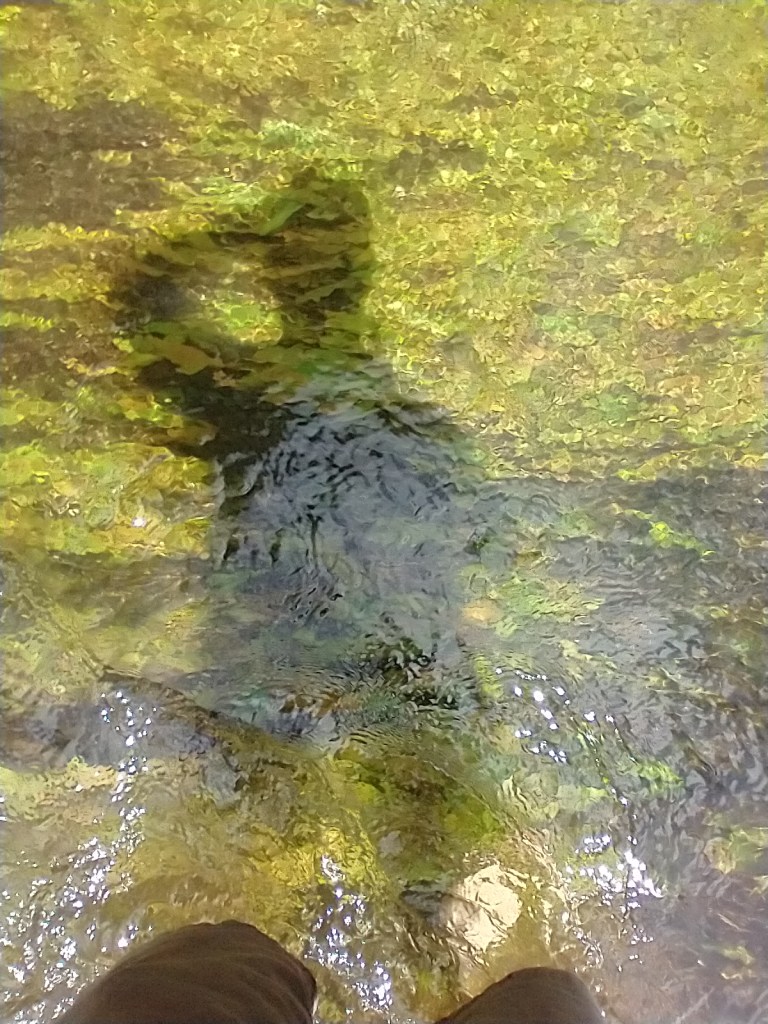
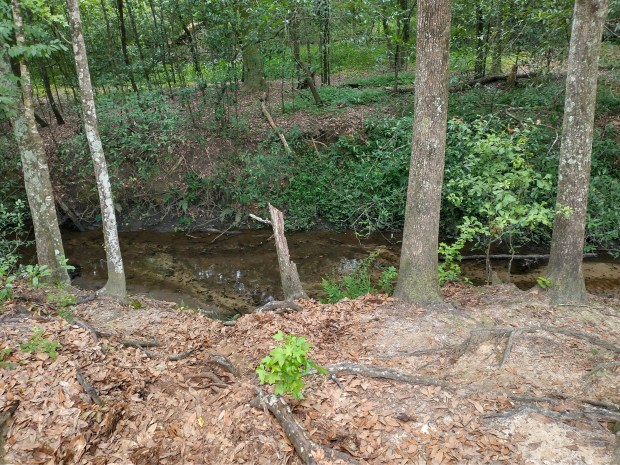
(I’m standing in a shallow branch of the Holston River which joins the French Broad River in Knoxville to become the Tennessee River.)
Those of you who have read my most recent entries know that I am living in luxury at my Aunt Linda’s Corryton, TN condominium after urban boondocking across the United States visiting all my hometowns. I only have Winchester, TN and Sewanee, TN left to visit. Most likely I will continue my journey to those places sometime next week, visit nearby family and then return to Corryton for more family visiting before returning West.
Right now I am of the mind to return to Denton, Texas on the way back across the country and try to find the old Shady Oaks Ranch or the space it once occupied. I have a lead on where it may be from a woman who returned my call. On a message she left to me on my phone she said she used to go there with her Girl Scout Day Camp but that if it is the place she is thinking of “it has been gone a long, long time.”
At the moment I’m very close to the kernel of my existence. Winchester is where I was born. It’s about 3 hours east. However, Knoxville is where my parents met going to school at the University of Tennessee. That’s just 25 minutes away. Dad was a Knoxville native; mom from Winchester. A secret that came out after dad died was that he had been engaged to marry another UT faculty child like himself, but he called off the wedding the night before and got one of his brothers to drive him directly to Winchester to see my mother. According to my source, he had felt that he didn’t have much in common with the woman he was engaged to and that it had felt almost arranged—like it was an inevitable expectation that developed after they began dating.
I’m sure my mother’s rebellious spirit felt exciting, perhaps almost exotic to him. Dad was an eagle scout and youth minister. Mom, who had it in her nature to challenge everything, may have been the yin to his yang.
Maybe when he broke up with his bride-to-be he had in mind the Everly Brothers, that duo that rose to stardom in 1957 with Bye-Bye Love. He went to West High School with them and not too many years before, one of the brothers (Don probably) slashed his tires and stole the date he had taken to a school dance.
Get me alone in a place with cable tv and I invariably end up watching the most gruesome stuff like 20/20 and Forensic Files. What is it that attracts humans to the macabre? Having known a few murderers in the Tenderloin (at least two before they committed their crime) I can say they were mostly sad or terribly disturbed people—except for one guy—a senior who came into the drop in center where I worked who had done a few decades in San Quentin after knifing a guy to death during a botched drug deal. He was actually kind of upbeat.
“Let me tell you buddy. It was either me or him and you know, from my perspective, him was better than me.”
Chuck was gruff but humorous except that every time he’d get his social security check he’d go to a bar, flash his cash and end up getting rolled on the street. He’d show up in the senior center the next day with a black eye or toilet paper stuffed up his nose. Okay, come to think of it, sad and terribly disturbed fit him pretty well if you scratched beneath the surface.
Anyway, landlocked and docked, this urban boondocker has a lot of time to couch surf but I actually haven’t been watching much tv—mostly just before I go to bed. Nothing like the sad life of killers to give me sweet dreams.
Actually, I’m a sucker for romantic comedies too. Adam Sandler has made some really bad movies but I’ve kind of enjoyed the ones I’ve seen him make with Drew Barrymore. Maybe she has a wholesoming effect on him. I watched “Blended” the other night. It only took about six hours—four hours of commercials and two for the movie. I did computer organizing in between.
Early on in this endeavor to visit all the places I lived with my family I said it may just end up being a journal about gas prices. Well, now that I am on a bit of a hiatus before visiting my last two places—Winchester, TN and Sewanee, TN—this might be a good time to show you my little gas chart:
As you can see my best fuel economy took place early on in the trip when driving away felt like a Sunday stroll and I crossed some great expanses as if I was just headed down to the local ice cream shop. 30.9 miles per gallon is pretty good for my old 2006 Ford Ranger. I estimated that I was going about 60 mph to get that. My worst average was in Tallahassee where I did a lot of city driving.
Finally, for you male urban boondockers I have found that a half gallon milk container and a binder clip is the best pee container to use while camping—no real aiming required and you can pretty much relieve yourself without having to get out of bed.
There really is no rhyme or reason to the way I create these time stamps on my post. Sometimes they represent when I start writing, sometimes when I finish and sometimes a point in the middle. This one represents a beginning.
When I was boondocking, I could claim noise or a sudden fright or the insecurity of lying in the back of a truck in a parking lot would wake me in the middle of the night. Here, who knows? I am literally in the middle of a cow field in Corryton, TN. Barbed-wire fencing surrounds me on three sides. It’s a seniors community and you have to be 55 to live in one of these condos. I don’t think I’ve ever been in a quieter place except when I was in a cabin in Willets, CA after a deep snow and another time when I tried out foating in a salt water isolation tank. I did hear the last of some early July 3rd fireworks when I went to bed last night, but I was fast asleep before they ended.
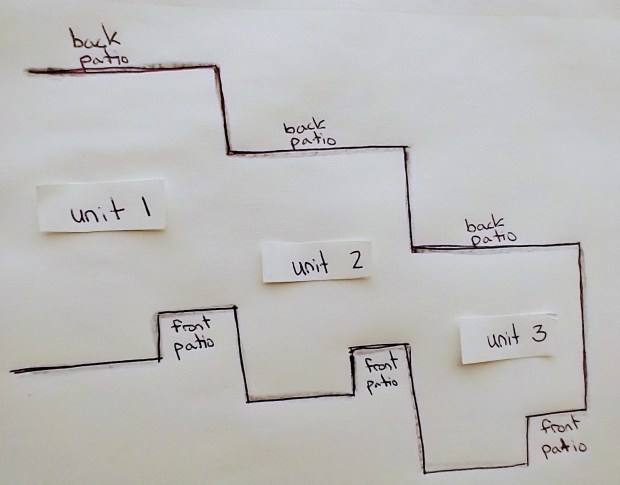
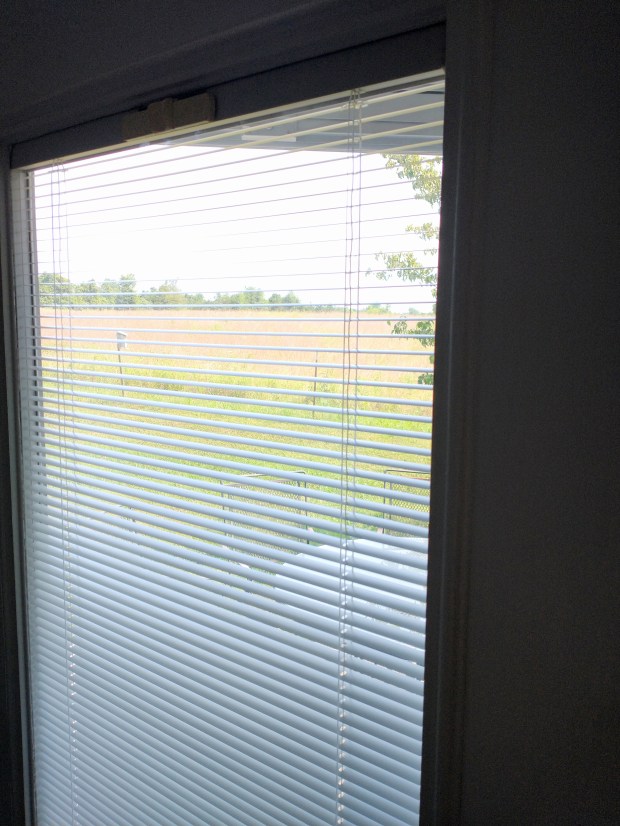
I’m in condo Unit 1. It has doors that shut well, a modern kitchen, and a large garage with a remote controlled roll down. These units have an ingenious step footprint that keeps back and front patios private. There are four groupings of three units like this in the whole development.My favorite feature: these blinds are inside the double window of the door. The opening and closing mechanism is a slide at the top. No dusting ever required, but not good for looking surreptitious through the blinds before a shootout.)
You’d think the frustrations inherent with being an urban boondocker on the road would end with the luxury of being in a newly built (within the last 15 years), two bedroom, senior residence condominium that has more square footage than my small California house. This place is a solid, landlocked ship, built on a slab foundation. The front door opens to a hall wide enough to accommodate that wheelchair I might have ended up in had the bathtub incident at the Wyndham Garden in Tallahassee not gone as well.
The hall floor, living room, and kitchen are wood though there is a laminate as thick as some pizza parlors put on their tables when they want to show pictures of pop culture buried beneath an inch of polyurethane that no hoodlum with a penknife could get to without spending several decades of his time and a good portion of his income sitting in the same booth working on it, in which case, in the intervening years, he would likely no longer be a hoodlum but would have traded in his penknife for a pocket protector or something and become a productive member of society.
The rest of the condo is carpeted. The slab foundation makes a person feel very special as if one’s movement is no longer mortal but related to the gods and how they walk across clouds making zero noise. When I come through the front door here I sometimes have a hopeful expectation that I will be greeted by a sloppy, excited dog; so profound is the quiet. It’s a writer’s dream until it becomes his nightmare.
Fortunately human problems exist here. It is ironic that the issues I have most as an urban boondocker—water incursions and wifi—have followed me here. The past two days I’ve taken these on with an aggression that can’t be equalled by anyone except another person with a great deal of time on their hands— a person, for example, like myself, living in a senior community.
But I’m not going to go into any further detail (proofreader please note correct use of further not farther) about Wifi because in the course of journalling about this just now I had an embarrassing epiphany. The truth is that I don’t have a problem at all if I pay a little extra money for additional data to use my phone as a hotspot. I can get as much fast internet here as I want. The issue is not about accessibility. It is about cheapness and stupidity and the fact that (green flag waving environmentalist that I am), until this moment I was of the opinion that I’d rather spend $3.99 on a gallon of gas to get to a McDonald’s with wifi than spend the same money to stay home and use my phone as a hotspot. Issue solved—idiocy acknowledged.
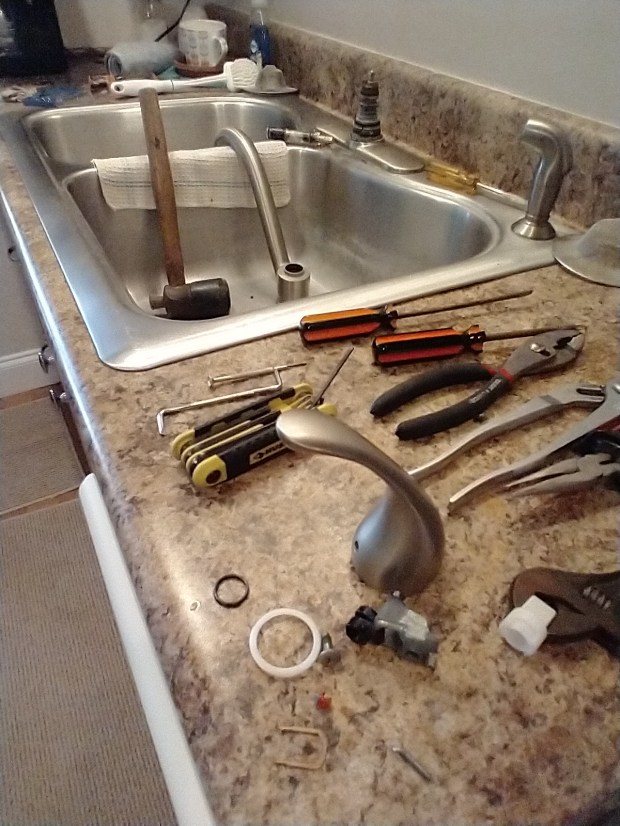
My other issue: water incursion. It certainly is not as dire as it was in the truck. It does not involve wetness where I need to bed down at night. Really it is more about using it as a scapegoat for a small bit of writer’s block I was having yesterday. You see, as I was sitting in the lazy boy—with an electronically controlled foot and back rest—about to embark on the further adventures of an urban boondocker, I heard a constant drip from the faucet. Having had a few limited, but successful, experiences in the plumbing department over the years, I assessed the situation and decided I could take it on. Six hours later this is what I’m left with:
Although it is sometimes the case, a hammer did not prove to be the right tool for this job.
I’m going to call a plumber on Tuesday. The one I’m interested in is closed Monday for the holiday. I’m okay washing dishes in the bathroom until then.
My aunt has told me not to spend money on her plumbing but, you know, this place is like a luxury hotel and it’s all mine as she has left it to go live with her lover across a few fields. Besides, at this point, I can’t even get the faucet put back together. Something happened in the course of taking it apart and the old cartridge, not to mention the new one, won’t seat back in the pipe so I can’t even return it back to it’s dripping glory.
Anyway, this rambling is all a bit of avoidance in terms of this trip’s mission which has to do with my somewhat rootless roots, recording the places I lived and reflections of how those places made me the person I am today.
I’ve touched on this human-made concept of race and I think I will continue to do so. I’m also beginning to see a theme in this journaling related to the environment and open space or the lack thereof—also, the general theme of housing.
I will admit to white fragility to the extent of being a porcelain figurine at times. I think we live in a shattered land with many shattered people. I am one of those. But have I invented this hurt? Is this just something like the wifi and the plumbing—a way to occupy my time? Or is it something real, something that needs to be fixed?
My opinion is if you don’t feel shattered by race then I think you are in what Kierkegaard called the greatest despair of all which is the despair of not knowing despair.
If you think that we just need to make America great again then you are not acknowledging that America never had a time when it was great—at least, not great in all things. We may have been great at war. We may have been great at industry. We may have even been great at opportunity, in comparison, in contrast to the larger world. But no, we were never great in all things. At best we were human. At worst, we were animals ripping the flesh from each other.
But I’m here to report that the manatee is not dead. I’m here to show you that humanity has potential. I’m here to offer up my experience in life. I’ve had one just as you have. I did not grow up in a bubble. Neither did the people of Corryton, TN. The cows that surround me in these fields will be milked two times today (maybe three if they are following the genetic breeding that is happening in Wisconsin). There are beef cows around here that will live their short life of one or two years and then be taken to the slaughter house and made into steaks and ground into hamburger.
As Hank Williams said, “I’ll never get out of this world alive”. Life is tough and old age ain’t for sissies (Bette Davis). So I’m hoping to grab hold of a little fearlessness in writing about my life. My plan isn’t to offend anyone. It is to tell part of my story.
Me and Tracy touring Wakulla Springs.
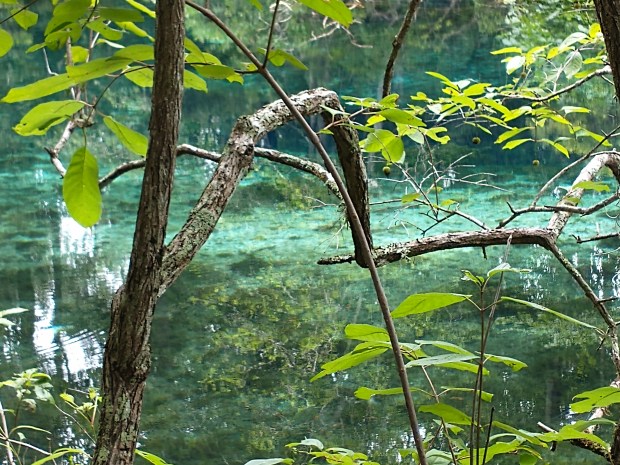
The state park is close to Tracy’s house. I went back on my own after borrowing a snorkeling mask. The swimming area borders a spot hundreds of feet deep. On clear days the cold water is as transparent as air. Creature from the Black Lagoon and old Tarzan movies with Johnny Weissmuller were filmed here. This place heavily influenced my wonder and awe concerning nature as a child.
Do you know what these are? Tracy cooks them, then puts batches in the freezer to microwave whenever he wants. He asked me to let him know what I thought of them when I was leaving his house to go back to the Springs. I dug in as soon as I got in the truck and texted him that I was having a hard time getting out of his driveway. Forget autonomous vehicles we need mechanized, boiled peanut feeders. This is a shallow area of the spring near the entrance. I stopped on the way in and saw an adolescent-sized alligator swimming across. On the way out I stopped again. Three small alligators were basking on a log with about a dozen turtles. Large mullet lazily swam about as if stocked in a pond.
This is the last house I lived in Tallahassee on Chowkeebin NeNe Street. Of all the homes my family had, this is the one I wish we had never left. It is in the idyllic, wooded, Indianhead Neighborhood and is not much changed since I lived there in 1972 and ’73. I have no idea why my parents bought this first home and just up and left it, but college professors follow jobs. They sold some Pacific Bell stock my dad’s mom gave them for the downpayment. Homes in this neighborhood are in high demand.
My sister and I often went walking to this park on our own or with cross-the-street neighbor children Pat and Gabbie Barrett. It was about a third of a mile from our house. Dad had a carved out bull’s horn that he would blow when it was time to come home for lunch or dinner. It resonated through the air with the same pure vibrational tone that called enslaved laborers back to work in the 1960 movie adaptation of H.G. Wells’ book, The Time Machine. https://tinyurl.com/2w86uxht This movie had weird racial overtones. All the slaves were white and the enslavers were dark-skinned monsters.
Living in an area carved out from the jungle made me think that all neighborhoods should be green and lush. For many years I based my opinion of neighborhoods on this one. It’s one of the reasons it took some time to get used to the grasslands of California. Most of the native species here could not live in much of the western United States without draining the Colorado and other major rivers to meet this ideal of landscaping.
The Indianhead neighborhood was entirely white when I lived there (as far as I knew). The Barretts have been gone at least two generations. The older couple I talked to didn’t recognize their name and had lived there 15 years and knew the previous owner had also been there about that long. In the course of talking to them I looked across the street and saw an African American tween appear and begin playing in the driveway of my old house. I’m happy to know this.
This spider jungle gym was not in Optimist Park when I was there. On the same spot fifty years ago was one of those heavy metal discs on a center shaft with handles that you ran fast to push and then jumped on to spin around. I guess Merry Go Round was the benign name. No doubt children were killed or brain damaged by getting clocked in the head with this very fun, dangerous playground machine.
I sometimes played by myself in this creek that runs through Optimist Park. The owners of the Barrett house said that letting a child have that freedom would never happen today, but we weren’t completely naive in 1972. There was a legend among children in the neighborhood that a long, black limousine would come through and try to entice us inside with lollipops.
I did my first sun salutation of the whole trip this morning. It’s a yoga stretch I usually do whenever I wake up. The only excuse I have for not doing it is that I’ve been in a lot of dirty parking lots and the sun salutation involves getting on your belly. Exercise is about routine and my routine has been pretty unsettled.
I arrived at my Aunt Linda’s late afternoon yesterday. She has a beautiful condo out in the middle of some fields in Corryton, TN. They are for seniors 55 and older. I guess I qualify. I’ll have the place mostly to myself for the month or so I plan on staying here. Linda fell in love with a local Lily magnate and moved in with him.
Stewart has a Day Lily farm and ships the plants all over the world. I met him for the first time last night. They are good together.
Jillian and I aren’t married and I call her my partner. For some reason that came up last night while we were eating and Linda said, “That’s what Stewart and I are, partners. There really isn’t a good word for unmarried couples.”
I said they could be wild and introduce each other as lovers.
“This is my lover Stewart,” I said, trying it out for her. That got a good laugh out of them. Stewart mentioned that they are both going on 80-years-old.
I managed to hit the road to leave Tallahassee a little after midnight yesterday. I only got about 45 minutes before tiredness overwhelmed me. I made it to a place called Bainbridge and I pulled into the far, back corner space in the parking lot of an Anytime Fitness. Across from me was a big rig parked in front of the neighboring Holiday Inn Express. This morning I realized I had parked next to a dumpster again; I was tired.
A dumpster in Bainbridge
As a reader you only see the seamless beauty of these posts (ha!). Sometimes they come easy and sometimes I struggle for hours as I did late last night. Even when they come easy, I make dumb mistakes like calling barbed wire bob wire. (Thank you for keeping me on track my favorite unnamed proofreader!)
Bob-wire is a regression back to childhood. There really was a time when I thought it was bob wire. It made sense. As a child in Texas I saw a lot of bobwhites. They make themselves known in the fields there calling out “bobwhite, bobwhite”. And the fields were always surrounded by bob-wire. Then, of course, our northern friends have the bobolink. But I really can’t claim that has anything to do with this inaccuracy since, as a child, I never lived in the North.
However, it is also the case that it takes a special kind of southerner to actually go to the effort to contort their mouth in the manner necessary for saying the word barbed. Southerners only want to open and close their mouth once per word and barbed goes from an open a to a closed(ish) r to the b with its delicate little but-I-was-going-to-say then into the tongue doing a little top-plate mash for the d. This is more gymnastics than most southerners want to do with their kisser unless the kisser is kissing. Bob, however, is an open and shut case as far as words go. Only a little idiot child would ever think it was somehow related to bobwhites and bobolinks or, that it might have been, that the person who invented bob-wire was named Bob.
But I am going far afield here into these bobwhite pastures and I’m not done with Texas and I’m not done with Tallahassee, Florida. Mississippi is good for the moment, but I’m sure I’ll be coming back to her.
Most importantly I have a picture here of the last house we lived in in Tallahassee (which I’ll post tomorrow) and a picture of my old friend Tracy who, by the way, I would not have recognized on the street. Some strange things happen to humans between the ages of 7 and 58. But you know, while I was with Tracy I kept looking for clues of that 7-year-old and they were there. The most telling was the way he held his body when we stood for the first picture at the brew pub.
As a child, Tracy always seemed ready for the next thing, ready for the next movement. When he stopped he was completely relaxed but there was always something in his eyes looking for what was next and in his body that was ready to move toward it. That’s what I see in this picture. Maybe it’s a characteristic that is unique to athletes. Tracy played basketball in high school and college. Athleticism ran in the family along with academic smarts.
The manager who recently bought a new Cadillac from Tracy took this picture.
On Wednesday, I went to visit him in the home he built on some land near Wakulla Springs. Turning off the highway onto the country lane where they live I came to a fork in the road. As I approached I saw a woman with a baby in her lap take off in a golf cart, leading me without acknowledging me, down the final drive to their home. She disappeared behind some trees before I turned.
Wait, isn’t this the way country folks lure people further and further into the backwoods until they become lost and eventually stop in a clearing where they exit their car, turn in circles looking at the window of blue sky above, and then, one by one, people appear from behind trees holding clubs and pick axes? Before the person is bludgeoned and chopped to death the soundtrack of cicadas rises to a deafening level.
Phew. I’m glad I never have thoughts like that.
When I got to Tracy’s house, his wife Renee was standing at the garage opening holding their grandson, Tristen, who they are part-time caregivers for. Tristen is their first grandchild, child of their middle son. (They have three children— another younger son and the oldest, a daughter.) Renee and I introduced ourselves and then I followed her into the house.
Tristen is beautiful. The 14-month old stood a long time at the door of the room where we were sitting before he decided I was okay enough to come in. Grandpa has 14 basketballs for him of various sizes. It’s clear there is just a smidgen of aspiration for him.
Tracy applied to be his own contractor for the house he built 22 years ago. It was a big learning curve. He grilled lunch for the workers everyday with the awareness that having builders show up consistently is the hardest thing to do. Keep ‘em happy with food!
White sand is what qualifies as soil here—it’s that close to the Gulf of Mexico. They have a nice lawn but Tracy said it’s hard to keep it going. The large, lovely brick home has vaulted ceilings, a two car garage, and a swimming pool off the porch in back. On the recommendation of his main builder he extended the roof over the porch and switched out the joists from 2x4s to 2x6s to support the extra weight. 14 acres of Tropical Florida jungle surrounds the area not landscaped for the house.
When I was a child I didn’t have much of a concept about the human-made construct of race when I met the Warners. It did not strike me as unusual that they lived on a street with black homeowners who lived in beautiful, modern, affluent homes. It struck me as magical.
The modern brick and block homes on their street had interesting architectural features like multi-pitched, cross-gabled roofs, double front doors with wide sidelights, and long, multi-paned windows with muntins and mullions.
The homes were set back with large front lawns landscaped with saw palmetto, palm trees and broad-leafed jungle plants. Each home was unique, but a common, sleek-lined, low-roofed modernity tied them all together.
Tasteful color combinations were used on the homes: brown with tan panels and white with turquoise trim. The Warner’s home had cream-colored blocks (similar to cinder blocks but smaller and with a finer grain). The multi-layered roof sections had brown facia. The front, double doors and transom-like panels on a half gable above the lower roof were painted sunset orange. The color gave the effect of an orange glow emanating from the center of the home at all times. As a child I don’t think I ever paid attention that those were not windows on the half gable but panels. I was happy to believe that a portion of the sun rose and set in their home; it held such a place of love in my heart.
Outside at night, lights cast beautiful, palmetto patterns across the front. Pulling back a tropical leaf I could always find green tree frogs of various sizes. Some were as small as my pinky nail but could stretch and articulate each finger as if waking from a nap and holding up a digit to tell me to wait while their voice returned.
The Warner’s pristine street ended after about 200 yards where another street connected at a right angle. This street was either dirt or very poorly maintained concrete. On one side, small houses sat close to the road on lumps of carved up land backed up to a hill. The road did not have a gutter and no driveways came off it that I remember. These houses did not have grass and the color of the dirt yards, homes and street seemed to be a single, whitish monotone that was a little glaring to the eyes. Turning the corner from Tracy’s street onto this one seemed like walking from a Technicolor movie onto an old black and white film.
These houses were more like the first two homes in Tallahassee that I lived in, yet in even worse condition. These folks were poorer than my own family. I was only down that street once. There was not much room between a pedestrian and someone on their porch—if there was a porch and not just steps. The street was short and, in my memory, dead-ended after about 75 yards.
Yes, we were poor but had potential. Dad was working on his Ph.D. while simultaneously teaching a few survey courses in the speech department at Florida A and M. Mom, working full-time as the department of social work secretary, was probably making as much money, or more, than dad. I used to visit her at work and spin in her heavy swivel chair, then go over to a room next to her office that housed a huge insect collection for the Entomology department.
The door leading to the room was one of those heavy wooden doors with the opaque windows—the kind of doors old buildings used to have and behind which private things went on. When I closed that door the world was silent.
Expensive, tall-legged, dark-stained-oak cases with sloped and hinged glass tops lined the walls and formed an island in the middle of the room. Inside the cases, at eye-level for me, were hundreds upon hundreds of carefully pinned and labeled insects. There were whole collections of butterflies and moths, grasshoppers and crickets, flies, dragonflies and ants. The beetles contained every color imaginable, some iridescent with tricks of light that could swallow me. There were stick bugs, bees and wasps, praying mantis and other creatures with six legs that only a divine being, several million years old, with engineering skills, a 120-color crayon box, and the mind of a six-year-old could have imagined.
I think my mom must have loved having that room as my babysitter when I arrived and she needed more focused time before leaving work.
I used to roll down this hill with my sister in front of the building at Florida A and M where my mom worked. One time we even brought flat pieces of cardboard to slide down.
Before I left Tracy’s house I told him I was going to go back and have one more look at the colors on his family home before I left Tallahassee.
“We talked about changing it at one point,” he said, “but mom said that’s the color your father wanted and that’s the way we are going to keep it.”
I think most everyone else on that street must have felt the same way. The house colors are just as I remember fifty years ago.
This is the one good picture I took out of about eighty last night when I went with Linda and Stewart to a friend’s fourth of July celebration.









 Spotty West Goes East