1/23/22

I feel very lucky to have land I can dream about going to. I did nothing to earn it. This land was walked on, dug in, slithered across and flown over for millions of years before I existed. It comes to me through the ambitions of my grandfather, a long-time chemistry professor and head of the department at the University of Tennessee. He was likely able to acquire the land at a good price during the great depression. Other people’s hardships worked in his favor.

Before him the land was taken from the original people through occupation, trickery and force by the mass of European-Americans who arrived to this “new world” which was for everyone else very, very old.

According to a neighbor there is the largest black bear he has seen that calls the “cute triangle” part of his territory and I would do nothing to take it from him.
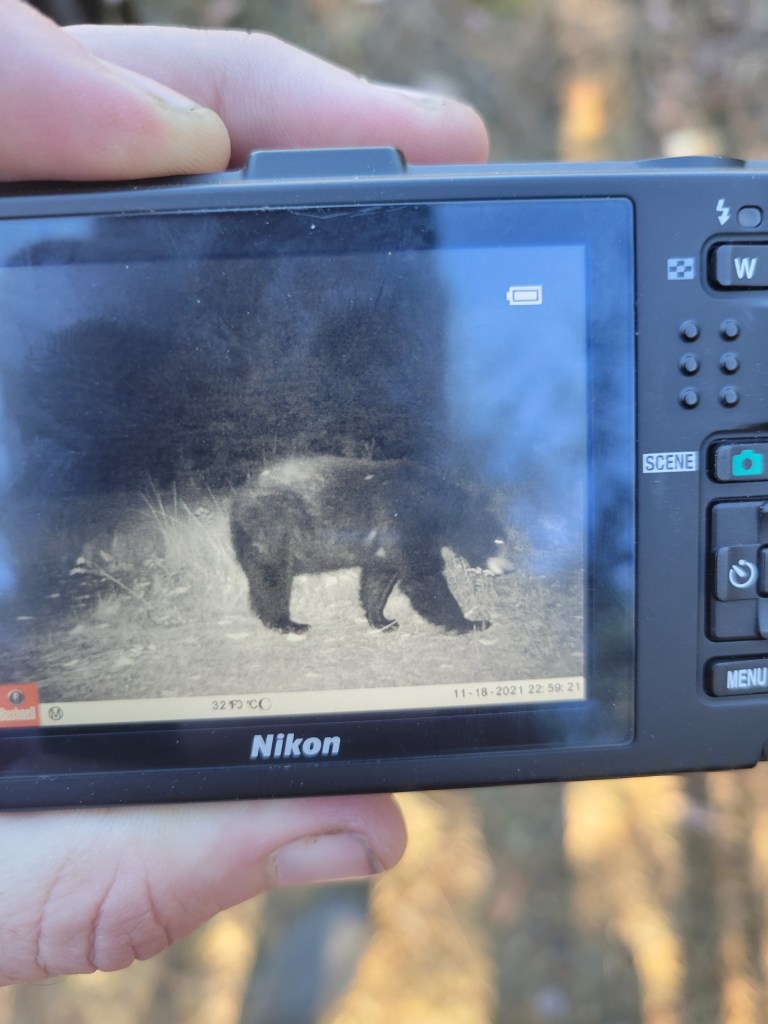
My neighbor, a deer hunter, has cameras set up around his land, mounted to trees. This is the bear that calls the cute triangle part of his home.

We are all occupiers on some level and it seems to me it is best to learn to share. What we do on land does not stop at fences. Clear cut forests erode neighboring lands and choke rivers. Oil extraction pollutes ground water. Non-native species can destroy habitats. Relocating people, not to mention killing them, creates societal disharmony for many generations to come. Such was the case for the Cherokee who resided here before the European-Americans.

——————–

It is not a metaphor to say I couldn’t see the forest for the trees this past summer. The only boundary I knew was the one that ran along Poor Valley Road. The green briar, poison ivy, downed trees, saplings, vine and bramble made walking through the forest a chore. To avoid a face full of spider webs I had to carry a stick and wave it about like Harry Potter continually casting spells.

My one attempt to start to discover where the boundaries lay was given up after ten minutes of crawling over downed trees, scrambling under overhanging branches, and trying to shake off vines that grabbed my legs like monster tenacles trying to pull me to center earth.

Winter is a better time to walk untended land. The overgrowth is died back. On my recent trip all the leaves had dropped except for the beech saplings whose leaves seemed to hover like drifting copper fog.

This is a sapling of the tree that Budweiser ages their beer in.

The forest was mostly brown. Splashes of green came from lichen and moss on tree trunks and higher up, the needles of various evergreens – loblolly, Virginia and white pine, cedar and around the memorials, hemlock.

More green lived around the memorial stones, in the form of Vinca minor, also known as cemetery plant. It was seeded by my grandmother Robbie three decades ago.

Seemingly absent, but just hiding in dormancy, was the sea of poison ivy that predominates during the summer. There was Christmas fern and a plant with dark green leaves with white stripes called pipsissiwa—a fun word to say.

I learned these plant names from Jeff, the forester I hired to tell me about the land and what was growing on it. I hardly knew where to start when I met him at 8:30 the morning of December 20. The wonders of the internet meant that all I had to do was give him the address of the nearest neighbor.

Back in the 1970s when I first visited this land with my family, my father had a hard time finding it. He’d probably not been back since his father’s burial in 1962. On subsequent trips, every decade or so, it was the same thing. He’d squeeze his eyes peering out the dusty front windshield, mouth agape, then mumbling, now where is that road?  It was like the place he’d known intimately as a child and teenager had disappeared with the death and dispersal of his family.

Going to it makes me feel like I’m resurrecting something that my father was unable to. By the time he introduced me to this place it may have only contained ghosts of what seemed to be a dream-like childhood obliterated by reality. It may be why he went into the theatre—so he could always have fresh dreams.

This was the first winter I’ve ever been to this place. It was not until I was traipsing through the forest with Jeff that my worries were eased about how he would identify trees without leaves. The bark and branching patterns were enough for him. It’s a bit like birders who use wing flap and silhouette to identify species without relying on color patterns or call. Yellow poplar, commonly known as tulip tree is abundant on the property. Jeff showed me how to identify it by the seed pods that hold on high in the limbs. Fortunately tulip poplar is a good wood if I decide I want to mill my own lumber for a cabin.
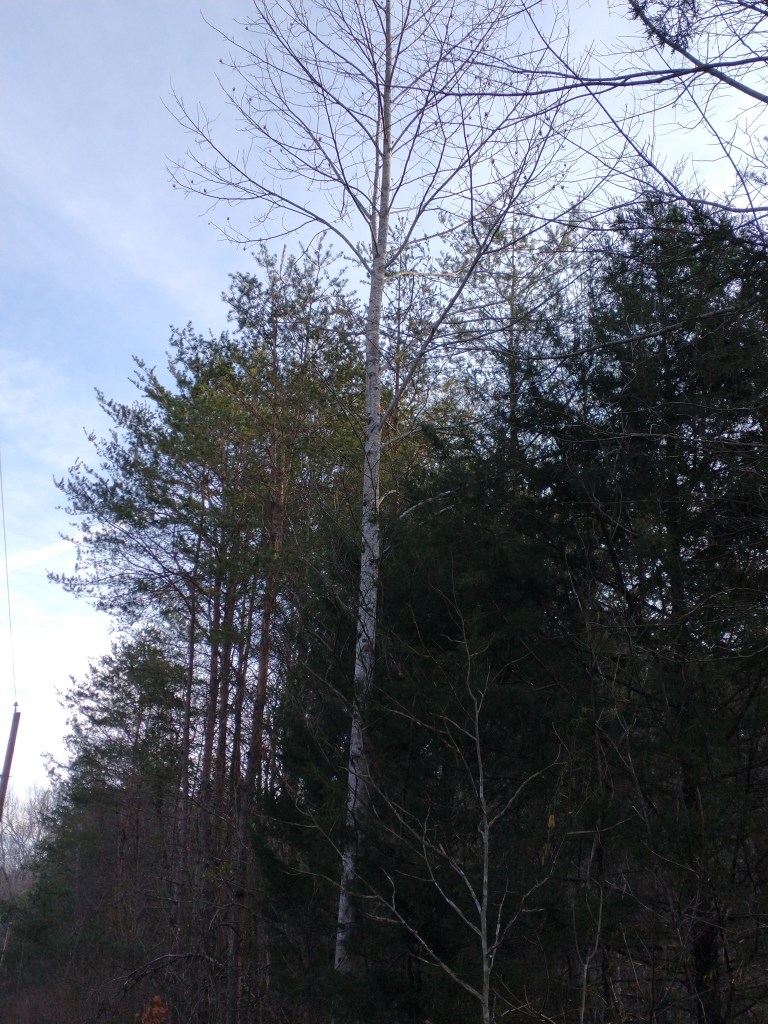
Tulip poplar grows straight and has few knots making it good for lumber. It is one of the softest hardwoods.

After watching numerous YouTube videos, I’ve decided I don’t want a log cabin but would rather have a stick or timber frame. Stick frame refers to the most common building method used today with lots of 2x4s. Timber framing uses fewer but more substantial pieces of lumber like 8x8s.

Other species identified on the land include four or five types of oak, red maple, hickory, dogwood, eastern red cedar, and gum.

The largest tree we found was a 42-inch white pine not far from the old shed.

Beyond the lesson of tree and plant species Jeff gave me an introduction to compass reading. I have a long way to go before I figure it out. The survey maps I have give compass readings from established points on the boundary. While I didn’t learn enough to use those I took a closer look at markers on the map and was able to use a downed barbed wire fence to establish a close approximation of the boundary line for the longest side of the cute triangle. Elevation maps also helped me estimate boundaries as well as another tip from Jeff about how to use a consistent stride to measure distance—something that is easier done when the winter die-back doesn’t require as much vertical leg movement.
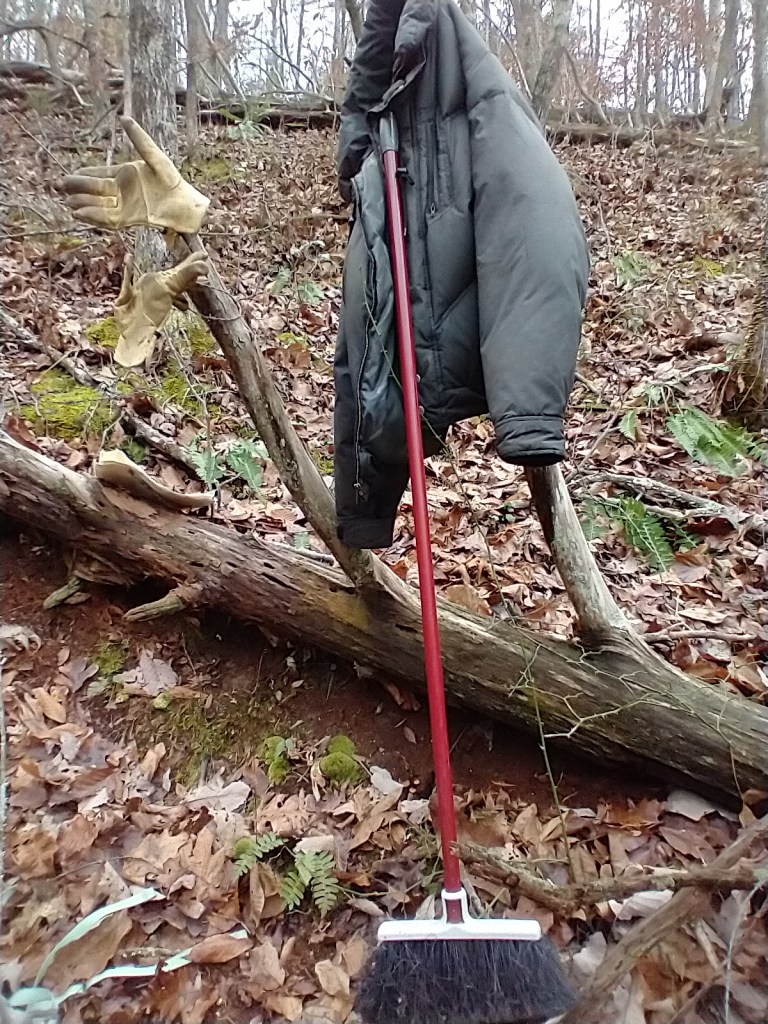
Trying to find the southern boundary line of the cute triangle I found it useful to have a coat and broom I could use to mark known positions while I went back or ahead to find more points. I walked this line three times on different days–losing the gloves one day and then finding them the next. 26 acres proved enough space for me to get lost for a few minutes coming back from the deepest point one evening at dusk.

I want to take my time getting to know this land. It seems like a large percentage of the harm and waste of resources that we encounter in the world has to do with our rush to get things done.

Jillian is a big fan of British narrowboats—a pretty slow, but relaxing way to get around. Yesterday morning she turned me on to the Falkirk Wheel. This is an amazingly engineered lock that can lift 600 tons of barge and water eighty feet in the air using roughly the same amount of energy it takes to boil eight tea kettles of water. It takes five and a half minutes. Five and a half minutes is like sitting through three or four red lights—something that feels interminable trapped inside a car but a whole different thing if you are being lifted heavenward in a boat.

It’s easier to go slow when you affirm that it’s all about the trip, not the destination.

——————-

One last thing…if you look at the “about” section of my blogsite I’ve said “A journal of nature, race and place.” That’s a pretty grand statement and I don’t know how true I will stay to it. My original summer journal had a clear directive to find all the places I’d lived growing up. Travelling back to those places I realized how intertwined they were with our American notions of race.  Talking about my experience with race is a big interest to me and it feels somewhat safe here where I can control the narrative and choose who it goes out to. Perhaps it is an indication of the unsteadiness I feel that I have set these parameters, but confronting issues around race is something I deal with on a daily basis as a public school teacher on a campus with such a wide variety of children from multiple backgrounds.

Rarely are the issues directly about race although sometimes they are, like when I had a discussion with two students who together decided to tease a child by equating racial identity with a sport. I’ve often had to talk to children about making fun of how someone speaks. I suppose this is more about nationality than race.

Mostly I deal with the legacy of racism which involves issues of poverty, privilege, and long-standing hurt. One of my favorite things to do with a kidney-shaped table full of newcomers is to look into their Yemeni, Guatemalan, Salvadorian, etc., eyes and sing “This Land is Your Land” pointing back to them with each “your” and back to myself with each “my”. Six-year-olds know what it is to feel like the land is not theirs and I like to disrupt the narrative that makes them feel this.  

Next up: More cabin and land plans. A continued exploration of the history?
The Winter Trip, 12/27/21

Happy New Year friends. I’m just back from a visit to see family in Tennessee and meet with a forester I hired to walk with me on the land I became enthralled with while writing my summer travelogue.

If you are seeing this for the first time and wondering what travelogue? Let me explain: In June, I left California with an outfitted camper on my truck with the intention of visiting and writing about every place I lived with my family growing up. The result is a 43,000-word journal which I will send in a separate email at your request. The pictures have lost a lot of quality in its current, compressed PDF form, but the writing is intact if you’d like some cozy winter reading.  

The land was not one of the places I lived, but has much family lore associated with it. Just 23 miles northeast of Knoxville, it was acquired by my grandfather starting in the early 1930s. For the next decade he continued to buy contiguous pieces until there were over 100 acres. I’ve been looking through old photos taken before I was born and comparing them with photos I took this past summer.

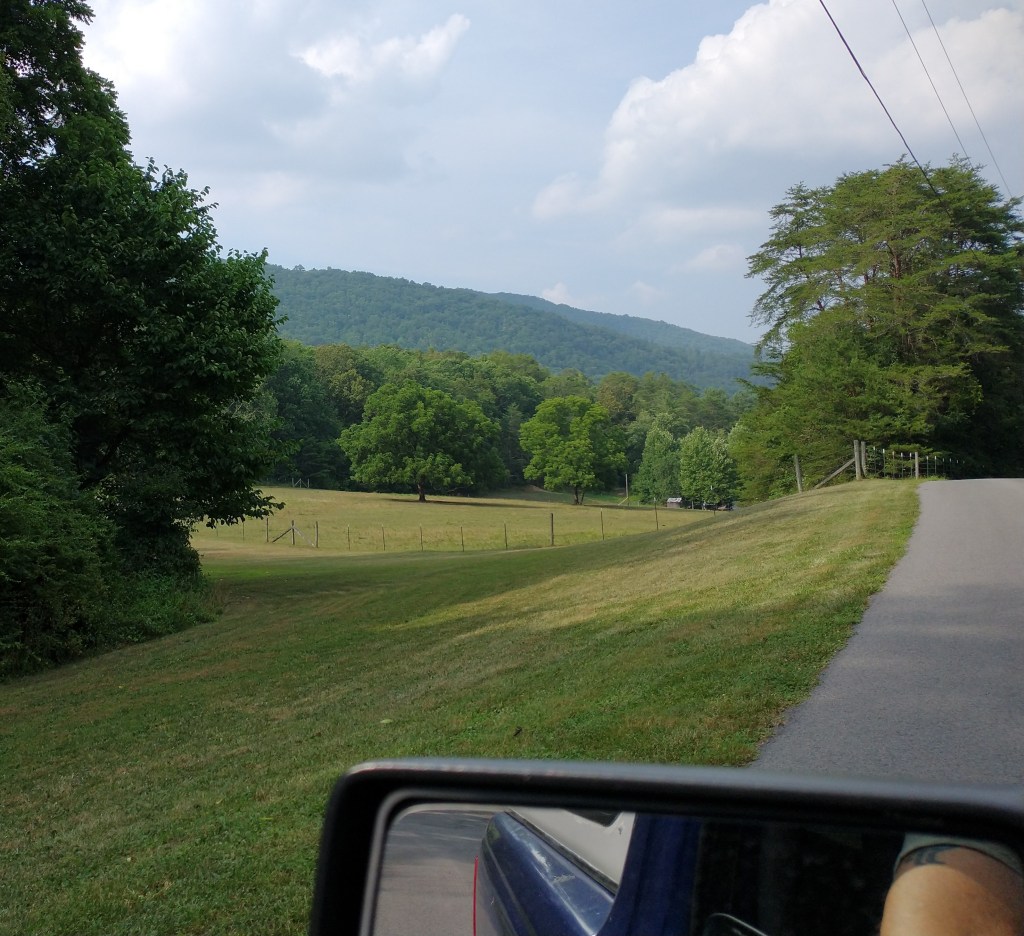
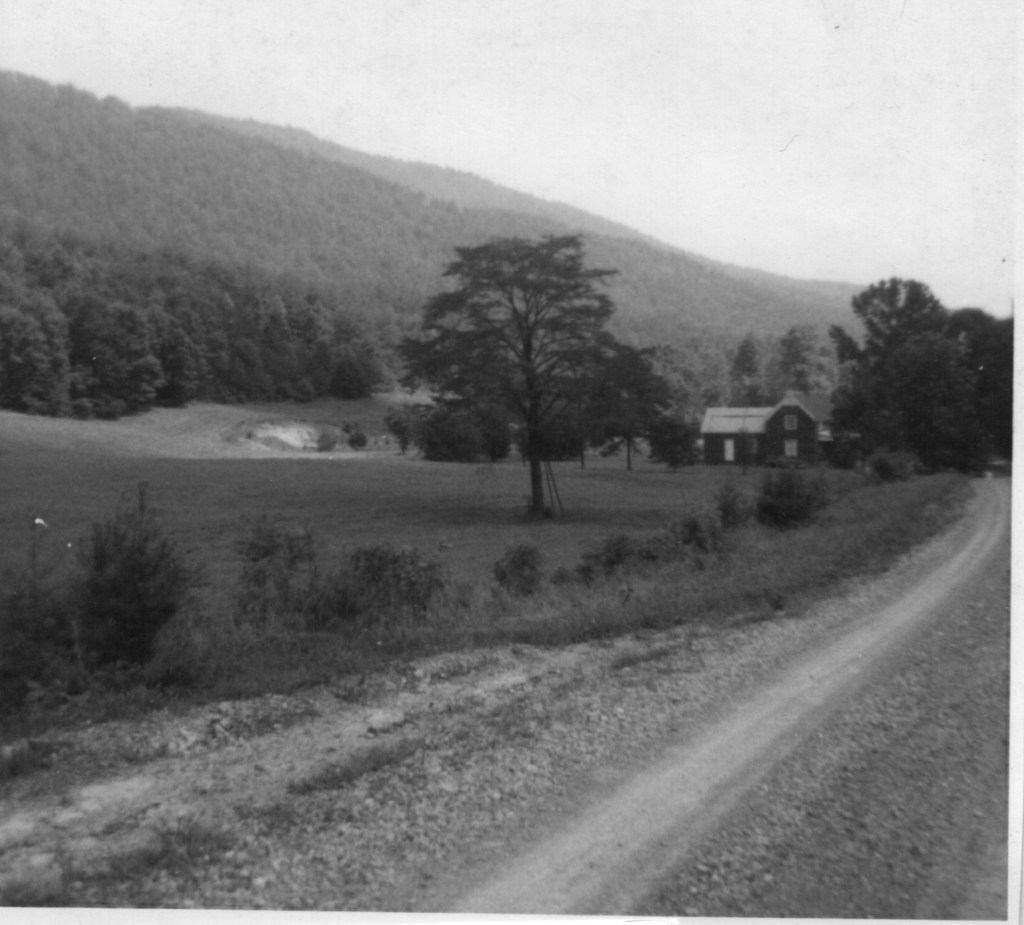
This road dissected the original piece. The farm house is visible in the old photo. Now the family property only includes what is on the south side of the road and a piece north of the road but not touching. Both are heavily wooded areas.

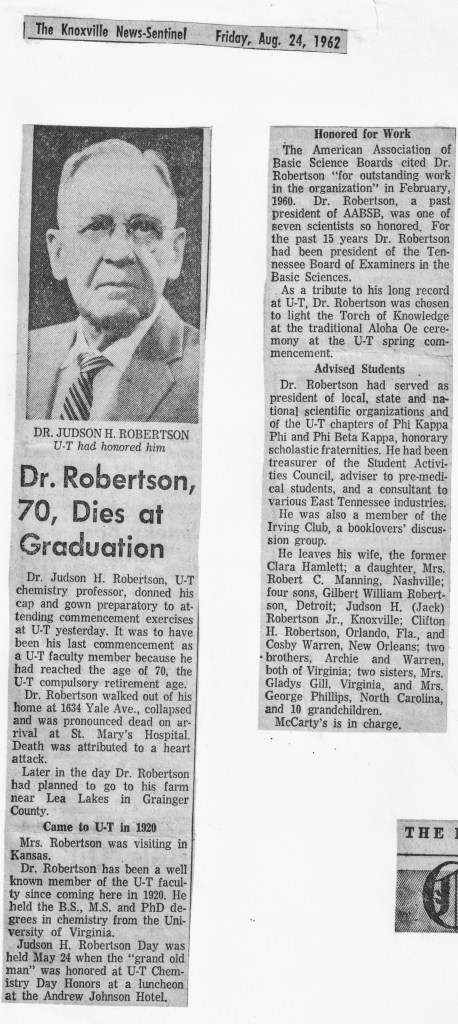
My grandfather Judson was a University of Tennessee chemistry professor. He bought the land and farmhouse as a place for his family to spend weekends, holidays and long summers playing, farming and exploring the woods. His plan was to eventually retire there.

My father, born in 1937 and the youngest in his family, had many memories associated with this place. Some of his stories include being snowed in and carried out on his father’s back to go get help for everyone left behind, getting buzzed by his half-brother Gilbert flying low over the farm during training to be a WWII pilot, and breaking his leg in a homemade box car ridden down one of the hills with his brother Clifton.

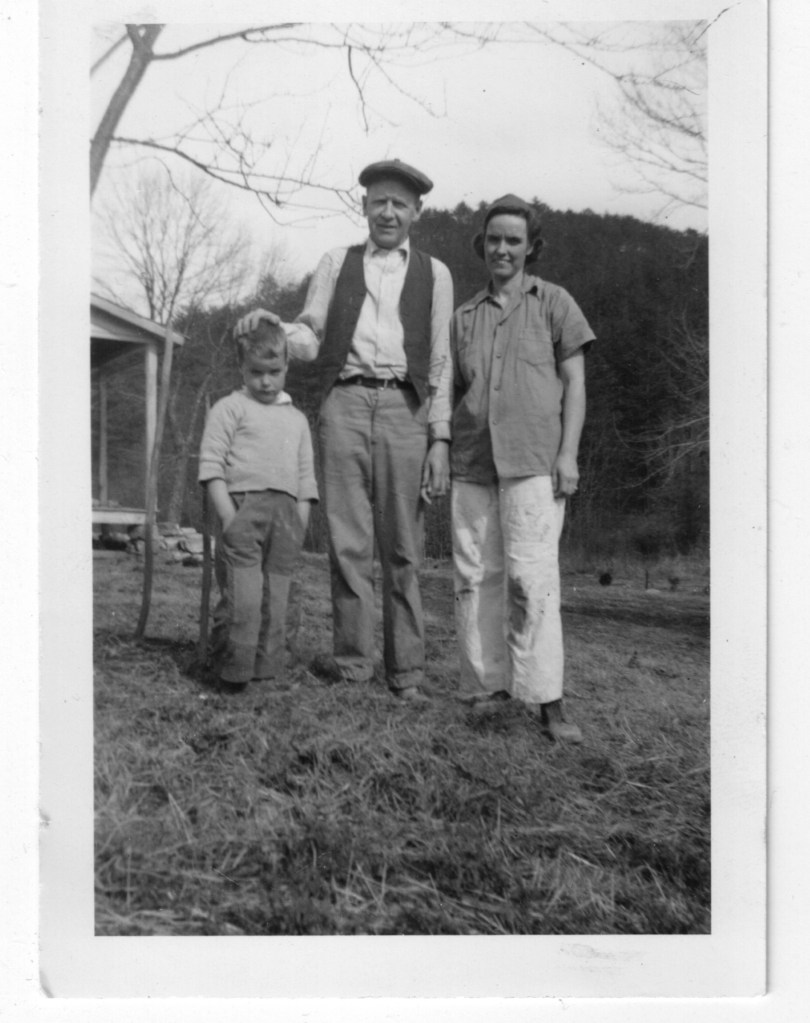
Dad with his parents at the farm. Judson was 15 years older than Clara–he born in 1892, she in 1907. Picture circa 1942. They were married in 1930.

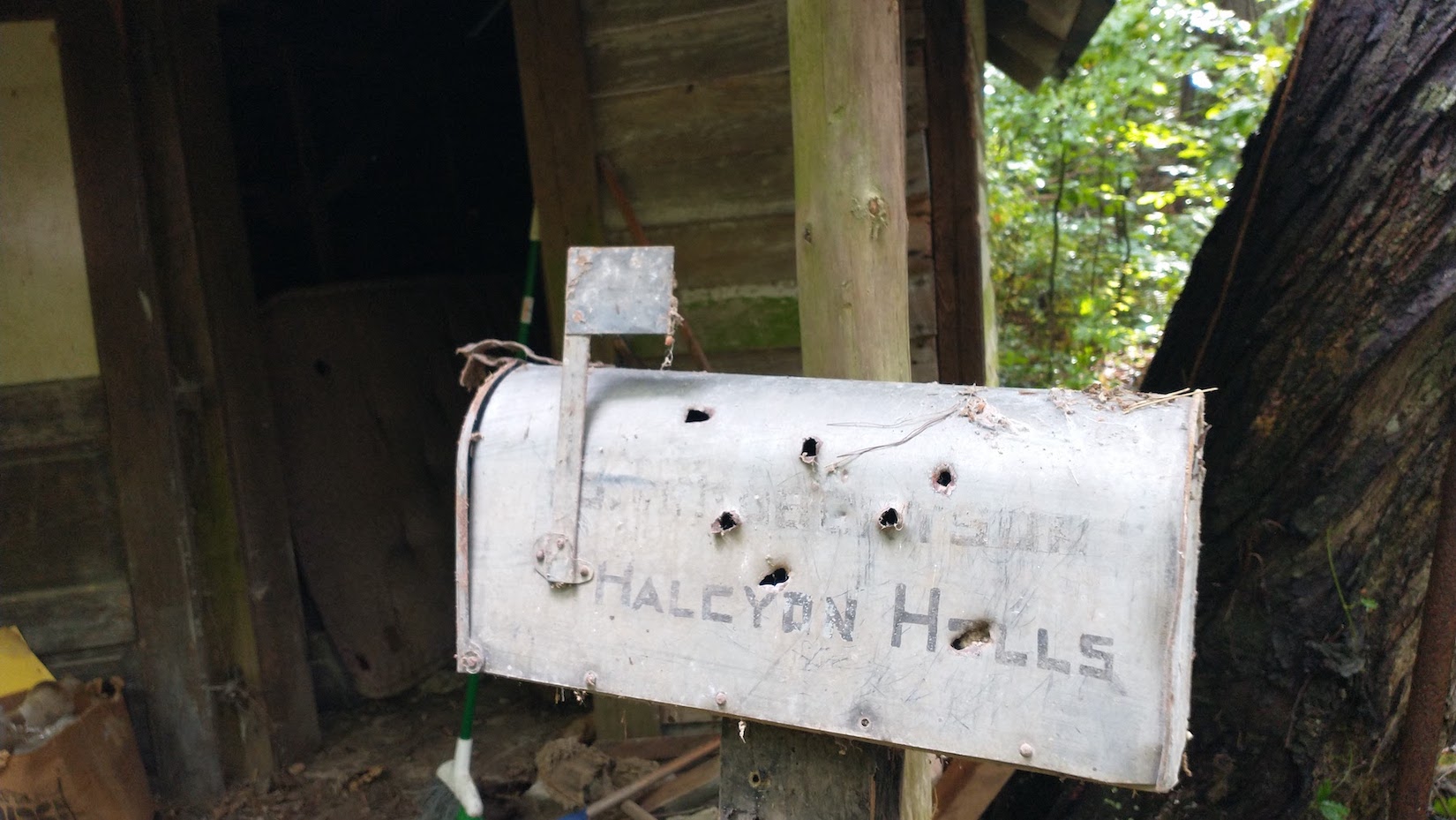
Dad, circa 1955, leaning on the same mailbox I pulled out of the shed this summer.

My father had not been long out of the nest when after 42 years at UT my grandfather died in his doctoral cap and gown at what was to be his last graduation ceremony before retirement. I never met him. (A rather astonishing photo shows the exact moment of the heart attack and the pained expression on his face.) My young parents had just left from a visit and were on their way back home to New Orleans where dad was attending Tulane. Mom was six months pregnant with my sister. They were stopped by a state trooper in Louisiana and told they needed to call home.

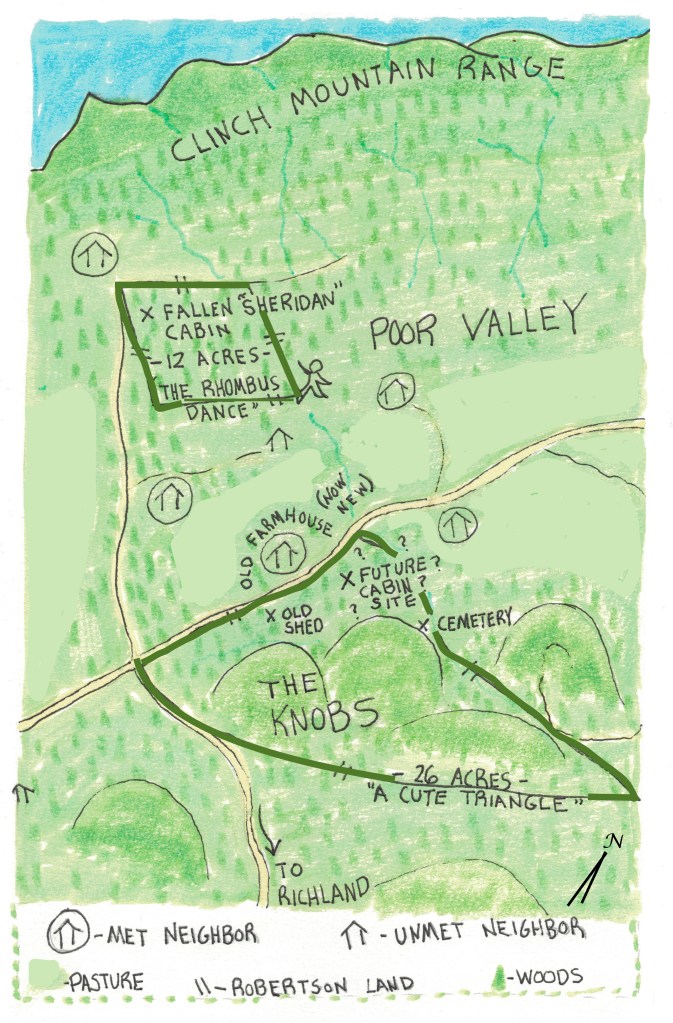
My grandmother Clara started selling pieces of the original acreage in the 1970s. The old farmhouse and sections of cleared, farmable land were the first to go. What remained was divvied between interested children. Today what is left in my family is a 26-acre section with borders in the shape of an acute triangle and a 12-acre piece in the shape of a rhombus. The two do not touch. The triangular piece is where my grandfather is buried and also where I might like to build a cabin.

The rhombus sits closer to the base of Clinch Mountain, first ascended by some Paleo-American predecessor to the Cherokee, but credited to Daniel Boone and William Bean in European-American history. The ascension may not be noteworthy as a purely physical accomplishment. The 150-mile mountain range is 4,600 feet at its highest but just over 2,000 feet near the land deeded to me and perhaps human/animal trails were already in place. However, the Clinch range along with higher Appalachian mountains mark western expansion of European-Americans into territory previously unknown to them.

From a wooded access road the 12-acre piece drops away gradually and then dips into a slanted bowl. Overall, the elevation changes are less extreme than the triangular piece which is further from the mountain base and characterized by several high knobs. The rhombus is also more open with large hardwood trees and less green briar and saplings. A few rather dramatic boulders of both the spherical and chunky type are lodged in the thawed, winter loam. One looks like it would make a nice picnic table. I imagine these boulders coming loose from the mountain top eons ago and thundering down the steep side snapping trees and throwing up wedges of earth until reaching their final resting place. I like the feeling of permanence these big rocks engender. I don’t like the idea of anyone moving them.

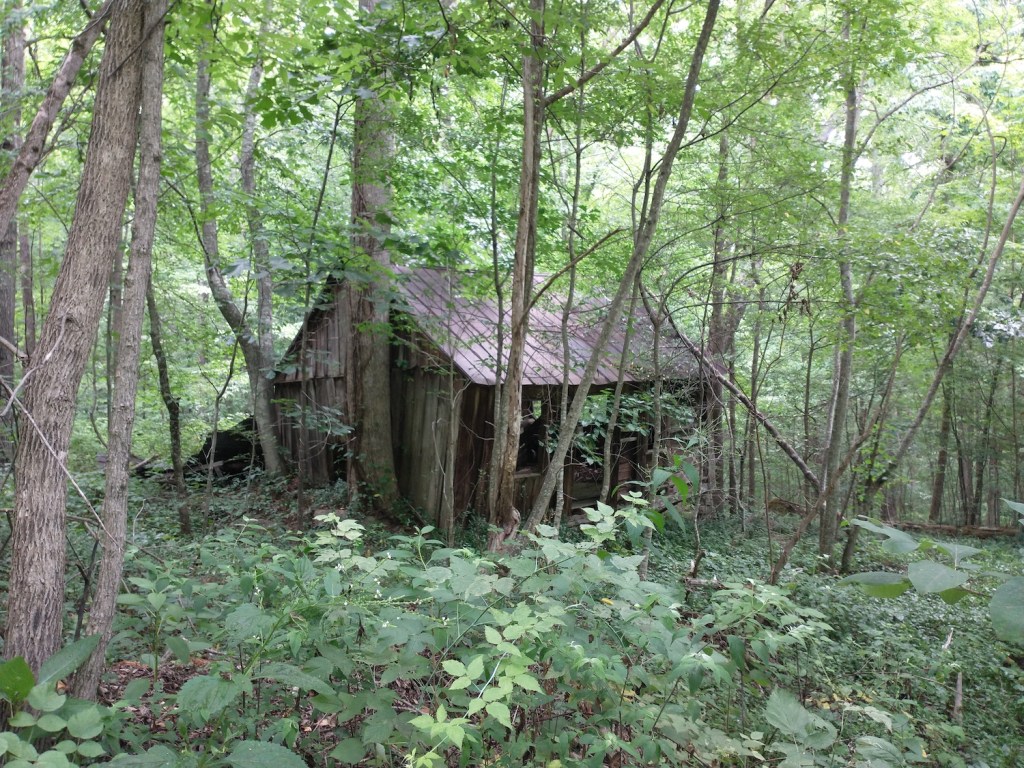
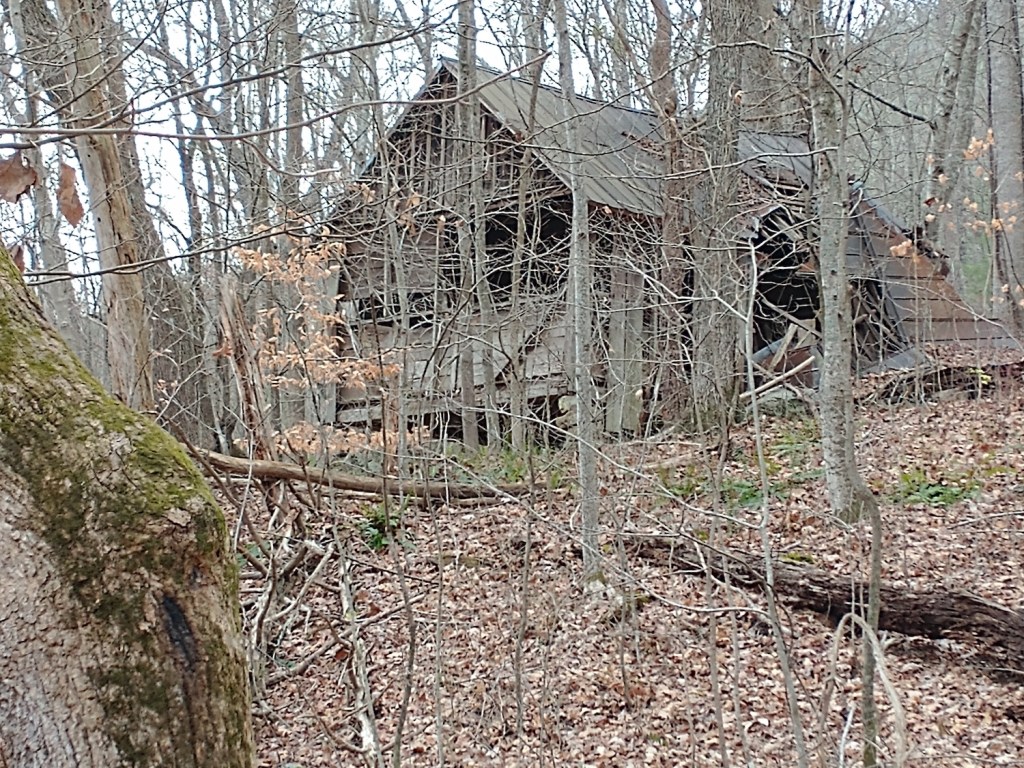
The Sheridan cabin, two-rooms with a metal roof sits near the south west corner. One room has collapsed and much of the walls of the other are open. I intend to salvage the roof of the fallen section and take it to the other property where I have my sites set on a flat shelf that juts out from the tallest knob. It is here I’d like to build a cabin that overlooks the little valley between the knobs and the mountain on the other side. Both pictures above were taken this year—the first in summer and the other in winter. The summer shot is on the uphill side and the winter on the downhill side. Note the visibility afforded during winter time. The time to walk land, find boundaries and plan is after leaf fall.

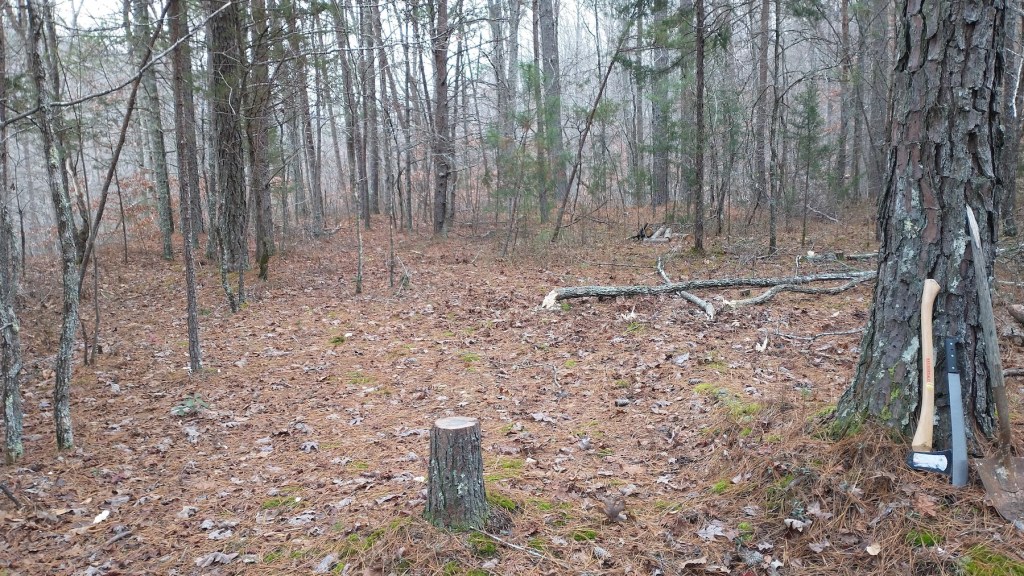
Future cabin site about 50 yards away from the cemetery. Lots of pines in this area—mostly Virginia and loblolly.

Incidentally, the land between the knobs and Clinch Mountain is called Poor Valley. My father talked about how this land wasn’t much good for farming. On the other side of the knobs, closer to the Holston River is Richland which is superior for growing food. I mentioned the poor soil to Jeff, the forester, owning the same lamentation that my father seemed fond of, but Jeff had a different take.

“What isn’t good for vegetables isn’t necessarily bad for trees,” he said. “It’s all dependent on what you are growing.”

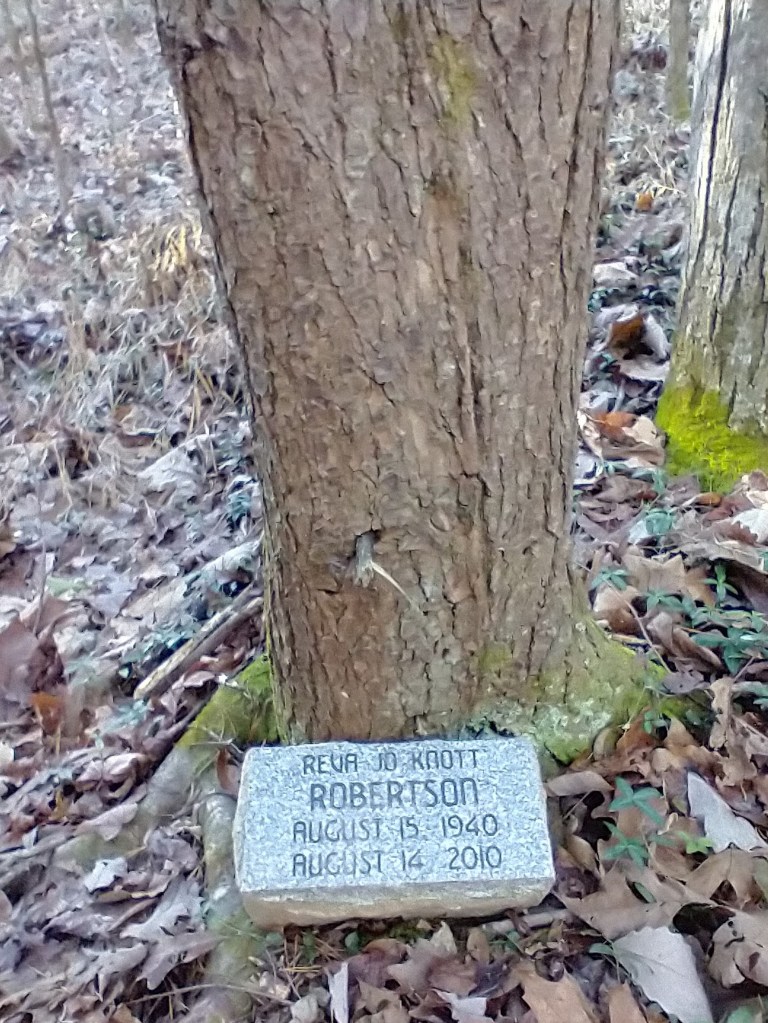
The shelf that extends out facing the mountain–the place where I’d like to build a cabin–begins to tilt around one side of the knob where the family cemetery is about 50 yards away. Three seven-foot granite slabs make up this small family plot at the base of the two-hundred foot knob. During this trip I added a marker for my mother. My parents had been divorced for 20 years at the end of their lives, but I don’t think mom would mind being memorialized alongside her in-laws.

I placed my mother’s memorial stone at the base of a double hemlock. Mom’s favorite tree was a Weeping Willow. There are none of those on the property. Hemlocks are a little weepy though so maybe that’s good enough. Eventually I may plant a Willow tree.

Although these recent photos make the woods look pretty tidy the summer foliage is gone and overgrowth died back during winter. Saplings abound and if I’d had more time I would have pulled a bunch from the wet soil while it was easy to—primarily along possible walking paths. Unlike the old photo you see below, the cemetery area has been left to go wild for many years now. I’m not necessarily a nice-and-neat lawn type person, but this land could definitely use some pruning. I’d like to make walking paths throughout with stopping spots for—as the forester suggests—places to take tea.

Picture with Bob Manning senior (dad’s brother-in-law) and his son Jeffrey at the cemetery site, before markers had been placed. Jeffrey’s older brother Bob jr. road with my grandfather in the ambulance when he died. He was 16 or 17 years old. His inability to do anything inspired him to get certified as an EMT later. CPR had not been invented at the time. To my great sorrow, Bob junior died during covid this year.
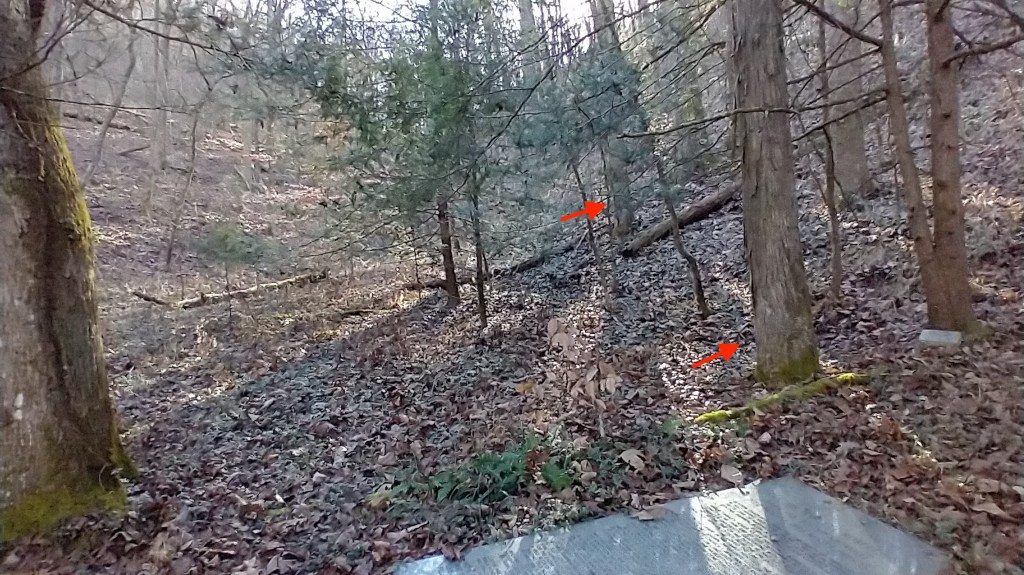
This is a photo of the same location at a slightly different angle taken a few days ago. The two arrows show the same two trees. The closest tree, a shagbark (or shellbark) hickory hasn’t grown a whole lot in the 56 years since the first picture was taken. Mom’s memorial stone is under the double hemlock behind the hickory.

On the opposite side of the knob the shelf slopes downward in a sort of ramp and near its lowest point next to a gully sits an old shed.

This is the same shed I spent many days cleaning out this past summer. Among other things it contained dishes, clothes, shoes, books, photos and memorabilia, skis, bat boxes, whisky stashes, tools, hardware, and games, most in their final stages of deterioration. Extra mattresses and old army bed frames were kept there during its heyday to be pulled out for guests at the farm house. Much of the mattress batting had been relocated by mice to make a well-constructed miceopolis that has grown up this past half century while humans stayed afield.

The bat boxes were sort of mouse high rises filled with the soft cotton. Three wooden chests were apartment complexes. The high and low shed shelves had corners filled with mouse material making me wonder if mice real-estate values are based on elevation and view just like humans’. There was chewed up paper and batting in shoes and I imagine the mice had fairy tales about the old mouse who lived in a shoe and had so many children she didn’t know what to do—except being a mouse she knew exactly what to do and likely moved up to one of those deluxe apartments pretty quickly with that kind of progeny.

Three blind mice is the worst sort of horror story here except for me who—in a matter of days—came and destroyed the years of work by these Lilliputian-like beings. I’ll never forget the tender eyes of one that came out from the soft fluff inside a wooden crate, looked at me, and then dove over the side before I started cleaning it out.

Next up…my walk in the woods with the forester.