2/20/22

Yesterday I sat down on a low, rather ugly cinder block wall that separates my neighbor’s yard from mine. The wall is made less ugly by the fact it has been painted red and somewhat matches my front door and the red walkway tiles that lead up to it. Sitting on the short wall made leaning over to pull weeds out of the gravel drive a bit easier. My neighbors are selling their house and I don’t feel obliged to make my place look nicer as much as to protect my investment – as in, I don’t want the property values around me to come down because I have a weedy front yard. 

Moments like this invariably bring up that Talking Heads song, Once in a Lifetime, and I ask myself, How did I get here? 

I also often recall a short story I read during my college days that features a neighbor who runs out of his house whenever a leaf falls on his perfect lawn. Not that I keep an immaculate yard, but it can lead one to wondering what’s the point? 

The tent encampment around the CVS pharmacy near here has been removed, as well as the ones on the open land near the skatepark and along the aqueduct under the highway 242 overpass. 

I’m not sure where the people went who were there. I don’t have a lot of firsthand information except for two unhoused women who I spoke with that were charging their phones at an outlet next to the water machine in front of the CVS. They were sitting against the wall eating Chinese food out of large Styrofoam clamshells when I pulled up on my bike. I asked if they minded if I locked up next to them there on the curvy S-shaped bike rack that is coming unbolted from the cement. Bike racks are a rarity in Concord so I appreciate this one despite its tenuous hold on the ground. 

The younger white woman, wore a pink, midriff, short sleeve knit that showed off a slight, pale paunch. She spoke so fast it was hard for my brain to process her words but what I could gather made sense. It wasn’t salad talk. The shelters were full. 

As she spoke her eyes darted around and she turned her head this way and that as a grass-eating animal might between bites. The short, older black woman (whom I’d had occasion to speak with before) contrasted her friend’s quickness with sad deliberation. 

I can’t say I have her pronoun right. I didn’t have occasion to use it, but, dressed to hide her sex in an oversized, long-sleeve oxford shirt tucked into baggy chinos, her story makes me think she might prefer to identify as him/he:

“I had to leave a shelter because this one woman didn’t like transgender people. She told everyone I exposed myself to her. Now why would I do that? I hate my body. I’ve always hated my body. I’m not proud of it. Why would I try and show it to somebody?”

I had met her this past summer before leaving on my cross-country road trip. Same place. Then, she was distraught over CVS not allowing her to put money on a phone card. I heard more of her story when she told me she was trying to get money together to go on a bus to visit her son in Las Vegas. 

The website Next Door has one of the longest threads I’ve ever seen on the subject of unhoused people in Concord. There is a very minimal amount of Not in My Backyard comments and the concern and thought people have put into the conversation is heartening. There are even a few unhoused people who have shared comments or given a glimpse of their story. 

I ride my bike by the concrete aqueduct under six-lane highway 242 two or three times a week on the way to the climbing gym. The former camp was there along the dirt bank above this human-made floodway but below the sidewalk. It was accessed by a big hole cut in the chain link fence. It’s usually night by the time I come back from the gym. Sometimes I would see the glow from a phone or light inside a tent or hear soft voices. Around Christmas, when it was easy for me to believe in Peace on Earth, I found myself feeling envious of these nomads. It’s easy to make up stories and romanticize from my privileged position… and perhaps there is some joy in these campers who can set themselves apart from the thronging mass of people who seem to carry on with a sort of hive-like mind. 

No doubt, I feel some pride and superiority myself–being one of the few people to dare ride a bike in this car-dominated, concrete town. Being outside of that car-bubble makes me closer to these castaways. But yeah, I’d rather have a bikeable city and they’d probably rather have a place to live. 

So back to protecting my overpriced investment—the current value of my small, 800 sq. ft. house is likely great enough to buy a whole apartment building in some other parts of this country. 

The truth is, I’m not only trying to maintain the house’s value. I’ve grown to like weeding. It’s meditative. When my mother was dying of lung cancer, I spent many hours at my home in San Leandro pulling burr clover from the large grass lawn, foolishly imagining I was helping to eradicate her disease—as if each plant represented some fractional part of the malignancy that I could psychically obliterate. I just had to put in the time and be thorough I imagined. We do what we can to cope. 

My ex-wife’s mom had taught me the name of that particular weed. On one of her first visits to our new house she had disappeared for some time on her own pulling this clover with burrs from our front yard. She suggested it was the bane of homeowners’ existence though I think she might have also gotten some pleasure out of the pulling. 

Most weeds come up nicely if the soil is moist. Burr clover spreads out low to the ground weaving between the blades of grass but if you gather the spread and pinch the central tap root, the whole thing comes up like a scribble scrabble overlay that once lifted reveals the fine, symmetric teeth of the lawn. 

We don’t have grass here. In the back is red lava pebbles and black, wood chip with more wood chip in front. There is chunky, gray gravel along the road and as a second parking area next to the concrete drive. All of these areas still manage to get weeds even with a groundcloth underlay.

I’d guesstimate I spend 30 to 40 hours a year weeding. This could be cut to two or three hours if I did what many do and just douse the areas with glyphosate–the main ingredient in Monsanto’s popular weed-killer Round Up. Or I could do what neighbor Phillip does down the street and just let the weeds take over. Depending on the time of year, he has wild fennel taller than himself and yellow grass up to his waist along with enormous prickly pear. In the back yard, the aptly named succulent, mother of millions, have mostly taken over except for a garden bed of healthy-looking marijuana plants. The seeds apparently run about $10 each for this crop. 

It’s all sort of a secret garden for the birds which seem to be very fond of his place and why wouldn’t they be since he also puts out bird seed on plates set atop large ceramic, glazed pots arranged one atop the other in an hour glass shape that makes climbing the slippery surface impossible for squirrels. 

He still has Bernie Sanders signs up in his front window as well as the listening hours for different programs on KPFA. I can count on him as an ally in braving these mean streets by bicycle. There is a contingent of us here. I want to give a celebratory wave each time I see another bicyclist.

A man named “Smitty” often posts to the Concord bike group on Facebook. I spoke to him at the bike valet parking and pop-up repair shop he helps with at music events at Todos Santos Plaza. I’m interested in doing some bike advocacy work with the city, but it’s not for him. He simply likes getting bikes into people’s hands. 

It’s important for me to remember that there are good people in the world otherwise my misanthropic side starts to creep in. Maybe the meek will inherit the earth and maybe we will get some bike lanes out here in Concord and maybe some small homes too for those people who must be hiding now in some areas that I don’t have occasion to pass by so often. 

——————

I’ve begun archiving some of my summer trip on this website, so you can go there if you have an interest in reading about my adventures visiting the fourteen places I lived as a child. My visits to my old home states of Texas and Mississippi are now posted. Also, the internet helped me locate one of the few places I lived in Texas that I wasn’t able to find when I was there. I found the address on an old drug store photo processing envelope. The photo below is a screenshot from a Google cam.  (Now the only place left to find is the Shady Oaks Ranch.)
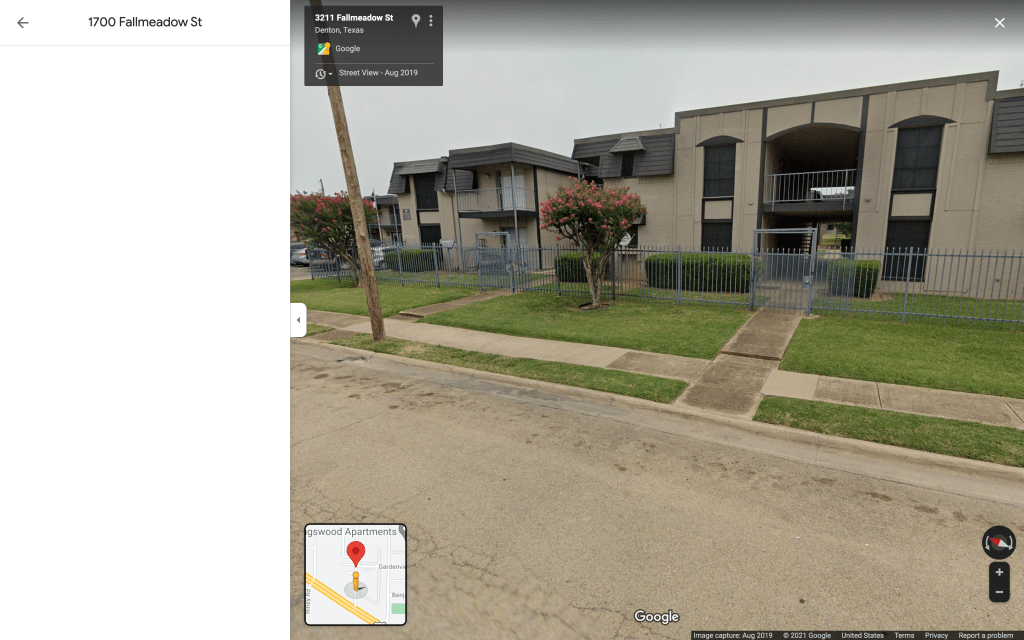
I don’t feel compelled to visit this place in person. There is nothing too special about the Fall Meadow apartment complex except that it was the first place we lived in Denton. It’s also where I lived when I first got glasses and could see the world clearly for the first time in several years. (I believe I had pretty good vision until I was about seven and then there was a steep decline until I got glasses when I was about nine.) Another fairly clear memory from this complex is learning the song Delta Dawn which was popular on the radio at the time. My sister and I got in the habit of singing it over and over again. My favorite line: She’s 41 and her papa still calls her baby. 
2/6/22

Much of my time these past few weeks was spent thinking about what I want to do on the land in Tennessee. I’ve talked about the cabin idea, but I’m also bouncing around the idea of just pitching a tent whenever I go there. It’s low impact and a hell of a lot easier. I did it a few days last summer borrowing a wildly luxurious 10-person tent of my cousin’s. I guess I need to think more along the lines of “What do I want to get out of this?” If the biggest part is “roughing it” and being close to the land then the most I might do is dig a decent latrine.

Along the low-impact line of thought, if I do build a cabin, concrete would not play a big part in its foundation. I would get some treated wood for a rail foundation or possibly a post and beam. I’ve read a study about treated wood which says it can last a hundred years or more if it is laid on a bed of gravel and has good drainage. ­­ You’ve seen the stuff—sort of reddish brown with indentations all over it where, presumably, horrible chemicals are steam-injected or somehow introduced into the lumber. It’s what I used for the foundation of my COVID 2020 summer shed project.

I’m also pondering how to cut, transport, and mill the lumber for a cabin. I don’t want to build a driveway to it. I’d rather the cabin be a walk-in. I’ve even pondered building one on the highest knoll which would have a hell of a view, but would require a ten or fifteen-minute trek on a steep trail that would likely need stairs cut into it.

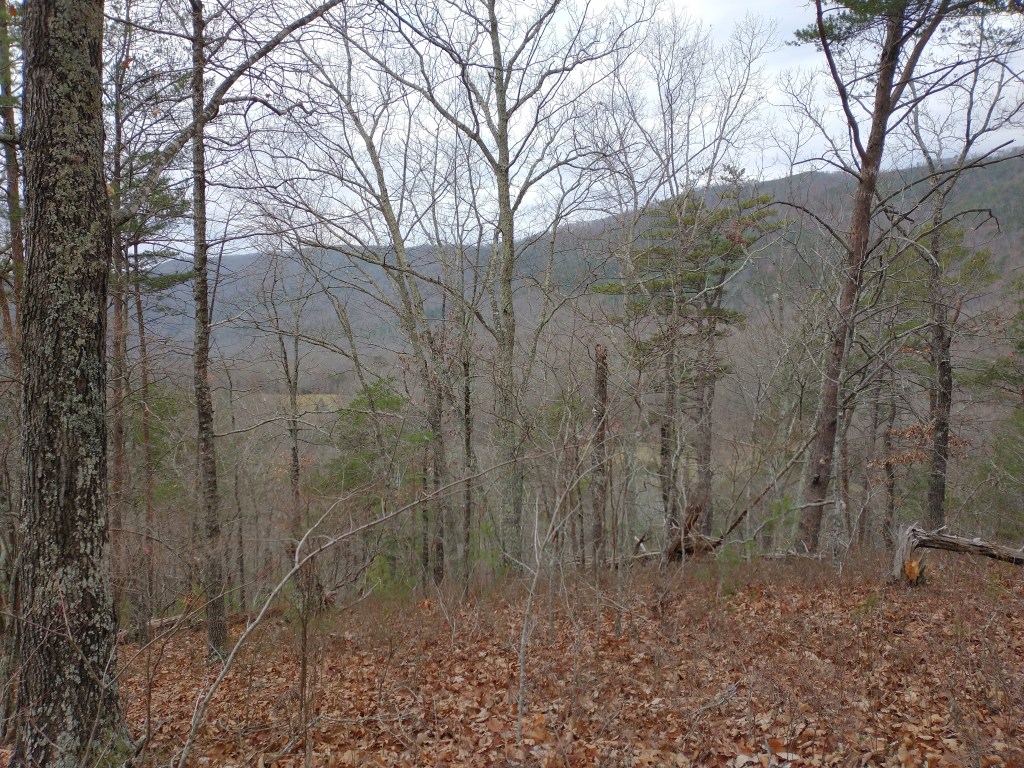
Looking northwest from the highest knoll. Clearing some of these trees would give a nice view of Poor Valley. Dead center may be one of those tulip poplars that are good for lumber.

The best spot remains the one near the memorial stones. Still there is the question of how to get the logs out of the forest and onto a trailer to take to a mill. Building a sled to drag them would serve the dual purpose of helping to make the trails more defined. I was also thinking of buying or renting a mule or horse which I could strap with a harness to pull the logs. Would a neighbor allow me to keep this animal on one of their fields? If so, what is the going rate for fielding an animal?

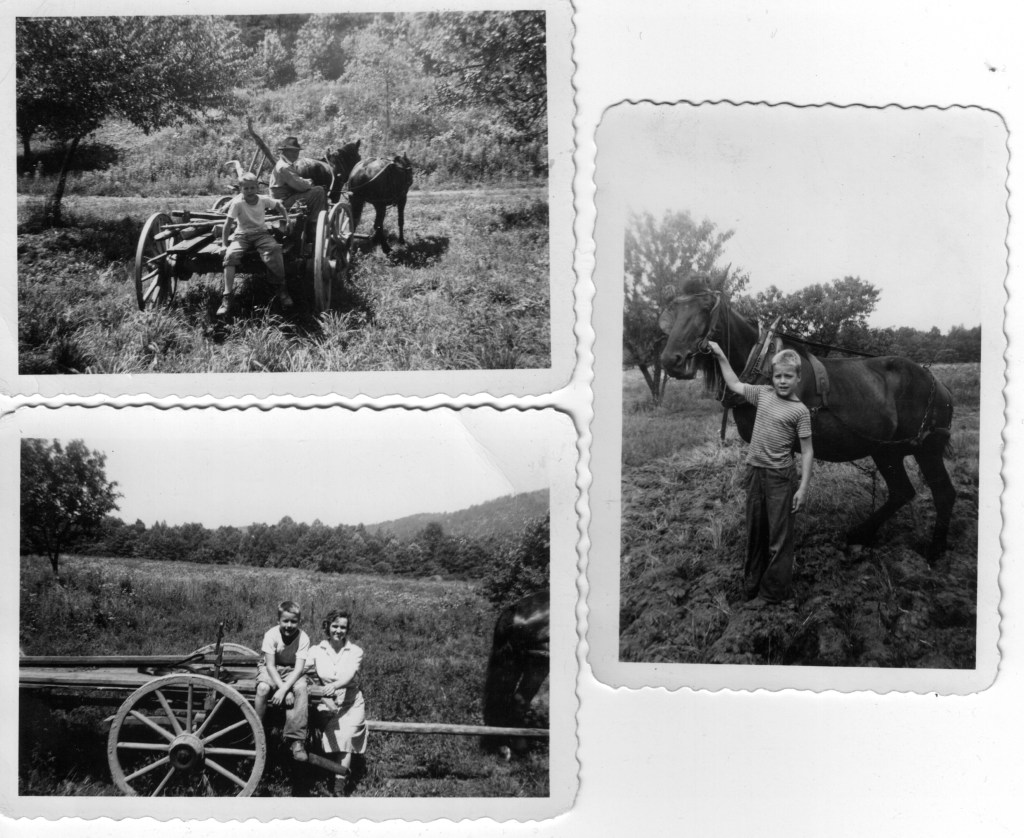
Horses were used for farm work when my dad was a kid. The farm is no longer in our family. It’s across the road from the wooded acute triangle.
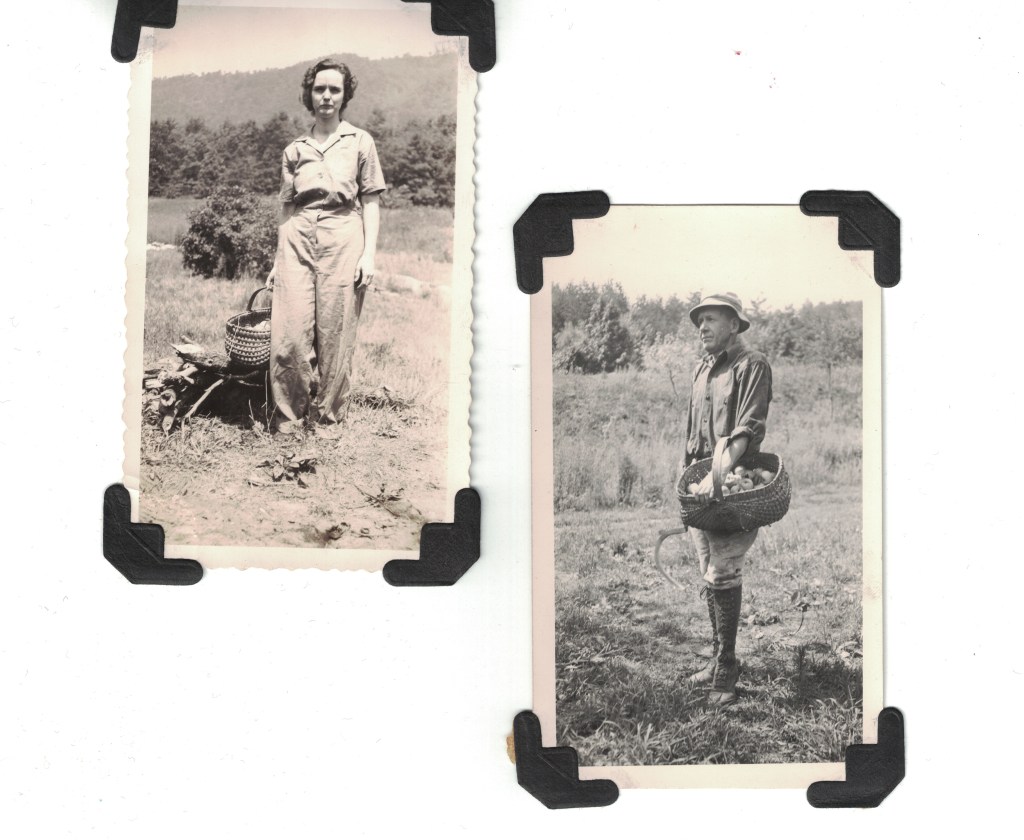
My grandparents were gentlewoman and gentleman farmers who went to the land on vacations and weekends. Farming had nothing to do with their subsistence. I suspect my grandfather, a UT professor, made extra money running tests and devising systems for local industry and government.

Another bonus to having an animal–donkeys and goats eat poison ivy. (I’ve heard.) Not sure if a mule or horse would. Could a donkey pull a log? I’m thinking some will need to be 12 feet or more for the posts I want to cut. Wet logs are heavy. Could I dry them on the land before moving them?

One neighbor has a wood mill that I might be able to rent. It is the kind where the operator pushes the blade down the log. Stewart’s son-in-law has a fancier one that has a drive that pushes the blade by itself. The advantage of using the neighbors is that it is close, but if I’m going to have to age the wood somewhere, like in a barn for instance, I’ll have to move the wood off site which would make the automated mill the better choice since I’d have to transport the logs a few miles anyway. Lots of questions here.

My grandfather was 45 years old when my dad was born in 1937. Photo 1941.
This is dad with his oldest half-brother Gilbert, a WWII pilot who flew over the farm buzzing the family during a training mission from a local air base. I never met Gilbert that I can remember, or his other half-siblings, Jack and Mary Elizabeth.

I started clearing a spot for parking during my December trip. I cut some small trees, pulled up saplings and shoveled dirt to start to even out a place. I was desperate to get a little work done before my plane was to leave at two o’clock from Knoxville. I arrived early that morning and in the few hours I was there two neighbors came by and generously offered to clear the spot for me with their machines.

Tobi stopped to talk to me in his big red truck that seemed to have the pulse of an underground Morlock factory thrumming beneath the hood. I raised my voice a few decibels to tell him who I was and we decided to exchange phone numbers. He invited me to get in the truck to go back to his place to get his phone.

“I can’t remember the number,” he said with a happy demeaner. “I’ve been hit in the head so many times I can’t remember anything.”

He and his wife Jean bought land about five years ago after he retired from the demolition business in Ohio.  Their land is across from mine at the east end. They had a prefabricated house put up behind a knob where it isn’t visible from the road.

When Tobi brought me back he parked his truck and got out so I could show him the parking spot I was working on.

“Five minutes on my Bobcat, I can do what will take you an hour to do by hand,” Tobi told me.

I think he meant he could do in five minutes what would take me five hours to do by hand but he probably didn’t want to sound too boastful. I asked him if he’d like to see where I was thinking of putting a cabin.

“I’d like to put a little wooden bridge here,” I said as we walked through a dip.

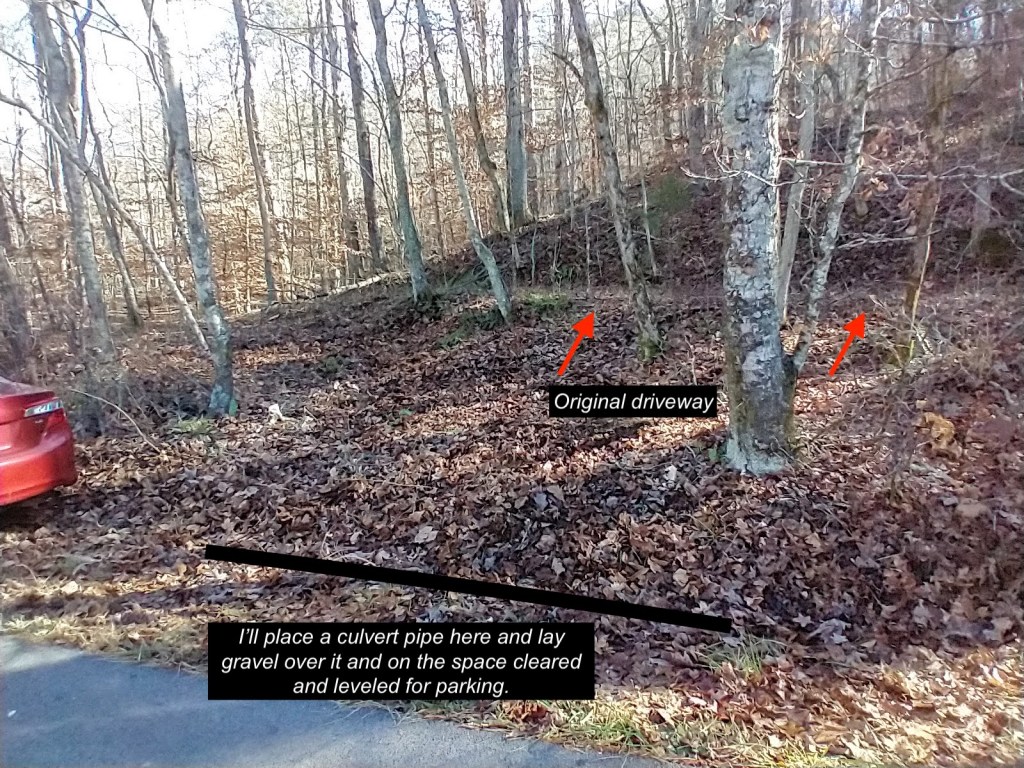
“Oh, right there is where there was a driveway before,” Tobi said, pointing to a long, gradual ramp that went below an incline we were about to walk up.

I’d never seen it before, but he was right. It takes practice to look at wooded land and see the marks of former development. When we came back we walked to where this drive had started from the road. I could see that it would take more shoveling and tree-cutting than the place I’d begun working on. Studying it more I could see that it was originally a half-circle drive that went through the woods and came out in a different spot. It must have been made for visits to the memorials and to bring in the heavy granite slabs in the first place. Sixty years had turned it back mostly to woods.

Before beginning to clear space for parking on the land.
After beginning to clear a space for parking.

While we were standing there talking, another person, Steven, my eastern neighbor on the same side of the road pulled up in another big truck.  They are popular here.

I’d met Steven when I was finding the corner boundary marker with the forester Jeff. A local guy, both military men–Jeff a war veteran and Steven a careerist–they talked about how the local sheriff’s department had come mostly from the high school football squad. Standing there in the cold with these dudes was more masculinity than I get in my normal life with the exception of the occasional proving-ground scenarios that arrive at the climbing gym—just as often with women as men. Not that these guys were trying to prove anything. 

“Mark out where you want the parking space and I’ll come by with my tractor and clear the area,” Steven said.

“Tobi was just offering the same thing,” I told him. “Thank you but I think I’m going to wait on making any decisions. I want to look at the space more first.”

There were several reasons why, beyond readiness, that I didn’t take these neighbors up on their offers. I had asked Tobi what he would charge and he said he didn’t hire himself out anymore.

“I just likes doing things for people.” I’m a bit like that myself sometimes so I could accept that, but I’m also wary.

Tobi had already asked me if it would be okay if he hunted deer on my land and I’d told him I didn’t want that. While Steven didn’t ask, he is a hunter on his own land and has a tree stand on one of our common boundaries. I would be surprised if he didn’t take a shot at a deer that happened by. I can’t help but think that a favor from either of these guys might make them feel I owed them. Anyway, I’d be happy to trade for their services I just want to clarify what that trade would be before we do it.

It could be that I’m making things unnecessarily complicated. I tend to do that. If anyone could change the quiet country life into the noisy inner workings of an overthinking brain, that would be me.

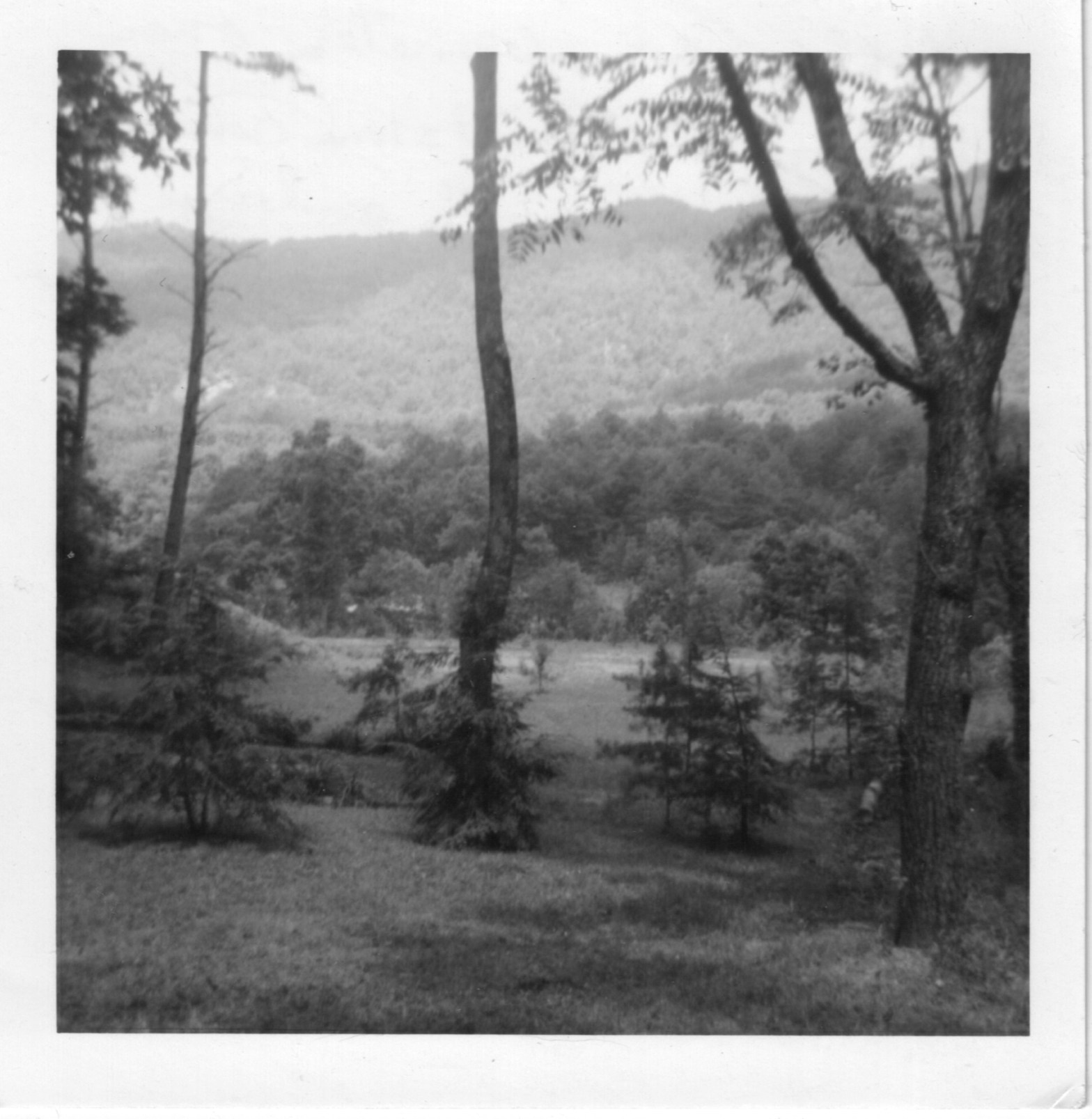
This photo was taken from the gravesites out toward the road and Poor Valley in the early 1960s. The viewpoint is from the opposite direction of those photos above and shows how the land was tended and cut back near the memorials when my grandfather’s stone was first laid. The red car would have been behind that incline on the left.

———————————–

Over a month ago I received an email from a group in my union that wants to take up the issue of racism and have an open discussion with teachers. They recognize that we, as teachers, must confront our own personal bias on a daily basis to be effective educators. Teaching brings out every skeleton you have in your closet and if you don’t want to deal with it then it’s better to slam that door and go into some other profession.

Anyway, this union group put out some videos, papers and a book to delve into as points of discussion for our first meeting. They were giving away copies of a book by Ibram X. Kendi, Stamped From the Beginning, The Definitive History of Racist Ideas in America—a daunting title for sure given the nature of this emotionally frail, white male. Nevertheless, I signed up to get one with an interest in being part of the discussion. The 511 page book (590 with index and bibliography) came to my school mailbox just a few days before the first meeting. Knowing there was no way I could read the whole thing by then I just flipped through different sections reading areas that interested me.

Having lived in the Bay Area for 31 years (and worked 20 in Berkeley and Oakland) I turned the pages like one might look around a corner into a dark alley anticipating that the woke police might be waiting to hit me over the head.

When I read the following passage–the italics are mine–I was getting ready to slam the book and run:

During America’s first century, racist theological ideas were absolutely critical to sanctioning the growth of American slavery and making it acceptable to the Christian churches. These ideas were featured in the sermons of early America’s greatest preacher and intellectual, Boston Divine Cotton Mather…Cotton Mather was the namesake and grandson of two of New England’s intellectual trailblazers

Greatest preacher! Intellectual trailblazers!!! So that is how he’s going to position things? I didn’t mind that he was calling out the church. I already knew it was the glue that kept racist ideology together for most Americans, but giving racists the title of intellectual trailblazers! Okay, now I know where this guy is going!  

I went about flipping through the book looking for how he was going to dismantle every piece of history. My page turning became equivalent to stomping down a hall despite the fact that this author’s intellectual credentials make me look like a Kindergartner.  (I know nothing about Cotton Mather and only the basics of early American history).

I was prepared for him to call Dr. King an assimilationist and then I really was going to throw the book across the room, but I calmed down and the more I read the more I saw that he really wasn’t trying to bludgeon anyone. I started thinking, maybe I am an assimilationist. I certainly know a lot about trying to fit in. Is that such a bad thing?

Well, yes and I won’t go into all the somersaults I’ve gone through over the years walking a tightrope between my racists and assimilationist tendencies, which he groups together, and anti-racists beliefs on the other side. It’s pretty clear my head has been messed with growing up in Tennessee, Florida, Texas, and Mississippi. And BTW… Jeez I’m touchy.

Wary, but interested, I decided I would go to the first zoom meeting of the discussion group. Then life happened. I had a very difficult week in which I felt suddenly at war with a coworker who I normally don’t have much to do with. Leading up to the meeting I was in a very I don’t give two-fucks mood. Needless to say this was not the headspace I wanted going into a meeting to discuss racism. So I skipped it and went online to look at more cabin-building videos.

Yesterday morning I read about the controversy with Whoopi Goldberg. You’ve probably read all you want about this. I’ll just say that one of the more salient comments I saw was that if you can’t have this type of discussion on The View maybe it should be named something else.

Another thing that it brought up was what I read years ago which has stuck with me. That is: race is a human construction. It’s just skin color. Race doesn’t actually exist.  Our real differences are cultural. Race is just a convenient way to lump everyone into the same group. It was a convenient way for Nazis to kill whoever they wanted.

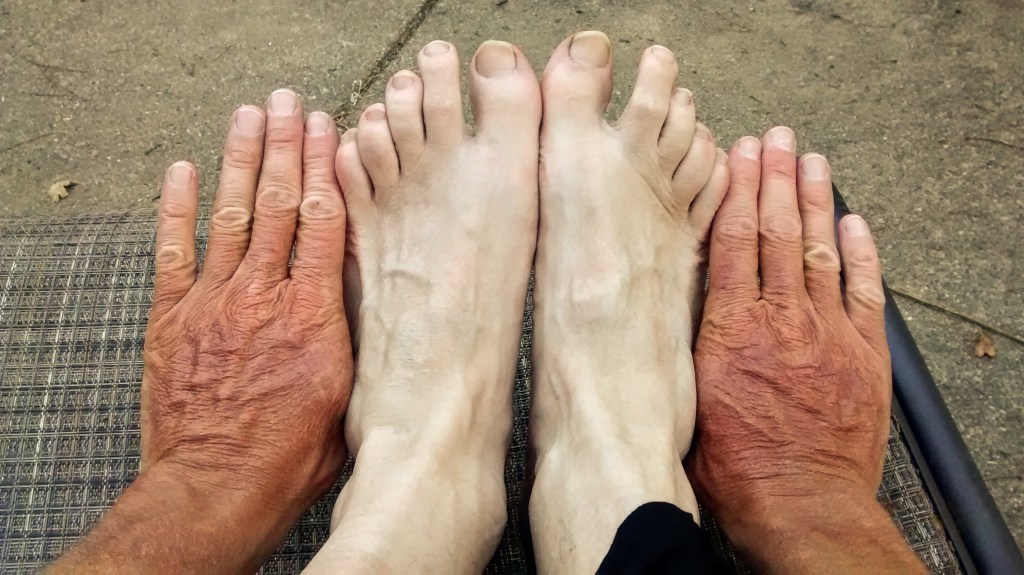
These are my hands and feet from a cross country motorcycle trip in 2015. My uncovered parts got a good tan. In bygone days genteel men and women stayed out of the sun. Whiteness said as much about socioeconomics as race.