3/20/22

Leaving work Friday I decided on an adventure. Originally, I was just going to go around the block on my bike to check out three sides of my school that I’ve never explored. Well, one really. I was on the neighborhood street on the east side once on my motorcycle. I was wearing a plastered helmet to look like Booster, the animated, robot, mascot for a website called Imagine Learning. Also, I’d driven down the major road on the west side once to do a home visit with the family of a kid who wasn’t showing up on Zoom. It was in the early COVID days way back in 2020. But I’ve never ridden on the Delta de Anza trail that runs on the north side.

During the height of COVID and distance learning, my Bay Point school had a teacher rally to drive through the neighborhoods and spread cheer to the kids who were stuck at home. A lot of schools were doing this. Jillian sculpted my helmet with plaster gauze to look like the mascot for a website my English Learner Department was encouraging our EL students to use. It was fun to drive around on my motorcycle waving at the kids who came out of their homes to see us.

I suppose I’m usually too tired for any neighborhood exploration after work. Emotionally it sometimes feels like the most I can do to make my way the half mile to BART. Of the two busy roads I traverse, one has a bike lane. The other doesn’t, but I ride carefully dashing into the car lane to turn at one red light instead of using the sidewalk and waiting through two. 

Wariness pervades. I keep an eye out and I’ve begun wearing a neon yellow vest. I still sometimes battle the dangerous sense of entitlement steeped in my critical mass days when once a month we, bike riders, took over the streets in SF and broke car windshields of drivers who dared nose their way into our mass. I didn’t partake in the breaking but watched and stood ground, feeling righteous anger — How dare they threaten our exposed bodies with their 3000 pound machines!!! It’s an anger that can be addictive and lead to bad outcomes if not properly checked. But that’s what war is right? 

Anyway, back to the Delta de Anza trail. On Friday, after two years of wanting to explore it, once I was there, I decided not to just go around the block but see how far toward home I could get. I was pretty sure I would be stopped.

Google maps shows no bike link between Bay Point and Concord north of Highway 4 on the bay side. There are, however, links to roads on the south side which go under Highway 4. In fact, Google’s default route shows using Willow Pass Road, but no cyclist in their right mind would do that. The alternative is Bailey Road which I tried — once. Big mistake. It wasn’t so much that I wasn’t in my right mind as much as plain ignorant. 

Bailey Road is actually worse than Willow Pass. Cars go just as fast, it’s curvy,  and it has even less shoulder — zero in some places.  There is the added fun of it being a very steep incline with a resulting decline. It’s hard to think what is worse—being hit by a car when you are struggling up a hill at 3 mph or when whizzing down it at 30? 

With all south-of-Highway 4 routes home not viable, I was hoping that on my Friday adventure I might discover some special northern wiggle, not apparent on Google.

Leaving my workplace, the Delta de Anza trail is wide and protected with bollards where it crosses numerous neighborhood streets, becomes lost and found again over two major intersections, passes homeless camps and garbage heaps, playgrounds and backyard fields of a junior high and another elementary school and then, three miles from where I started, arrives unceremoniously in someone’s driveway. 

Whoopsie daisy. How many other people have found themselves here? I wouldn’t have been surprised if I’d seen a sign —  “Welcome to the Garcia’s. Now turn around and get the hell off.” 

So this was my first dead end, but after removing myself from the gates of someone’s private property I looked around and the view was worth it. I had, in fact, with that last crossed street arrived in what could only be called the country. The land was elevated and gave a wide view of Suisun Bay.

It wasn’t even four o’clock. The sky was blue. It was 70 degrees without wind. Everywhere around me golden poppies, purple lupine and yellow mustard were covering the fields. Southward was Highway 4. I knew there were no routes that way, so I let my bike coast north toward the bay and turned west on Port Chicago Highway.  Perhaps I’d find a path, but if I didn’t there wasn’t a lovelier day to explore. 

Port Chicago looked like any of the other scary roads I’d tried. No margins to speak of and nothing to keep people from going a hundred miles an hour. Not even curves in this part. The only thing — there was no one on it.

Still, I was wary. When a truck finally appeared in my rear view I prepared to veer into the sandy dirt, but the driver gave me a wide berth and passed at a tip-your-hat speed. I started to relax a bit. I’d be able to hear someone coming a long way off and didn’t need to obsessively check my rear view. 

Soon I found out why there weren’t many people on this road:

This is Port Chicago Highway. From here it loops next to Suisun Bay and then comes inland to Concord within just a few blocks of my house. Unfortunately a large swath of it is off limits as it crosses a mostly defunct Naval Weapons station. This is the same station where 320 sailors and civilians, mostly African American, lost their lives with one huge munitions explosion in 1944. https://en.wikipedia.org/wiki/Port_Chicago_disaster)

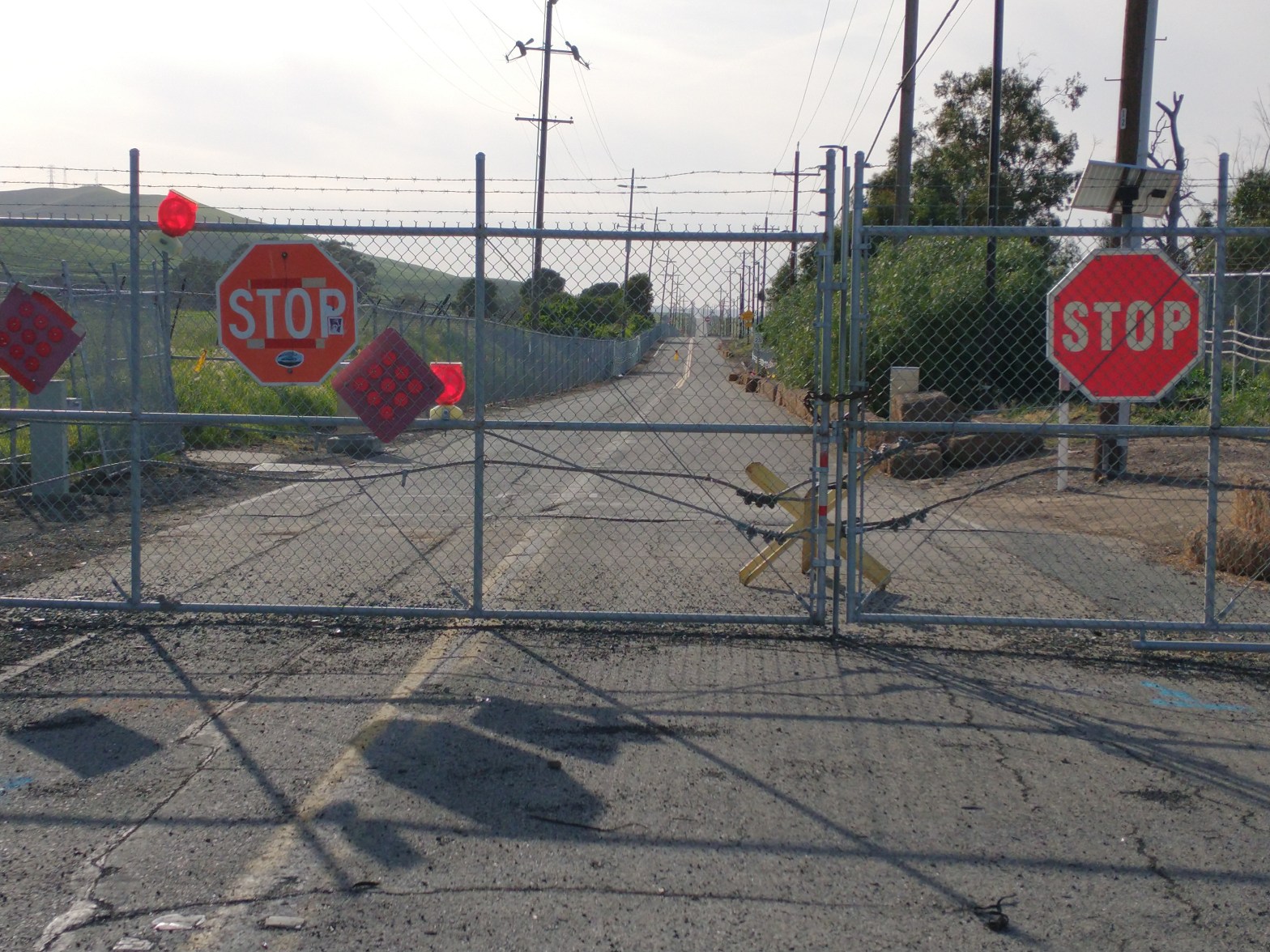
The whole base is fenced off with dozens of these signs wherever someone might think of climbing the fence. 

I was worried that I might get shot just taking this picture.

Okay, another dead end. So left or right? Those options were still available. Left looked more promising even though that was the direction of the highway. Perhaps a path ran between the green hills. 

I started down a narrow asphalt road, pitted and decayed with age. It followed the Naval Weapons station fence. I passed over an old, but sturdy looking wooden bridge that spanned the canal and soon found myself surrounded by green globular hills covered in wildflowers.
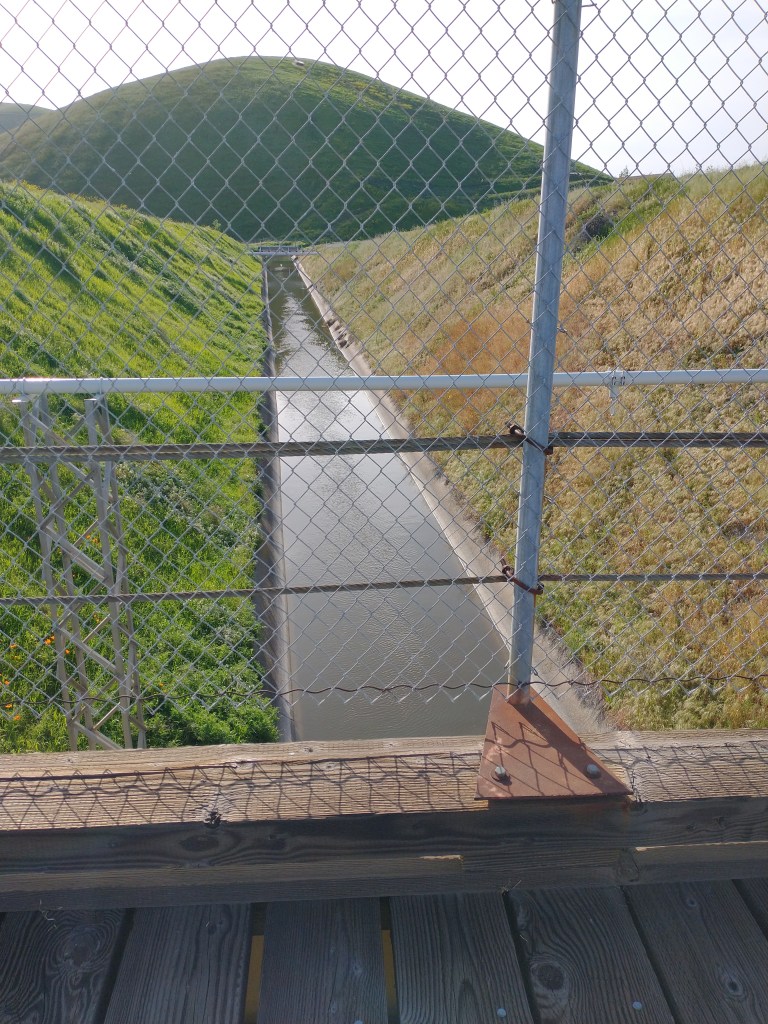
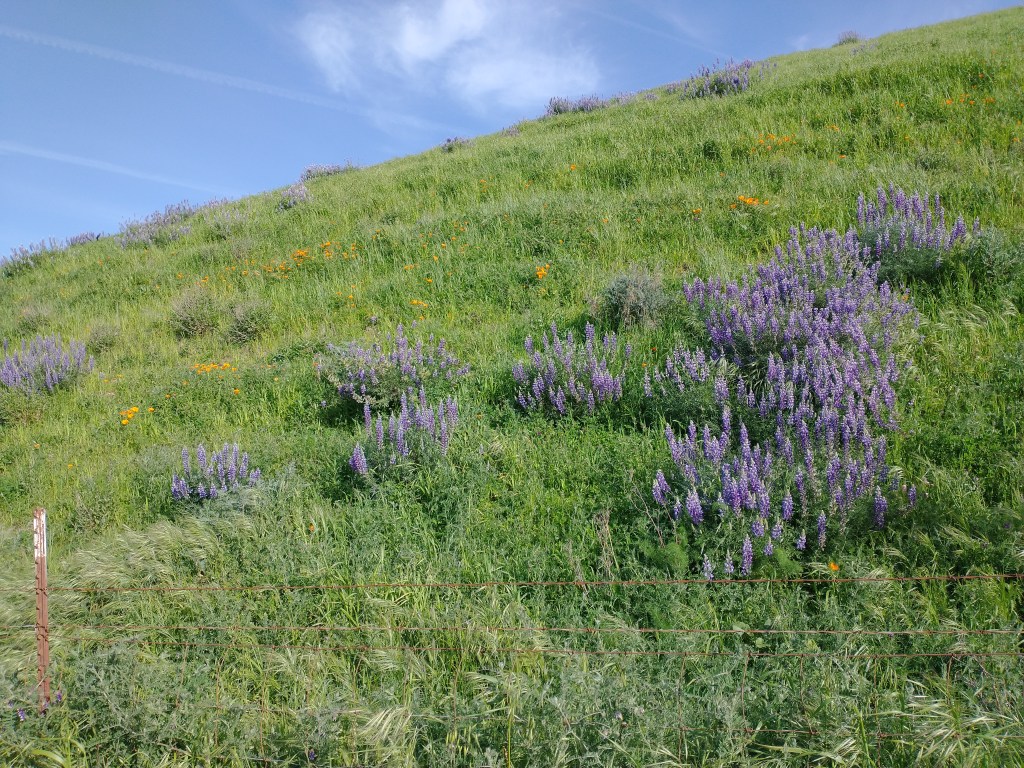
I stopped to watch a Red-tailed hawk making lazy circles over the hillside. Finding nothing she rose to the ridge and surfed the edge to the far end. I followed her up the road and found a cluster of a few houses there and a man getting out of his truck, gathering a lunch box and hard hat from a days work. Perhaps this was the person who had passed me earlier on Port Chicago. I looked up the road where yet another fence ended my advancement. 

“Hola,” I said. 

“Hi. How’re you doing?” he replied. 

“Do you know if there is a way to get to Concord from here?” 

“No there isn’t. That way,” he said indicating the fenced off road, “goes onto Chevron land and they don’t let people pass through there.” 

I told him my dismay that the canal trail didn’t extend through and he offered theories about why. Then I told him how beautiful I thought it was out here and he thanked me. 

When I left, I circled up to the chain link Chevron fence. It was padlocked and unmarked. On the other side was a muddy barnyard and a bunch of goats. Maybe Chevron employs someone to keep the grass down around their facilities or maybe a resistant goat farmer was grandfathered in. Who knows? It was my third dead end. 

As I left a few more trucks came up the road. Others probably coming home from work, but my dark side imagined more sinister scenarios. I was, after all, in a cul-de-sac of sorts. Blackwater security? Drug cartel henchman making sure the bike rider isn’t snooping around? It’s always strange to find yourself in a remote place that isn’t actually that remote. 

Well, there was only one more chance to find a way through and that was to go the opposite direction at the T—north toward the bay. 

I passed back over the sturdy wooden bridge. 

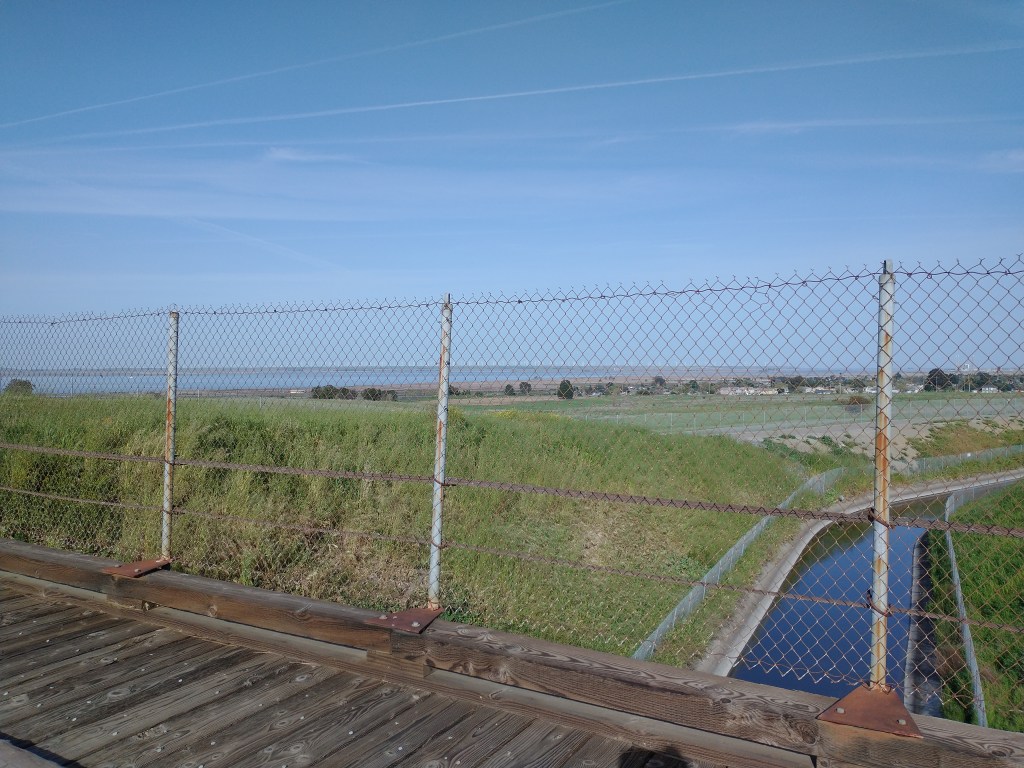
There’s the bay in the distance

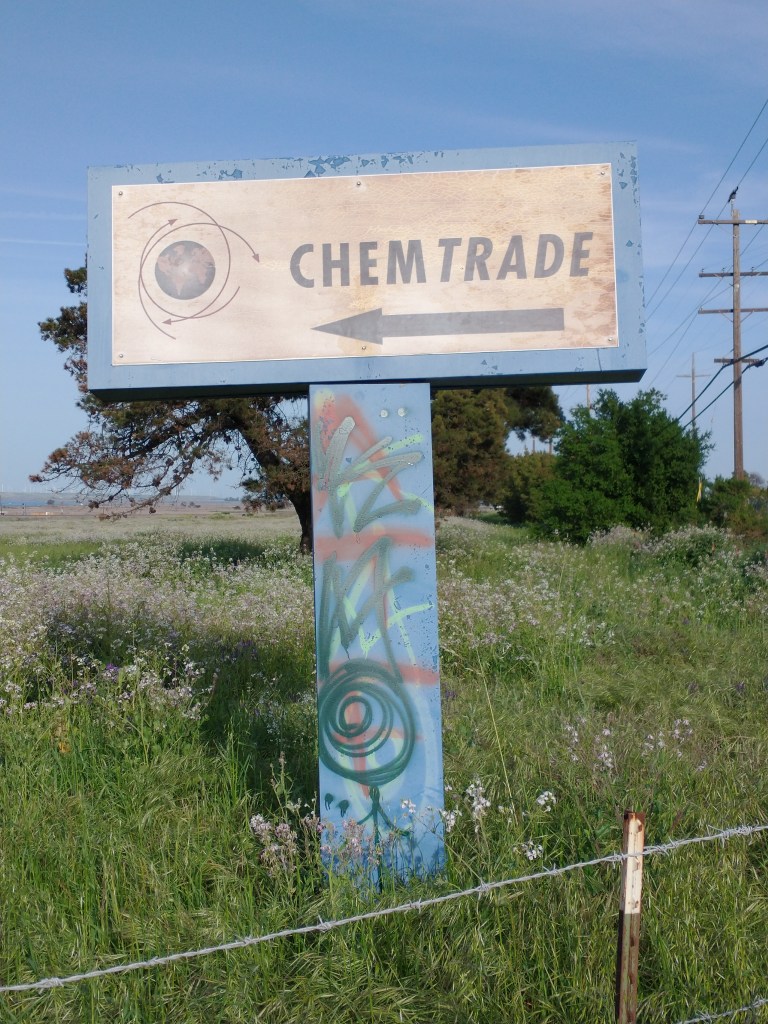
This sign was at the corner. The graffiti strangely went with the arrows and world logo. 

I passed a trucking company and then got to the guard house and entrance to the chemical company. It was yet another dead end. My fourth and last. My campaign to find a way through, if that’s what it was, had played its way out.

A loud motor was running in a pavilion-like structure about 50 yards behind the west fence, but there didn’t seem to be anyone around. I couldn’t tell if the place was defunct or if everyone had just clocked out. It was now a little after five. I’d have to ride back in the direction of my school and take the BART home like I usually do. 

I didn’t mind. As the old saying goes, it’s all about the journey, not the destination. It’s something good for me to remember when a student is being difficult, when a driver yells at me for no reason, or when I simply don’t get my way. I might be getting better at this.  It’s possible the time between feeling anger and acceptance is narrowing. Maybe someday I’ll be able to just skip the anger altogether, look at the situation, nod my head, and say okay. Then get to work on what needs to be done. 

Between the railroad, the Naval base, and Contra Costa Water District there were so many signs and not a single gap in the fence. These three entities plus Chevron form a block to the vagabond, cyclist, walker and explorer heading east on the beautiful land next to Suisun Bay.
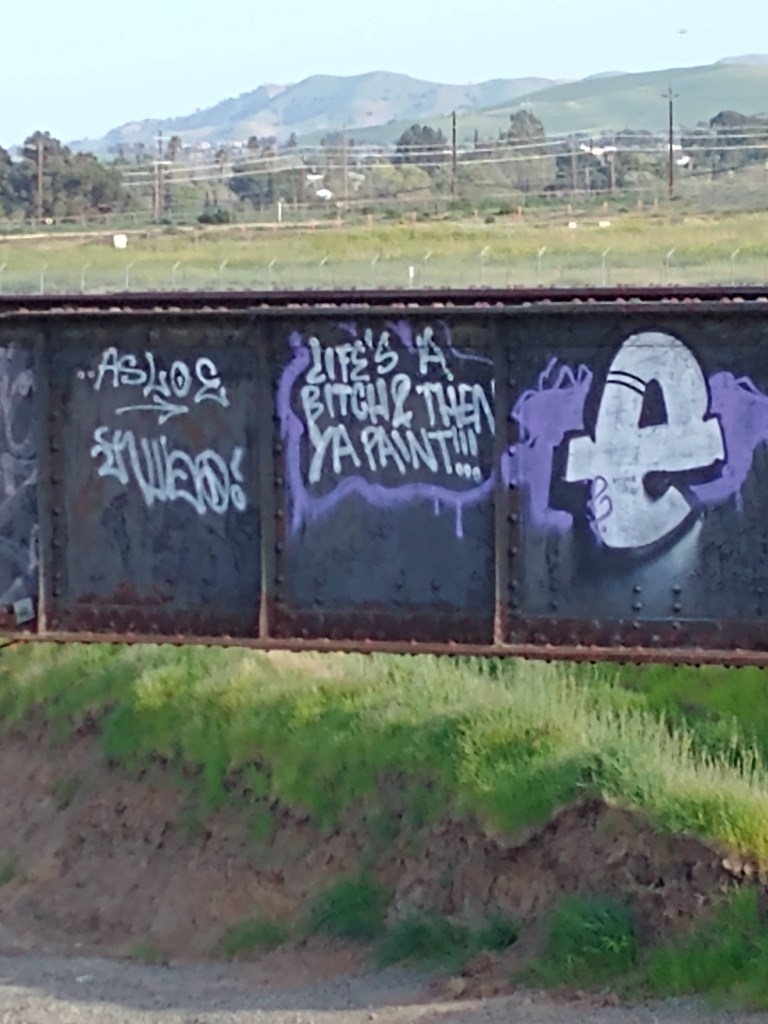
There was some particularly nice graffiti along the tracks next to the chemical plant.
“Life’s a bitch & then ya paint!!!”
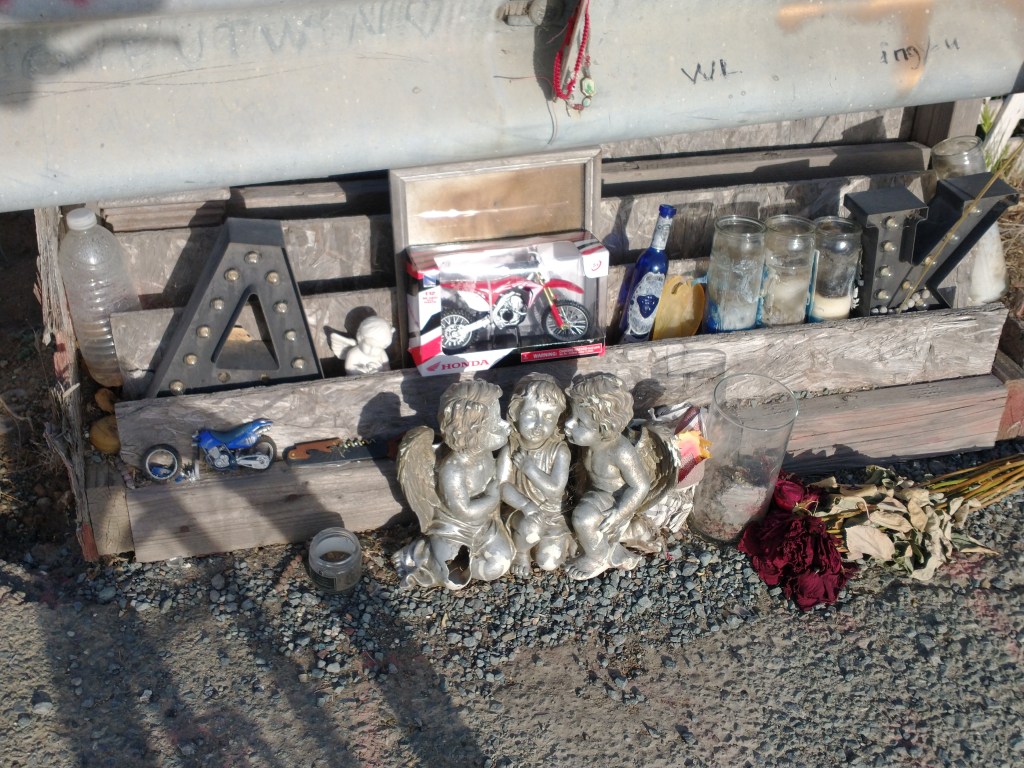
I’m guessing this memorial was for a dirt biker who frequented the area which is ripe with trails and dirt banks for jumps. I have to wonder if this person died doing what they love or if something else got them?
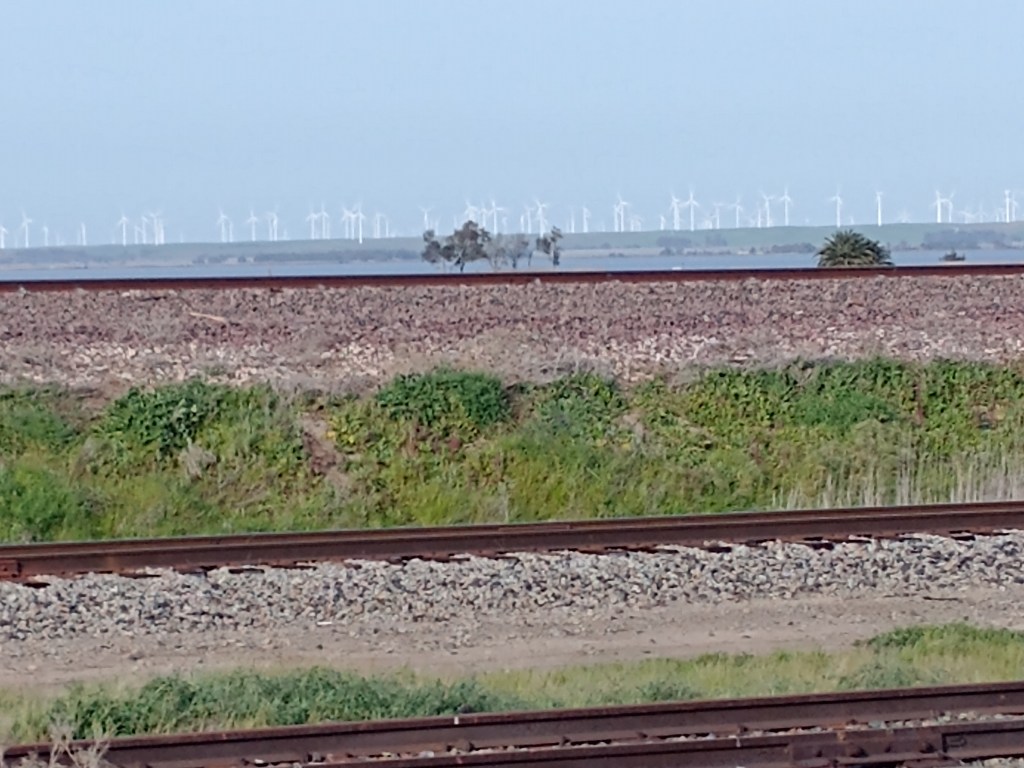
The Shiloh wind farm with 275 turbines is visible across the bay
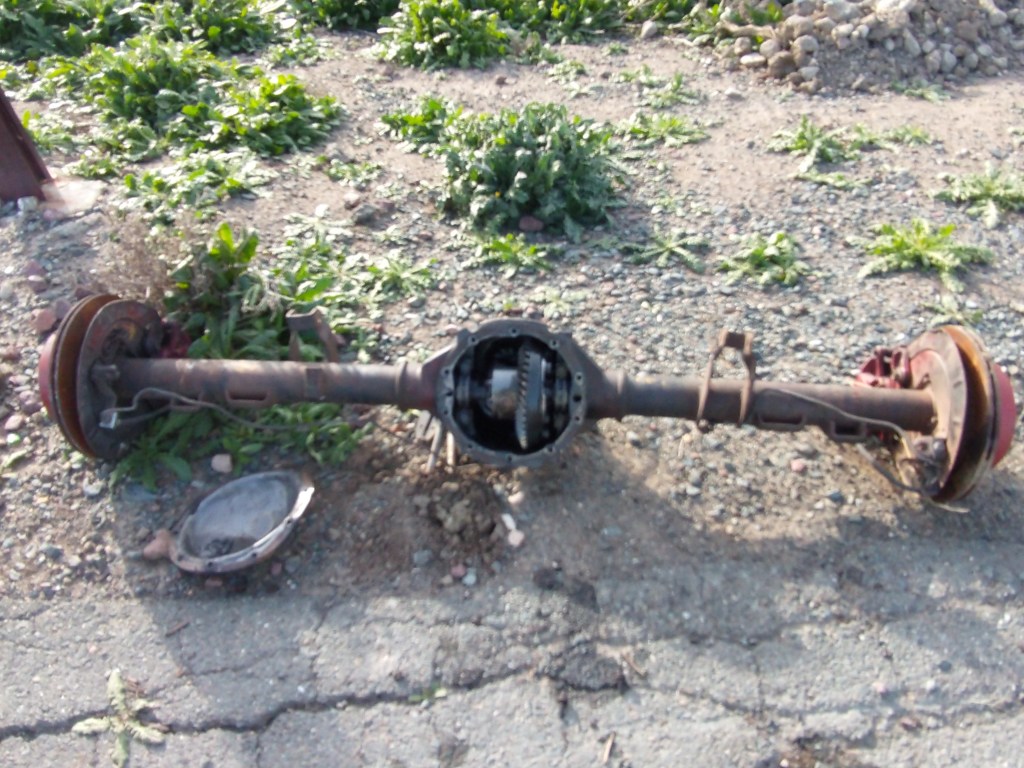
There are lots of places here where people take advantage of the open space to dump things. I came across this car axel.
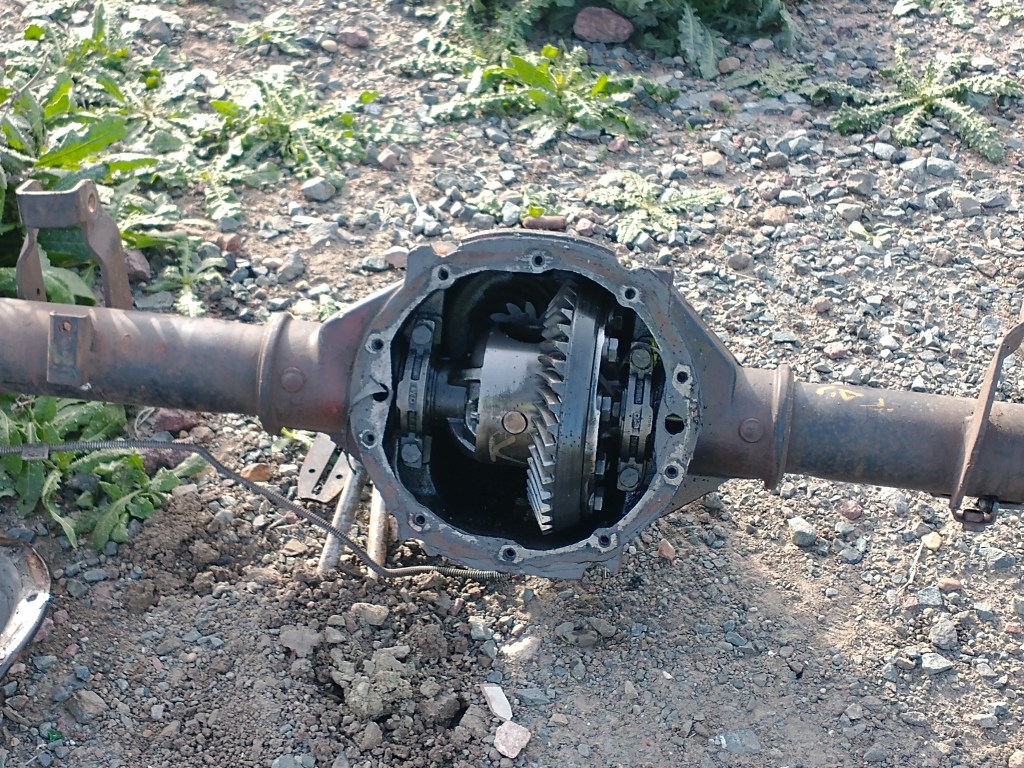
That lump in the middle is called the differential. It’s what allows one wheel to go faster than the other when turning corners. This one is open and gives a good idea how it works with gears.
This is another memorial I came across at the start of my Friday ride. It is right across from my school. I usually come through the side parking lot, so I missed when it first appeared, but it hasn’t been there too long–probably a few weeks. I found a news link to the name. Sadly, this person died riding a motorcycle. I was just a week into my cross country trip last summer when it happened.

_______________________________________

I’ve added to my archives if you are interested in my cross country trip from last summer. I’ve now archived 16 out of the 36 journal entries. To find them simply click on the Archives heading at the top of this post.

3/6/22

This weekend, I went down a few rabbit holes reading about psychological tic disorders that are being spread over social media and another topic, Lia Thomas, the transgender woman who is breaking all kinds of competitive women’s swimming records. There seems to be some commonality in both stories —i.e.—that people need to be seen and that we live in a society where people feel embattled to express who they are. (Please do not read into that statement that I think the reason people transition from one sex to another is for attention.)

Lia Thomas’ story is particularly compelling. Does a trans female have the right to compete against cis females? The NCAA has ruled yes — after the person undergoes a full year of hormone replacement therapy. But others claim that post puberty trans females can still have an advantage by having greater lung and heart capacity and a larger size. That is a legitimate criticism to me. 

Lia Thomas’ thoughts on this particular point were not addressed in the Sports Illustrated article — it was an informative essay not an interview — but what is clear is that Lia is an elite competitor and that her need to be a competitor at this level is in her DNA. What is also in her DNA is her need to be a woman. I have no doubt that those urges are every bit as strong. 

So here is why this is potentially a non-issue (at least for individual competition) and how, everyone — in my mind (sometimes a fantastically delusional place) — can be made happy and whole: 

Sports is all about data—most wins, fastest time, most points, etc. Any sports fan knows that there are a million data points to look at, all titillating to that geeky, nerd-self that some fans have inside.   

My point is, let things stand exactly as they are, but record wins and other data with notations of sex. Michael Phelps (cis man). Lia Thomas (trans woman). People then won’t feel as if their cis records (fastest time, most hoops) are being unfairly broken.

There is room on the podium to have two gold medals. For anyone who has the innate ability, loves competition enough to train four hours a day, and also feels strongly enough about who they are to have sex reassignment surgery, there has to be an arena for them to show the world what they can do.

Cis women will still have records for cis women. Cis men will still have records for cis men. Trans men and trans women will have records too. And for the elite athletes who are the top in the world, there will be an arena for them to be seen on a grand scale. 

I suppose for some people this will be too much like giving out participation ribbons. Where do we stop? Will there be nationally broadcast competitions by age group? Basketball associations for players five feet five and under? 55+ gymnastics? Swim competitions with fins? I guess I’m being a little bit flippant, but at the same time I think, why not?

What about coed teams? Why is it that women’s teams still don’t get the level of attention and coverage as male teams? It seems like a good time to completely rethink competitive sports. Judging by the new categories being added to the Olympics, it is already changing. 

I read an article that the Eophoria actor, Hunter Schafer, wants to be identified as a trans girl not as a cis girl. I admire her for that and wonder if that is common among transgender. So what’s the matter with categorizing sports people and their accomplishments by gender, especially since we already do that. It may satisfy all the people that are worried about the ethics of allowing transgender people to participate in gender segregated sports and maybe it will satisfy transgender participants as well.

___________________________

I guess if my blog has a theme, I’m blowing it out of the water this week by going on tangents. Still, gender identity definitely relates to place and having one in the world, as well as my next topic — accessibility to the streets. 

Locally, there was a violent incident in Concord that has shaken and angered me. Last week, a fifteen year old boy was killed on his bicycle about eight blocks from my house at the corner of Galindo Street and Clayton Road. One person is being charged with vehicular manslaughter.

I was on my way to the climbing gym a little after four o’clock when I saw his covered body being loaded into the ambulance. The whole block was cordoned off. A half dozen police cars had their lights rolling. All major corridors were jammed with vehicles. 

At this intersection, Galindo is a two-way street with seven lanes and Clayton is one-way with four. Neither have medians which would have likely prevented this accident. It’s just a wide swath of asphalt without a safe place to rest or barriers against crazy driving. Concord is filled with similar intersections.

This accident comes just two weeks after I witnessed the driver of a new Dodge Charger become impatient at a red light, make a sudden left turn from the far right lane and T-bone a woman turning onto the freeway at Bailey Road in Bay Point. A month before, I came across a concrete mixing truck that had turned over a few feet from this same spot and destroyed the concrete barrier between the on and off ramp.  

I turn my bike lights on at all times now. I’ve taken to wearing a yellow safety vest given to me by my old principal, Mr. Ruiz, who could barely see me riding in the fog one day.

We desperately need traffic calming here—bulb outs, medians, bike lanes, sharrows, no parking zones, signage, etc. It’s easy for car drivers to make the case for the city to not do these things. After all, very few people ride bikes. To this argument I say, “Have you seen the movie Field of Dreams? Build it and bicyclists and pedestrians will come.”

The truth is, most municipalities in the United States do very little to make walking and riding easy or safe. Cars have owned the culture for a long time. 

Things may seem to be getting better. Motor vehicle fatalities peaked in the United States in 1972 with 54,589 deaths. In 2020 there were 38,680—and this with a hundred million more people. Still, I wonder how much of this is primarily due to seatbelt laws and air bags—measures that do nothing to improve the safety of bicyclists and pedestrians? 

The streets feel more dangerous than ever to me, but I’m getting older. Danger is around every corner. It might not be long before I no longer want to go out at night.