It may be useful, I’m thinking, to recap a theme of this blog in the way that a cliff-hanger, double-episode of Star Trek, The Next Generation recounts what last went down. (An episode of this series has been a nightly treat lately for Jillian and me — often while we eat dinner.)
I inherited two parcels of land from my step-mom a few years ago. These were left to her by my father who died in 2009. She could very well have sold them off and used the money for any number of important things but knowing that I took great interest in this land and its proximity to dear relatives she deeded them to me.
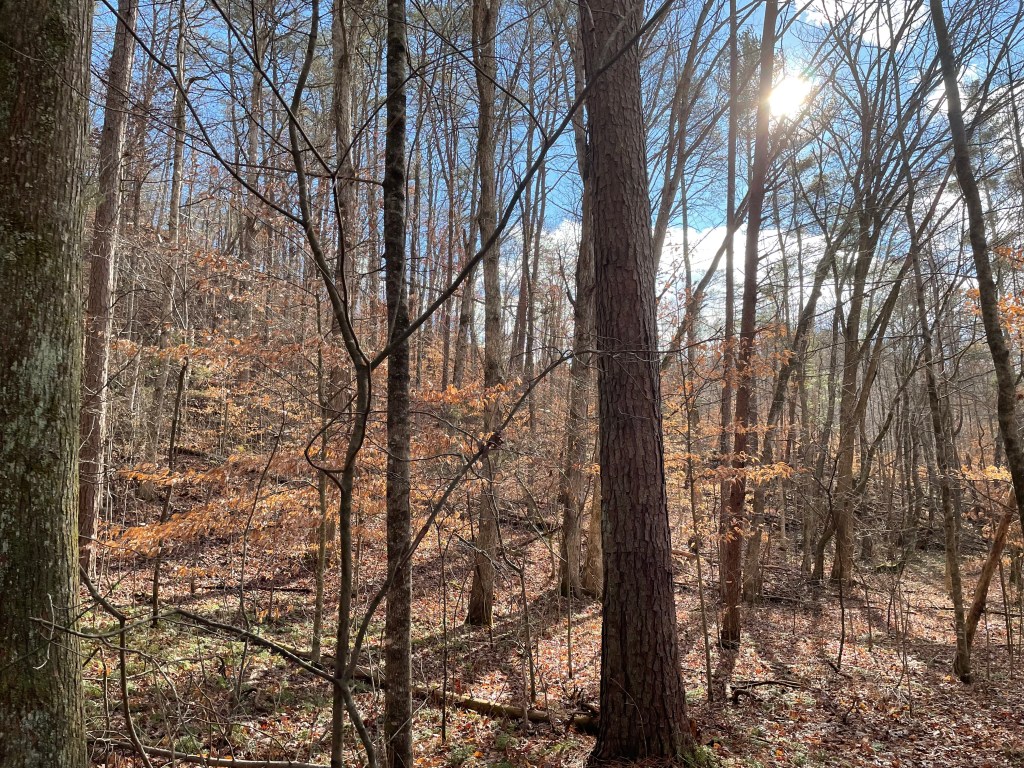
There is a 12-acre piece shaped like a rhombus and a 26-acre piece shaped like an acute triangle. Both are heavily wooded, the larger parcel more so and with a prominent knob near the center. If you think of the top of the knob as a circle, about 270 degrees of it has a steep approach with the remaining 90 degrees connected by a more gradual incline like a wide land bridge.
The smaller parcel does not have such an extreme elevation change but has deep rolls nonetheless. The land here is characterized by large grey boulders that may have tumbled from the high ridge of the Clinch Mountain range that sits behind it at 2200 feet. Over a hundred acres of this mountain side are for sale but finding a buyer for acreage measured on the side of a wall may be difficult for the owner who I’ve not met.
My two pieces of land are separated by what is known as Poor Valley—the space between the knobs and the mountain—probably 250 yards as the crow flies. Despite its name, the best and flattest areas for farming and building are in this small valley. Together this made one continuous parcel of about 200 acres that my University of Tennessee, chemistry professor grandfather bought and pieced together in the 1920s and ‘30s.
This was the land that my father had enjoyed all through his childhood as a vacation retreat from their family home in Knoxville 24 miles away. It’s the land where my grandfather is buried and my grandmother and uncle have memorial stones. Three of its acres are designated a cemetery.
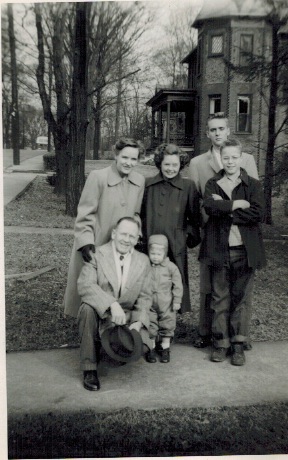
As a young man the joy and familial good times my father had on the land throughout the 1940s and ‘50s must have played like a silver screen in his mind — summers in the farm house, gardens planted and apples picked, horses ridden, sled rides in winter and always exploring the surrounding woods.
But the movie reel must have been canned when my grandfather died suddenly on his last day of work, dressed in his doctoral cap and gown. Dad was still a young man—just 25. My grandparents had planned to retire there to the country farm house.
Alcoholism took several siblings. My parents battled with it themselves. Some sort of bitterness weighed heavily on the memory of idyllic earlier times–something related to the unstitching of the family.
No one treated the land as sacred ground when I was growing up. I heard stories of it but only visited two times, first in 1972. I stepped out of the car and kicked rocks on the side of the road. We were just passing through on our way to my mom’s relatives. The old farm house was still there but Grandma Robbie had put it up for sale. Dad’s remaining family were scattered by then. We were living in Florida. Dad was estranged from the half-brother who still lived in Knoxville. I don’t remember even walking to the gravesite of his dad.
Years later, the next time I went with my dad he had a hard time finding the place. The movie reel in his brain had been relegated to some dusty shelf.

On all the remaining 38 acres there is only one spot that is almost perfectly flat and the place best suited for a cabin or house. It is not far from the memorial stones and sits atop a small rise looking across the valley to the face of the mountain range. The one time I ever walked on this spot with my father he talked about its potential. I imagine he had discussions about it with his mother and siblings and probably his father before he died.
“This is the place, if anyone ever wanted to build a cabin or house…this is the place they would do it.”
Those solid words became a whisper that nobody was left to say but myself. Last week I returned from a week-long visit to the land I’ve grown to love. It’s become a biannual pilgrimage these last four or five years.
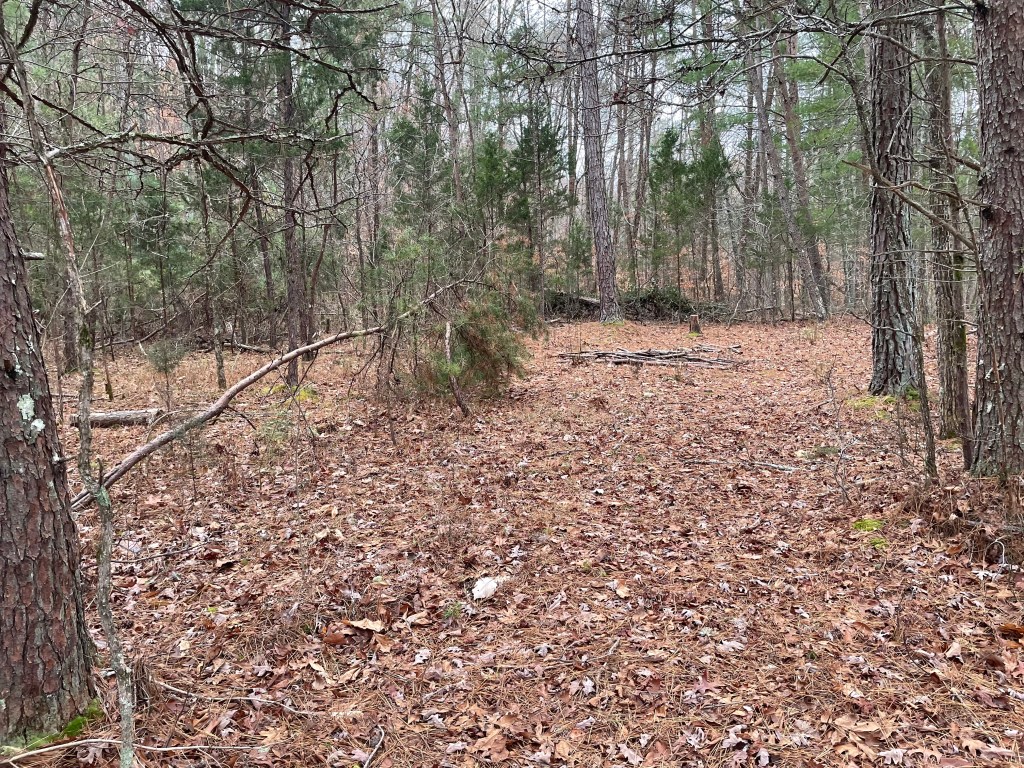

One thing I’m convinced of now is that winter time is the season to take advantage of outdoor work. As long as it stays below 45 degrees the ticks sleep like clocks whose gears have been seized by the cold. The poison ivy loses its leaf and the fat and thin vines that climb the trees lose their chewiness and become dry and brittle, easy to chop with an axe or machete. Sometimes merely giving a twist of the blade between tree and vine is enough to break it. I’m not sure how bad these vines are for trees but I’ve got a grudge against them and figure the fewer the better.
It can be cold in winter, but this is preferable to the summer whose humidity and heat is elevated by the need to cover for protection against the biters and allergens.
It is also eminently more walkable. The ground cover that grabs your boots and threatens to trip you with every step has died back. The leaves are gone that reduce visibility. They are piled six inches deep. There is no way to walk quietly. They no longer hide the limbs that wack you in the face if you aren’t careful. There are no spider webs. You don’t have to carry a web wand to remove them as you walk. Poisonous rattlers and copperheads, although I’ve seen none, apparently disappear in the winter. I’m not sure where the snakes and spiders go. Perhaps they are having a tea party somewhere underground.
The shape of the hills and valleys are visible. There are places where I can see a hundred yards or more.

This would be the time of year to do a tree count by species and size. Leaves are not always a big benefit for identification anyway. Some species leaf out very high. Saplings, sweet gum, maples and other smaller species block the visuals by forming a lower canopy. I’m getting better at identifying trees by shape and bark pattern. What I’ve learned this trip is that I have many more oak trees than I previously thought.
I’ve also found that there were once many cedars. Now it is difficult to find a live one. The bodies of dozens and dozens lie in the southwest corner of the Acute Triangle and adjacent to the falling cabin on the Rhombus.
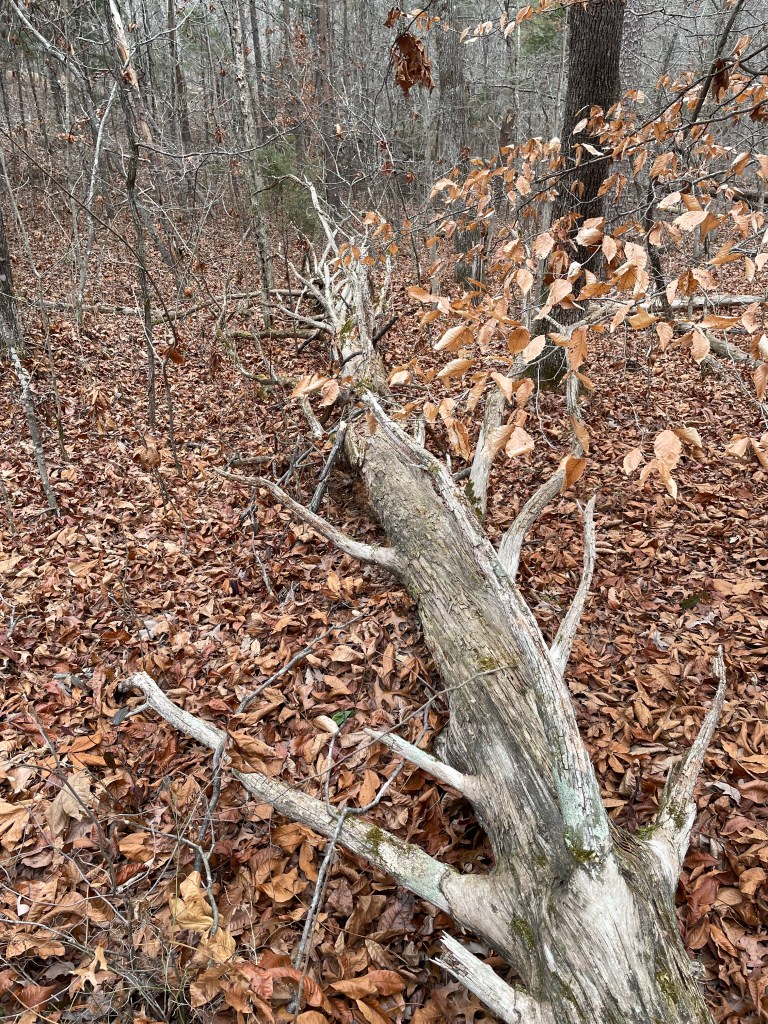
I’ve experimented with chainsawing into these cedars. Many are so deteriorated the saw goes through them like butter and the wood is crumbly and white with no distinctive cedar smell. However, the short limbs often have a solid core and maintain the smell and red color. I brought back samples in my luggage to experiment with.
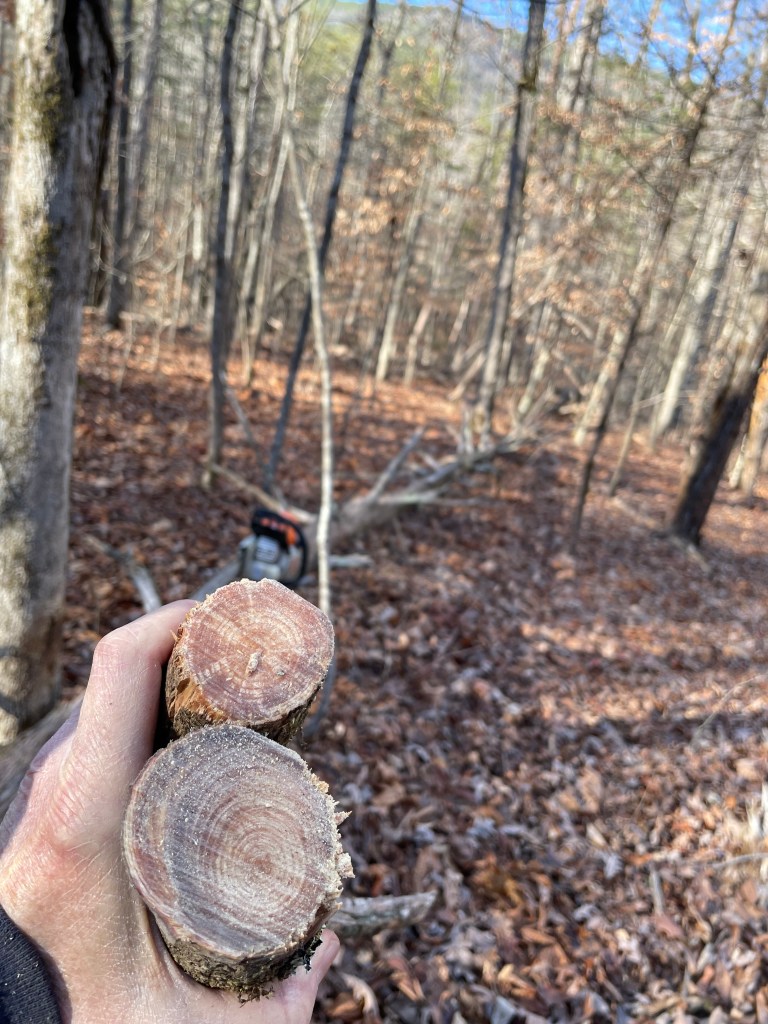
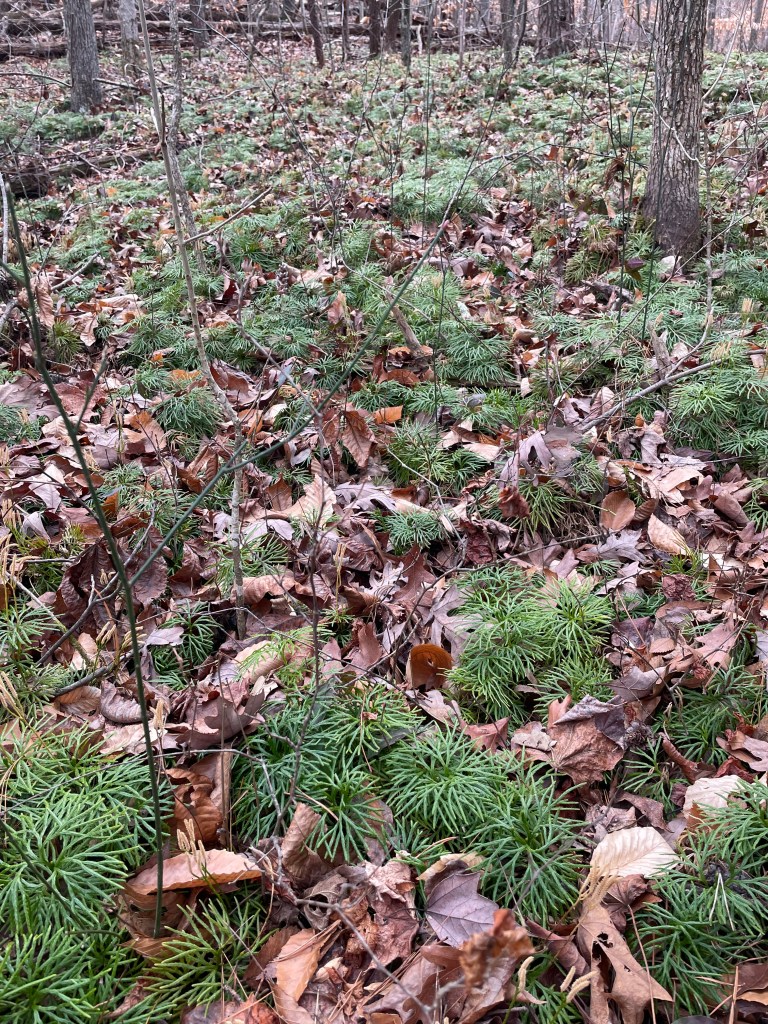
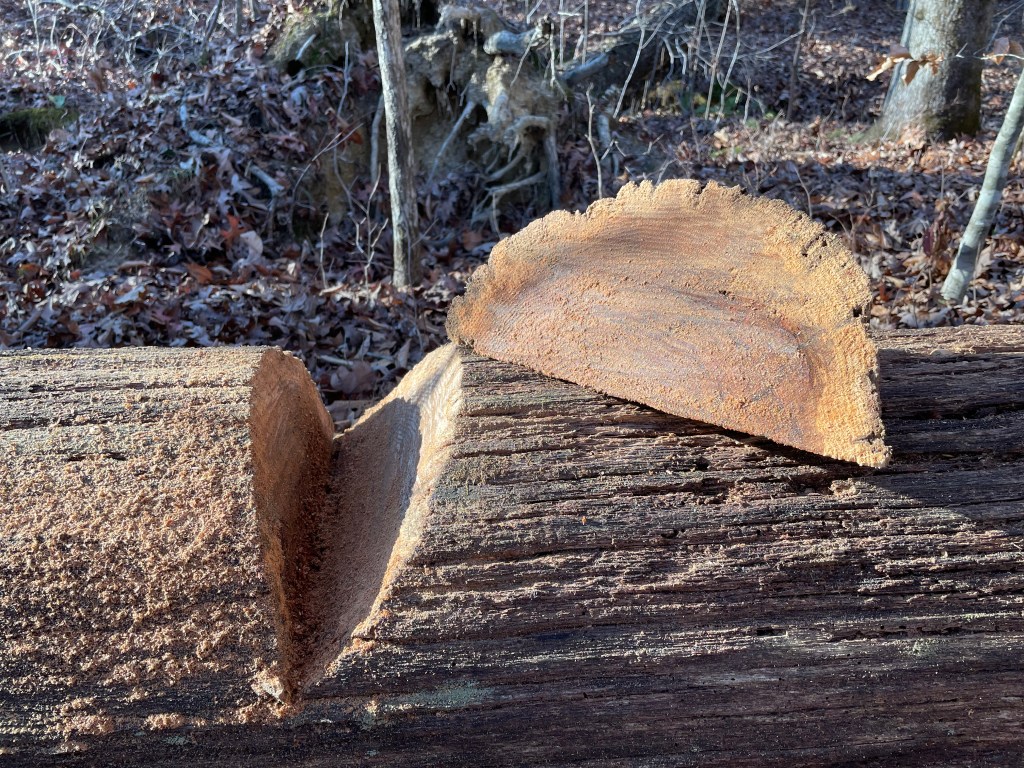

I’m still not adequately worried about snakes although another neighbor introduced himself from his car window and showed me pictures of two local timber rattlers that had been killed. Both appeared to be approaching baby anaconda size. One was held chest-high folded over a pole. Both halves of the draped body almost reached the ground. The head was a surprisingly sharp and large equilateral triangle. I’m guessing this was accentuated by the head hanging down and it being dead. This video has convinced me not to kill a rattler or copperhead if I come across one. I do, however, think I will invest in some snake gaiter leg guards.
I had no more sightings of bears but almost every neighbor I talked to had new stories. The two goats from an earlier picture I posted have succumbed to predators and their human parent suspects bears although another neighbor thinks it’s packs of canines bred from wild dogs and coyotes.
The goat-daddy’s theory gained some authority when he told me that one of the goats had been found dragged up and over a barbed wire fence, a feat that only seems achievable by bears (having no reports of mountain lions in these parts).
The other goat was found several weeks after it went missing—just a spinal cord attached to a skull which in my mind lends itself more to the wild dog theory.
In terms of goals, I accomplished as much as I could have hoped for on this trip which included a fair bit of relaxation, visiting family, and except for a few strenuous days only mild exertion.
There was a good deal of thinking about how to proceed though. The phrase work smarter not harder came to mind more than once. As I approach my last year in my fifties I’m feeling prepared to shuck off at least some of the traits that mark me—according to one close friend—as a dang fool.
With that in mind I surprised myself with what I consider a few smart choices this trip. Retelling that will be part of my next post which will come out soon. It is mostly written but is too long to include here.
 Spotty West Goes East