January 19, 2025

I have a new routine to write when I’m fresh in the morning and look at news when I’m tired at night. I get free library subscriptions to The NYTimes, The Washington Post and am currently paying one dollar for a year-long trial subscription to the SF Chronicle which has automatic renewal at a much higher rate. I bet they hope I forget about that but I won’t. That’s what calendars are for. I probably should support my fellow writers and just pay, but there’s a reason they are free—or close to it—and who am I to try to figure it out? 

Together with these three newspapers there is more news than I can look at. I’d be better informed if I substituted one of these papers for a more radical doomsday-type publication and added in a more conservative Tennessee newspaper but my gut is probably going to churn no matter what news I take in. 

The Post and The NYT usually have similar headlines. The writing is good in both. The NYT usually sends me three or four breaking news emails every day in addition to The Morning and I have to ask myself how much news can break? 

The SF Chronicle seems to have lots of strange gaps in their reporting that often makes me ask “okay, what happened?” but it’s local(ish) news for me even in Concord and I should probably pay attention to that. 

I’ve also decided that with all the crazy people in Trump’s junk drawer (Jillian told me people are calling it that instead of a cabinet), it’s probably best not to get worked up every time Broken Stapler #1 says they are going to invade Greenland or Dried Up White-Out says we need to stop requiring vaccines for children in public school. I just can’t be a yo-yo all the time on their rubber band.

This is my 2025 pick for book of the year (although it came out in 2022). The story is so compelling. It’s heartbreaking at times but there are lots of wait-for-it moments when the soul sings.
My favorite MLK jr. book that I’ve been reading to students for years. Warning: You will likely cry with joy at the end. Fantastic illustrations.

—————

I’m feeling better about the prospect of getting a cabin made. It’s been close to five years since I’ve been exploring this land and it feels, for the first time, like I’m finally getting a good map of it in my head. 

For one thing,  I found a good place where I can stage logs and then take them out to the road for cutting with a portable mill. I’ve passed by this spot a thousand times walking the trail the 170 yards from the proposed cabin site to the shed where I store tools. It’s flat, close to the road and largely free of any big trees. I think I never considered it before because it’s directly across from my nearest neighbor’s house and in the summer it’s overgrown with vines that offer a visual barrier that I like. 

The neighbor’s chickens were scratchin’ around next to the road and stepped into the woods when I approached them.

Now, as I’ve gotten to know my neighbors the idea of having complete privacy from the road doesn’t feel as important.There are plenty of spots on this 25 acre lot where I can get that. 

Most distant and remote is a little valley on the other side of the central hill and between the next hill which becomes the neighbor’s property after it tops out. This little valley—more of a holler—is almost completely absent of woods. If there were flying fairies, quidditch tournaments or witchy broomstick games this is where they would be played. It would be nice to have a cabin here, but there is no flat spot. Where the hill ends, the next one starts. The valley is a V not a U. A cabin could be built on the hillside with supports like you see in the Bay Area’s Oakland hills but my joy in this place is about the absence of human intrusion not dreaming of what it could be.
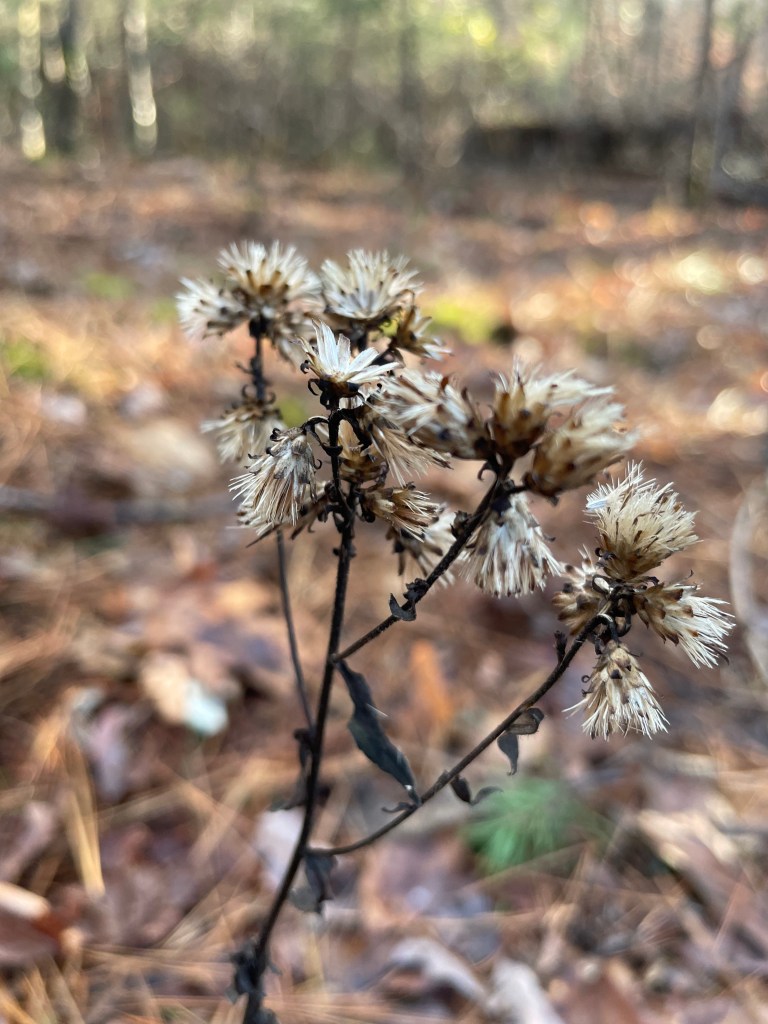
A pretty winter weed that I’m too lazy to try to identify right now. It’s probably something obvious.

A while back I named the machete as the most valuable tool in my kit. That remains true even after making trails through the ever-encroaching wilderness. When I go back in six months there will be vines and saplings trying to take over again.

With this in mind I’m offering up another tool that tops the list and was most useful on this last trip. I threw a pair of $15, fleece-line gloves in my luggage at the last minute. I figured they might come in handy if it gets very cold, but that wasn’t why they ended up being so valuable.

It was the extra thickness that offered protection pulling up Multi-floral Rose. I got plenty of practice on that patch of land that I’ve decided is the perfect staging spot for bringing out all the logs to be milled. This species of rose is very aggressive and next to Poison Ivy the most prevalent vine on the land. It grows in clumps that extend out in an exploding firework shape. It grabs hold of your clothes like blackberry bramble and a thicket of it is not something you want to take on in the summer unless Aguirre, the Wrath of God and other Werner Herzog movies inspire you to go into nature and do the most difficult thing you can think of. 
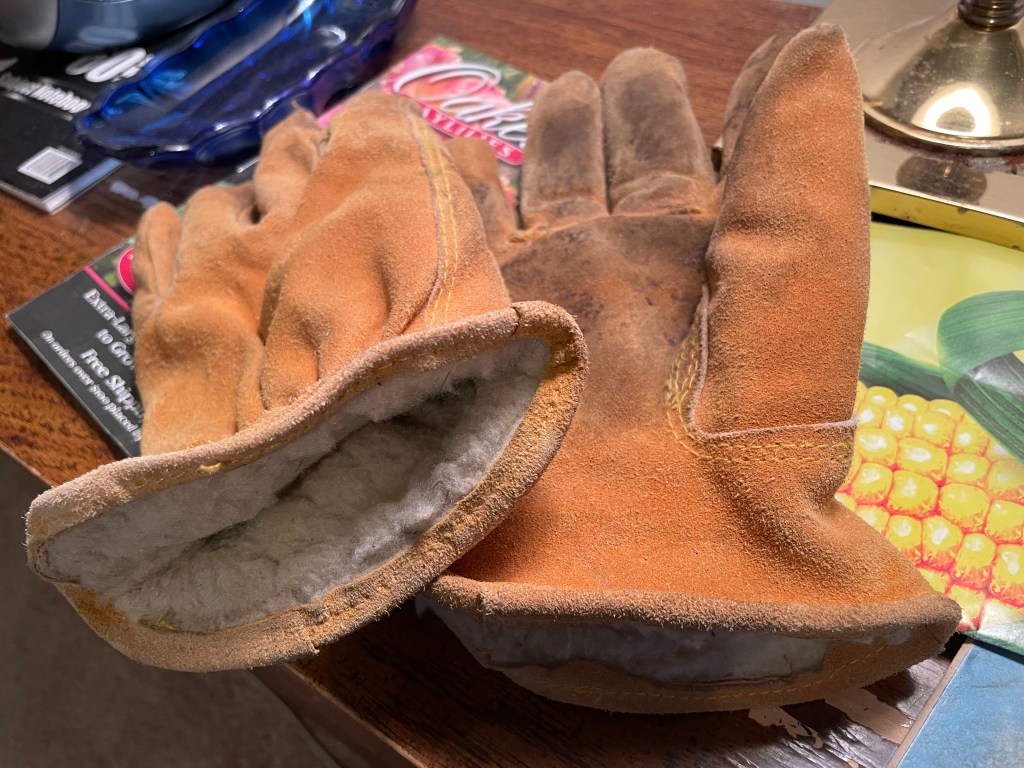
Winter is definitely the time to clear Multi-floral Rose. The leaves are gone and you can see where every shoot is heading. Though it still has live green vines, most are brown and dead and if you are lucky, as I was, the soil is soft with recent rains. Some of the clumps I could pull out on my first effort, gathering most of the vines in my hands and leaning back. Any that gave trouble, I’d dig around the edge with my shovel and lean back on the handle to break roots and get some uplift on the ball. This preparation was usually enough. The next time I leaned away with a handful of thorny vines imbedded in my gloves the remaining roots would start popping like a kettle of corn and soon I’d be holding the whole explosion of plant in the air, triumphantly carrying it to a neighboring pile.
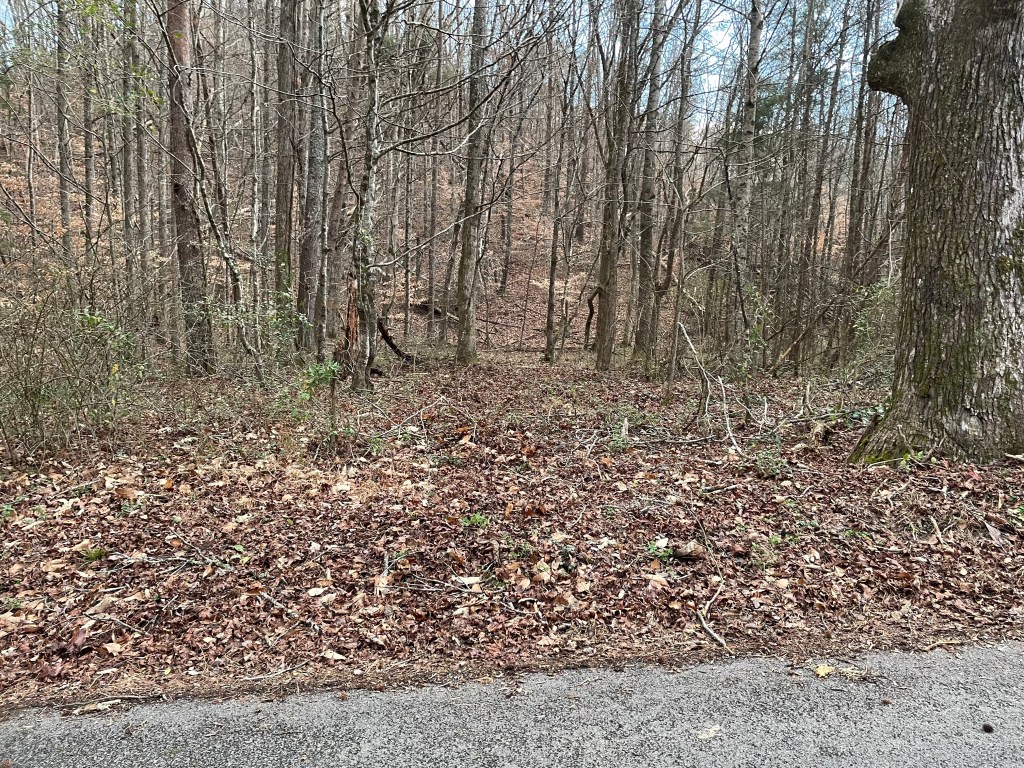
The log-staging area I mostly cleared of Multi-floral Rose

The gloves also made it easy to pull up all the Loblolly and Winged Elm saplings on the PCS. It was rare that I had to use the machete on a sapling in this area. The ground is covered with pine needles and moss of varying shades of green and grey. Beneath this is about an inch or two of topsoil followed by white shale and clay that becomes increasingly hard to dig into about six inches down. During wet weather it is a miniature flood plain with much of the water washing off the knob behind it. The moss and top soil make it spongy. 
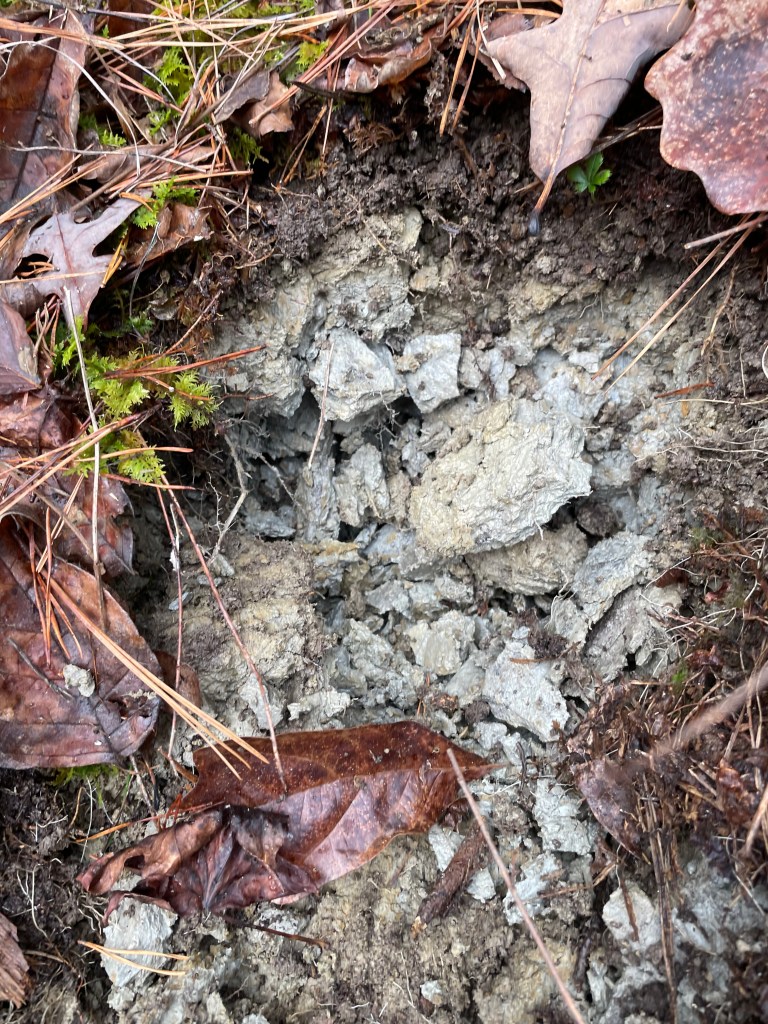
Shale and clay earth just beneath the PCS surface
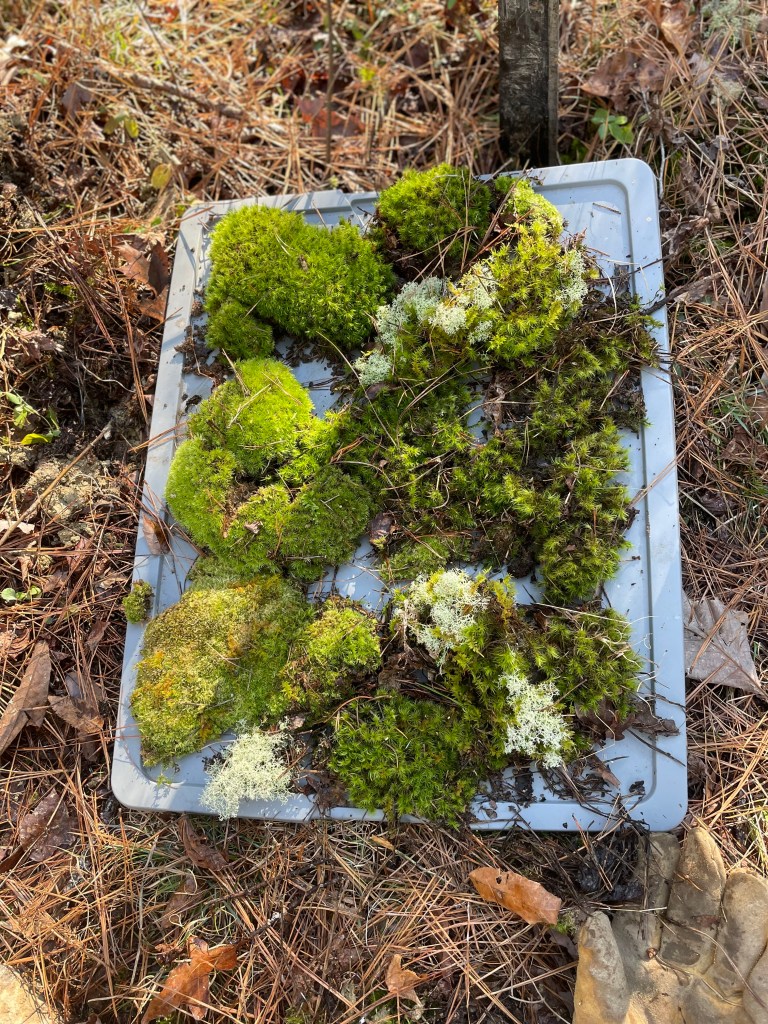
Ground moss collected from the PCS
I used the harvested moss to line the rock stairs I put in last summer. I’ll see if it lasts but I don’t know why it wouldn’t. The stuff is pretty hardy and there was some in the stair area before I brought all this extra in.

The poor quality of soil on the PCS is probably why there are only a few species of trees there — Loblolly, Cedar and Winged Elm. Oaks which start out with a single, deep tap root definitely don’t like it. I imagine the shale is too difficult to penetrate. Those other species have roots that spread wide and shallow—at least in the beginning. I’ve no idea what the root system looks like for some of the older, surrounding pines that top out well over a hundred feet. I imagine when a tree grows that big it must start to have powerful roots that can make their way into deeper territory. 

Ideally, I would have a well here on the PCS pumping water directly into the house, but I don’t know how much water makes it through the clay. Neighbors, Chuck and Rhonda, across the road, are roughly at the same elevation and hidden behind a small knob. They told me they hit water at 150 feet but drilled to 200 and take water from that level. 

They came by on the day I was cutting up some fallen trees near the road. They arrived in their new, gleaming diesel pick-up and put it rumbling into park. Michigan natives, they had a retirement home built here five years ago and are still adjusting to it. Chuck misses the snow but they have a daughter who lives nearby in Knoxville with her fiancé. Ever-friendly, Chuck invited me up to their place to say hi. I told him I may take them up on that. I’ve been a few times before. Rhonda said, “I’ll give you a piece of pie!”

The next day I called them when I started to get hungry and asked if it was okay if I took my sandwich up and ate it while I visited. 

“We have food,” Chuck exclaimed in his cheerful voice that made it sound like the introduction to a Broadway song. 

“Oh, thanks, but I made this sandwich and I better eat it,” I said.

“Well, you like coffee,” Chuck asked?

“Sure”

“Well, we can give you some of that.”

We talked more about their water while I was there. Chuck gave me a glass to taste and it was exactly what I would want in drinking water—pretty much tasteless. 

Their aging dogs Fatty Mattie, a standard poodle mix  and Waggy Maggie, a black lab are slightly mis-nicknamed since Maggie is a bit plumper than Mattie and Mattie is a bit more waggy than Maggie. At any case it was nice to get my hands on some dogs, missing Sasha so much in the short time I was in Tennessee. The feel of a short shorn standard poodle’s curls is a textural delight.
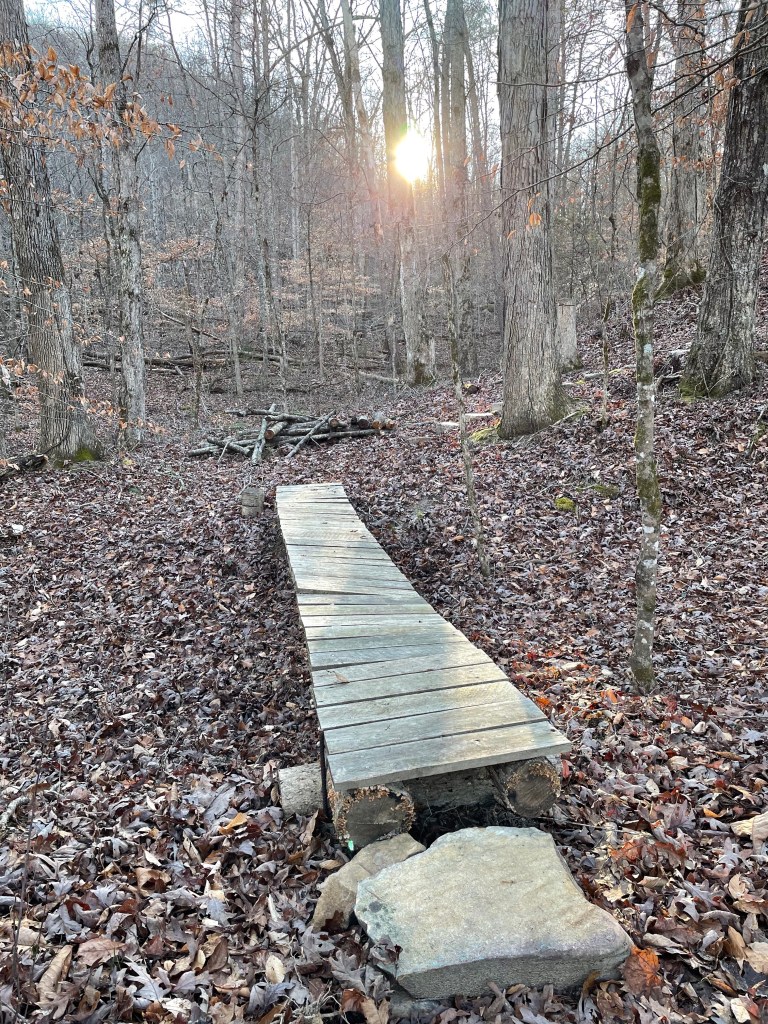
The old bridge is holding up, but growing a carpet of Turkey Tail Mushrooms which I scraped off the underside of oak logs. I don’t want to help the Mycelium network to advance the bridges ultimate failure.
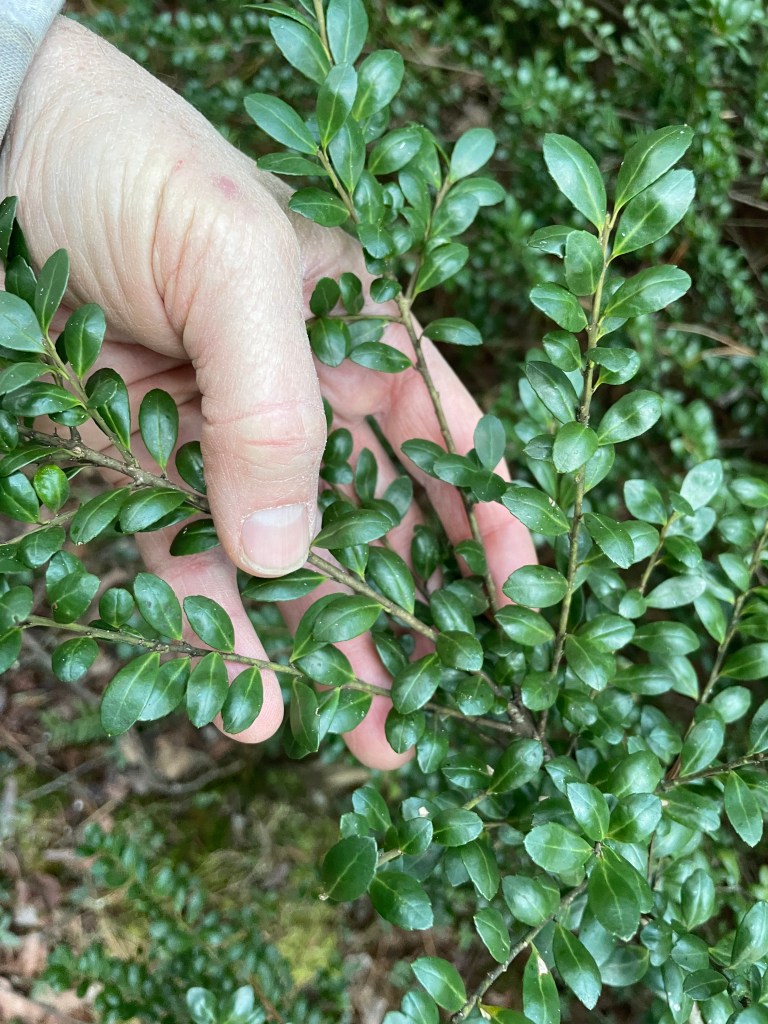
A Google search indicates this is a Japanese Holly, an invasive species. I admit that I’m not as concerned as a should be about invasives. This is a pretty plant and the only one I’ve found on my land. It is part of a big, lush bush at the base of the hill at the back of the PCS. I used the dark green as a backdrop to film the falling snow that didn’t stick. I’m quite fond of it and will keep it until convinced otherwise.
Numerous trees helped break the fall of this 120 foot, 30-inch diameter Tulip Poplar. Evidence includes skid marks down the side of another big poplar and a Loblolly Pine that snapped 12 feet from the ground. A free fall directly onto the Sheridan cabin would have probably meant its demise. Maybe the structure would have failed without the brace I put on the opposite side and a pole on the inside. My work to do that may have been a mistake if I wanted to have an easier way to disassemble it. 
The tree now laying on the ground is so beautiful and straight. It would be a waste not to use it for lumber. I’ll have to think about how to deal with it next summer. This one is not near the log staging area. It’s on the other piece of land. However, the closest neighbor has said I can use his tractor to pull cut pieces out. He also has a non-automated mill he will let me use. By non-automated I mean it is the kind I would have to push the saw through.
The top branches of the fallen poplar are big enough to be sizable trees by themselves.
An eight foot crater was left where the tree fell exposing lots of rocks for harvesting.

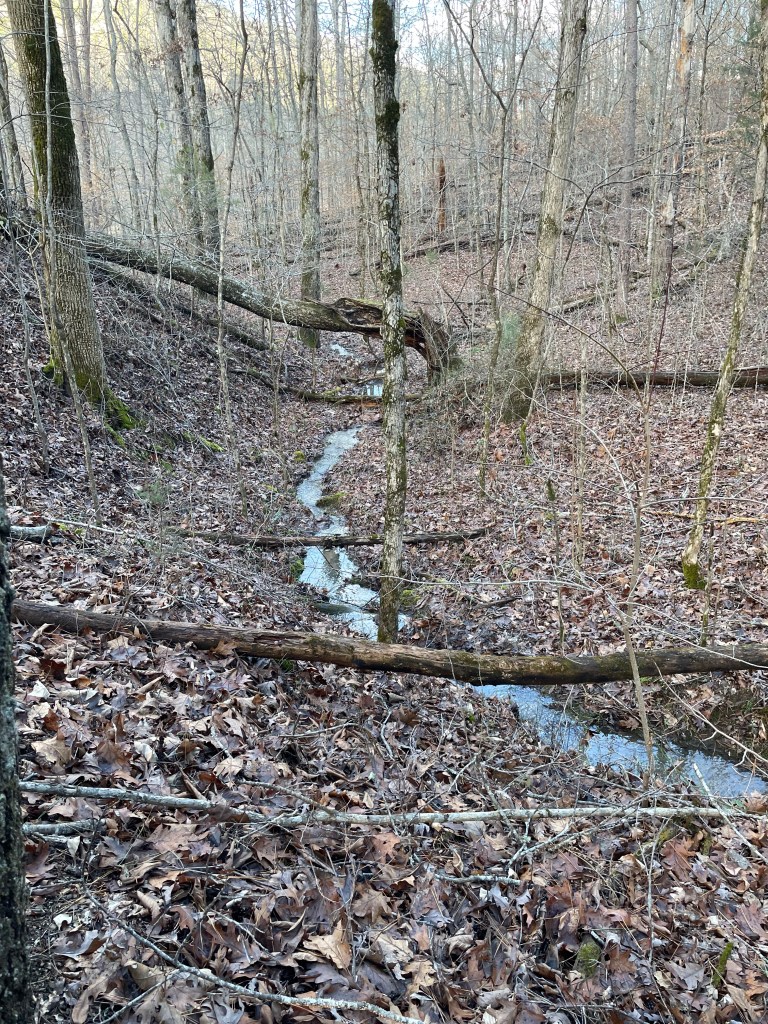
There were numerous wet-season creeks that I saw on the land for the first time on this trip.
This place holder was on the back of every seat on the American Airlines flight I took home. Was this the idea of a radical literacy advocate bemoaning the state of our video-saturated world or did they just want to make sure you didn’t put coffee cups and snack wrappers in the magazine pockets?

January 12, 2025

As is always the case, the few things I had on my list to do on my latest Tennessee trip grew into a thousand things in my head. 

What I did do was rake a thick layer of leaves off the new gravel driveway. I figure it’s best to minimize the rate at which a layer of topsoil will eventually overtake it given the number of trees and the fact that I won’t be there every week to uncover the grey rocks.

There is a pile of shoved up dirt at the end of the driveway the bulldozer made to grade it. This has become my de facto compost pile. I added all the raked leaves to it. Between wagon loads I threw shovels of dirt on top to weigh them down. I also carved out a channel on the downhill side to make an area for water to escape the driveway. I’ve no idea if this is useful as there are plenty of opportunities for water just to seep into the ground or flow out in all the lower areas, but this type of engineering comes from my earliest childhood instincts to play in the dirt. I don’t think we humans loose that. Same with water. I imagine I’ll enjoy gazing at the ripples of a stream and dragging a toe through a placid pond as long as I live. It’s why I like going to the land. Just to play. 

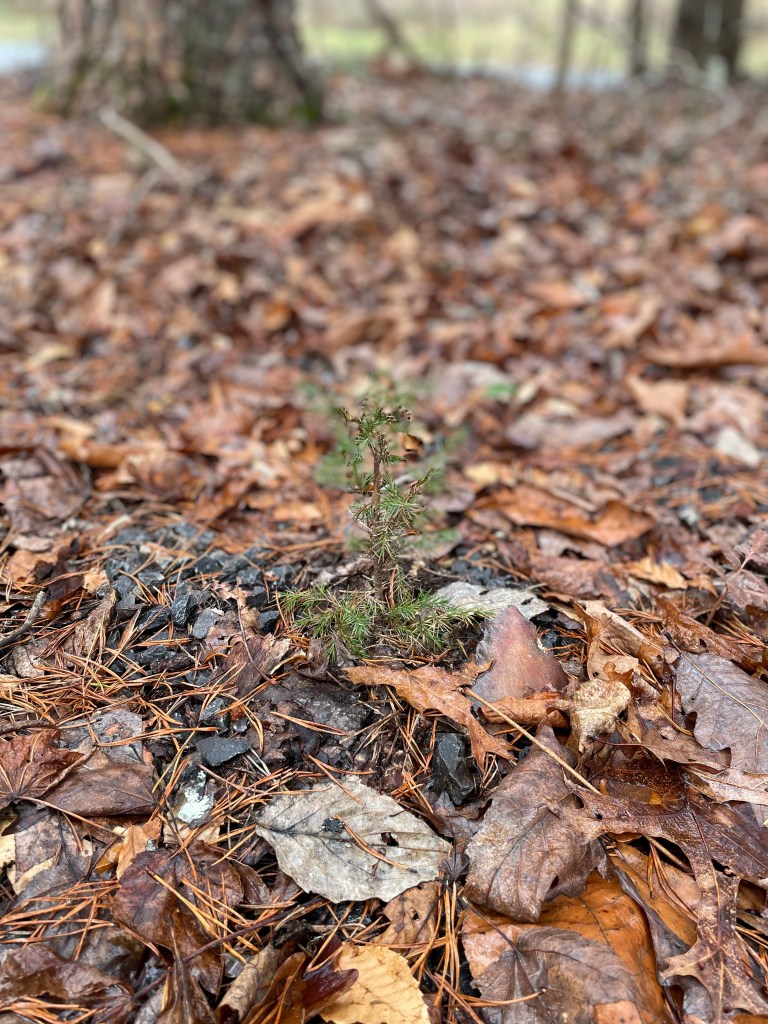
While I was messing around at the driveway I moved a small cedar sapling about three feet away to get it out of the range of car tires. I dug up another from the proposed cabin site (hereafter abbreviated PCS) and planted it in line with several others. There are now four or five cedars lining the drive. I’ve no idea if they will turn into big trees and if those big trees will be full and gorgeous. All I know is I like the smell of cut cedar and I like the beautiful red wood which has nothing to do with why I’m planting them there. Ta boot, I’ve noticed is seems to be a crapshoot whether a cedar is beautiful or scraggly and most of the cedars on my property tend toward the latter. 

The driveway and seventy five yards away at the PCS are where most of the cedars grow. In other places, notably on the west side of the property and around the falling cabin on the other property are numerous large cedars in advanced states of decay laying on the ground like dinosaur bones—evidence of a time when they played a more prominent part in this world. I’m not sure if a blight took them out or changing climate or changing composition of soil. Maybe they just all grew and aged out at the same time. Their placement is random so I don’t think they were planted. Most of the cedars I see in this area of country line fields and roads and I suppose were planted (or kept) there as hearty trees, live fenceposts and windbreaks. This lining-along-the-edges is what I’m doing without having researched it or even given it much thought. It’s a wordless tradition passed on by a common landscape template.

The tiny cedar I moved out of the driveway.
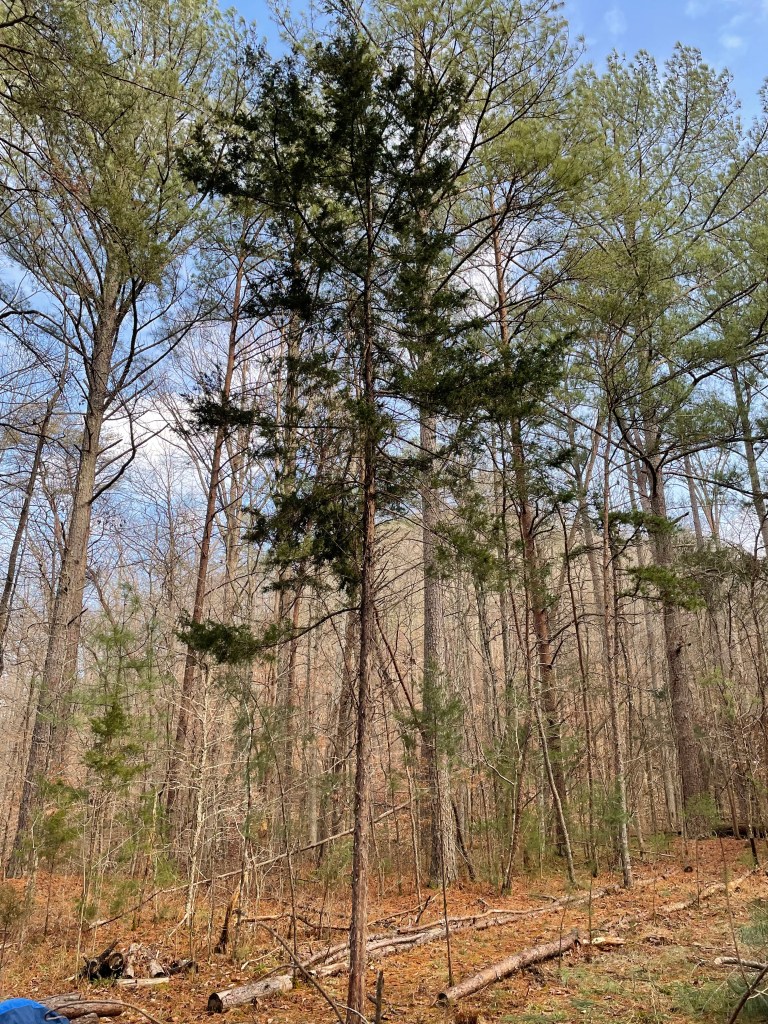
This may be the largest cedar on the property. There is no old growth cedar.

I didn’t end up doing a burn. More reading about why winter burns require a state permit convinced me to wait until summer when there is more moisture in the surrounding trees and less chance of them catching fire. I also had the feeling that the heavy, cold air would keep most of the smoke in the valley and that while all my neighbors probably burn wood they prefer it going out their chimney than coming in the front door. 

I spent a substantial amount of time further clearing the PCS back to the base of the knob—the high hill that will be in my backyard. I was anxious to get out to the land each day but because of jet lag I didn’t make it there before noon except for the last two days. I didn’t feel bad about it. I’m physically exhausted after four or five hours of hard labor and the sun sets early in the winter. By then my back is aching and I’ve become very sluggish—particularly in the case of chainsawing for a few hours. The chainsaw is heavy and so are the chaps. In fact, it’s debatable whether the chaps that protect my legs add safety or not. I stopped wearing them after the first day. They tire me out quicker and I’m more likely to do something stupid when I’m tired. 

Most of the clearing was of Loblolly Pine and Winged Elm saplings just a few inches across with a few larger Loblollies thirty feet tall and not more than five inches across. I won’t cut any of the cedars until I’m sure what the footprint of the cabin will be. I transplanted a few larger ones to line the trail going to the memorial stones. Two I dug up with a ball of earth slicing through any long roots with my shovel in the process. Two others I pulled up with most of the roots intact. (The soil was a wet bog making it easy.) I’m curious if either transplanting method works although I didn’t do a good job labeling which tree was dug up and which was pulled out and by the time I get back this summer my memory will fail. If any are alive I’ll be happy and it will pay to learn which method is successful for the next time.  

Winter is definitely the time for clearing but still with all the tangle of vines and saplings it didn’t take long to make a real obstacle course at which point it was important to turn the chainsaw off and clean up. All the small stumps I made were trip hazards enough. The more tired I became the more I stumbled. I can cut the stumps to about an inch above the ground but any closer than that and I risk getting the chainsaw in the dirt which quickly dulls the chain and makes sawing more difficult and hazardous. Stopping to resharpen the chain is about a fifteen minute project. I can do it in the field but it’s best to do it back at home. Eventually I may not have to watch a YouTube refresher course every time I go to Tennessee. 

It’s important to keep the chainsaw steady when sharpening the blades. Instead of buying a vice I can keep the chainsaw from moving up or down by pinning it under a couch at Aunt Linda’s using a hammer through its handle.
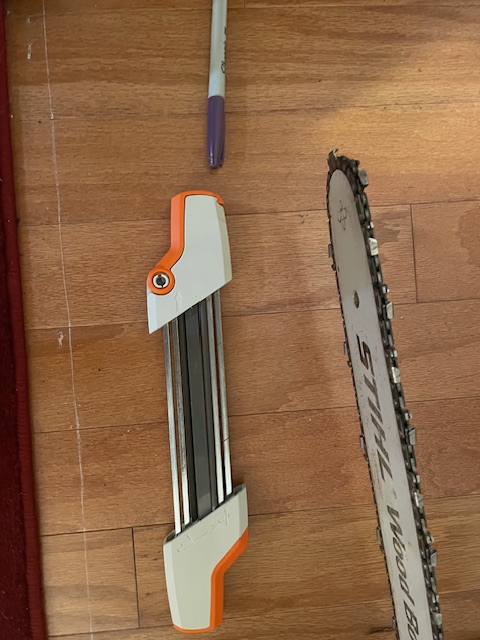
This handy 3-in-1 chainsaw file keeps two round files proportionally at the correct distance from a flat file and allows me to sharpen each chainlink of blade with one hand and use the other hand to keep the bar from moving left or right.

There is a fairly large and straight Loblolly that only has a slight lean that I’ll remove for space for the cabin and which I may mill for lumber although I’ve not researched its qualities for building.  I also don’t know how much lean a tree can have before it effects the grain and causes warpage in the milled lumber. Mostly I’m considering all the large, straight Tulip Poplars for framing and Oaks for flooring and siding. (Maybe I can use Oak for roof shingles but I don’t know if that’s a thing.)

I’ll remove other big pines that aren’t taking up PCS space but lean in a direction and have a reach that might be catastrophic to the structure. The winds were high while I was there and on a day when I was working on the PCS my neighbor said she listened to a tree of mine come down across from her house for what she said was several minutes. The next day on a hike to the top of the knob I found it on the way back down. 

( The way the trees swayed in the wind reminded me of wave action and the way plant life can move underwater.)
This is the pine my neighbor heard falling. This webbing of wood is helping to keep it from going all the way down.
I used the panorama option on my phone camera to get in the whole length of the hanging Loblolly Pine. There is a lot of potential energy at work in there keeping it taut.

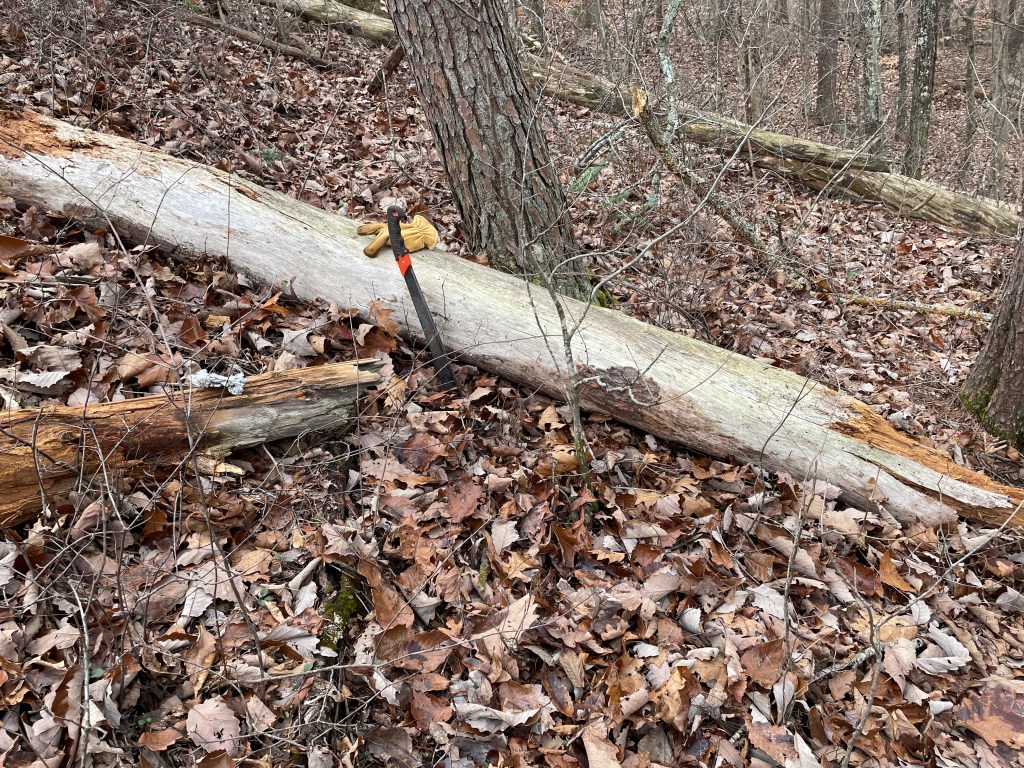
This was a fifteen foot tall rotted stump that I came across coming down from the knob. It was really fun to push it over. It landed with a satisfying, heavy thump and slid about thirty feet down the hill.

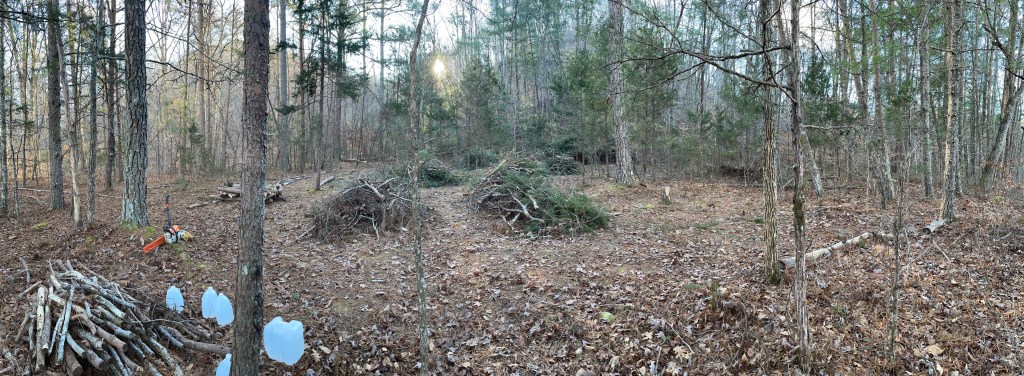
All the clearing I did on the PCS added three more burn piles. This time I stacked all the larger logs to keep out of the burn. I’ll eventually use them for my own fire place or more likely cut them up and put them on the road for free firewood.

The PCS as seen using the pano feature on my phone

One day I saw the neighbors boys, Nate and Charlie, working in the valley across from me. The older boy, a freshman in high school who I’d only met once before, was driving an ATV with the younger, Charlie, a sixth grader,  on a wagon hitched behind. 

They were dissappearing around a stand of trees and coming back with full loads of firewood. 

I’m debating how many trees, if any,  I want to remove for a clear view of the valley and Clinch Mountains. A cabin on this spot won’t be visible from the road below but someone could stand in the upper part of the field or behind the tree line and see my structure. The question is how much do I value a feeling of privacy versus having an unobstructed window on this usually serene, pastoral mountain view?

While the boys were collecting firewood, I went over to some fallen trees up the natural embankment near the road and sectioned off two foot logs. I’d been wanting to clean this area up. When I saw the boys go around the stand of trees on their property again I waited for them to cut their engine and then yelled, “Hey Charlie.”

My voice echoed through the valley. It took a moment then I heard echoing back “Yeah?”

“When you guys finish there, come back over here on your way back.”

Again there was a lag until I heard,  “Okay!” 

It felt good to hear that distance—the voice confirming what the eyes can’t see, to know of space that a city or even a small town can make me forget. 

When they came back I asked Nate if he’d like the logs of the fallen tree. Nate is quiet and what I would describe as cautious.

“It’s pine,” I offered before he could answer. “I don’t know if you want it. Another neighbor told me he doesn’t burn it because all the creosote in it can cause a chimney fire.”

Nate looked at the logs and thought for a few moments more. His demeanor reminded me that I might do well to nurture a less impulsive side of myself. 

“We’ll take it,” he said. Then the two boys began loading up the logs as I walked up the side of the bank and began throwing more down. 

The car windshield on my second to the last day in Tennesseee. It snowed one day but was too warm to stick. The temperature was dropping into the mid-twenties at night but warming to the high thirties in the day.
Aunt Linda sent me this picture two days ago when freezing temperatures stayed. I was sorry to miss it.