January 19, 2025

I have a new routine to write when I’m fresh in the morning and look at news when I’m tired at night. I get free library subscriptions to The NYTimes, The Washington Post and am currently paying one dollar for a year-long trial subscription to the SF Chronicle which has automatic renewal at a much higher rate. I bet they hope I forget about that but I won’t. That’s what calendars are for. I probably should support my fellow writers and just pay, but there’s a reason they are free—or close to it—and who am I to try to figure it out? 

Together with these three newspapers there is more news than I can look at. I’d be better informed if I substituted one of these papers for a more radical doomsday-type publication and added in a more conservative Tennessee newspaper but my gut is probably going to churn no matter what news I take in. 

The Post and The NYT usually have similar headlines. The writing is good in both. The NYT usually sends me three or four breaking news emails every day in addition to The Morning and I have to ask myself how much news can break? 

The SF Chronicle seems to have lots of strange gaps in their reporting that often makes me ask “okay, what happened?” but it’s local(ish) news for me even in Concord and I should probably pay attention to that. 

I’ve also decided that with all the crazy people in Trump’s junk drawer (Jillian told me people are calling it that instead of a cabinet), it’s probably best not to get worked up every time Broken Stapler #1 says they are going to invade Greenland or Dried Up White-Out says we need to stop requiring vaccines for children in public school. I just can’t be a yo-yo all the time on their rubber band.

This is my 2025 pick for book of the year (although it came out in 2022). The story is so compelling. It’s heartbreaking at times but there are lots of wait-for-it moments when the soul sings.
My favorite MLK jr. book that I’ve been reading to students for years. Warning: You will likely cry with joy at the end. Fantastic illustrations.

—————

I’m feeling better about the prospect of getting a cabin made. It’s been close to five years since I’ve been exploring this land and it feels, for the first time, like I’m finally getting a good map of it in my head. 

For one thing,  I found a good place where I can stage logs and then take them out to the road for cutting with a portable mill. I’ve passed by this spot a thousand times walking the trail the 170 yards from the proposed cabin site to the shed where I store tools. It’s flat, close to the road and largely free of any big trees. I think I never considered it before because it’s directly across from my nearest neighbor’s house and in the summer it’s overgrown with vines that offer a visual barrier that I like. 

The neighbor’s chickens were scratchin’ around next to the road and stepped into the woods when I approached them.

Now, as I’ve gotten to know my neighbors the idea of having complete privacy from the road doesn’t feel as important.There are plenty of spots on this 25 acre lot where I can get that. 

Most distant and remote is a little valley on the other side of the central hill and between the next hill which becomes the neighbor’s property after it tops out. This little valley—more of a holler—is almost completely absent of woods. If there were flying fairies, quidditch tournaments or witchy broomstick games this is where they would be played. It would be nice to have a cabin here, but there is no flat spot. Where the hill ends, the next one starts. The valley is a V not a U. A cabin could be built on the hillside with supports like you see in the Bay Area’s Oakland hills but my joy in this place is about the absence of human intrusion not dreaming of what it could be.
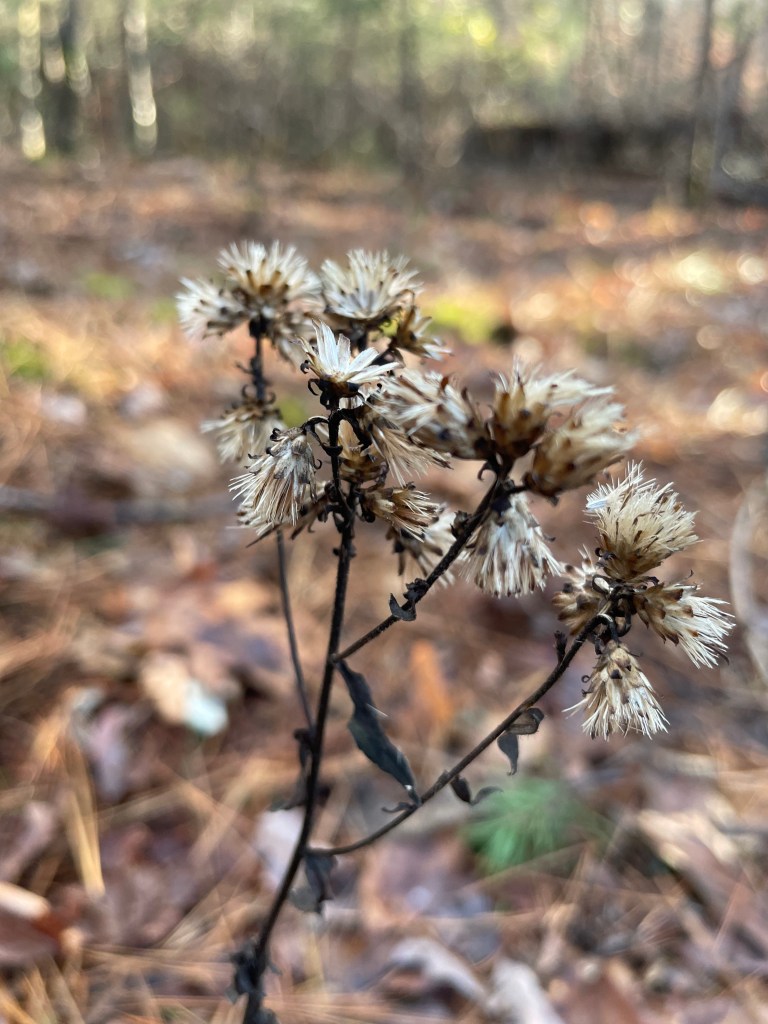
A pretty winter weed that I’m too lazy to try to identify right now. It’s probably something obvious.

A while back I named the machete as the most valuable tool in my kit. That remains true even after making trails through the ever-encroaching wilderness. When I go back in six months there will be vines and saplings trying to take over again.

With this in mind I’m offering up another tool that tops the list and was most useful on this last trip. I threw a pair of $15, fleece-line gloves in my luggage at the last minute. I figured they might come in handy if it gets very cold, but that wasn’t why they ended up being so valuable.

It was the extra thickness that offered protection pulling up Multi-floral Rose. I got plenty of practice on that patch of land that I’ve decided is the perfect staging spot for bringing out all the logs to be milled. This species of rose is very aggressive and next to Poison Ivy the most prevalent vine on the land. It grows in clumps that extend out in an exploding firework shape. It grabs hold of your clothes like blackberry bramble and a thicket of it is not something you want to take on in the summer unless Aguirre, the Wrath of God and other Werner Herzog movies inspire you to go into nature and do the most difficult thing you can think of. 
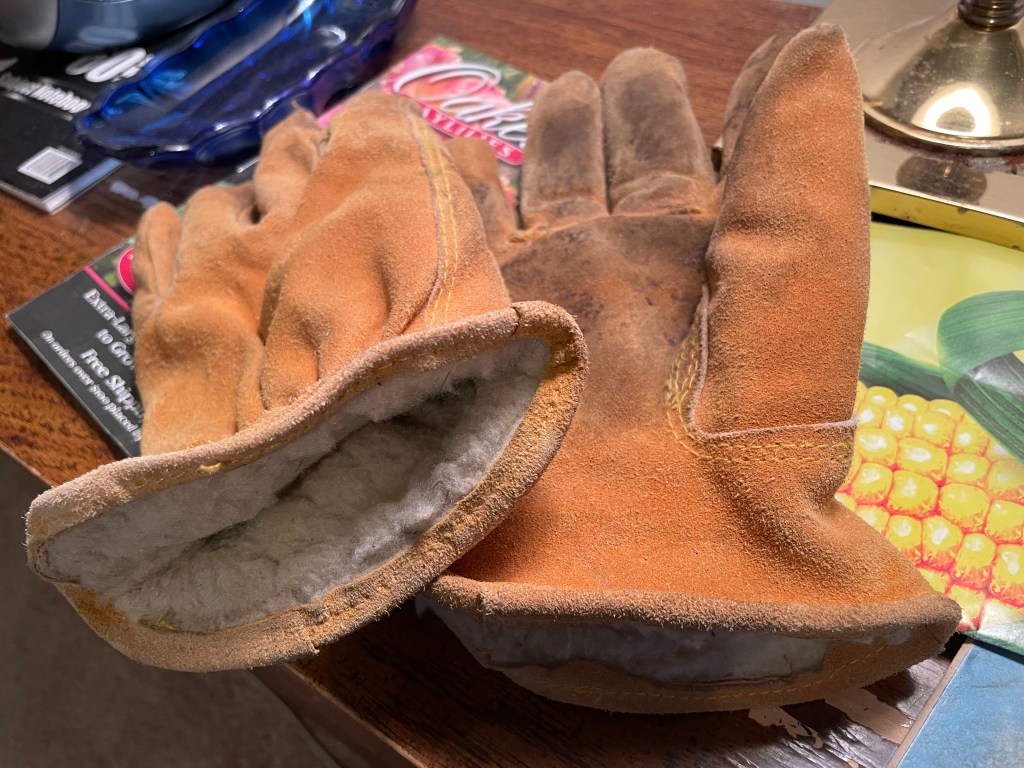
Winter is definitely the time to clear Multi-floral Rose. The leaves are gone and you can see where every shoot is heading. Though it still has live green vines, most are brown and dead and if you are lucky, as I was, the soil is soft with recent rains. Some of the clumps I could pull out on my first effort, gathering most of the vines in my hands and leaning back. Any that gave trouble, I’d dig around the edge with my shovel and lean back on the handle to break roots and get some uplift on the ball. This preparation was usually enough. The next time I leaned away with a handful of thorny vines imbedded in my gloves the remaining roots would start popping like a kettle of corn and soon I’d be holding the whole explosion of plant in the air, triumphantly carrying it to a neighboring pile.
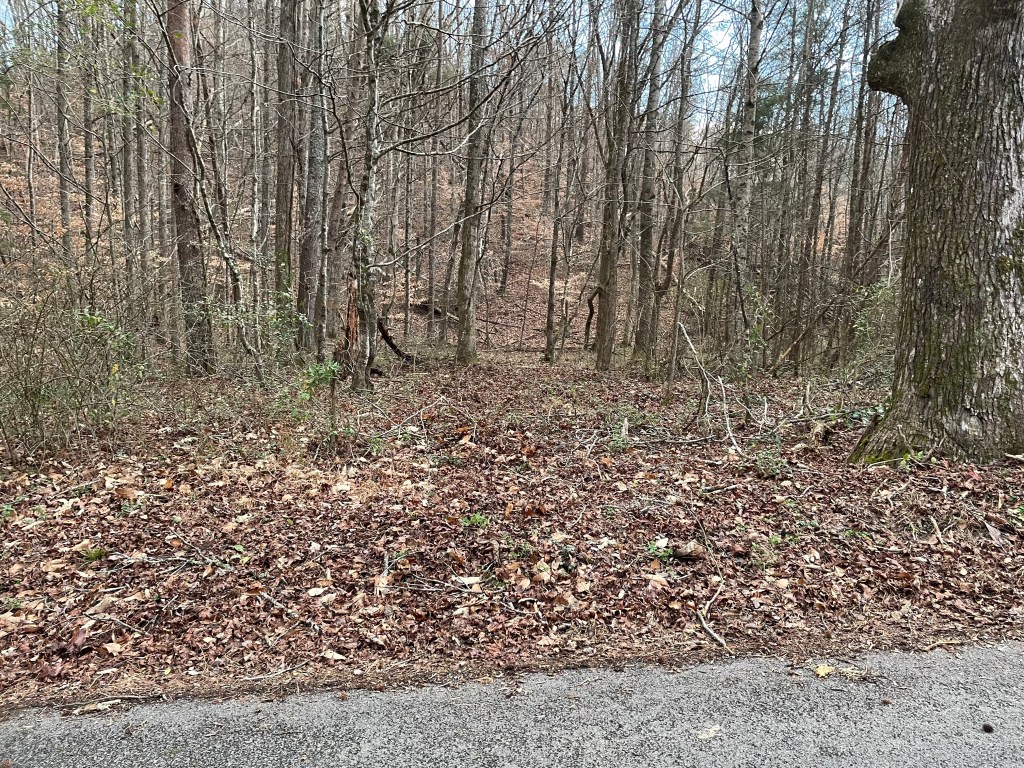
The log-staging area I mostly cleared of Multi-floral Rose

The gloves also made it easy to pull up all the Loblolly and Winged Elm saplings on the PCS. It was rare that I had to use the machete on a sapling in this area. The ground is covered with pine needles and moss of varying shades of green and grey. Beneath this is about an inch or two of topsoil followed by white shale and clay that becomes increasingly hard to dig into about six inches down. During wet weather it is a miniature flood plain with much of the water washing off the knob behind it. The moss and top soil make it spongy. 
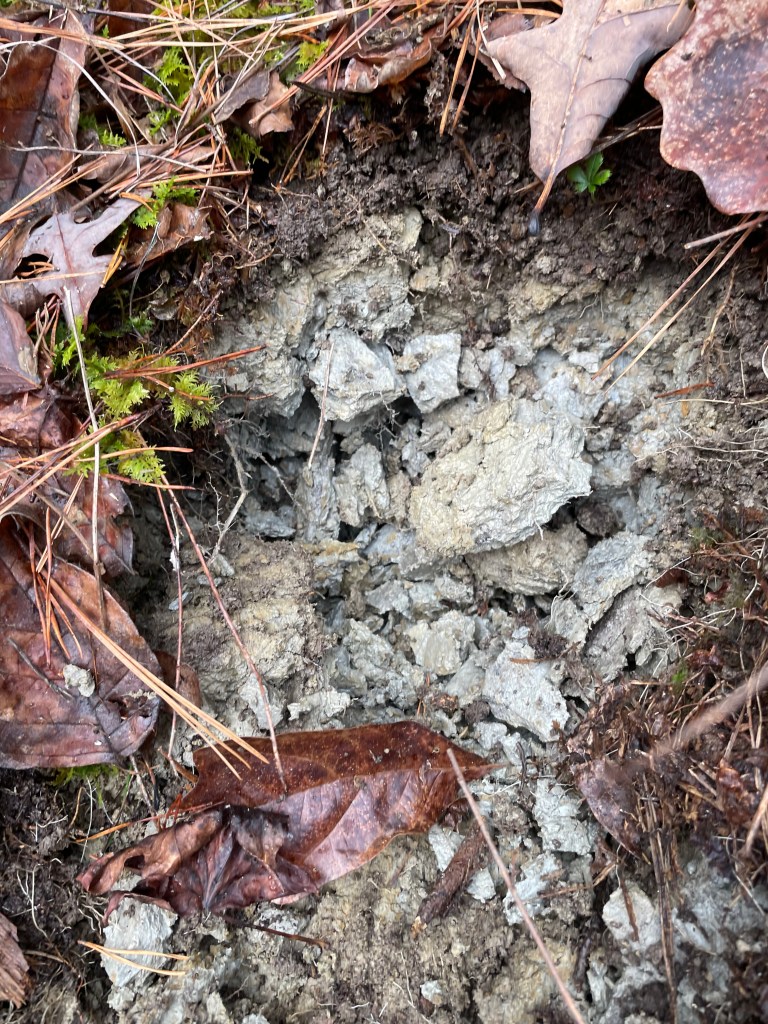
Shale and clay earth just beneath the PCS surface
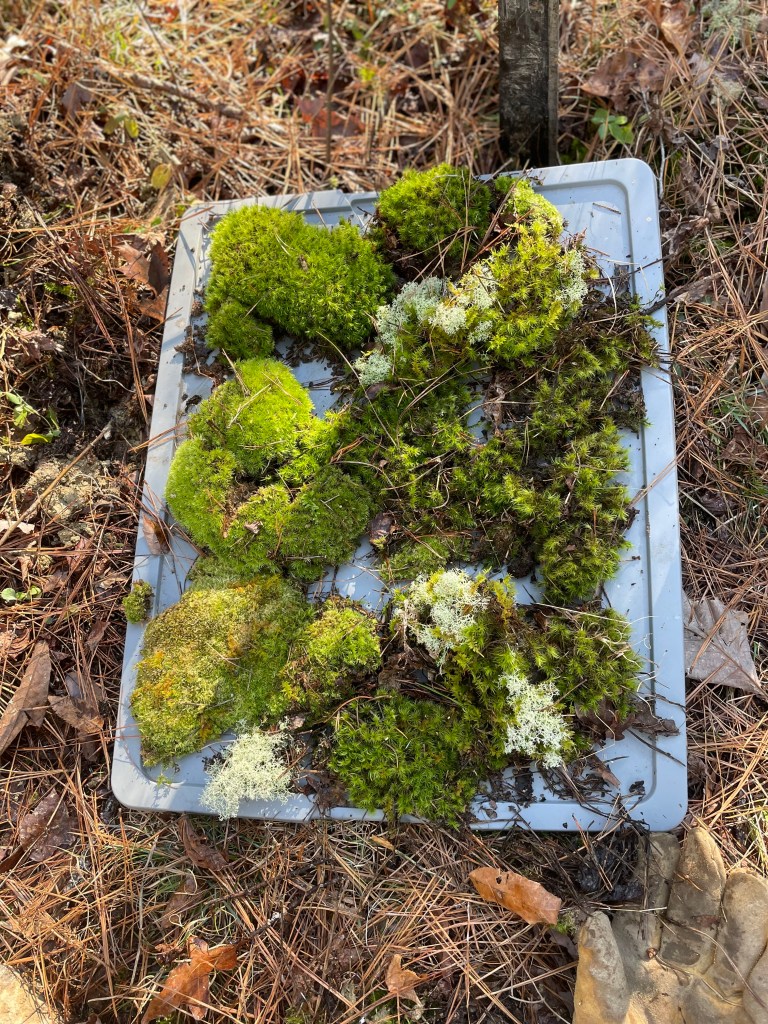
Ground moss collected from the PCS
I used the harvested moss to line the rock stairs I put in last summer. I’ll see if it lasts but I don’t know why it wouldn’t. The stuff is pretty hardy and there was some in the stair area before I brought all this extra in.

The poor quality of soil on the PCS is probably why there are only a few species of trees there — Loblolly, Cedar and Winged Elm. Oaks which start out with a single, deep tap root definitely don’t like it. I imagine the shale is too difficult to penetrate. Those other species have roots that spread wide and shallow—at least in the beginning. I’ve no idea what the root system looks like for some of the older, surrounding pines that top out well over a hundred feet. I imagine when a tree grows that big it must start to have powerful roots that can make their way into deeper territory. 

Ideally, I would have a well here on the PCS pumping water directly into the house, but I don’t know how much water makes it through the clay. Neighbors, Chuck and Rhonda, across the road, are roughly at the same elevation and hidden behind a small knob. They told me they hit water at 150 feet but drilled to 200 and take water from that level. 

They came by on the day I was cutting up some fallen trees near the road. They arrived in their new, gleaming diesel pick-up and put it rumbling into park. Michigan natives, they had a retirement home built here five years ago and are still adjusting to it. Chuck misses the snow but they have a daughter who lives nearby in Knoxville with her fiancé. Ever-friendly, Chuck invited me up to their place to say hi. I told him I may take them up on that. I’ve been a few times before. Rhonda said, “I’ll give you a piece of pie!”

The next day I called them when I started to get hungry and asked if it was okay if I took my sandwich up and ate it while I visited. 

“We have food,” Chuck exclaimed in his cheerful voice that made it sound like the introduction to a Broadway song. 

“Oh, thanks, but I made this sandwich and I better eat it,” I said.

“Well, you like coffee,” Chuck asked?

“Sure”

“Well, we can give you some of that.”

We talked more about their water while I was there. Chuck gave me a glass to taste and it was exactly what I would want in drinking water—pretty much tasteless. 

Their aging dogs Fatty Mattie, a standard poodle mix  and Waggy Maggie, a black lab are slightly mis-nicknamed since Maggie is a bit plumper than Mattie and Mattie is a bit more waggy than Maggie. At any case it was nice to get my hands on some dogs, missing Sasha so much in the short time I was in Tennessee. The feel of a short shorn standard poodle’s curls is a textural delight.
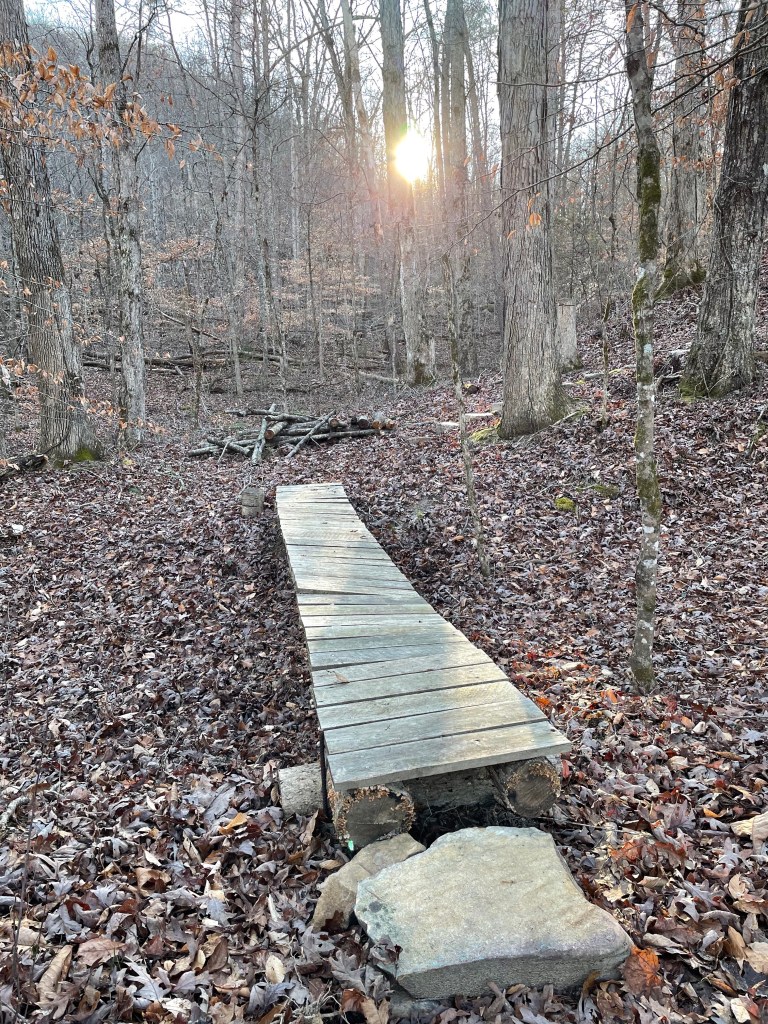
The old bridge is holding up, but growing a carpet of Turkey Tail Mushrooms which I scraped off the underside of oak logs. I don’t want to help the Mycelium network to advance the bridges ultimate failure.
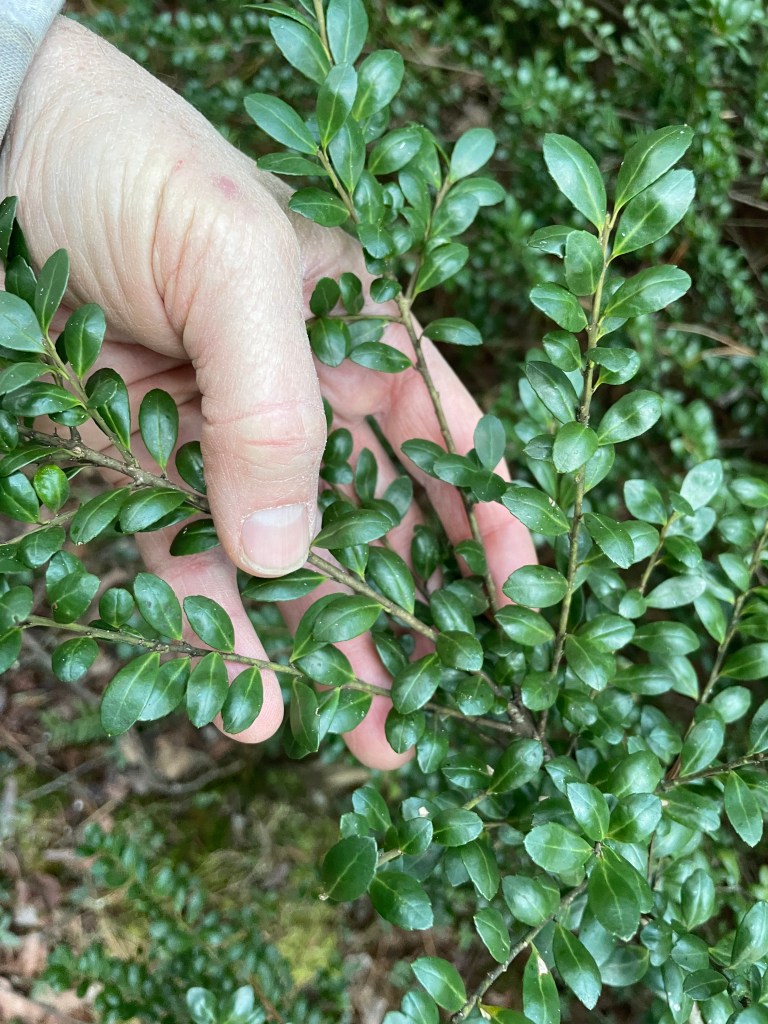
A Google search indicates this is a Japanese Holly, an invasive species. I admit that I’m not as concerned as a should be about invasives. This is a pretty plant and the only one I’ve found on my land. It is part of a big, lush bush at the base of the hill at the back of the PCS. I used the dark green as a backdrop to film the falling snow that didn’t stick. I’m quite fond of it and will keep it until convinced otherwise.
Numerous trees helped break the fall of this 120 foot, 30-inch diameter Tulip Poplar. Evidence includes skid marks down the side of another big poplar and a Loblolly Pine that snapped 12 feet from the ground. A free fall directly onto the Sheridan cabin would have probably meant its demise. Maybe the structure would have failed without the brace I put on the opposite side and a pole on the inside. My work to do that may have been a mistake if I wanted to have an easier way to disassemble it. 
The tree now laying on the ground is so beautiful and straight. It would be a waste not to use it for lumber. I’ll have to think about how to deal with it next summer. This one is not near the log staging area. It’s on the other piece of land. However, the closest neighbor has said I can use his tractor to pull cut pieces out. He also has a non-automated mill he will let me use. By non-automated I mean it is the kind I would have to push the saw through.
The top branches of the fallen poplar are big enough to be sizable trees by themselves.
An eight foot crater was left where the tree fell exposing lots of rocks for harvesting.

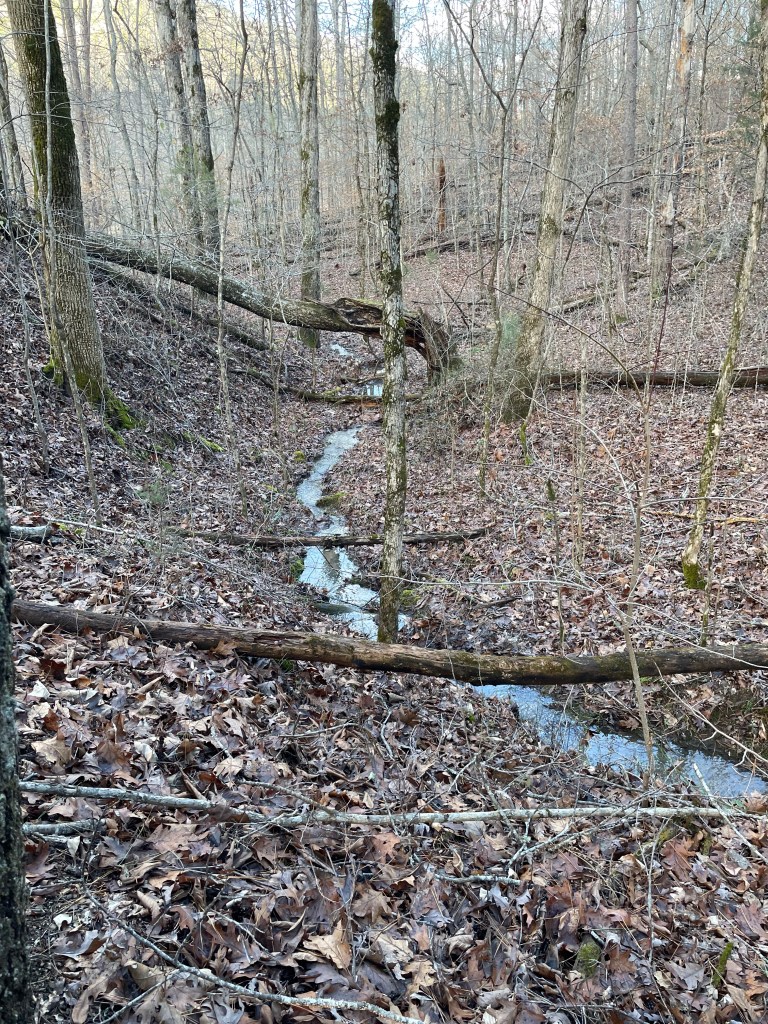
There were numerous wet-season creeks that I saw on the land for the first time on this trip.
This place holder was on the back of every seat on the American Airlines flight I took home. Was this the idea of a radical literacy advocate bemoaning the state of our video-saturated world or did they just want to make sure you didn’t put coffee cups and snack wrappers in the magazine pockets?

October 12, 2024

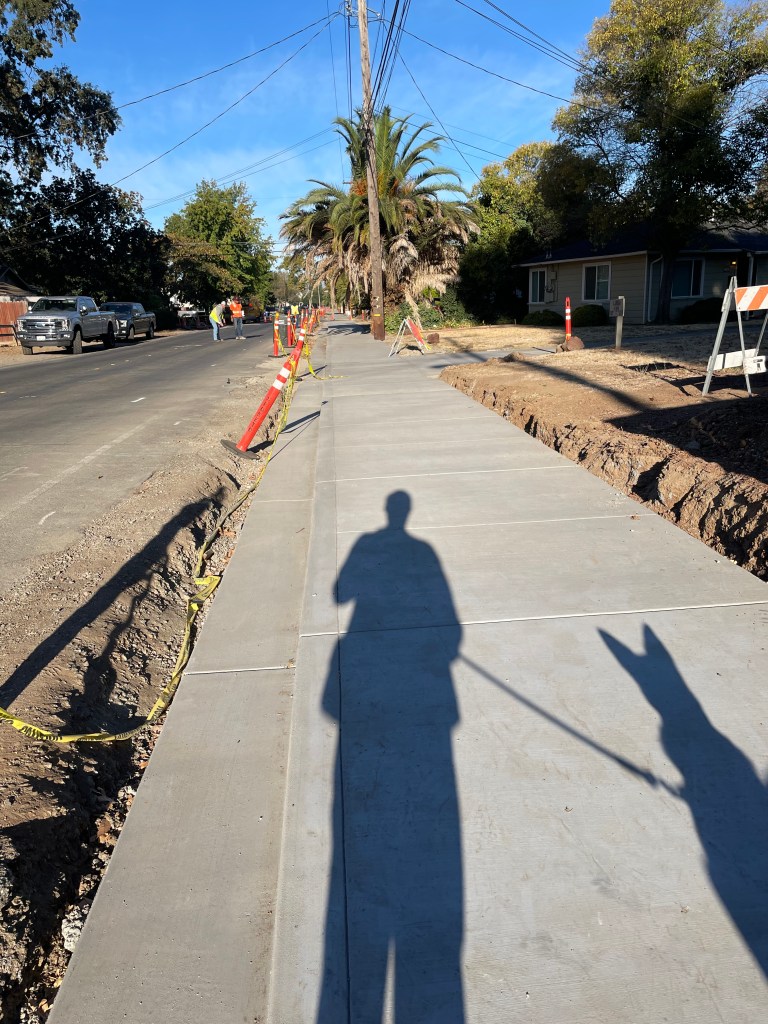
Two Italian-American companies are putting in new sidewalks on my street. Sposeto is doing the sidewalks. Ghilotti is doing the accompanying roads. Taken together the names make me feel like I’ve walked into an Italian creamery. The job they are doing is sweet. The sidewalks have beautiful lines and are clean like a newly frosted cake. The project is moving along quickly. The whole neighborhood is smiles as we see our tax dollars at work. 

Concord is a town in what is increasingly less of an outskirt of the central Bay Area. But it is on the edge of country and I often relish the knowledge that I can drive west of here and quickly be in an area that feels like amber waves of grain. If you walk around my neighborhood you occasionally come across a fenced in yard that upon further inspection is really more like a field. At the back of one nearby is an old metal windmill rising up between patches of prickly pear cactus. 

My street is half of a large oval. It starts and stops on the same street it curves off of. It’s what’s left of an old horse race track that existed in the late eighteen and early 1900s. The green park around the corner where I take Sasha for walks was the centerfield where the winning horses were given their ribbons and where fans sat around picnic baskets to watch the race. 

The margins of the street were all gravel until this new sidewalk started to appear. All told, a peek into a backyard field strewn with piles of junk and blackberry bramble could give a deceptively country feel. But walking in most directions you will find that soon enough the squabbling of scrub jays and mockingbirds is replaced by a yawling white noise as you reach one of the main thoroughfares that flow cars like red blood cells through an artery.

A good portion of the 125,000 residents that live here are commuting in the direction of Oakland and San Francisco. The ones that don’t get there by BART train are doing it in their cars. 

Recently I’ve started walking Sasha in different directions to try to accustom her to the sights and smells that surround us in case she ever gets loose. She is skittish around loud noises so it’s hard to walk her along one of the busy roads but I hope that she will build up some tolerance. I’d hate for her to run hairy scary into traffic for being too freaked out. 

On our walks I have her sit at cross streets and wait with me to look both ways before we cross. I’m not sure if she’d do that on her own but I want her to know that where a road crosses you have to be extra careful. 

On a recent walk Sasha and I stopped by a Little Free Library  nearby and found a copy of Mo Willems’ We Are in A Book. I almost never find used copies of his books much less free ones. This title along with Should I Share My Ice Cream is probably the most popular of his twenty something titles. 

We Are in A Book is funny and profound. It gets you thinking about mortality and what it means to exist. For several of my last years teaching in Oakland another first grade teacher, Ms. Sandoval, and I would act out one of these two books at the school’s annual Family Literacy Night. It was always a hit and we’d have a fifteen minute show within each of the three thirty minute rotations. Several times we got donations of Mo Willems books to hand out. It was so fun! After doing this for a few years we had it down and could get the show up and running with only one or two rehearsals. Ah, the excitement of live theatre!

——————-

I want to tell you about another fantastic book I recently finished. It was recommended by my old friend Elijah. It’s about the Mississippi city he grew up in and where I went to school from 8th grade through my first year and a half of college. It’s called Hattiesburg, an American City in Black and White

There is certainly something extra special about reading the story of a place where you walked and grew, but this book is also extraordinary because of the way that the author, UNC history professor, William Sturkey, shows the power and framework of Jim Crow.

Sturkey is particularly effective because he manages to resist any discernible ax grinding despite having black ancestry. He lets history itself be the flat stone that makes indisputable facts sharp and painfully apparent. 

The book helped me understand better how a boy like myself raised in a liberal, artsy, educated household could not be immune from racist beliefs. It helped me understand how Hollywood may have got it right spiritually and mentally (if not physically) when they sometimes showed southern black communities with white picket fences and children dressed in clean, starched and pressed clothes. And it helped me understand the depth of a brutal social construct that I always felt as a coiled threat beneath the gentle surface of southern hospitality.

Without trying to explain what I mean by all those statements, I want you to know that Hattiesburg is both horrible and hope-filled as it looks at the resilience and determination of black people in a Jim Crow southern town. These are the people that went to Washington to try to get their right to vote enforced. It explains some of the humored looks I got from a few elders when I stepped into the black neighborhood that started across the railroad tracks behind my house,  a naive but sincere 18-year-old trying to register voters to support the Mondale/Ferraro ticket in 1983. I had no idea who I was talking to. 

It was also fascinating to make a connection with a previous book that I’ve recommended: “Ecology of a Cracker Childhood” which bemoaned the loss of old growth Long Leaf Pine forests throughout the south. It turns out that Hattiesburg was founded and built as the hub of a vast network of lumber mills cutting down those forests. The mills ran continuously for fifty years bringing prosperity to hundreds of thousands of people from the 1880s up through the Great Depression until the last of those great, majestic pines were cut down just like the fictional Truffula trees in Dr. Seuss’ story The Lorax

Hattiesburg, the book, also ended any misconceptions I had of white Mississippians who tried to wear the banner of proud, self-determined, state-rightist who remained independent of outside influences they thought would sully their whiteness.

The town was established post slavery and grew quickly because of the help and investment of northern industrialists and the mass of low-wage workers. After cutting down all the trees it survived the Great Depression, holding on by its fingernails with federal relief and recovery funds. Then leading up to WW2 Hattiesburg was renewed as an economic hub with the federal renovation and expansion of Camp Shelby which housed and trained up to 40,000 soldiers at a time. 

Throughout this era blacks took the lowest wage jobs available to them and during the depression only received federal and NGO relief when it somehow made it past the hands of local authorities who made sure whites got more than their share.

Eye-opening indeed was the extent to which white southerners held a burning cross in one hand fighting off what they saw as  federal encroachment while using the other hand to collect federal funds. Socialist-minded Franklin Roosevelt got well over 90% of the Mississippi vote in all four of his presidential elections…and almost all of those voters were white because of exlusory voter registration practices. 

In Hattiesburg the racist registrar of voters regularly used the question, “How many bubbles are in a bar of soap,” to exclude blacks who needed something harder than the state constitutional law questions or reading tests required to gain their voting rights.

The unexpected story is the community pride and the black town that grew up next to the white town with its own set of businesses and its own set of leaders.  The unexpected story is the way people not only survived but thrived. Even for those who moved away they remained connected to Hattiesburg. Chicago may have been the most popular destination. The latest issues of The Chicago Defender newspaper were regularly passed around until they were worn out and news stories about Hattiesburg regularly made it into those Northern black-owned and operated papers. 

Anyway, there is so much more to say about this book but it is better read. 

—————

Before I go, I want to show a few things that I left out of my last blog post concerning work on my Tennessee land way back at the beginning of July. (I’ve really missed getting a post out sooner.)

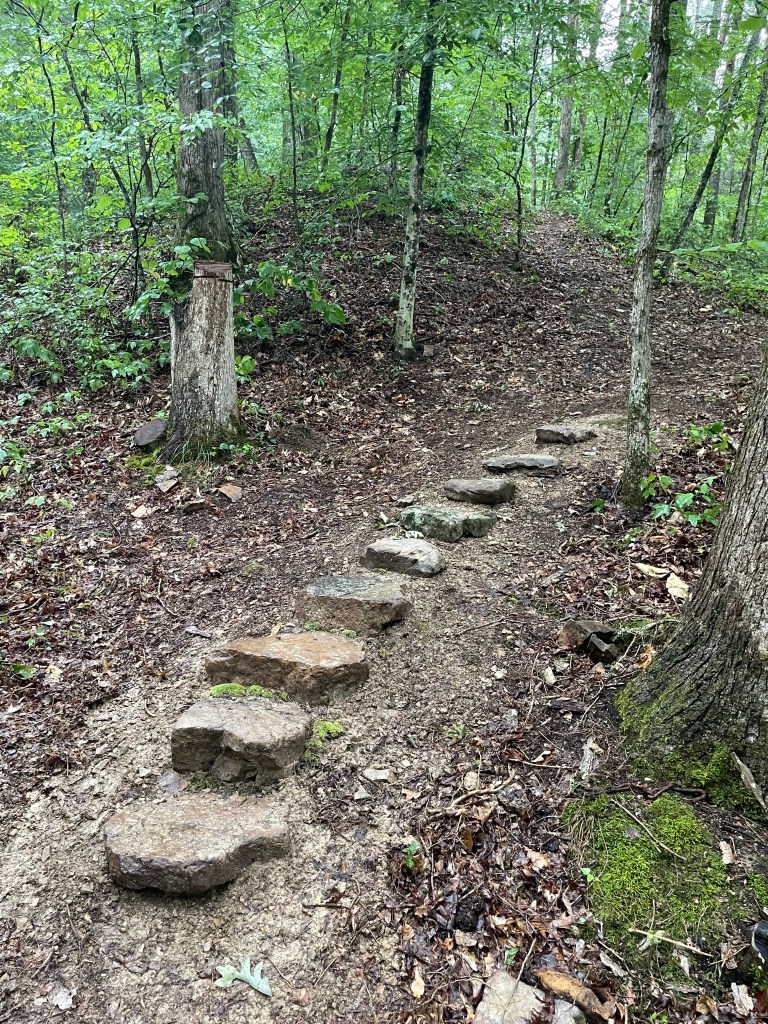
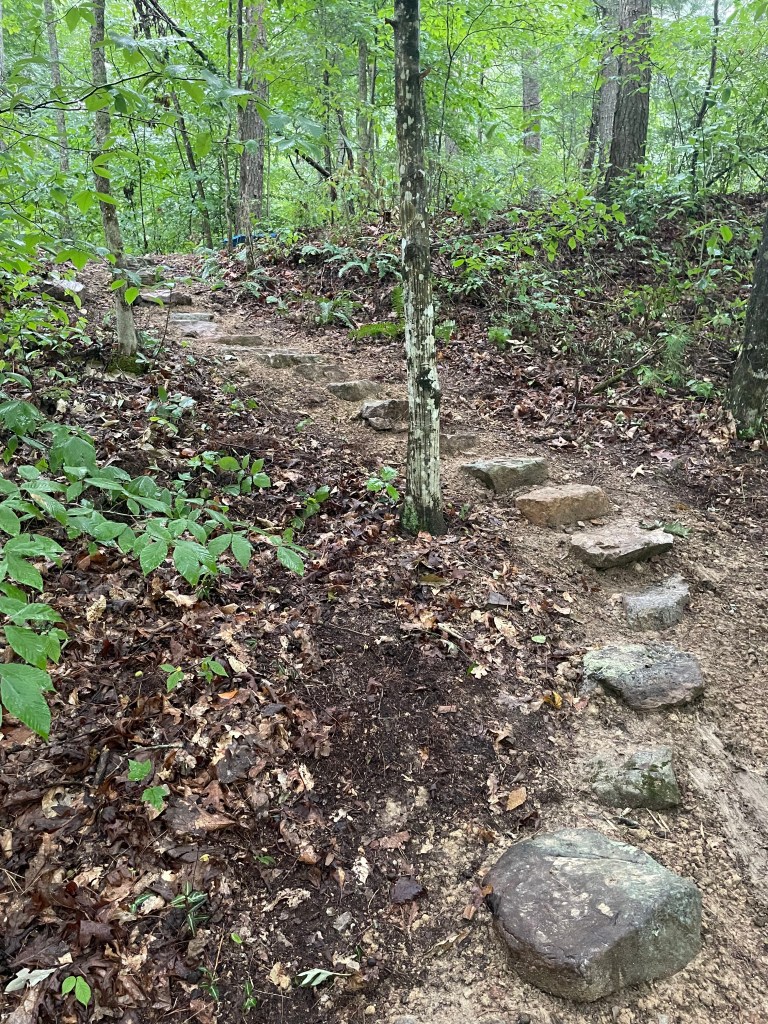
These are the steps I put in to help make the walk easier up the small hill on the main trail that leads to the proposed cabin site. This work is what had me battling the horse fly. (Yes it was usually just one at a time but that was enough.)

Lower Hill Steps
Upper Hill Steps–I had a bad start on these. I was making the gap too wide between steps–trying to go cheap so to speak. I had to remove the ones I set and start placing them closer.
I got some good advice from a neighbor to keep up with the clearing of the flat spot for the cabin. I plan on burning these piles when next I visit. I may have to get a burn permit if it is winter time. Strangely, burn permits aren’t required in the summer. Apparently trees pull the sap into their trunks in the winter and are more flammable.
This is the underside of some Winged Elm leaves (still on the branches) I threw into the burn pile. I love their color. I thought these trees had some horrible disease because of the misshaped branches. Turns out that’s just how the Winged Elms fly.

December 31, 2023

I had a video of me singing Cat Steven’s “Oh Very Young” here as a bit of a teaser to get people interested in this latest blog. I figured some people might be more interested in bad singing than good writing. (Bad and good are likely overstatements on both accounts.) I actually think the singing was okay, but in the end, after a few problems getting the video to appear as the featured photo I chickened out.

Voice lessons are on my bucket list though. I say this while acknowledging that the bucket spills over like a child’s ten-thousand lego collection. It includes ideas that, like the toy, venture far beyond the original rectangular-shaped blocks. My bucket list is messy and unachievable if what science predicts is true and I only have one life to live.

To that end I recently gave away a guitarrón that I found tied to a pole and labeled “free” near the elementary school where I take Sasha to play. Learning a bass, string instrument is one of those legos scattered in the corner of the room collecting dog hair and dust far from the bucket.

This new year, I’m likely giving up several other things that are not on the bucket list but have been a part of my life for many years to a greater or lesser extent—motorcycle riding being the greater one. 

About a month ago I was in two fender benders two days in a row both, coincidently, on my way to see a movie in the theater—something I don’t do on a regular basis making the accidents all the more odd.

In the first incident I was standing at the box office when I heard yells across the parking lot. My truck had rolled backwards and bashed into the bumper of a parked vehicle. In the second incident, I was on my motorcycle stopped in traffic. I looked backwards for a clearing and then quickly accelerated around the car in front, raking off my side view mirror and doing considerable damage to the side panel of that vehicle. Both accidents were 100% my fault. 

Amazingly I was still able to make both movies without illegally leaving the scene. 

The first movie, Radical, was one of those teacher-hero movies that  we like to indulge in. (Not a feel good movie as much as an empowering one.) The second was Fallen Leaves a reluctant love story and bemusing comedy with interesting directorial choices that created a different time and place. I liked them both. 

The two accidents might be a small price to pay to bring an end to my participation in this notoriously dangerous activity. I’ve been riding motos for about 40 years. It’s fun, convenient, and inexpensive but in my estimation I no longer focus well-enough to ensure my survival. 

I’m replacing the mirror housing which I’d already glued together three times. I’ll spit-shine the bike and sell it in the spring when people are more interested in riding.

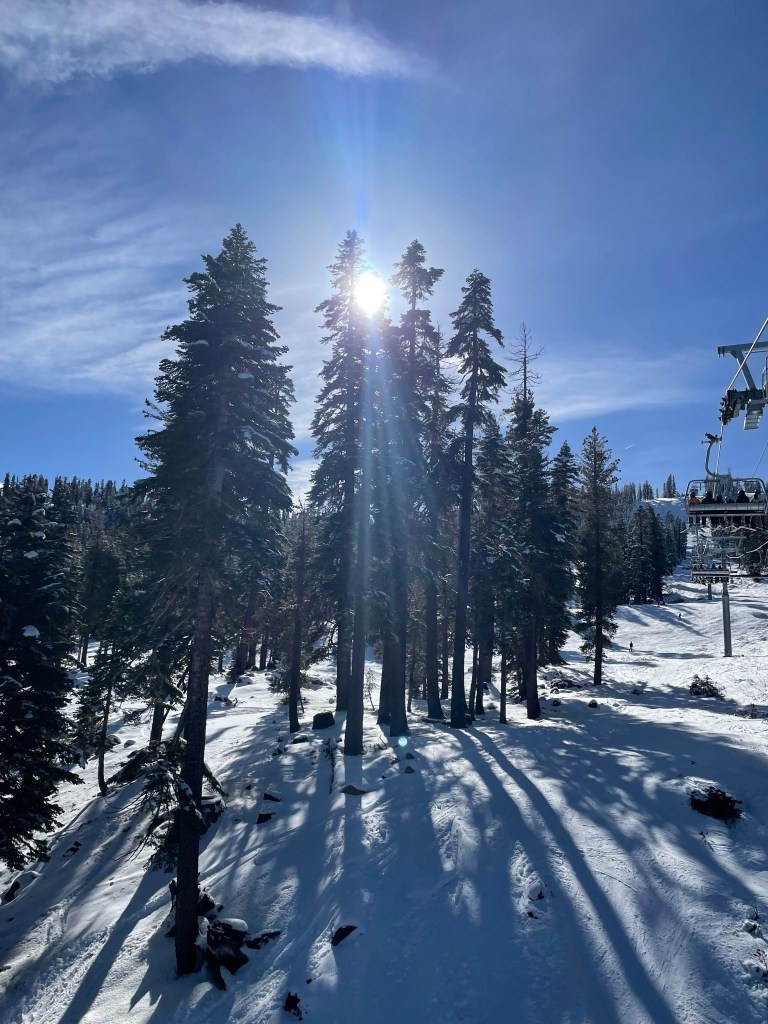
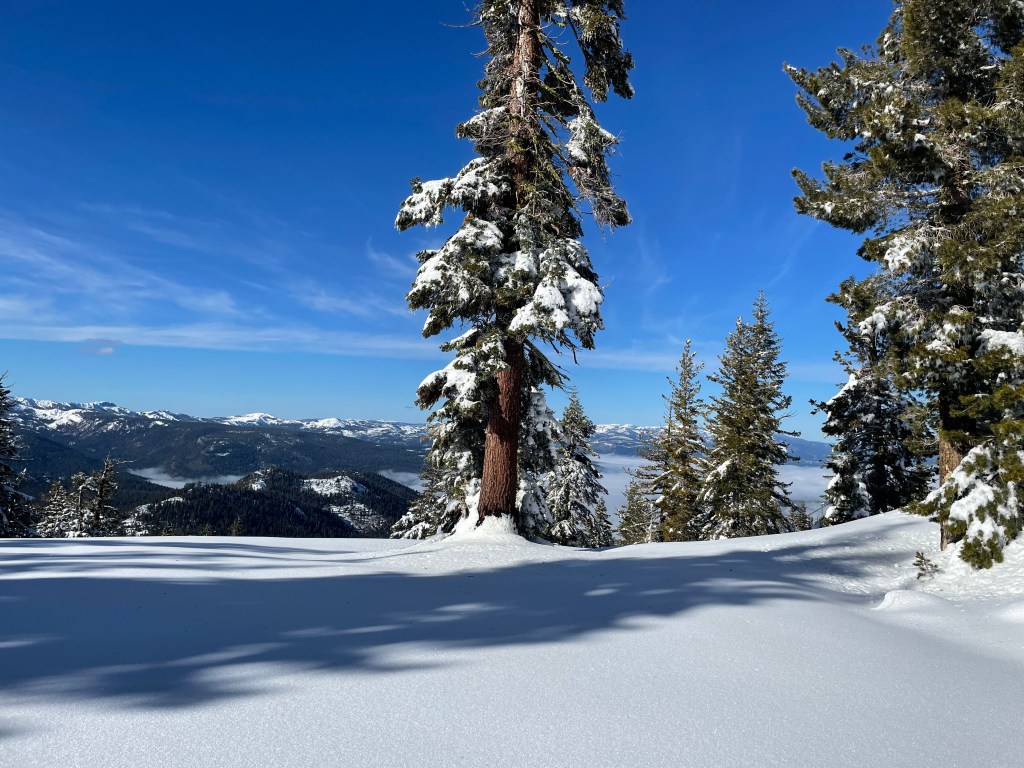
The other activity I will be giving up is down-hill skiing. There is no great emotional cost here. I’ve only done it about ten times in my life. I went a week ago and found myself close to terror after deciding to take three lifts to the top of the mountain and then finding there were no easy slopes down. (Planning and stupidity play a part in this as well.) 

A view from the ski lift.

I don’t have a problem staying on my skis as much as slowing and, of course, with that equation there is a point where the two lines traversing the x and y axes cross each other and end like a cat’s ball of string. Fortunately, helmets are standard issue these days. To be fair, the conditions weren’t great with a lot of crusted over snow, but when I figure in the cost of a lift ticket, rentals, a hotel room, and gas to get there it is a hobby I can afford to give up. 

A view from the top.

The dangerous activities I intend to keep (living being among them if you pay too much attention to the news and Next Door Ring camera postings) include riding my electric bicycle and bouldering in the climbing gym. Concord has dramatically increased the safety of bicycling by painting new bike lanes. My heart has leapt for joy with each new lane that has appeared. 

Yesterday I shipped my bicycle battery to a business in Colorado to get a complete rebuild. The battery is ten years old and losing its range. The cost is $700 versus buying a new one for $1700. The rebuild is supposed to be better than new as it will add on some extra range and amperage. 

I was just shy of 20,000 miles on the old battery before I shipped it off for a rebuild this past Friday.

————————

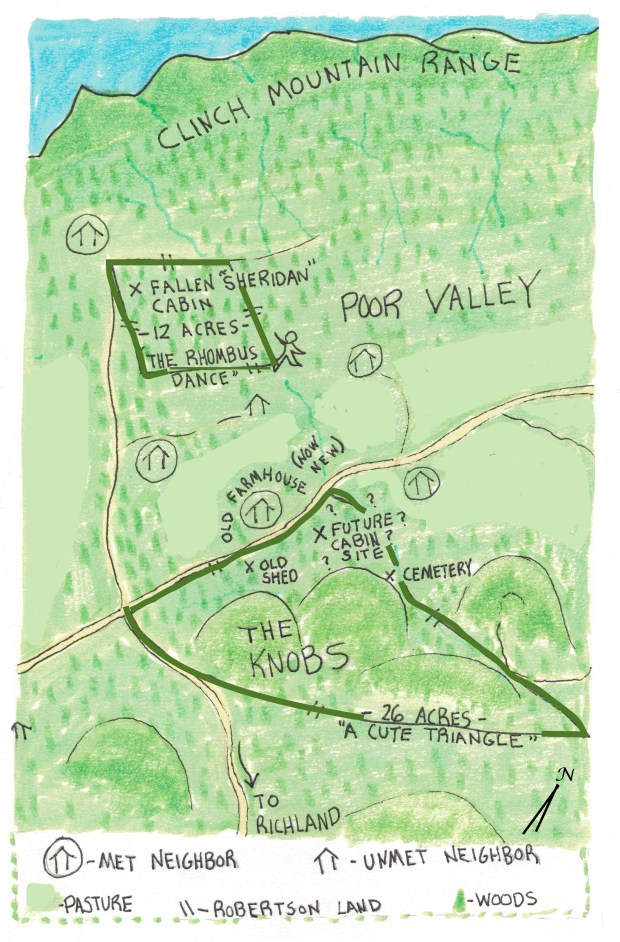
Tomorrow I leave for Tennessee to finish off my vacation at my Aunt’s in Corryton and work on my land which is nearby. On the to-do list is finding out why my driveway permit has not been granted although I put the application in with the county over a year and a half ago. The driveway is the space off Poor Valley Road that I intend to gravel near the footbridge I built this past summer. Crossing this footbridge is a short uphill hike to the tabletop where I may someday build a cabin that will overlook the valley between the knobs and the Clinch Mountain range. 

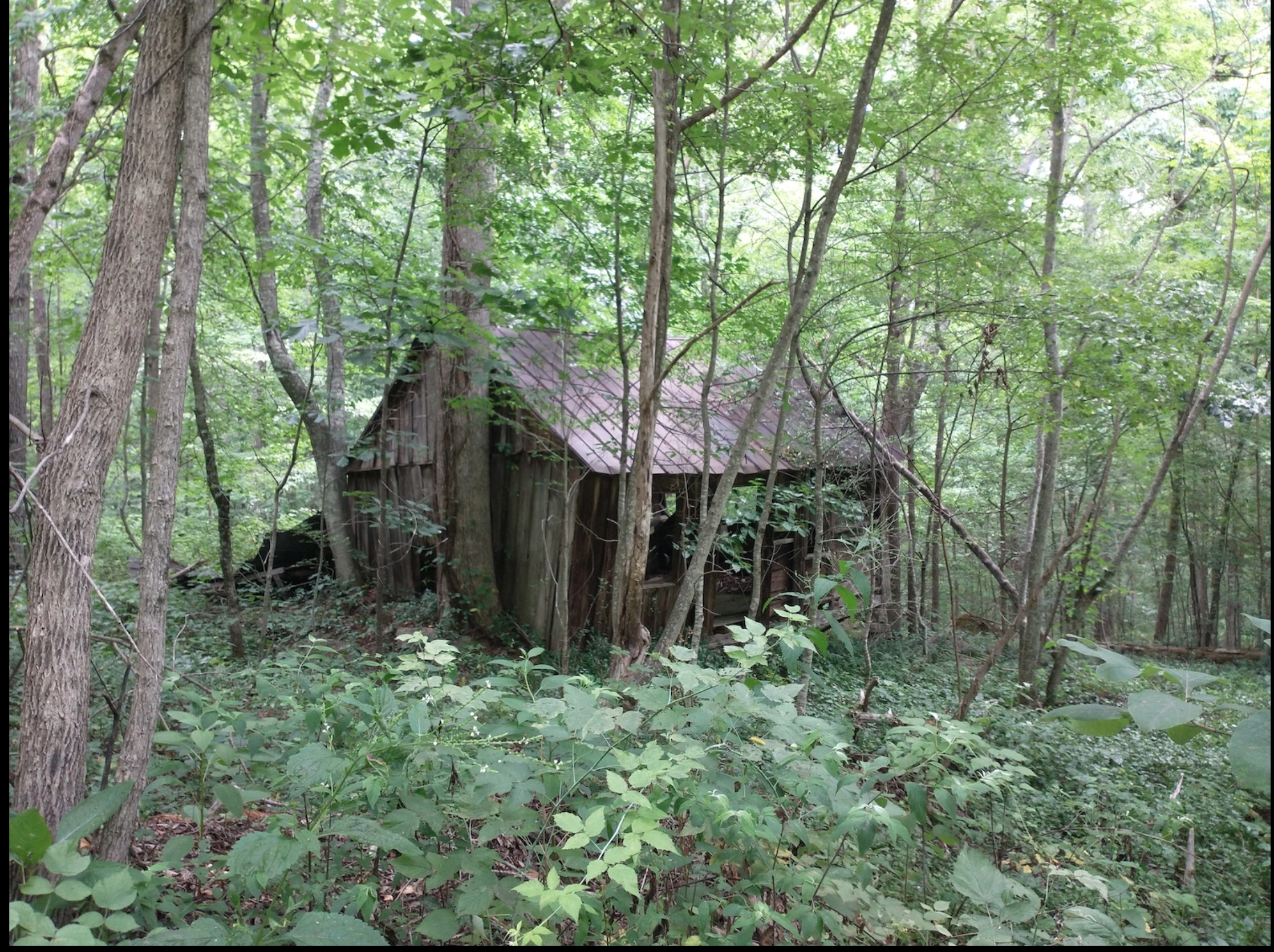
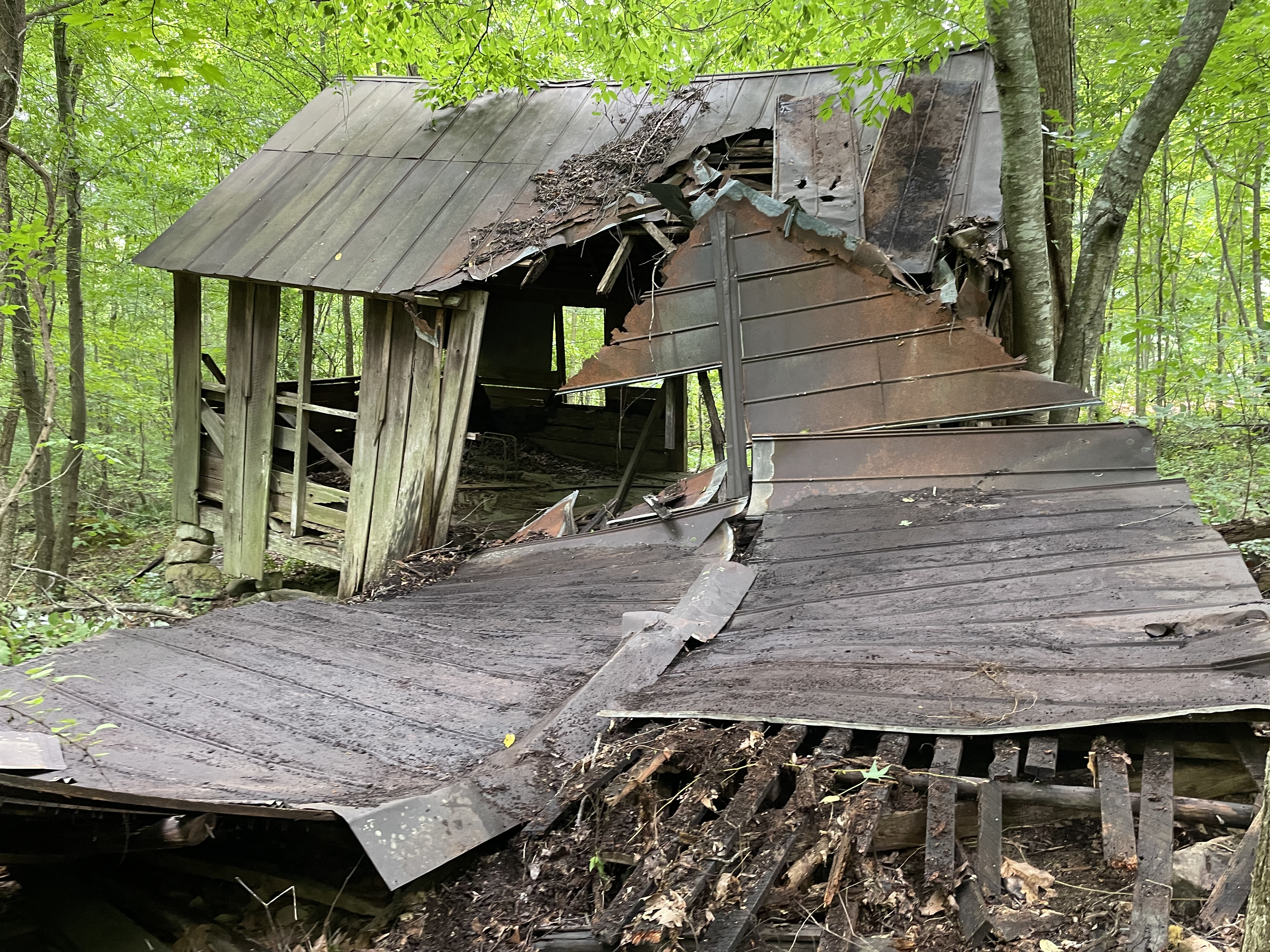
That intention relates to another thing on the to-do list which is to deconstruct the falling Sheridan cabin to use some of the timbers for building the new structure. There is hundred-year old metal roofing that I’d like to salvage along with strong, oak dimensionals of similar age. 

I’ve given plenty of thought on how to do this deconstruction with little surety that it is achievable in the short time I will have this trip.

I’ve been watching YouTube videos which are helpful although most show deconstruction of structures that are more stable than my falling cabin. Common wisdom seems to suggest that taking it apart from the roof down is the best way to insure the maximum undamaged salvage. How to do this safely is the trick since the whole structure is leaning precariously. Walking on the roof secured by a rope attached to an overhead limb might be a good strategy if there is one available. I might also be able to brace the leaning structure adequately with wood on one side and tie it to trees using a winch on the other side. 

I’ve also thought of just pulling the cabin down. One person suggested this might be accomplished with less damage to the wood if I first cut halfway through the supports at the bottom.

Whatever progress I make, or don’t, I’ll be sure to include it in my next post. 

The image on the left makes the cabin seem almost usable. The image on the right is what you see when you go around the other side.

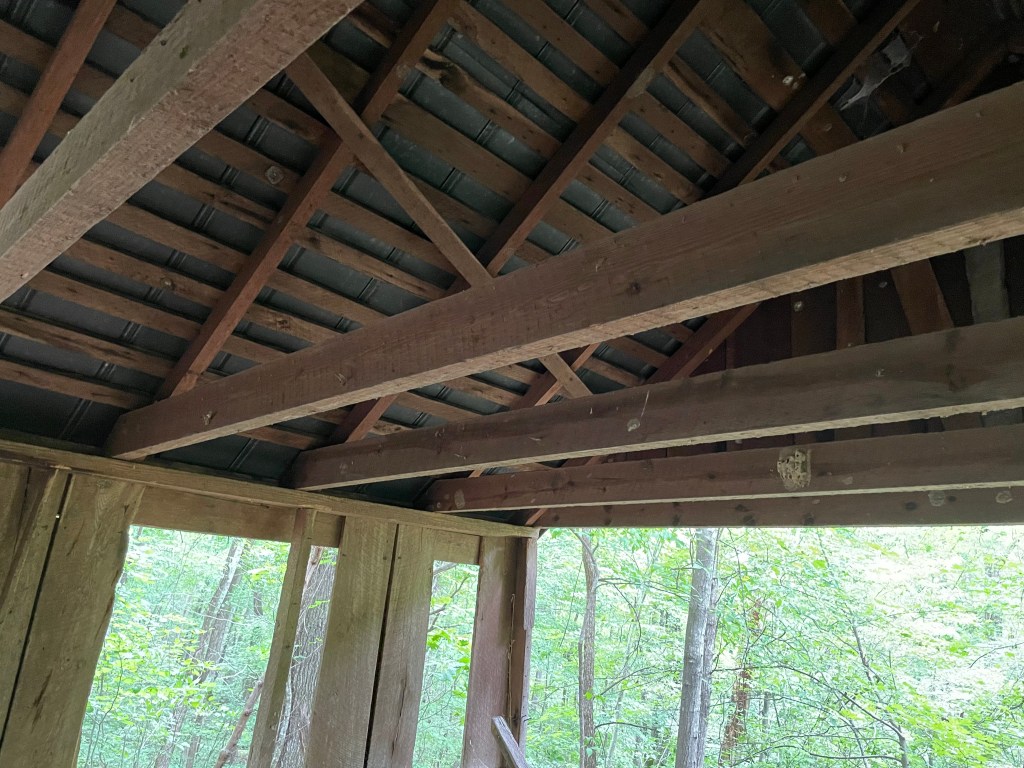
There is a lot of good century-old wood in it like these 2×6 joists.

————————

This coming year feels fraught with tension at home and abroad. I sure hope people stop fighting. I know that sounds like a simplistic wish for these complicated and deeply ingrained divisions, but it’s a starting place. People agreeing to not kill each other is always a good starting place. 

Peace in the New Year. 

The couch under the front window is a favorite spot for our fuzzy family. Old man Buddie and little lady Ruby Lou sit atop while the incredible Sasha Moonbeam faces the camera.