January 4, 2026

I was helping one of my students with doing some multi-digit subtraction a few days before our winter break and he asked me “Why do they call it borrowing if you never give it back?”.

I was flummoxed. I didn’t have a good answer and I’m not sure if I do now. Subtraction is just about taking away. You don’t give back at all. In the subtraction algorithm one digit takes from the next digit over so it can give what it needs to the digit below it. It’s all just part of a process. It’s like your body taking nutrients from your stomach to power your brain.

I think in the education world the correct term to use might be “regrouping” which makes more sense in terms of meaning but maybe not as much in common language. We are a nation of borrowers, but how often do we regroup? That involves teamwork or at least the notion that we have multiple things going on and sometimes we need to sort them out.

The language is important to me as a writer but I didn’t care much about it as a kid which made this student’s inquiry kind of special.

Back when I was his age my number sense was better than my word sense so when teachers said, “borrow from the whatever and carry the one”, it didn’t matter that the language didn’t make sense. I understood it was just a shortcut to get to the answer even though there was more wrong with the language than just the teacher saying “borrow”. 

Carry the one was a complete lie. In the subtraction algorithm you never carry a one (for whole numbers any way). You might carry a ten, or a hundred or a million, but one is not a number that gets carried.

From what I remember teachers didn’t pay much attention to number sense. You either had it or didn’t and the addition and subtraction algorithm (stacking numbers on top of each other) was hoisted on us pretty quickly before we had a good idea of how much bigger 1,012 is than 112. 

But what did I know about what teachers were paying attention to? I wasn’t paying attention to them!

_________________

I made it back to Tennessee for some time on the land and family visiting. My old friend Steve joined me. I met Steve way back when his wife was his girlfriend and I worked with her at Hospitality House in the Tenderloin neighborhood of SF. 

Steve and my Aunt Linda hit it off big time. Often, when I left them alone I’d come back in the room to see them laughing and smiling, telling stories or talking history. 

My trip was short. Steve’s even shorter. I arrived on a red-eye last Saturday and he came that night. He left on New Year’s Eve and I left New Year day. Still we got a lot in which included some delicious meals made by Aunt Linda and winter camping on a night that got down to 22° F. 

Surprisingly, the red-eye wasn’t too bad. I had everything I needed to make sleep possible—my 40+ year-old down jacket from college days, a window seat, a neck pillow, Benadryl and two doses of NyQuil in a 2-oz bottle. It’s one of the few times that having a congestion cold was convenient. If I ever take a red-eye again I might try to skip the cold but take the doxylamine. I made sure to clear my ears with a gentle, pinched-nosed push at intervals all the way up to cruising altitude and again on the way back down for both jumps of my trip.

I think another thing that helped was that when I got to Tennessee, I stayed up and didn’t try to “sleep off” the red-eye which would have likely just confused my body more. 
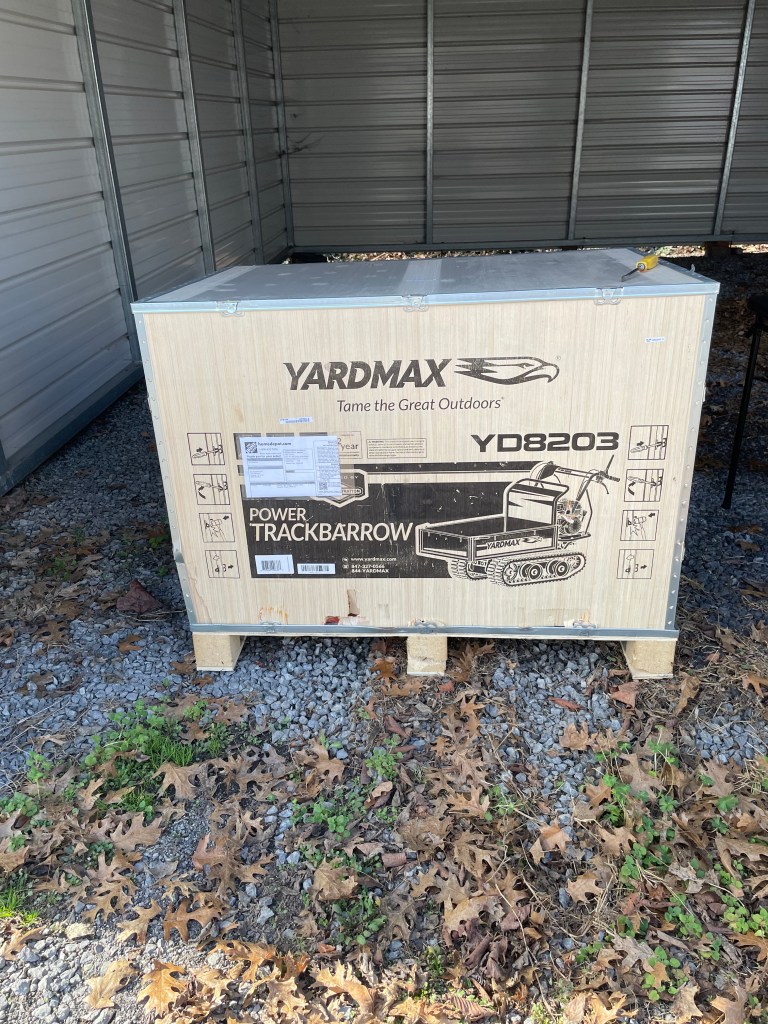
I purchased the track barrow I’d been pondering. Linda picked me up from the airport and when we got back to her house I went straight to work unpacking the crate and putting it together.

Before I got too deep into it I walked down to the farm office nearby and picked up Stewart’s truck, then drove out to my land picking up some gas for the new machine on the way. I wanted to see if I had any lumber that might fit the bill for making ramps, but I pretty much knew I didn’t. It was really just an excuse to check in on the land. 

It’s exciting to walk the main trail after I haven’t been there in a while. Not much had changed beyond everything. Absent summer foliage, I could see the shape of the land through the vertical line of timbers. Shades of brown was the theme instead of green. There was a small tree down across the trail near the south entrance. It was at head-height caught up in some limbs and would be easy to take out with a chainsaw. 

At the north driveway entrance, the long limb barrier that I had placed on forked branches and hammered into the ground was down on one side. A fork had rotted out.

A thick pile of leaves covered the gravel drive and all the trails. The top leaves were dry but underneath recent rains made a wet matted layer. My footsteps had a lighter, higher pitch than the tumbling sound that can happen when walking through leaves that are dry and basket-deep.

The planks I’d cut from the oak last summer had all dried without warpage, but none were thick or long enough to be used for a ramp. My new machine weighs 660 pounds. The ramp kit I bought recommends two 10’4” 2x8s for the truck tailgate height of 32”. In the shed I had one twelve foot, 2×8 from the orange box store, but by itself it was useless and two six foot planks were two short. 

By the time I walked the land and looked around the sun was getting low and I still needed to pick Steve up at the airport. I locked the shed and started out the 22 miles to the big box store. I at least wanted to have what I needed to load the machine the next day.

The next morning as Steve birded on Linda’s front porch I finished attaching the handles and sides to the track barrow. It comes partly disassembled to fit in a smaller crate. 

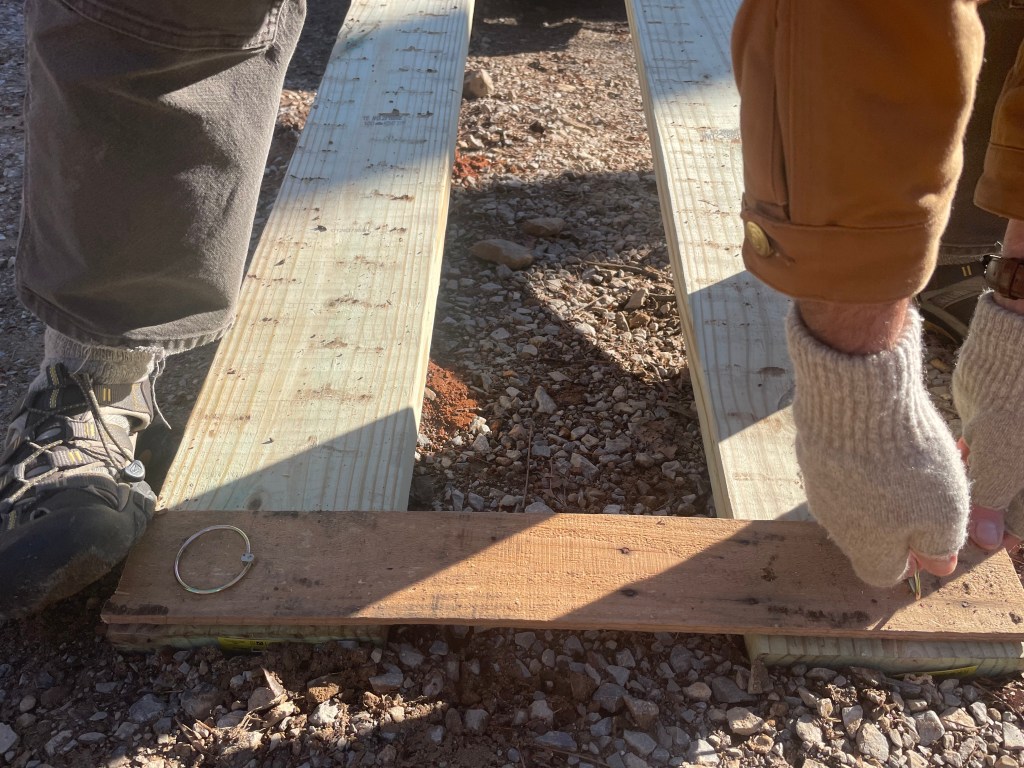
Steve scored a Red-breasted woodpecker for his life list and I grabbed Linda’s binocs so I could add it to mine. When I finished putting together the barrow and ramp I lined everything up to load. Steve helped with the eyeballing. Of course, I’ll have to get used to doing this alone, but it was nice to have the extra set of eyes this first time. I’d had the not very practical thought of only loading the track barrow on ground where I could stake the ramp planks to keep them from moving but Steve had the idea of cross bracing the planks by screwing a piece of lumber between them. 

First time loading the track barrow I ran out of gas half way up the ramp! I had only added a little because I wasn’t sure how much I would use on this trip.

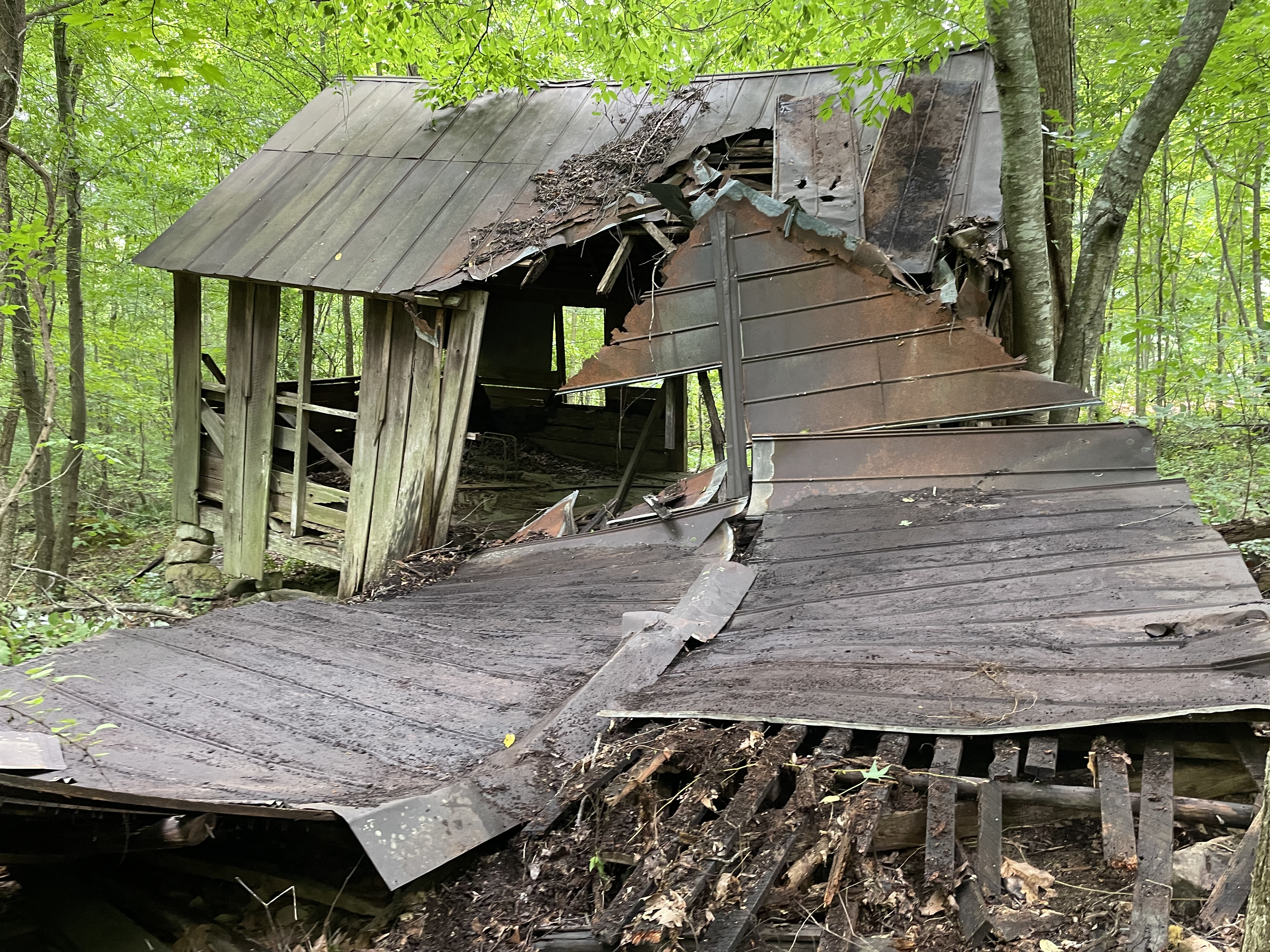
By the time we got the track barrow out to the land there was only enough time to unload it and hide it beneath some tin roofing inside the falling cabin. Days tend to slip away fast in the winter. Hiding the machine was in all likelihood an unnecessary step on a private road that has numerous postings about its privacy including, until recently, one that mentions getting shot, but I was beginning to consider the machine my baby and asked Steve to help me take measurements of the bed so I could cut some plywood from the crate it came in to protect that beautiful powder coat from any scratches and dings. 

I imagine the neighbor took down the posted threat of trespassers being shot out of consideration for our other neighbor’s relatives. The other neighbor, Dennis, was shot and killed by accident last April. I’m sure his relatives appreciate not having reminders about what will likely never be far from their minds. 
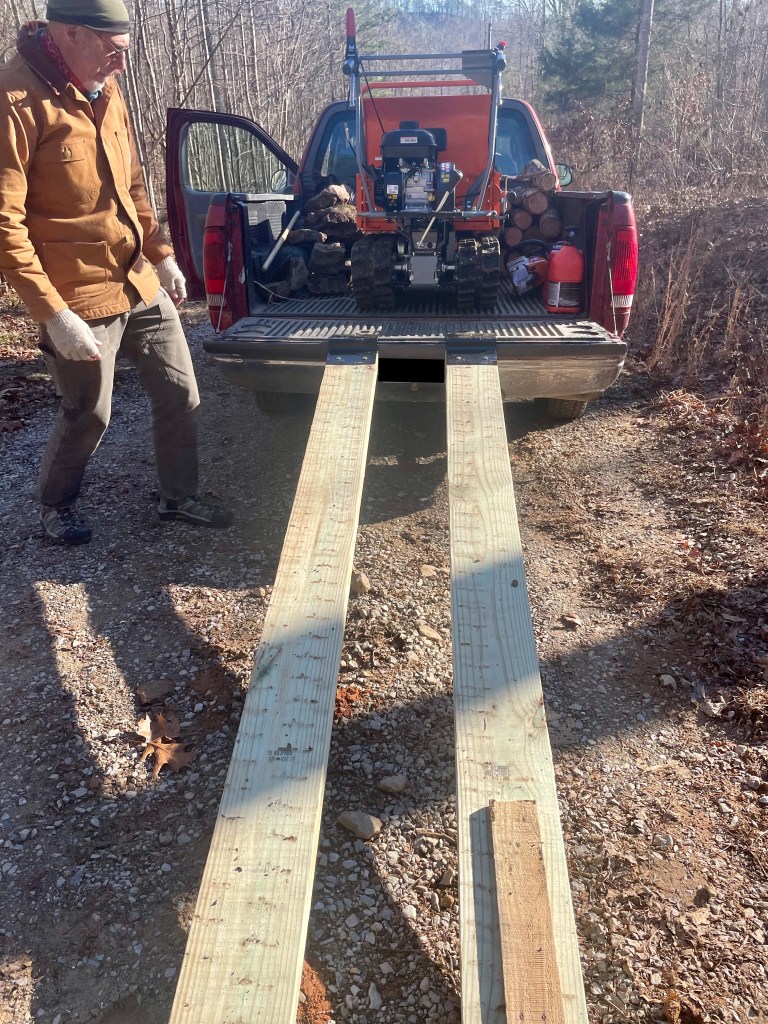
Screws to hold the ramp together evolved to push pins which make for easy removal and loading in the truck.

When we got home I used the last light of day to cut the protective pieces for the track barrow while Linda and Steve talked in the kitchen. That night we celebrated and relaxed with drinks, food, and wonderful conversation.

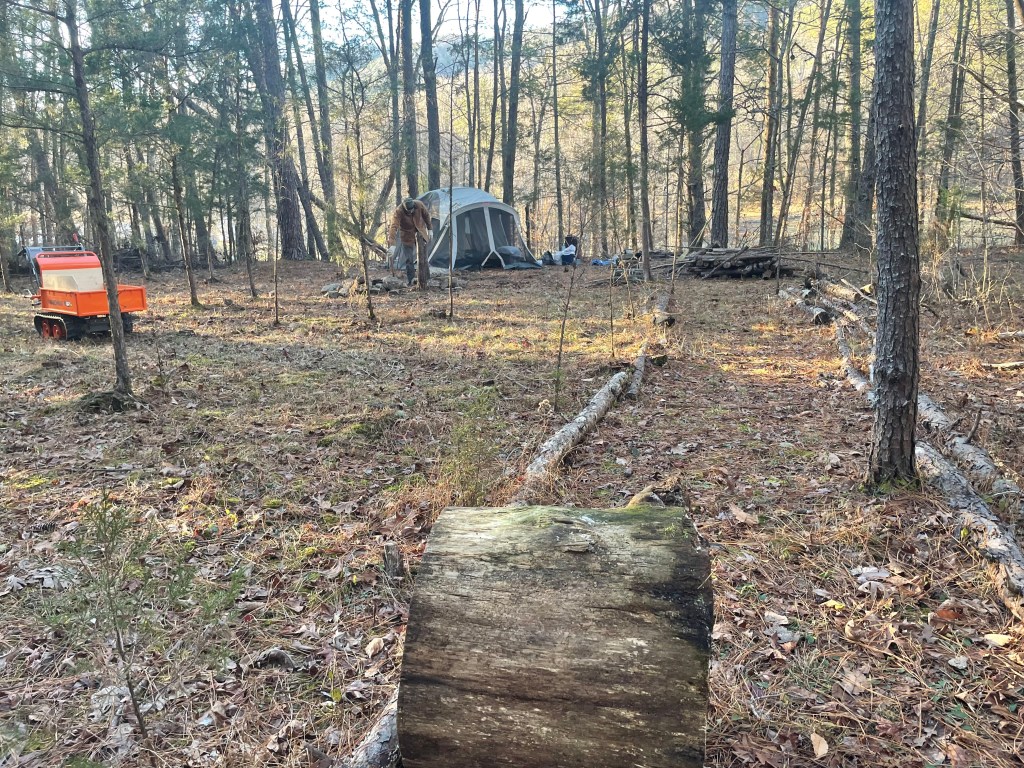
The next day we set up camp at the proposed cabin site and then headed over to the falling cabin with the track barrow. We did three loads of rock and a load of seasoned, cut oak to take back to the campsite. I learned pretty quickly that a full load of heavy rock gives the machine a heft that can pretty much yank your arm off if you change direction too quickly. Back at the camp I also learned why people like chopping seasoned oak logs with an ax. It doesn’t take much to split. The pieces fly apart with a satisfying crack. 
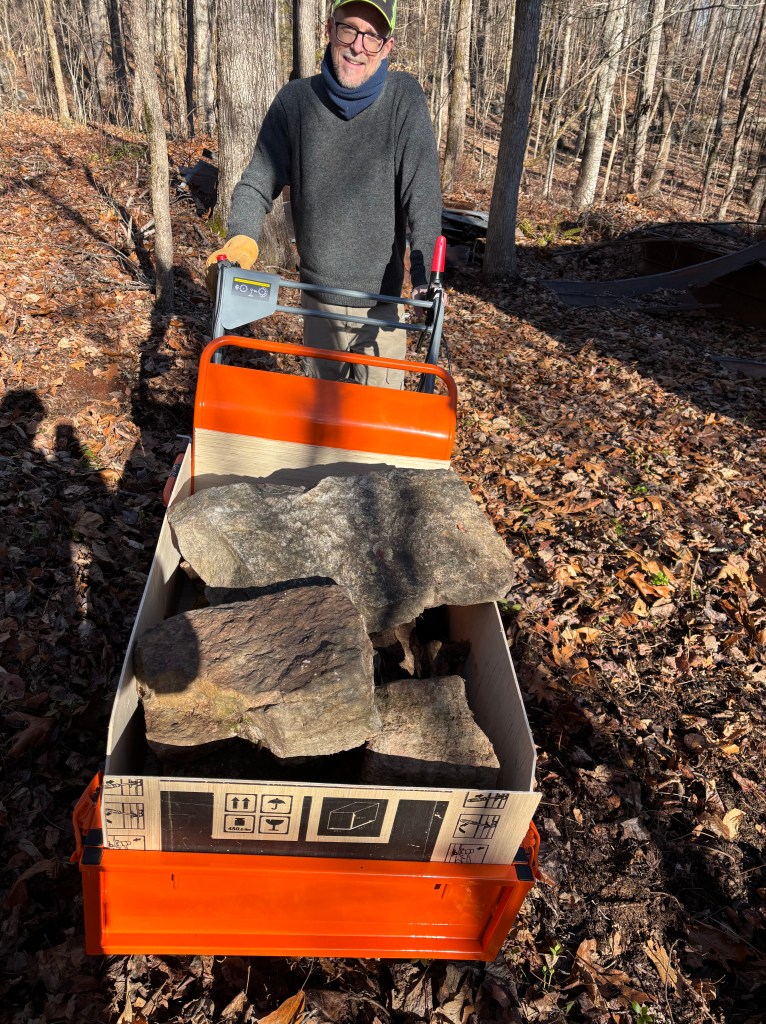
Load of big rocks. The machine is rated for moving 600 pounds but one YouTuber claims to regularly use it to move 2,000 pound loads.
Steve making the camp fire ring

When it got dark and we had the camp ready to make a fire we walked back to the truck and went into Blaine for a meal at the Mexican restaurant. We returned full-bellied, started a fire and played two games of chess reaching down to the ground between our camp chairs. When we turned in we didn’t feel the need to bank the fire as it was safe in the rock walls. 

It took me three hours to go to sleep which is how long it took for my body heat to win out over the intransigent cold inside my sleeping bag. After that I slept pretty soundly according to Steve’s report of my snores although I felt like I was just below the surface of wakefulness. In the morning I stuffed my down jacket in my sleeping bag to warm it and watched and waited for the light to grow before I rose.

It was easy to build a fire back up from the coals. When Steve woke we went back into Blaine and ate a hearty Waffle House breakfast, came back, broke camp and then hiked up to the top of the knob and came back to camp on a longer path.  Driving out with the track barrow and all the camping equipment we stopped at a pond to look at some small birds floating among Canada Goose. We steadied ourselves on a fence to get a good look with our binocs. Ring-necked ducks—another addition to both our life lists. 
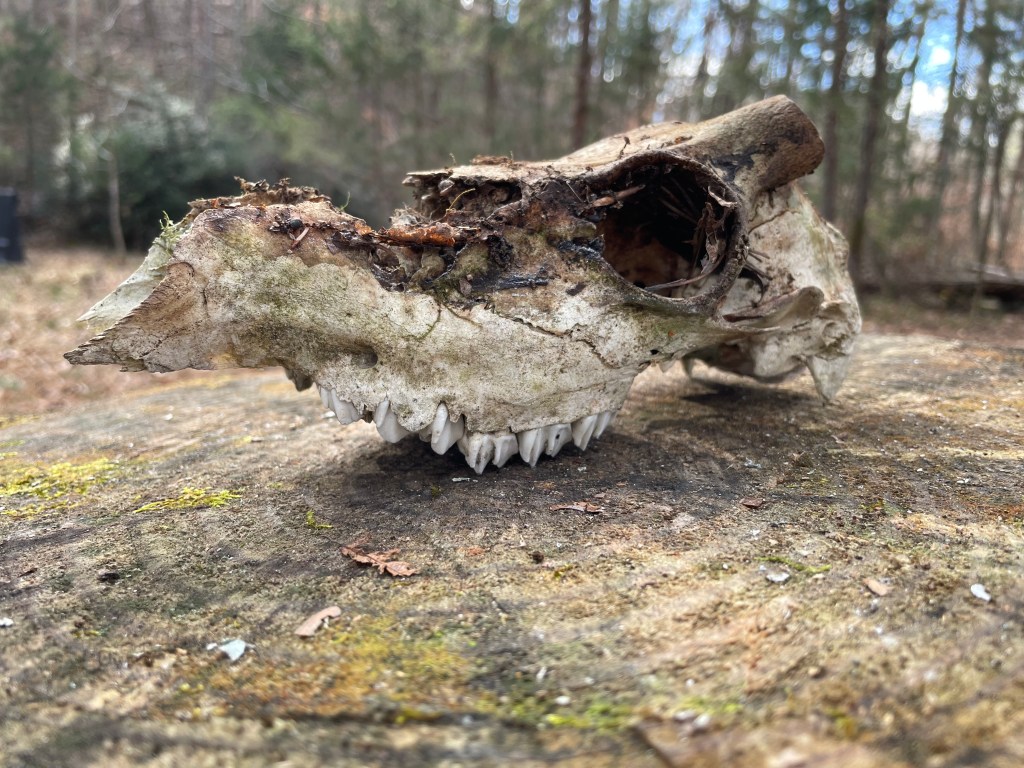
Deer skull Steve found on our hike
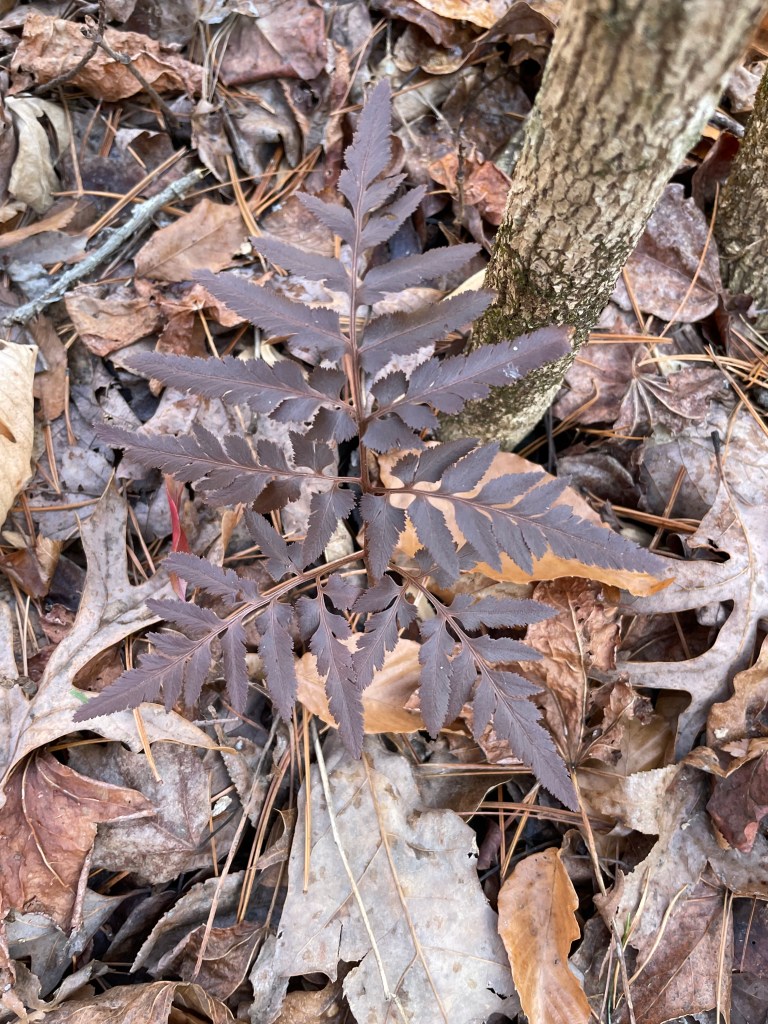
Cut-leaf grape fern

Denouement

It certainly wasn’t the highlight of my trip but yesterday, I found a had a stowaway accompany me back from Tennessee. Ticks don’t have necks, so I guess the best way to describe the one found on my back would be to say it was embedded up to its shoulders. (So much for the idea that ticks aren’t active in cold weather!)

It apparently was dead and didn’t wiggle its legs when I asked Jillian to touch it with a hot match hoping it would let go and back out. (No longer a recommended procedure.) While I’d like to believe that my body produces some substance that kills ticks who dive in head first, it probably has nothing to do with any superpowers of mine. 

Complete removal was unsuccessful. The head is still in there.

An interesting psychological awareness has come from this. I’ve learned that I’m not freaked-the-fuck-out by a tick embedded in me. I only get that way when I find one crawling on me.

I have a prescription of Doxycycline which I got specifically for this contingency. I’ve taken two doses. Unfortunately it has a “Discard 6/2/24” date on it. An email with pictures has been sent to my doctor. 

I think this was coming into Chicago which was 12°F

December 29, 2024 — Somewhere in the Air

I’m heading east to Tennessee. I’ve boarded a plane and I’m sitting on the rainy runway at SFO. It’s still dark at 6:56 a.m. The sun won’t likely be coming up as much as faintly glowing behind these clouds that are low and grey and closed in. I’m guessing we will be above them in the near future breaking through to a strikingly sunny world that appears to be opposite this place below. 

I don’t know how many times I’ve started a blog on a plane or in an airport. This part of a trip rarely makes it to the final draft, but I’ve had such a hard time writing anything I want to publish lately that I’m likely just to let it be. What’s that saying, perfection is the enemy of progress? This new year I’d like to embrace imperfection—my own and others.

There is a “particular issue” that the captain has announced “needs to be looked at” so we are getting a late start.  I’m all for issues being looked at

Getting on a flight for me is a bit like being one of those thousands of thirsty, dehydrated wildebeest looking at the water and knowing there is a very large crocodile in there that will eat one of us. It is a sad fact that flying results in plane crashes and that plane crashes rarely end well, but it is the price we flyers pay to get from here to there in a rapid fashion. 

Statistically it is still much safer than driving but, to me, pondering the moments of terror before a plane crashes bears a closer resemblance psychologically to being caught in the jaws of an aquatic carnivore. I think we’d all rather take our chances with a car spinning out of control.

It did not help that this morning I read about the Korean airline crash that killed everyone on board except for two people in the tail section of the plane. The tail section, I’m guessing, is the best place to be. I don’t know the physics but I imagine tail sections are light weight and once they are separated from the heavy engines and wings they probably act a bit like a parachute. 

Under normal circumstances the tail end doesn’t offer the best ride. Every bump has the feel of riding a broncing buck as it flexes and pops. It is also, of course, the section that takes the longest to get out of after landing, so generally, it’s less desirable 99.99 percent of the time. 

I’m sitting above the wings and engine on this flight. It’s smoother here, but this is where these planes usually rip in half. Mine will at least be a quick death. 

Four days ago I read about the crash that happened in Kazakhstan. Almost half the passengers lived. I wrote this poem about it: 

If I’m lucky I’ll have 3,500 more breakfasts. If I’m very fortuitous 7,000 or more and hopefully without surviving an airplane crash.

Anyway, It’s probably best if I just move along to my Tennessee plans. Better not to harp too much along this line of thought. 

I’ll visit family of course. As for the land, I really only have a few things on my list—more clearing of the potential cabin site and a burn of the brush pile I made last summer. It’s probably best to wait on burning any new piles I make. They’ll be less smoke if I give it a chance to dry out. 

This sign will replace the Fairyland sign for the next year. Fairyland is a fairytale inspired theme park in Oakland that I took my 1st grade students to half a dozen times over the years. The park changed the sign in conjunction with the Sogorea Te’ Land Trust to recognize the ancestral caretakers of the land—the Lisjan Nation—and reinforce the park’s commitment to amplifying Indigenous voices and stories within its programming. I have a desire to learn more about the people who were on the land I’m caretaking.

No local burn permits are required in Grainger County. However, the state requires burn permits except in the summer months. This is counterintuitive to me. I would have thought it’s safer to burn when it’s cooler but apparently it is dryer in these months and therefore more prone to start an unwanted fire. 

I recently went on line to get the permit. It was wonky. I couldn’t figure out how to put in a date or the location. Of course, I don’t have an address just a parcel number. Finding the location involves using a zoom function that feels as awkward as trying to pinch a small piece of egg shell out of a bowl of raw egg whites. I just ended the pain early and clicked enter to see what would happen. I was issued a permit for a piece of land that looked to be a dozen or so miles away from mine. I didn’t see any way to cancel it.  

My guess is the state doesn’t take these permits too seriously. It is probably a way to collect data and a way to quickly issue a No Burn notice in the case of weather events or conditions that would make burning particularly dangerous. 

Anyway, at least I now know that I can register for a permit on the day I need it and I’ve had some practice using the site.

I picked this book up at school. It’s a great read. It’s the first in Wilder’s series of autobiographical stories. A friend said it’s a book hailed by “preppers” (people who prepare for disasters and end time scenarios). Certainly it is useful for anyone interested in homesteading. The detail Wilder goes into makes you feel almost prepared to smoke deer meat, make cheese or tap your maple trees. Apparently the series has negative stereotypes of Native Americans. I didn’t run into that in this first book but I wouldn’t be surprised since the U.S. government had a full scale war going on against Native people at the time when Wilder was a girl. Sounds like these books have plenty of teachable moments for any educators who would like to take them on. I have a friend who would like to do a parody of these books she loves. They do feel ripe for something to contrast the clean-faced, Michael Landon tv version.

Environmentally, burning is not the best thing to do. It would be better to wood chip all the brush and spread it out in the forest. But how do you get a wood chipper? Can I rent one and how would I get it up the little hill to the flat spot where I have all the brush and trees chopped down?

This sort of thinking further leads me down the path of getting an all-terrain vehicle. Of course, buying an ATV and using the gas or electricity required to power it would likely negate several times over the environmental benefit of wood chipping all the brush I will ever produce. Where would I store an ATV anyway? Do I build a secure shed at the end of the new gravel drive way? Do I see if I can store it in my aunt’s garage? In that case, can you legally drive an ATV on the roads to get it from point A to B or would I need a trailer and the use of Stewart’s truck to haul it? With all that, wouldn’t it be time to get my own truck? 

You can see how the dominoes begin to fall and this is just around the thought of wood chipping some brush? Building a cabin will entail a massively larger set of details.

And to that…about three months ago I had a fall bouldering at the climbing gym. It was a sideways fall onto my right side and I stuck out my dominant hand to brace myself. With a locked elbow my arm became a pole shoved into the socket. I stood up feeling a pulsing, but not unbearable, pain in my shoulder and told the people around me “Well that’s a good way to break your arm”. 

After some self-massage I continued to climb for a while. I still have good mobility. I kept going back to the gym and playing tennis (serving underhand) before it became apparent I needed a longer rest. I went in for X-rays a month later. Looking at the black and white prints the doctor showed me something that he said may be a hairline fracture in my collarbone. He said it should heal on its own in six to eight weeks. He even said I could continue climbing if I was careful. I did that for a while but without fail I inevitably moved in a way that resulted in a sharp pain. So I’ve basically stopped all activities that involve any unpredictable motions with my right arm. I even stopped throwing frisbee for Sasha with my right hand and taught myself to throw with my left. I’m still not as good with that side but much better than I was. It’s felt like being six again and first learning to throw. It’s a good reminder of what it takes to build coordination—lots of practice. 

A week ago I passed the two month mark for my shoulder to heal on its own. I haven’t seen much improvement. I scheduled an appointment with a physical therapist for when I get back. I hope I might be able to get some advice on how to help move the healing along. 

This is all just a long way to say it is increasingly unlikely that I’ll build a cabin in the least environmentally-impactful way. At my age and with slow healing injuries like the one I’ve got, I’ll likely require considerable help from machinery. 

Of course the least impactful thing I can do is to not build a cabin at all and to not jet off twice a year to visit this land or my ancestral people. Perhaps writing about these quandries is a sort of carbon offset along with my commuting by bike and the solar I’ve put on my house. I don’t like to think of my life as some sort of accounting tabulation and I’m kind of agnostic about karma or someone with a quilled pen and ledger at those imagined pearly gates. But how can we love life and not look at ourselves as caretakers? I’ll have to just balance things the best way I can.

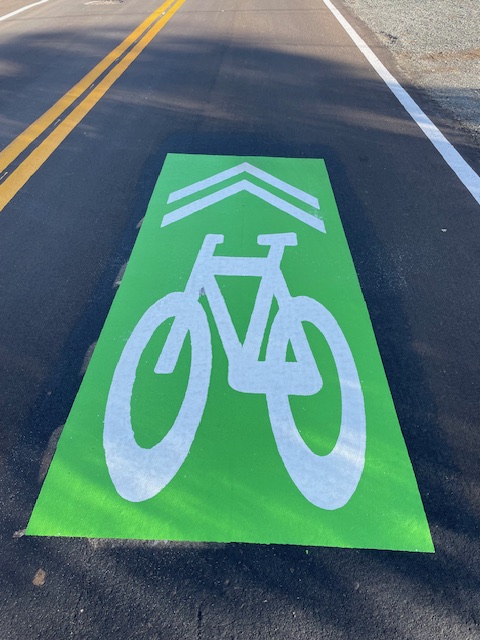
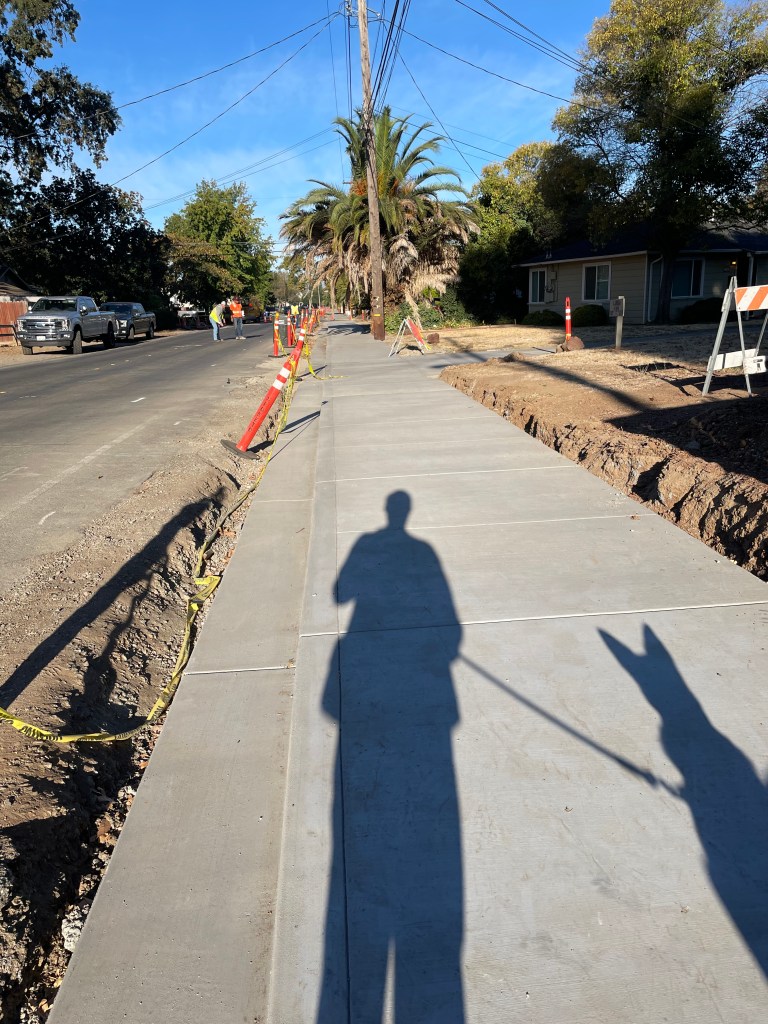
I was happy to come home one day last month and see the street filled with these bike sharrows. This one is right in front of my house. This was the last phase of the new sidewalk and street paving project that is happening in my neighborhood.

——————-

We’ve been flying in that sunny, strange, high altitude world for a while now. The cloud layer gave out past the Sierras and picked up again above the midwest. I have a two or three hour layover in Philadelphia before getting on a smaller plane to Knoxville. The goal is to get this piece posted in that time and set up a landing for whatever I happen to get done while I’m in Tennessee. If I can learn to throw left handed I can learn to be okay with the imperfect and whatever that means in terms of my writing. Hopefully some of you are still with me on this journey. 

October 12, 2024

Two Italian-American companies are putting in new sidewalks on my street. Sposeto is doing the sidewalks. Ghilotti is doing the accompanying roads. Taken together the names make me feel like I’ve walked into an Italian creamery. The job they are doing is sweet. The sidewalks have beautiful lines and are clean like a newly frosted cake. The project is moving along quickly. The whole neighborhood is smiles as we see our tax dollars at work. 

Concord is a town in what is increasingly less of an outskirt of the central Bay Area. But it is on the edge of country and I often relish the knowledge that I can drive west of here and quickly be in an area that feels like amber waves of grain. If you walk around my neighborhood you occasionally come across a fenced in yard that upon further inspection is really more like a field. At the back of one nearby is an old metal windmill rising up between patches of prickly pear cactus. 

My street is half of a large oval. It starts and stops on the same street it curves off of. It’s what’s left of an old horse race track that existed in the late eighteen and early 1900s. The green park around the corner where I take Sasha for walks was the centerfield where the winning horses were given their ribbons and where fans sat around picnic baskets to watch the race. 

The margins of the street were all gravel until this new sidewalk started to appear. All told, a peek into a backyard field strewn with piles of junk and blackberry bramble could give a deceptively country feel. But walking in most directions you will find that soon enough the squabbling of scrub jays and mockingbirds is replaced by a yawling white noise as you reach one of the main thoroughfares that flow cars like red blood cells through an artery.

A good portion of the 125,000 residents that live here are commuting in the direction of Oakland and San Francisco. The ones that don’t get there by BART train are doing it in their cars. 

Recently I’ve started walking Sasha in different directions to try to accustom her to the sights and smells that surround us in case she ever gets loose. She is skittish around loud noises so it’s hard to walk her along one of the busy roads but I hope that she will build up some tolerance. I’d hate for her to run hairy scary into traffic for being too freaked out. 

On our walks I have her sit at cross streets and wait with me to look both ways before we cross. I’m not sure if she’d do that on her own but I want her to know that where a road crosses you have to be extra careful. 

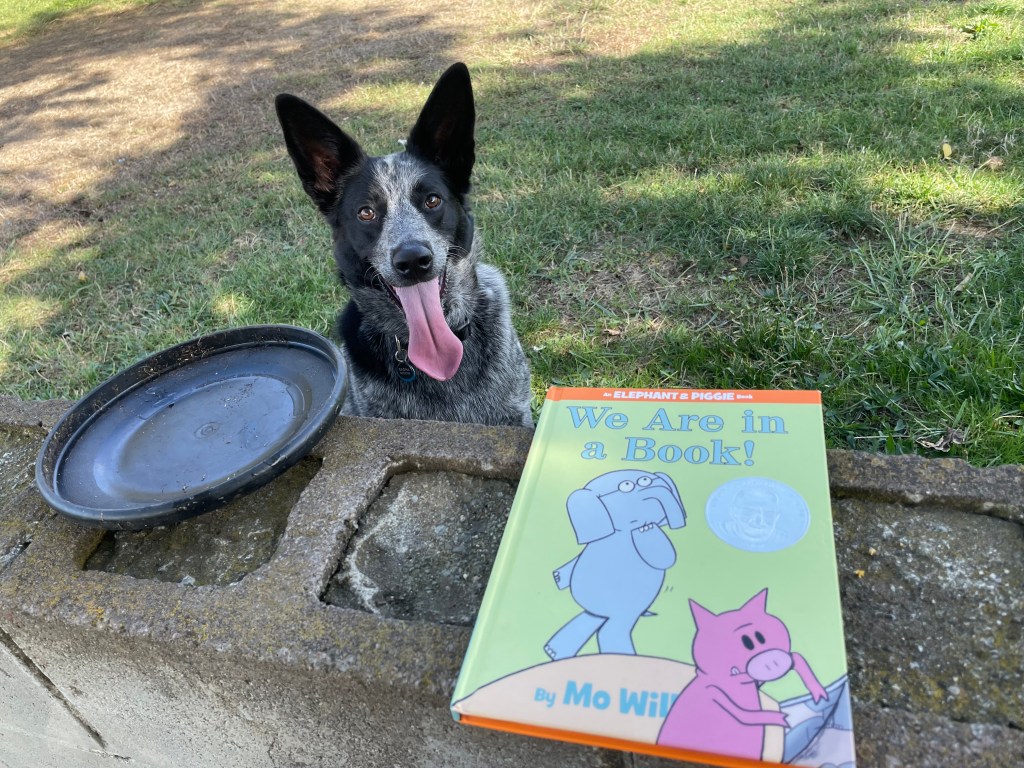
On a recent walk Sasha and I stopped by a Little Free Library  nearby and found a copy of Mo Willems’ We Are in A Book. I almost never find used copies of his books much less free ones. This title along with Should I Share My Ice Cream is probably the most popular of his twenty something titles. 

We Are in A Book is funny and profound. It gets you thinking about mortality and what it means to exist. For several of my last years teaching in Oakland another first grade teacher, Ms. Sandoval, and I would act out one of these two books at the school’s annual Family Literacy Night. It was always a hit and we’d have a fifteen minute show within each of the three thirty minute rotations. Several times we got donations of Mo Willems books to hand out. It was so fun! After doing this for a few years we had it down and could get the show up and running with only one or two rehearsals. Ah, the excitement of live theatre!

——————-

I want to tell you about another fantastic book I recently finished. It was recommended by my old friend Elijah. It’s about the Mississippi city he grew up in and where I went to school from 8th grade through my first year and a half of college. It’s called Hattiesburg, an American City in Black and White

There is certainly something extra special about reading the story of a place where you walked and grew, but this book is also extraordinary because of the way that the author, UNC history professor, William Sturkey, shows the power and framework of Jim Crow.

Sturkey is particularly effective because he manages to resist any discernible ax grinding despite having black ancestry. He lets history itself be the flat stone that makes indisputable facts sharp and painfully apparent. 

The book helped me understand better how a boy like myself raised in a liberal, artsy, educated household could not be immune from racist beliefs. It helped me understand how Hollywood may have got it right spiritually and mentally (if not physically) when they sometimes showed southern black communities with white picket fences and children dressed in clean, starched and pressed clothes. And it helped me understand the depth of a brutal social construct that I always felt as a coiled threat beneath the gentle surface of southern hospitality.

Without trying to explain what I mean by all those statements, I want you to know that Hattiesburg is both horrible and hope-filled as it looks at the resilience and determination of black people in a Jim Crow southern town. These are the people that went to Washington to try to get their right to vote enforced. It explains some of the humored looks I got from a few elders when I stepped into the black neighborhood that started across the railroad tracks behind my house,  a naive but sincere 18-year-old trying to register voters to support the Mondale/Ferraro ticket in 1983. I had no idea who I was talking to. 

It was also fascinating to make a connection with a previous book that I’ve recommended: “Ecology of a Cracker Childhood” which bemoaned the loss of old growth Long Leaf Pine forests throughout the south. It turns out that Hattiesburg was founded and built as the hub of a vast network of lumber mills cutting down those forests. The mills ran continuously for fifty years bringing prosperity to hundreds of thousands of people from the 1880s up through the Great Depression until the last of those great, majestic pines were cut down just like the fictional Truffula trees in Dr. Seuss’ story The Lorax

Hattiesburg, the book, also ended any misconceptions I had of white Mississippians who tried to wear the banner of proud, self-determined, state-rightist who remained independent of outside influences they thought would sully their whiteness.

The town was established post slavery and grew quickly because of the help and investment of northern industrialists and the mass of low-wage workers. After cutting down all the trees it survived the Great Depression, holding on by its fingernails with federal relief and recovery funds. Then leading up to WW2 Hattiesburg was renewed as an economic hub with the federal renovation and expansion of Camp Shelby which housed and trained up to 40,000 soldiers at a time. 

Throughout this era blacks took the lowest wage jobs available to them and during the depression only received federal and NGO relief when it somehow made it past the hands of local authorities who made sure whites got more than their share.

Eye-opening indeed was the extent to which white southerners held a burning cross in one hand fighting off what they saw as  federal encroachment while using the other hand to collect federal funds. Socialist-minded Franklin Roosevelt got well over 90% of the Mississippi vote in all four of his presidential elections…and almost all of those voters were white because of exlusory voter registration practices. 

In Hattiesburg the racist registrar of voters regularly used the question, “How many bubbles are in a bar of soap,” to exclude blacks who needed something harder than the state constitutional law questions or reading tests required to gain their voting rights.

The unexpected story is the community pride and the black town that grew up next to the white town with its own set of businesses and its own set of leaders.  The unexpected story is the way people not only survived but thrived. Even for those who moved away they remained connected to Hattiesburg. Chicago may have been the most popular destination. The latest issues of The Chicago Defender newspaper were regularly passed around until they were worn out and news stories about Hattiesburg regularly made it into those Northern black-owned and operated papers. 

Anyway, there is so much more to say about this book but it is better read. 

—————

Before I go, I want to show a few things that I left out of my last blog post concerning work on my Tennessee land way back at the beginning of July. (I’ve really missed getting a post out sooner.)

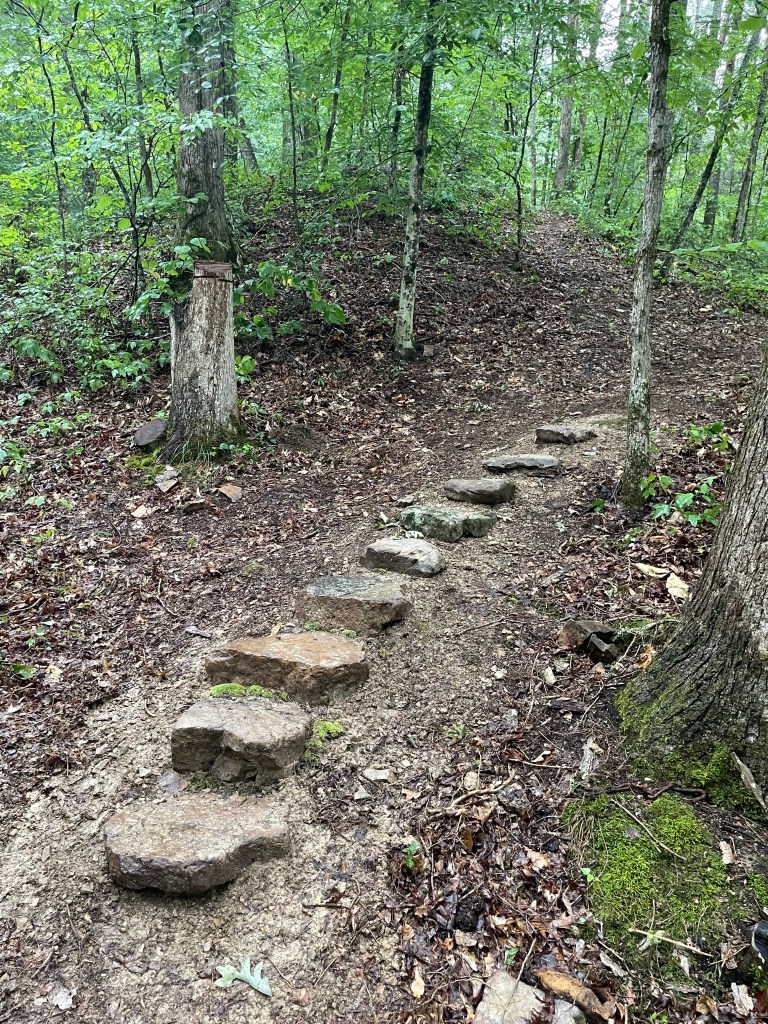
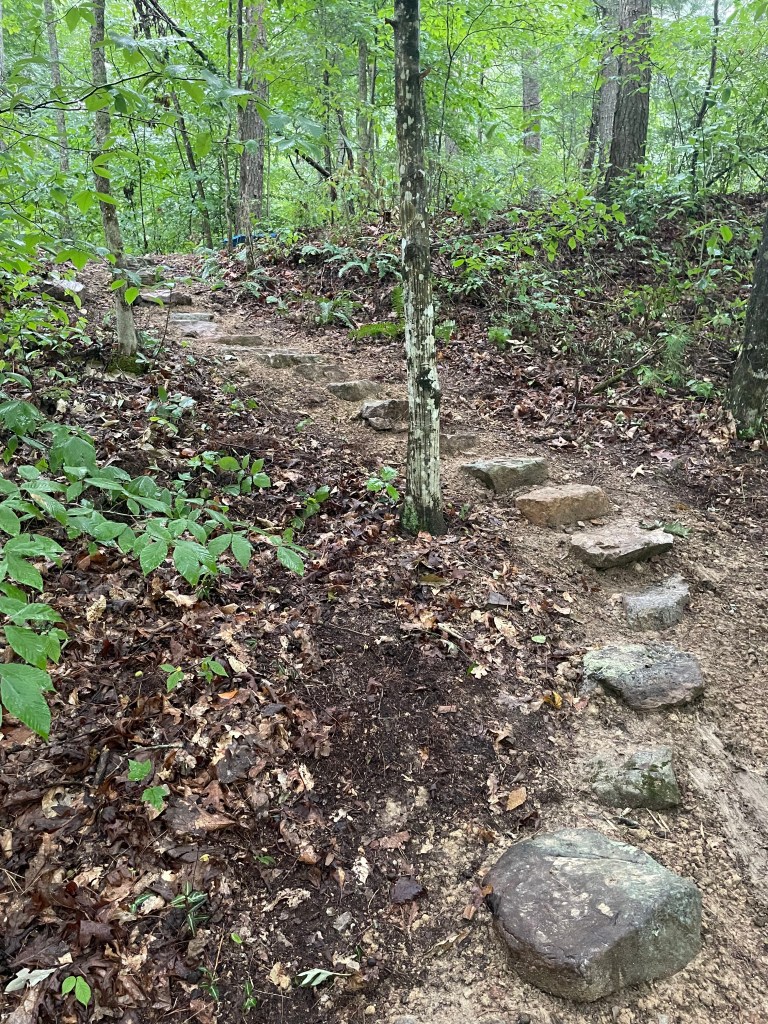
These are the steps I put in to help make the walk easier up the small hill on the main trail that leads to the proposed cabin site. This work is what had me battling the horse fly. (Yes it was usually just one at a time but that was enough.)

Lower Hill Steps
Upper Hill Steps–I had a bad start on these. I was making the gap too wide between steps–trying to go cheap so to speak. I had to remove the ones I set and start placing them closer.
I got some good advice from a neighbor to keep up with the clearing of the flat spot for the cabin. I plan on burning these piles when next I visit. I may have to get a burn permit if it is winter time. Strangely, burn permits aren’t required in the summer. Apparently trees pull the sap into their trunks in the winter and are more flammable.
This is the underside of some Winged Elm leaves (still on the branches) I threw into the burn pile. I love their color. I thought these trees had some horrible disease because of the misshaped branches. Turns out that’s just how the Winged Elms fly.
April 6, 2024

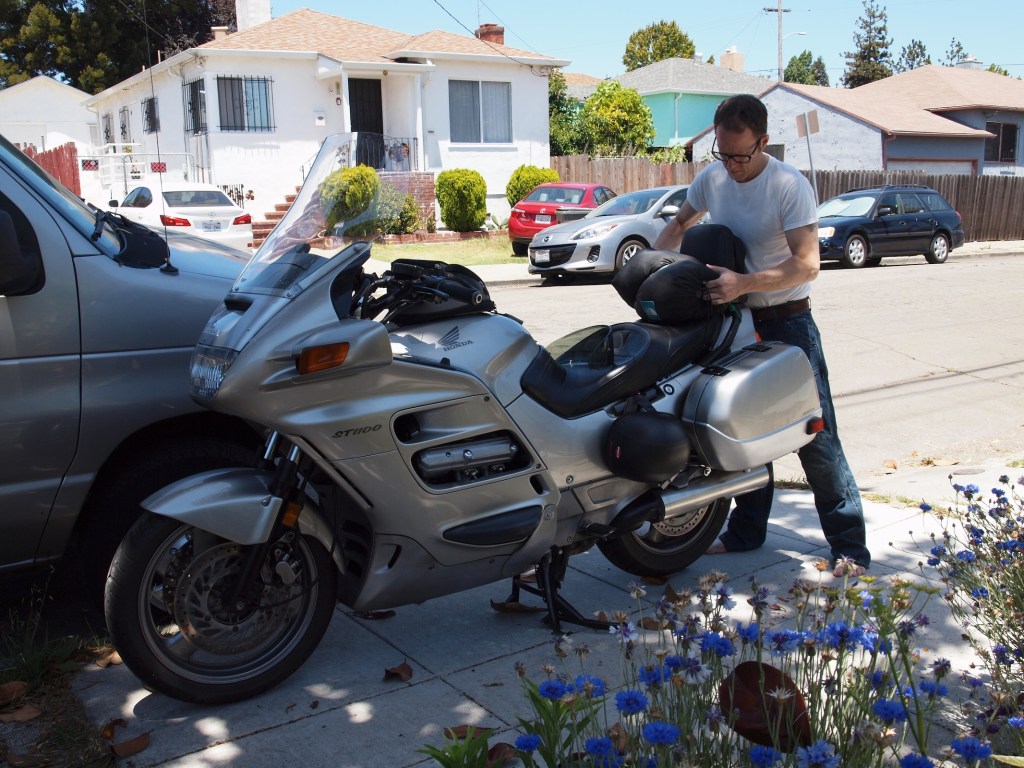
I made good on my intention of getting rid of my motorcycle. Last week a seventy-one-year-old man with 45 years of riding experience drove off on it. A small lump formed in my throat as I watched him ride away. Otherwise, it felt good. I couldn’t have asked for more. The buyer wasn’t likely to kill himself. He was mechanical so I knew he could take care of the Silver Spaceship. Also, his age reminded me that getting back in the saddle again was not outside the realm of possibility. 

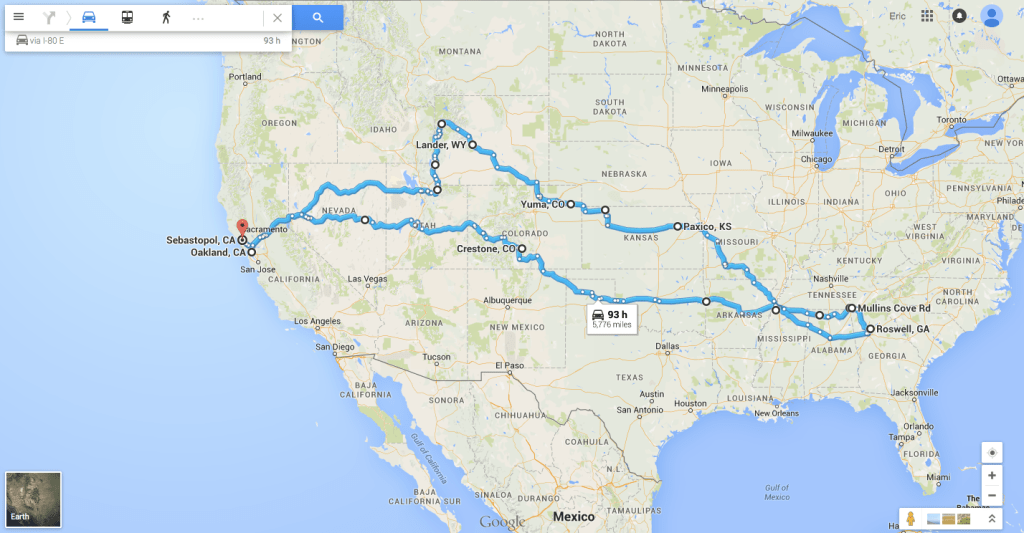
Here I’m preparing to leave on my 2015 cross-country trip. The trip is why I bought the bike.
I went on the northern path and came back on the southern.

I used the Bay Area’s home-grown Craigslist to advertise the bike. They now charge five dollars to list vehicles. I balked at the notion at first. I have always associated Craigslist with free advertising. When a place popped up for me to enter a credit card number I wondered if it was legit. I looked this new protocol up online and confirmed they’ve been charging the fee for vehicles for about four years. It makes sense. Five bucks may be enough to keep some scam-operators from operating and it’s not too much to ask for selling something worth hundreds of dollars. 

My reluctance was short-lived for another reason. While I would have difficulty answering Marie Kondo’s question Does it spark joy while gazing upon one of my shirts, if I think about Craigslist or, another favorite, Wikipedia, I can answer a definitive yes! Craigslist has been a source of joy since my earliest days of internetting. 

I listed my 1991 Honda for $1700. That price is on the low end for these motos. The ST1100 is one of the best old bikes out there. It’s powerful, reliable, and a smooth, comfortable ride on the highway.  There were cracks, breaks and holes in some of the panels that cover almost the entire bike but that’s to be expected for a 33-year-old motorcycle. The sun breaks down plastic. Mechanically it was near flawless. 

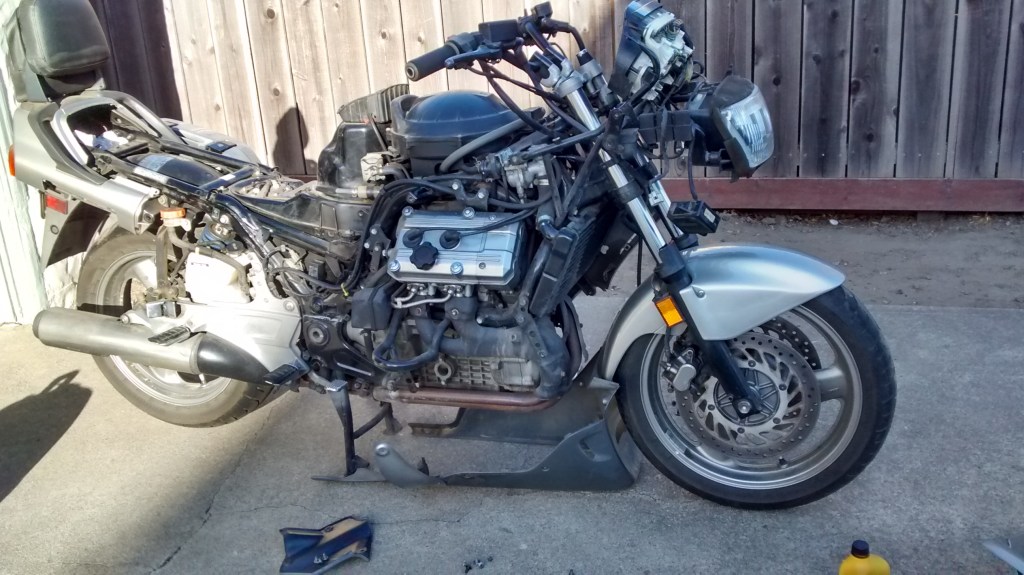
In 2018 I took all the plastic fairings off the bike to give it a thorough cleaning and a good look. It was an all day job. Somehow I still failed to grok that the engine is liquid cooled. (See that black rectangle behind the front fender? Duh. Radiator!) After the cross country trip and riding it for another five years I’d never added coolant. I found out the hard way when the last remnants boiled away in steam on a trip to Napa in 2020. I stopped before any major damage was done. The Silver Spaceship got its one and only ride on a tow truck back to Concord.

As soon as I posted on Craigslist immediately got a slew of low ball offers with sloppy grammar and syntax that made me feel their desire for a quick deal all the more poignantly. 

“Hi,  Let me know if you consider taking $900 for it, this Sat.”

“Nice bike that I will love to give a home but I  am quite strapped and only have 1100.00 to work with at the moment.”

And the best of the worst:

“I have a 2002 Toyota Sequoia that needs a small amount of mechanical work with air bushings and things it’s a great running condition the motor and tranny or a flawless it’s got some higher mileage on it but I’ll be willing to trade straight across need a bike to ride out to LA tonight would trade my SUV and probably most of the mechanic tools inside of it to get the motorcycle so I can head out to go to my girlfriend I was waiting for me program in LA county you can call me at 831-xxx-xxxx ASAP tonight would be better thank you”

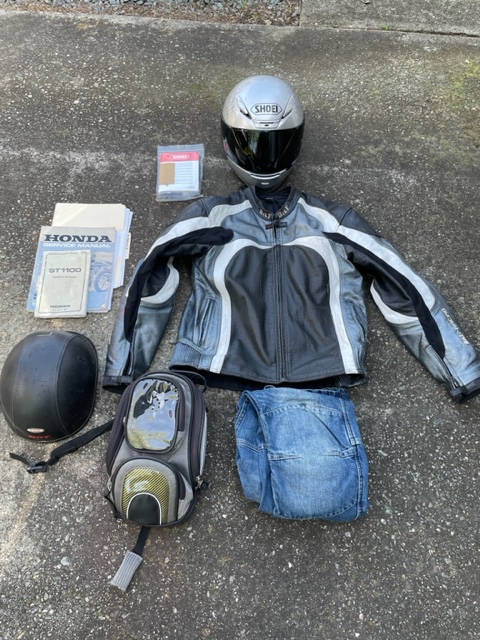
After a bunch of these I was getting a little depressed. The bike had treated me so well in the more than eight years since I bought it from its original owner. Did it really have no more value than this? Should I drop the asking price to $1500? I was including a leather jacket, riding jeans with armor knees, the shop and owners manual, a tank bag and two helmets—all old but serviceable. 
I had already dismissed the idea of parting it out. I could get more money that way but it would be a lot more work taking it apart. Also, this felt akin to sending R2D2 to the junkyard. You don’t do that to an old friend that has years of life left in it.  

I thought on this for a few days and finally decided to leave the price. If nobody bought my moto then I’d just keep it. I didn’t have to take it to the city anymore and lane split across the bay bridge or allow the 20-year-old in me to accelerate to sixty in four seconds. I know how to ride safe. It could just be my cruising bike for April Sundays and midnight August nights, for country rides and smooth open highways and perhaps, for the rare woman who will swing her leg over and lean back onto the rest. 

It felt karmic—like I had just needed to get my head in the right place—when a few hours later I got an email from Lou who wrote a nice note that included these words: “Have cash, don’t want to insult you with ridiculous offers.”

I was pleased that someone else recognized the value. 

Bike and accoutrements as advertised on Craigslist.

I don’t want to co-opt anyone’s ancient belief system but I do feel that inanimate objects live and have a spirit. It feels authentic to give value to things, even things that are seen as trash. All properties have usefulness. It’s easy to see value in an old motorcycle that mechanically works well, but it’s there too in a sun-denuded water bottle matted with grass clippings and dirt on the side of the road. 

I wonder what kind of world it would be if human’s primary goal was to seek value in things and help guide them to a place where that value can be realized? What if we could bring that same feeling of value to our human relationships? What kind of world would we live in then?

I hope that Craigslist person got down to L.A. to see their girlfriend and to begin their program—if that’s what they were trying to say. I hope they didn’t have to give up their tools to get there. The value of things increases exponentially with access to tools. Materials and their possibilities take on a whole new meaning.  

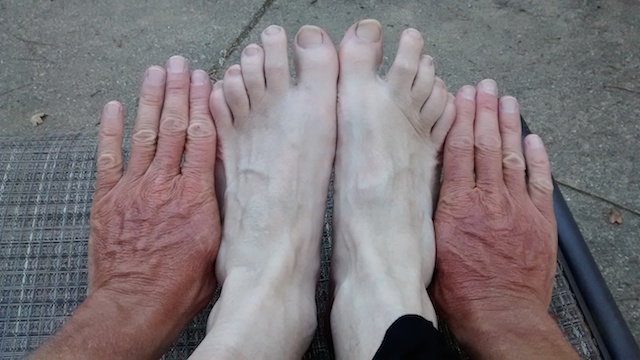
My feet and hands post 2015 cross-country trip.

February 17, 2024

I first started this post 40,000 feet above the Midwest somewhere on a double-aisled 767 jetliner on my way back from Tennessee. Through swaths of cloud I could see the land covered with snow like a white jigsaw puzzle on a black table top. The pieces that weren’t yet put together showed dark, curvy edges—a river and its tributaries crossing the otherwise rectangular allotments.

This whole business of flying is a remarkable thing and I felt particularly thankful to be alive on this second leg of my journey after a harrowing short flight from Knoxville to Atlanta on a smaller aircraft. We were in the midst of a massive east coast storm and it was bumpy. News stories and images were still fresh of a jet plowing into another plane then flaming down the runway. Another lost an escape door 16,000 feet in the air. 

Our ascent was bad but the descent worse. It felt like riding atop an avalanche on a 100,000 pound sled at 400 mph. I asked a flight attendant on the way off the plane how the ride rated in scariness from one to 10. 

She smiled and said, “That was pretty bad. I think it was a solid eight.” 

I was thankful she hadn’t said nine or 10 because I needed to know that things could get worse without dying if I was going to keep flying.

If I’m still at this regular Going-East business when I retire in a year or two I’m more likely to take a slower, statistically more dangerous, but psychologically easier method of travel. I’d like my mode of transport to be environmentally greener too, but short of riding in an electric vehicle with all the seats occupied or a Greyhound or Amtrak also at capacity (three scenarios not likely to happen) the comparisons and calculations I’ve found don’t point to one mode of transportation being much better than the other. I sometimes imagine a low-flying glider released from a giant sling shot. 

Realistically, walking or biking is the least impactful way to go from California to Tennessee. It’s a far-fetched proposition although I must mention that my friend Marlow made an annual 1000 mile round trip on a recumbent bicycle with a trailer and a greyhound dog from Jackson, WY to Moab, UT. He did this for seven years. The first few years it was a 2400 mile round trip to the Arizona/Mexico border until he decided he didn’t need to go that far south to comfortably winter in a better climate.

The options for travelers in the United States may be the worst they’ve been in fifty years. Available destinations for intra and interstate travel on busses and trains is less than half what it once was. How ironic is it that you can’t take a choo choo to Chattanooga? The Amtrak goes to so few places its website treats destinations like expensive hors d’oeuvres on a five star restaurant menu. 

The blue plate specials on Greyhound are a better deal but still limited. They don’t have as many buses or lines as they used to and many of their terminals have closed. When I travel by Greyhound to or from Knoxville I have to wait at a city bus stop next to a parking lot at midnight. Then if I’m coming to Knoxville the ride share to Corryton just 20 miles away costs almost as much as the bus ticket from Raleigh 360 miles away. 

None of this is terrible news for people who have means and money, but this continent has become less traversable to poor people. When you get on trains and busses it’s no surprise why they are often less than half full. 

In terms of combating climate change a full bus or train is better than a full plane or a single electric car. The problem is we all want to individually wipe our hands clean but attacking the problem requires a group effort and collaborative thinking.

——————-

To pick up where I left off on my last post about doing a few smart things, number one among them was ditching my plan to demolish the old Sheridan cabin during this trip. I realized that even if I could get it down in some fast, probably dangerous—or at best merely destructive way—I’d barely have enough time to tear it apart, sort the usable lumber, and store it in a manner safe and dry from the elements. I only had a week. 

With this decision I slipped into a more thoughtful place. I began to look at the cabin as an interesting problem rather than something to conquer. As I began to work I let the knowledge of what was required manifest organically.

This laissez faire attitude extended to other areas that might otherwise have been stressful. Unbeknownst to the highway commissioner he may be doing me a favor in his failure to approve my driveway application that is almost two years old. Same goes with the new neighbor who has a road going over my land and was sold the property with the idea that it was his free and clear.

How to deal with that and the other are not cogs in the wheel but large gears that keep me from jumping into things too fast.

Besides, there is no rush to do what may never get done — specifically build a new cabin using parts from the old. In acknowledging this I freed myself from any anxiety on the subject.

I painted this sign and nailed it to the cabin perhaps 15 years ago when I first started having the idea of doing something on the land. I could see evidence that hunters liked to use the cabin as a stand. A fire pit showed that they warmed themselves here and probably used some of the lumber as kindling.
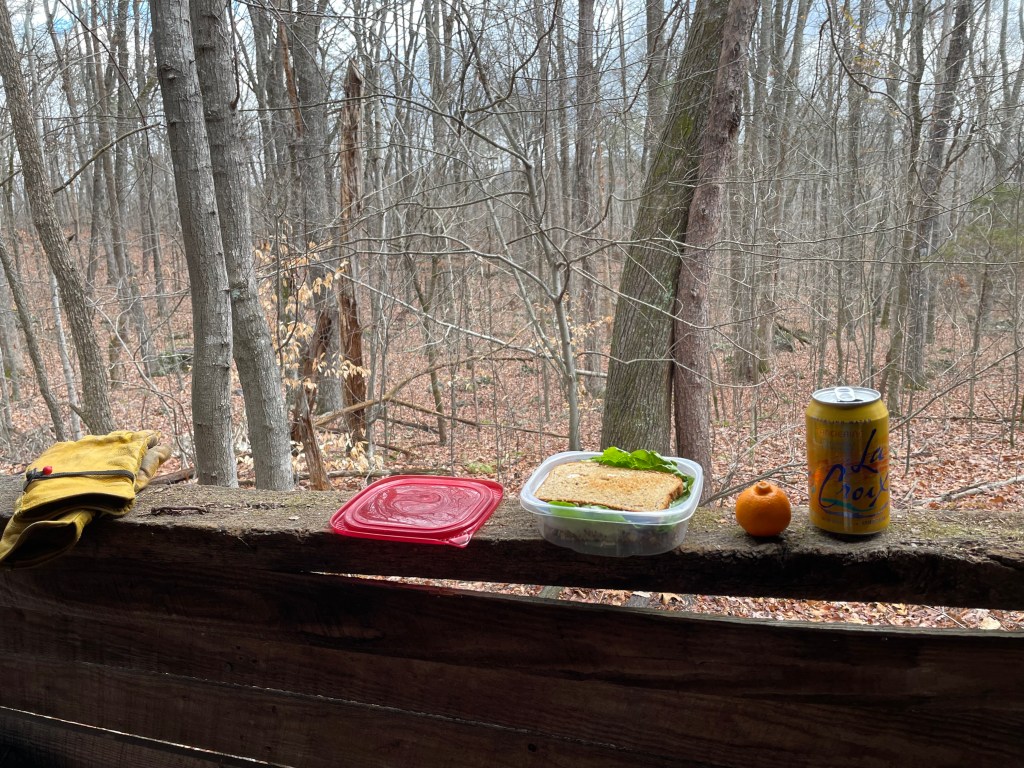
Lunch inside the cabin. It’s a good view for a hunter to catch a tiptoeing deer.

Smart item number two: I recognized that a deconstruction site needs room to move around in safely as much as a construction site does. Doing so not only helps avoid twisted ankles, it also saves time from stumbles and obstructed pathways. 

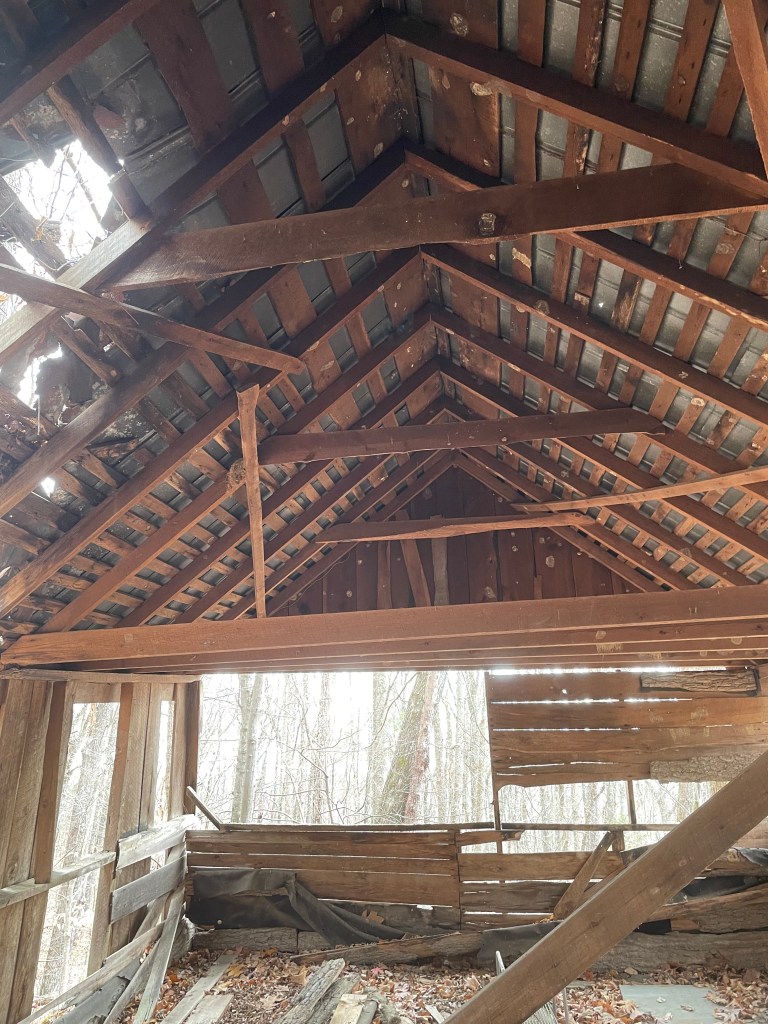
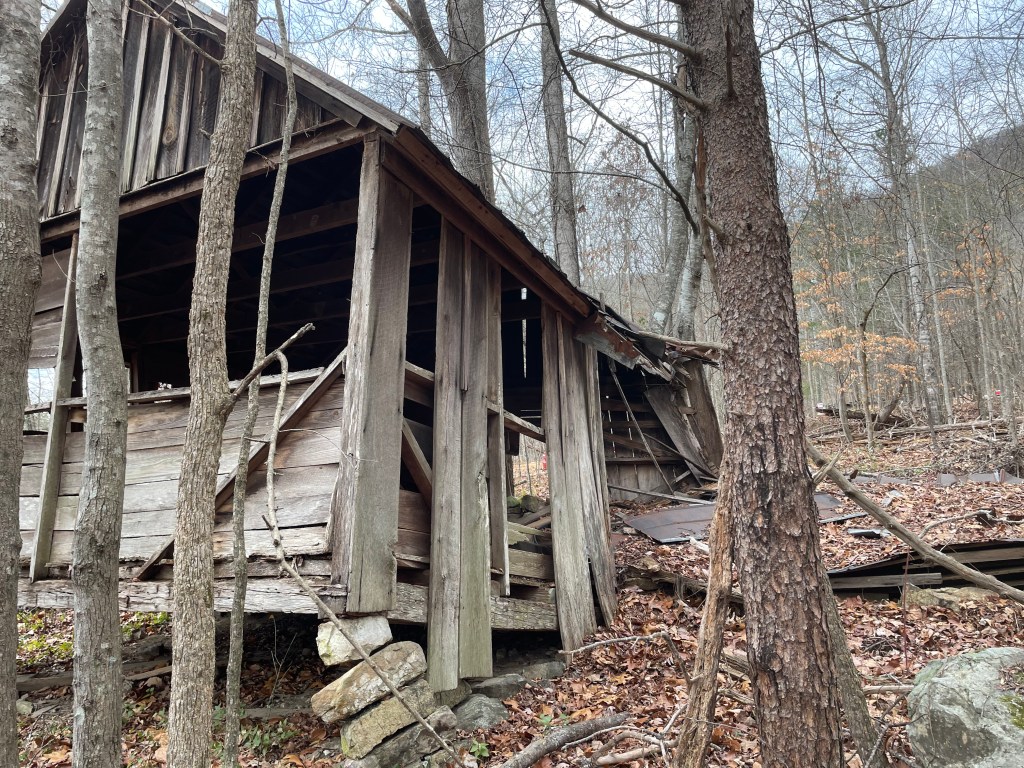
With this in mind I started tearing apart the fallen walls and roof of the part of the cabin that had come down several decades ago. The original structure was a backward L-shape and it is the shorter line of the L that fell and pulled with it about half the wall on the north side along with a good chunk of its roof. I’m guessing this room was a kitchen area because there is a rock structure at one end that could have been a fire place and a metal roof panel on top of the heap had a section cut out for a chimney. 

The debris of the fallen room.

I cleaned this fallen area working through the heap. I pried the metal roofing off, then knocked apart the battens from the rafters. It came apart easily since most of the fallen lumber is in different stages of decay. The wood got progressively worse as I got closer to the ground. In some places it was simply saw dust made by decades of insects and bacteria. 

Lattice of fallen roof after I removed the metal.
As night approached on my first day of demolition I used some of the roofing to make a dry box for some of the wood that may still be usable. Rain was expected the next day.

The demolition was difficult my first day because I was using less than ideal tools—a long, round pry bar and the back of an axe as a hammer. Both contained an unnecessary heft and imprecise bluntness. I returned the next day with an actual hammer and new pry bar that was flat and could grab the nail heads easier.

I took occasional breaks from this back-aching work to straighten up and look at the roof line where I intend to begin disassembly next summer. Over and over I assessed if I would be able to run a line between the trees and attach to a rope with enough lead to allow me to work on the roof and still keep me safe should it fall out from under me.

This is most of the wood I’d like to save.

I also took time during these breaks to assess the lean of the cabin. It was clear I was safe working on the fallen side, but working inside the cabin or on the opposite side facing the lean was not without the possibility of it falling on top of me. 

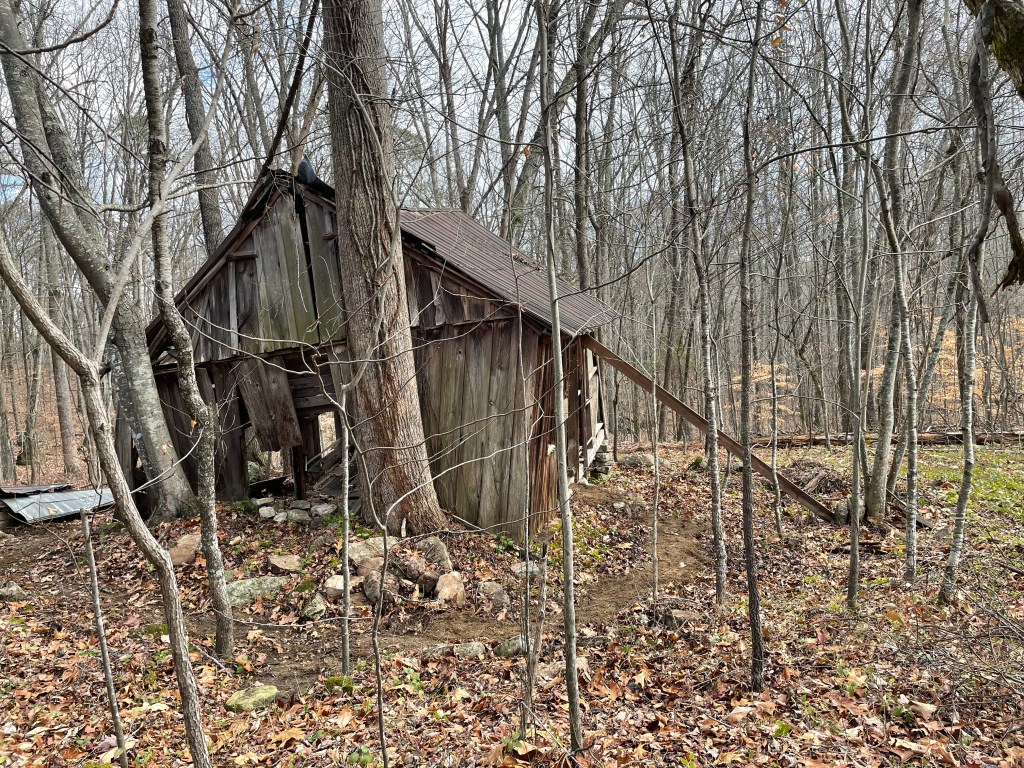
The cabin made a dangerous shift since my last visit. The rock pier that supports the northwest corner had opened like the pleat of an accordion. I have a feeling this development had something to do with my pulling up the remainder of the oak floor boards at the opposite corner last summer. This left only the north half of the cabin with flooring. A wood foundation is similar to a wall in that it relies on its sheathing to keep it from folding up in the way that a rectangle becomes a rhombus.

To safely take the cabin apart I would have to shore it up.  To do this I removed a 16-foot, 2 x 6 joists from its interior. The beam had spanned the width of the cabin but was now only attached on one side.

I hammered the stubborn wood from a rafter where it was attached with long, thick nails. The hammer blows made the whole cabin vibrate. I mentally practiced diving to safety between joists. The stupidity of it hit me later. To make the overall project safer I’d engaged in a dangerous activity in the moment and that’s when accidents happen. This could very well have ended with me receiving a Darwin award. I could have easily cut a small tree to use as the brace instead. 

To staunch the lean I braced one end of the 2×6 against the base of a tree and attached the other end under the eave.

After the brace was in place I continued to work on cleaning up around the cabin. Much of it is surrounded by assorted football size rocks hidden beneath a spaghetti work of vines. Unseen and unlevel they were ankle twists waiting to happen. The vines were great for catching a shoe and stopping me in my tracks. (I attributed an old-timey cowboy voice to them that said, “Whoa. Hold up there feller. Where do you think you’re going?”)

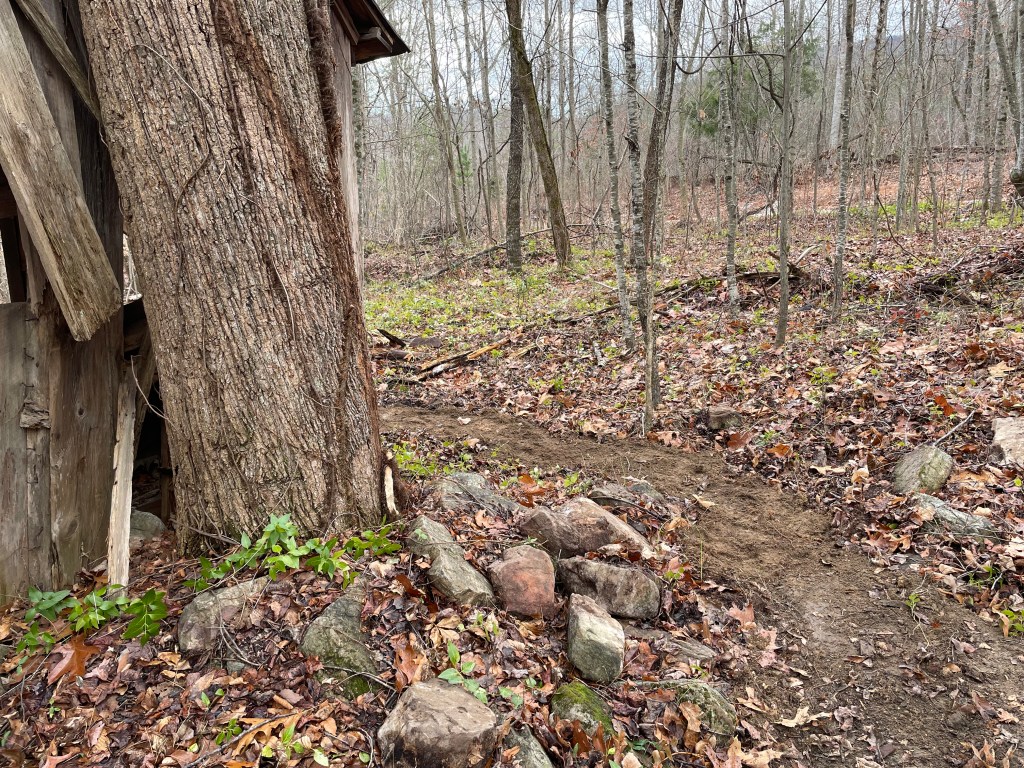
I pulled up the vines and lifted dozens of these big rocks from the ground where they were lightly seated in the loamy soil. I chucked them aside. In their place I began to make a path using the dirt that was soft and full of wood rot from the now cleared wing area. With no wheelbarrow I used a half piece of roof tin as a sled. Over and over I piled it with dirt and slid each load to the closest spot of the path I was making. In this way I was continually walking over the new dirt, packing it in as the path grew. 

Path around the cabin.
The lean is easy to see in this view.

I have to wonder if this fresh dirt won’t end up being an incredibly fertile space for my two least favorite plants to pop up before I can get back this summer: The leggy, multiflora rose vines fall over when they get long and grab my clothes when I pass. I’ve already spoken at length about poison ivy. Anyway, it won’t be hard to clean up anything that grows between now and June and it’s a small price to pay for a level walkway.

Between the hard labor there was another area I kept figuring on. I kept walking through the missing northwest wall of the cabin wondering why this portion of the roof wasn’t falling on my head. What I’d thought might be a corner post turned out to be a few pieces of siding hanging from the roof without even touching the ground. 

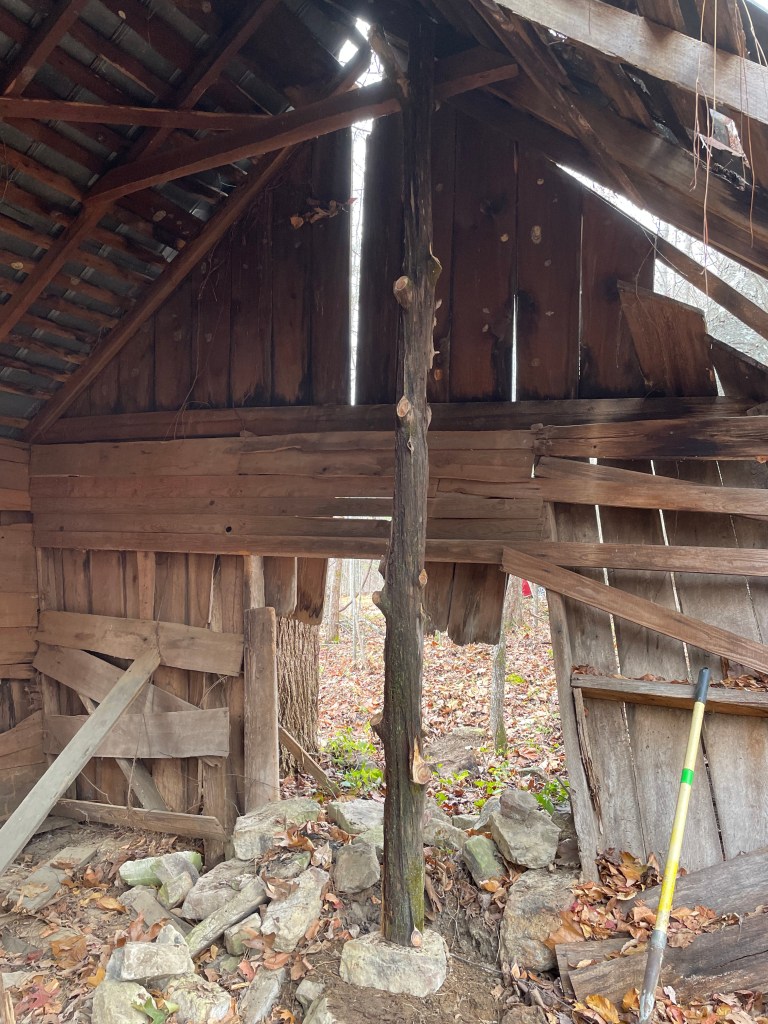
Finally I figured out that it was just the upside down v-shape of the rafters with their opposing force and a few collar beams taking the place of the missing joists that was keeping this part of the structure from folding up. It seemed just slightly more solid than transcendental levitation and I pretty much dropped everything I was doing right then and there to make a post fashioned out of a fallen cedar that had not rotted out. 

The post

At some point early on in my deconstruction preparation, the neighbor whose goats died stopped to make sure I wasn’t some interloper stealing wood off the cabin. I walked out of the woods to meet him on the dirt road and told him about my plans for taking it down and reusing the good lumber for a new place. 

“Aw well, I know you’ve got to do what you’ve got to do, but we’ll sure hate to see her come down,” he said. 

I appreciated him saying that. I’ll hate to see the cabin go too. I like an old dilapidated cabin as much as the next person whether in person or in the form of an oil painting or artistic photo. It represents a special kind of peaceful solitude to anyone who’s ever thought of living out in the woods. But more than what it symbolizes I love the idea of reusing its materials and making it a part of a cabin that I can actually use.

December 31, 2023

I had a video of me singing Cat Steven’s “Oh Very Young” here as a bit of a teaser to get people interested in this latest blog. I figured some people might be more interested in bad singing than good writing. (Bad and good are likely overstatements on both accounts.) I actually think the singing was okay, but in the end, after a few problems getting the video to appear as the featured photo I chickened out.

Voice lessons are on my bucket list though. I say this while acknowledging that the bucket spills over like a child’s ten-thousand lego collection. It includes ideas that, like the toy, venture far beyond the original rectangular-shaped blocks. My bucket list is messy and unachievable if what science predicts is true and I only have one life to live.

To that end I recently gave away a guitarrón that I found tied to a pole and labeled “free” near the elementary school where I take Sasha to play. Learning a bass, string instrument is one of those legos scattered in the corner of the room collecting dog hair and dust far from the bucket.

This new year, I’m likely giving up several other things that are not on the bucket list but have been a part of my life for many years to a greater or lesser extent—motorcycle riding being the greater one. 

About a month ago I was in two fender benders two days in a row both, coincidently, on my way to see a movie in the theater—something I don’t do on a regular basis making the accidents all the more odd.

In the first incident I was standing at the box office when I heard yells across the parking lot. My truck had rolled backwards and bashed into the bumper of a parked vehicle. In the second incident, I was on my motorcycle stopped in traffic. I looked backwards for a clearing and then quickly accelerated around the car in front, raking off my side view mirror and doing considerable damage to the side panel of that vehicle. Both accidents were 100% my fault. 

Amazingly I was still able to make both movies without illegally leaving the scene. 

The first movie, Radical, was one of those teacher-hero movies that  we like to indulge in. (Not a feel good movie as much as an empowering one.) The second was Fallen Leaves a reluctant love story and bemusing comedy with interesting directorial choices that created a different time and place. I liked them both. 

The two accidents might be a small price to pay to bring an end to my participation in this notoriously dangerous activity. I’ve been riding motos for about 40 years. It’s fun, convenient, and inexpensive but in my estimation I no longer focus well-enough to ensure my survival. 

I’m replacing the mirror housing which I’d already glued together three times. I’ll spit-shine the bike and sell it in the spring when people are more interested in riding.

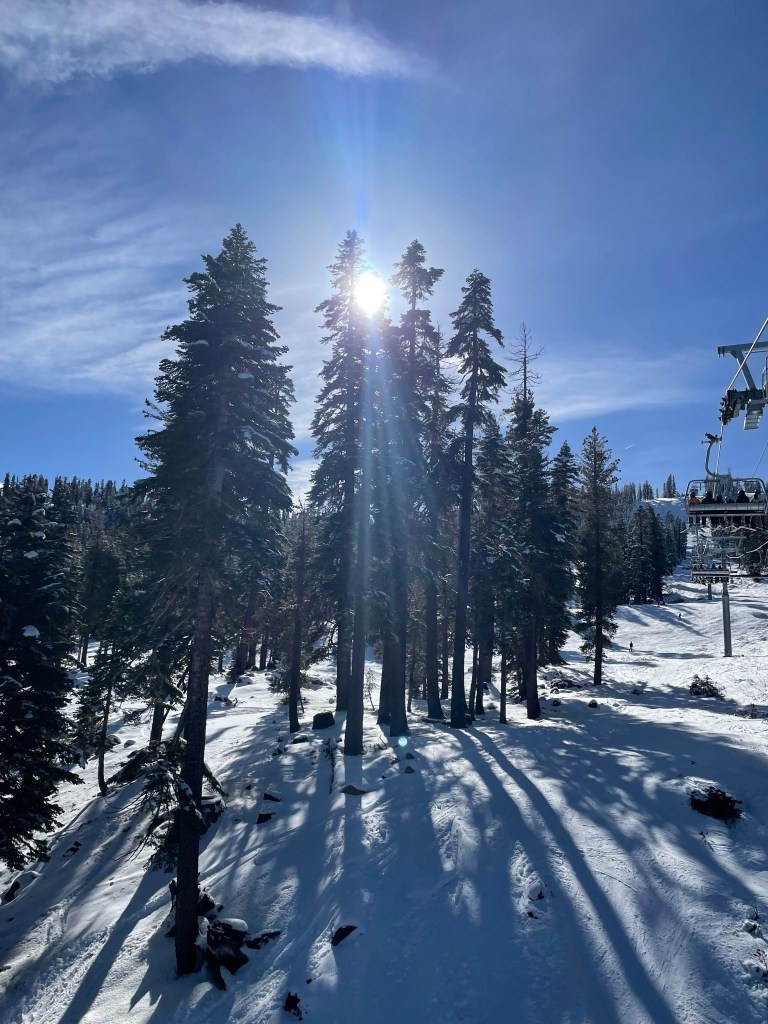
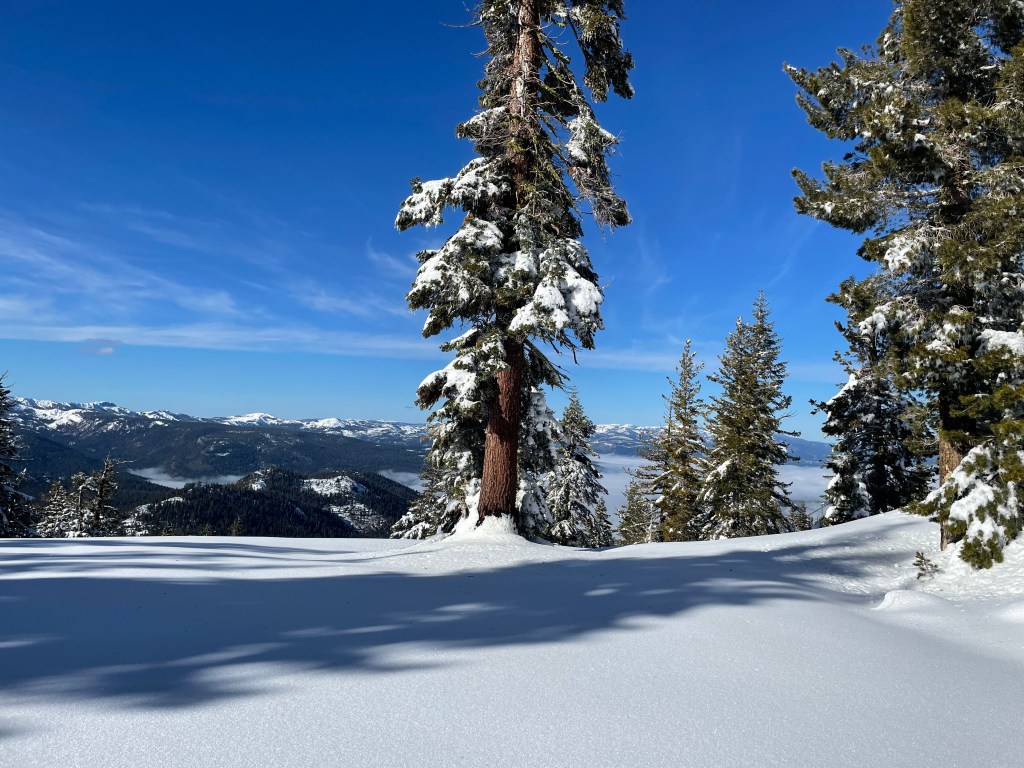
The other activity I will be giving up is down-hill skiing. There is no great emotional cost here. I’ve only done it about ten times in my life. I went a week ago and found myself close to terror after deciding to take three lifts to the top of the mountain and then finding there were no easy slopes down. (Planning and stupidity play a part in this as well.) 

A view from the ski lift.

I don’t have a problem staying on my skis as much as slowing and, of course, with that equation there is a point where the two lines traversing the x and y axes cross each other and end like a cat’s ball of string. Fortunately, helmets are standard issue these days. To be fair, the conditions weren’t great with a lot of crusted over snow, but when I figure in the cost of a lift ticket, rentals, a hotel room, and gas to get there it is a hobby I can afford to give up. 

A view from the top.

The dangerous activities I intend to keep (living being among them if you pay too much attention to the news and Next Door Ring camera postings) include riding my electric bicycle and bouldering in the climbing gym. Concord has dramatically increased the safety of bicycling by painting new bike lanes. My heart has leapt for joy with each new lane that has appeared. 

Yesterday I shipped my bicycle battery to a business in Colorado to get a complete rebuild. The battery is ten years old and losing its range. The cost is $700 versus buying a new one for $1700. The rebuild is supposed to be better than new as it will add on some extra range and amperage. 

I was just shy of 20,000 miles on the old battery before I shipped it off for a rebuild this past Friday.

————————

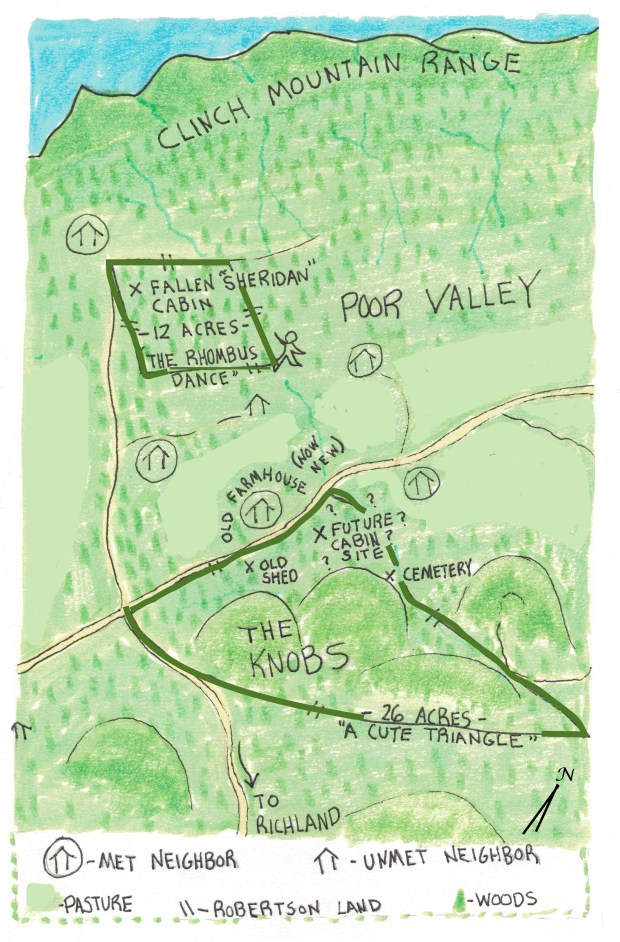
Tomorrow I leave for Tennessee to finish off my vacation at my Aunt’s in Corryton and work on my land which is nearby. On the to-do list is finding out why my driveway permit has not been granted although I put the application in with the county over a year and a half ago. The driveway is the space off Poor Valley Road that I intend to gravel near the footbridge I built this past summer. Crossing this footbridge is a short uphill hike to the tabletop where I may someday build a cabin that will overlook the valley between the knobs and the Clinch Mountain range. 

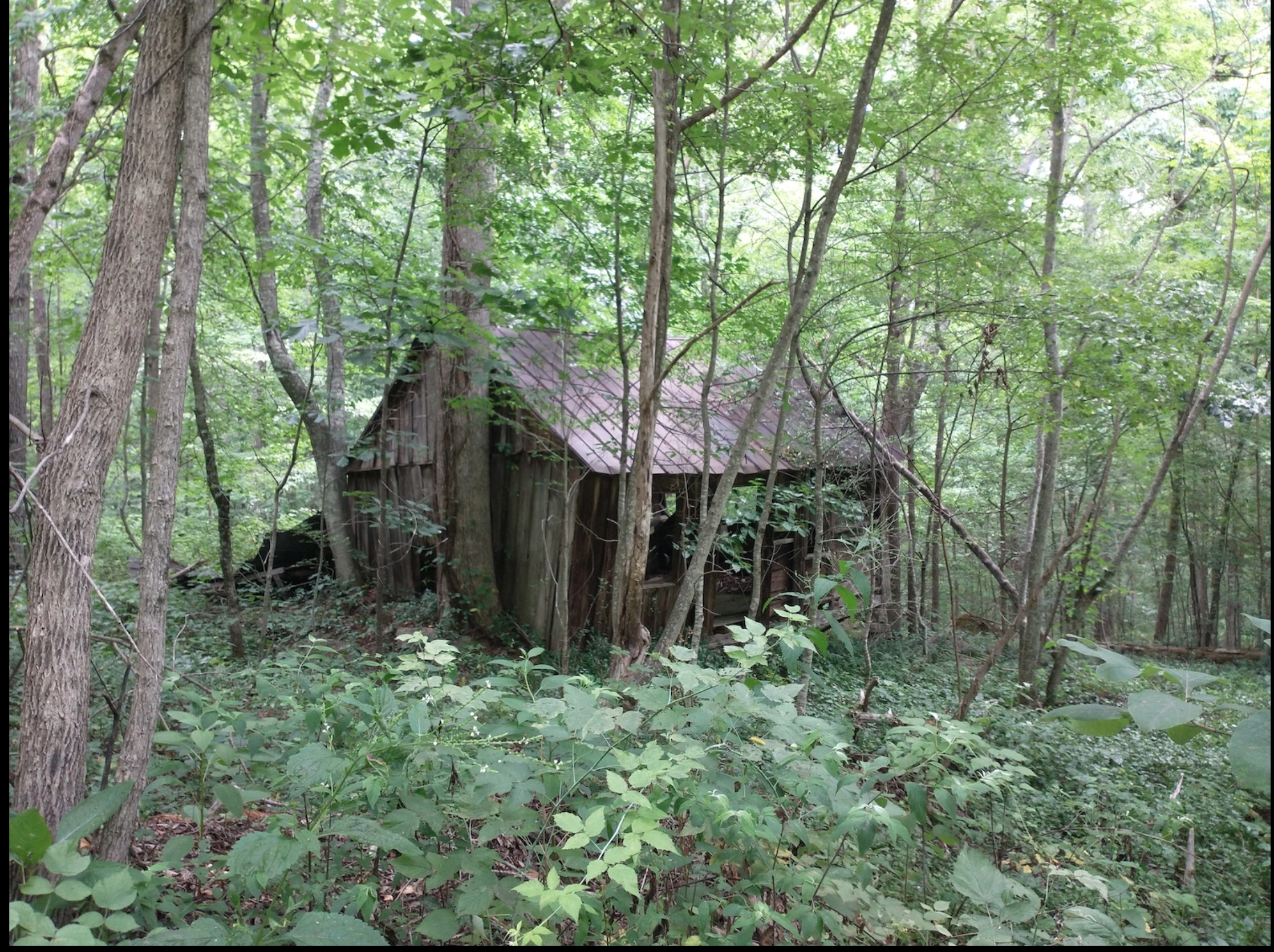
That intention relates to another thing on the to-do list which is to deconstruct the falling Sheridan cabin to use some of the timbers for building the new structure. There is hundred-year old metal roofing that I’d like to salvage along with strong, oak dimensionals of similar age. 

I’ve given plenty of thought on how to do this deconstruction with little surety that it is achievable in the short time I will have this trip.

I’ve been watching YouTube videos which are helpful although most show deconstruction of structures that are more stable than my falling cabin. Common wisdom seems to suggest that taking it apart from the roof down is the best way to insure the maximum undamaged salvage. How to do this safely is the trick since the whole structure is leaning precariously. Walking on the roof secured by a rope attached to an overhead limb might be a good strategy if there is one available. I might also be able to brace the leaning structure adequately with wood on one side and tie it to trees using a winch on the other side. 

I’ve also thought of just pulling the cabin down. One person suggested this might be accomplished with less damage to the wood if I first cut halfway through the supports at the bottom.

Whatever progress I make, or don’t, I’ll be sure to include it in my next post. 

The image on the left makes the cabin seem almost usable. The image on the right is what you see when you go around the other side.

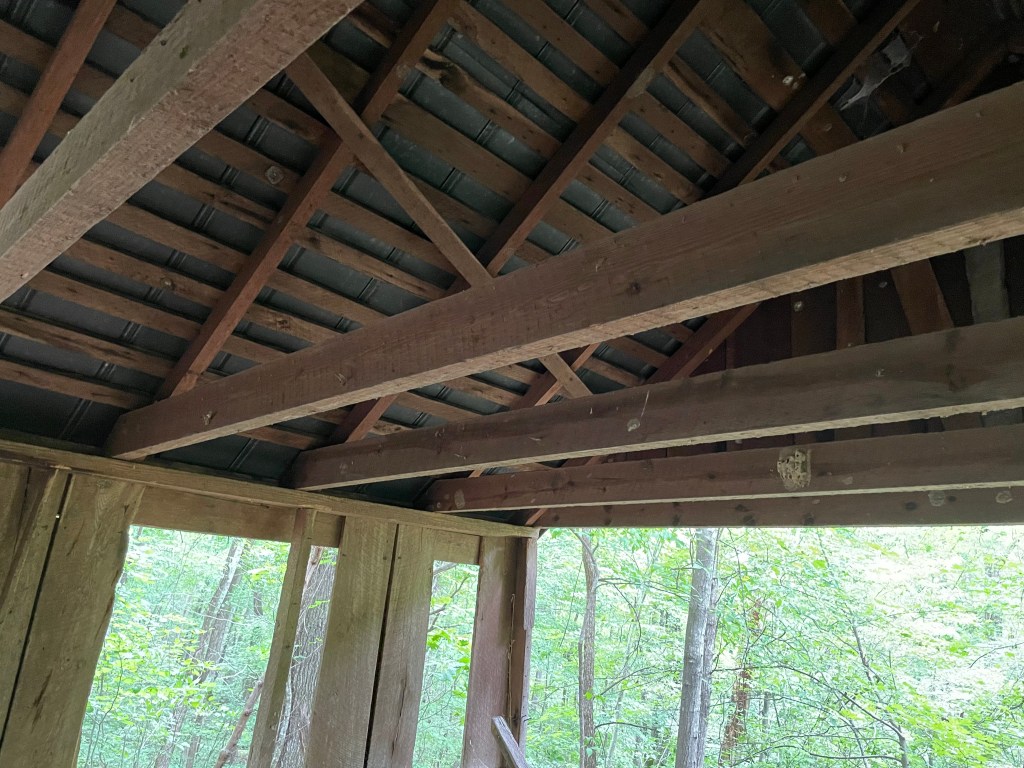
There is a lot of good century-old wood in it like these 2×6 joists.

————————

This coming year feels fraught with tension at home and abroad. I sure hope people stop fighting. I know that sounds like a simplistic wish for these complicated and deeply ingrained divisions, but it’s a starting place. People agreeing to not kill each other is always a good starting place. 

Peace in the New Year. 

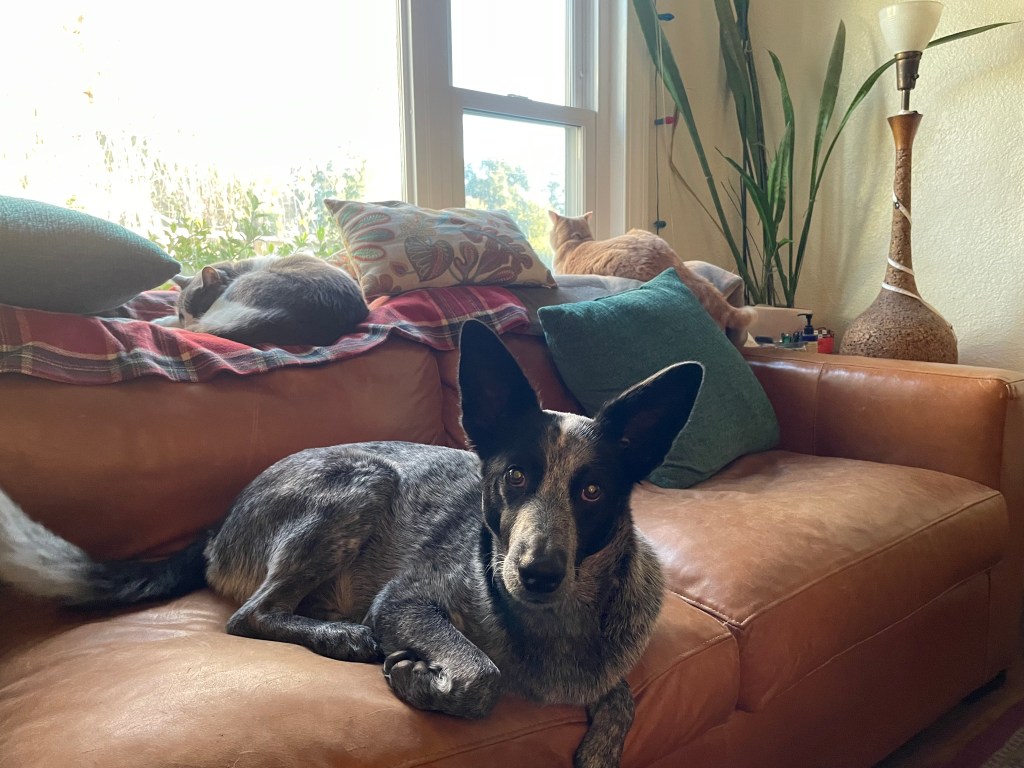
The couch under the front window is a favorite spot for our fuzzy family. Old man Buddie and little lady Ruby Lou sit atop while the incredible Sasha Moonbeam faces the camera.