-
January 4, 2026
I was helping one of my students with doing some multi-digit subtraction a few days before our winter break and he asked me “Why do they call it borrowing if you never give it back?”.
I was flummoxed. I didn’t have a good answer and I’m not sure if I do now. Subtraction is just about taking away. You don’t give back at all. In the subtraction algorithm one digit takes from the next digit over so it can give what it needs to the digit below it. It’s all just part of a process. It’s like your body taking nutrients from your stomach to power your brain.
I think in the education world the correct term to use might be “regrouping” which makes more sense in terms of meaning but maybe not as much in common language. We are a nation of borrowers, but how often do we regroup? That involves teamwork or at least the notion that we have multiple things going on and sometimes we need to sort them out.
The language is important to me as a writer but I didn’t care much about it as a kid which made this student’s inquiry kind of special.
Back when I was his age my number sense was better than my word sense so when teachers said, “borrow from the whatever and carry the one”, it didn’t matter that the language didn’t make sense. I understood it was just a shortcut to get to the answer even though there was more wrong with the language than just the teacher saying “borrow”.
Carry the one was a complete lie. In the subtraction algorithm you never carry a one (for whole numbers any way). You might carry a ten, or a hundred or a million, but one is not a number that gets carried.
From what I remember teachers didn’t pay much attention to number sense. You either had it or didn’t and the addition and subtraction algorithm (stacking numbers on top of each other) was hoisted on us pretty quickly before we had a good idea of how much bigger 1,012 is than 112.
But what did I know about what teachers were paying attention to? I wasn’t paying attention to them!
_________________
I made it back to Tennessee for some time on the land and family visiting. My old friend Steve joined me. I met Steve way back when his wife was his girlfriend and I worked with her at Hospitality House in the Tenderloin neighborhood of SF.
Steve and my Aunt Linda hit it off big time. Often, when I left them alone I’d come back in the room to see them laughing and smiling, telling stories or talking history.
My trip was short. Steve’s even shorter. I arrived on a red-eye last Saturday and he came that night. He left on New Year’s Eve and I left New Year day. Still we got a lot in which included some delicious meals made by Aunt Linda and winter camping on a night that got down to 22° F.

Surprisingly, the red-eye wasn’t too bad. I had everything I needed to make sleep possible—my 40+ year-old down jacket from college days, a window seat, a neck pillow, Benadryl and two doses of NyQuil in a 2-oz bottle. It’s one of the few times that having a congestion cold was convenient. If I ever take a red-eye again I might try to skip the cold but take the doxylamine. I made sure to clear my ears with a gentle, pinched-nosed push at intervals all the way up to cruising altitude and again on the way back down for both jumps of my trip.
I think another thing that helped was that when I got to Tennessee, I stayed up and didn’t try to “sleep off” the red-eye which would have likely just confused my body more.
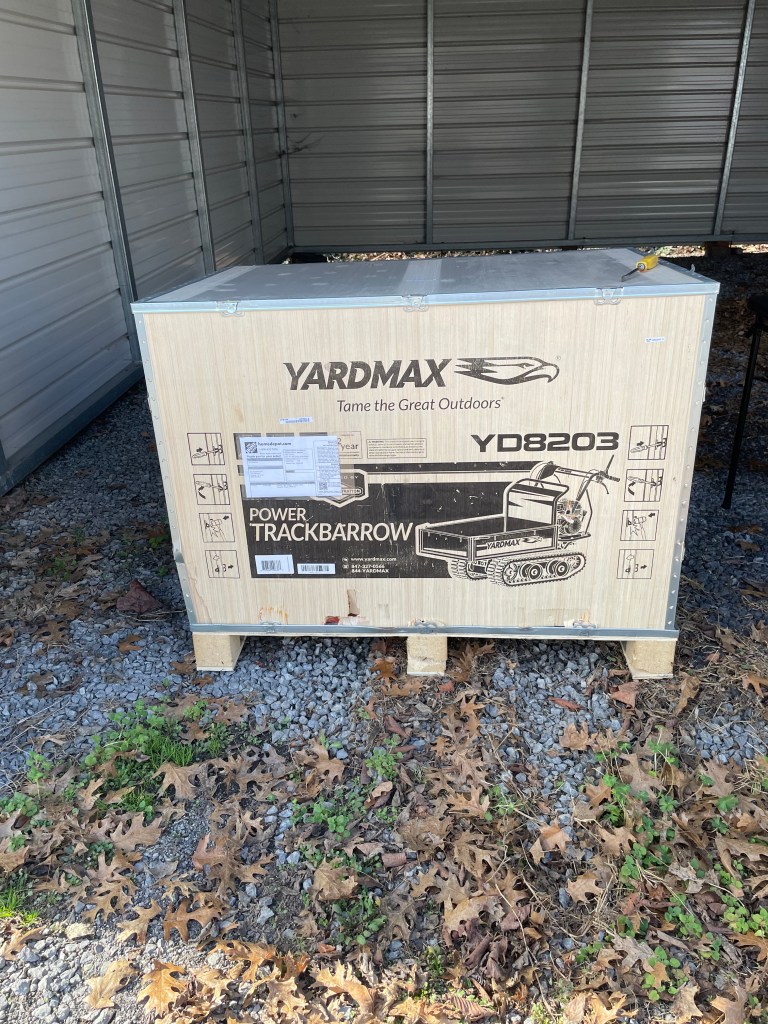
I purchased the track barrow I’d been pondering. Linda picked me up from the airport and when we got back to her house I went straight to work unpacking the crate and putting it together.
Before I got too deep into it I walked down to the farm office nearby and picked up Stewart’s truck, then drove out to my land picking up some gas for the new machine on the way. I wanted to see if I had any lumber that might fit the bill for making ramps, but I pretty much knew I didn’t. It was really just an excuse to check in on the land.
It’s exciting to walk the main trail after I haven’t been there in a while. Not much had changed beyond everything. Absent summer foliage, I could see the shape of the land through the vertical line of timbers. Shades of brown was the theme instead of green. There was a small tree down across the trail near the south entrance. It was at head-height caught up in some limbs and would be easy to take out with a chainsaw.
At the north driveway entrance, the long limb barrier that I had placed on forked branches and hammered into the ground was down on one side. A fork had rotted out.
A thick pile of leaves covered the gravel drive and all the trails. The top leaves were dry but underneath recent rains made a wet matted layer. My footsteps had a lighter, higher pitch than the tumbling sound that can happen when walking through leaves that are dry and basket-deep.
The planks I’d cut from the oak last summer had all dried without warpage, but none were thick or long enough to be used for a ramp. My new machine weighs 660 pounds. The ramp kit I bought recommends two 10’4” 2x8s for the truck tailgate height of 32”. In the shed I had one twelve foot, 2×8 from the orange box store, but by itself it was useless and two six foot planks were two short.
By the time I walked the land and looked around the sun was getting low and I still needed to pick Steve up at the airport. I locked the shed and started out the 22 miles to the big box store. I at least wanted to have what I needed to load the machine the next day.
The next morning as Steve birded on Linda’s front porch I finished attaching the handles and sides to the track barrow. It comes partly disassembled to fit in a smaller crate.
Steve scored a Red-breasted woodpecker for his life list and I grabbed Linda’s binocs so I could add it to mine. When I finished putting together the barrow and ramp I lined everything up to load. Steve helped with the eyeballing. Of course, I’ll have to get used to doing this alone, but it was nice to have the extra set of eyes this first time. I’d had the not very practical thought of only loading the track barrow on ground where I could stake the ramp planks to keep them from moving but Steve had the idea of cross bracing the planks by screwing a piece of lumber between them.

First time loading the track barrow I ran out of gas half way up the ramp! I had only added a little because I wasn’t sure how much I would use on this trip. By the time we got the track barrow out to the land there was only enough time to unload it and hide it beneath some tin roofing inside the falling cabin. Days tend to slip away fast in the winter. Hiding the machine was in all likelihood an unnecessary step on a private road that has numerous postings about its privacy including, until recently, one that mentions getting shot, but I was beginning to consider the machine my baby and asked Steve to help me take measurements of the bed so I could cut some plywood from the crate it came in to protect that beautiful powder coat from any scratches and dings.
I imagine the neighbor took down the posted threat of trespassers being shot out of consideration for our other neighbor’s relatives. The other neighbor, Dennis, was shot and killed by accident last April. I’m sure his relatives appreciate not having reminders about what will likely never be far from their minds.
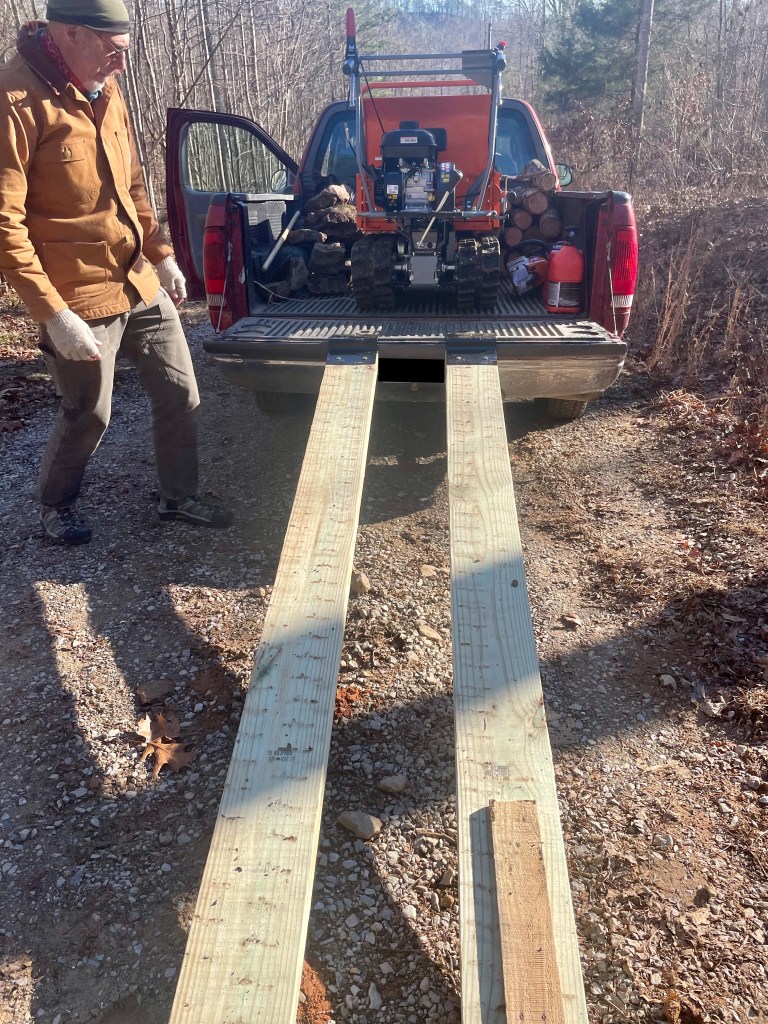
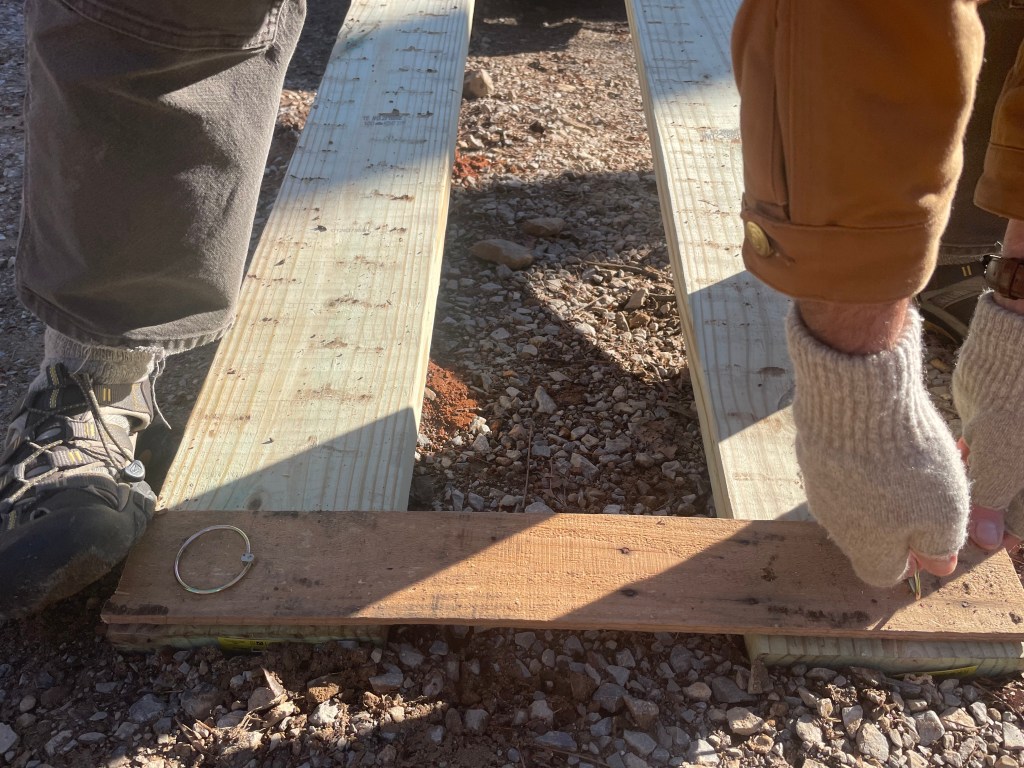
Screws to hold the ramp together evolved to push pins which make for easy removal and loading in the truck. When we got home I used the last light of day to cut the protective pieces for the track barrow while Linda and Steve talked in the kitchen. That night we celebrated and relaxed with drinks, food, and wonderful conversation.
The next day we set up camp at the proposed cabin site and then headed over to the falling cabin with the track barrow. We did three loads of rock and a load of seasoned, cut oak to take back to the campsite. I learned pretty quickly that a full load of heavy rock gives the machine a heft that can pretty much yank your arm off if you change direction too quickly. Back at the camp I also learned why people like chopping seasoned oak logs with an ax. It doesn’t take much to split. The pieces fly apart with a satisfying crack.
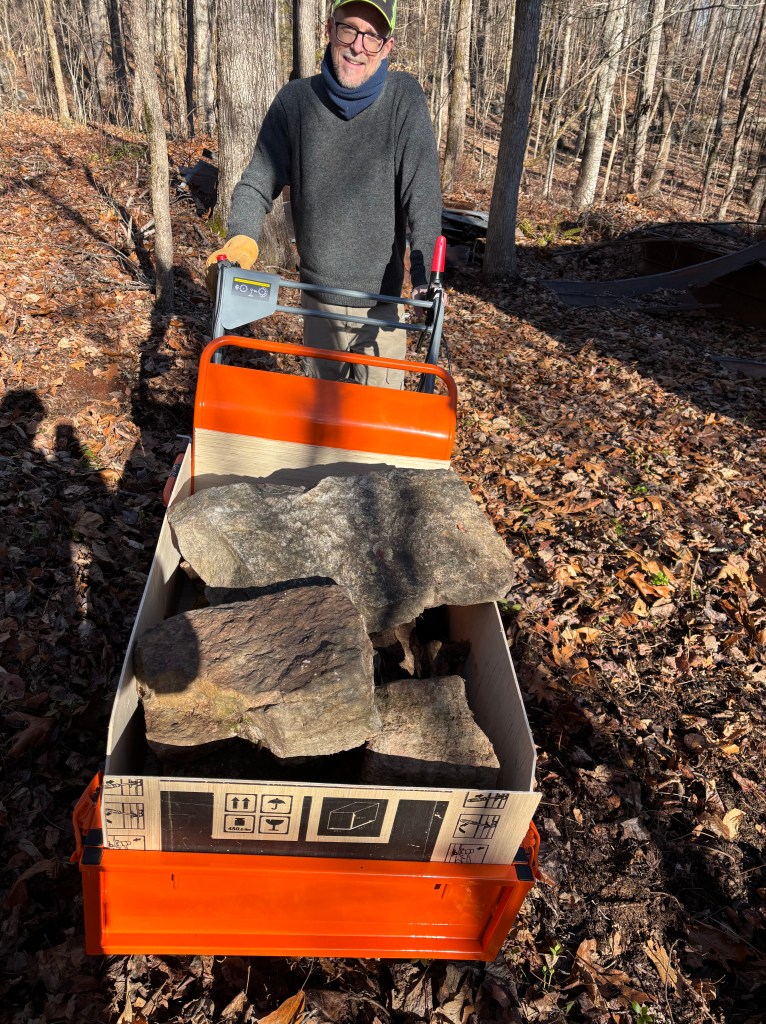
Load of big rocks. The machine is rated for moving 600 pounds but one YouTuber claims to regularly use it to move 2,000 pound loads. 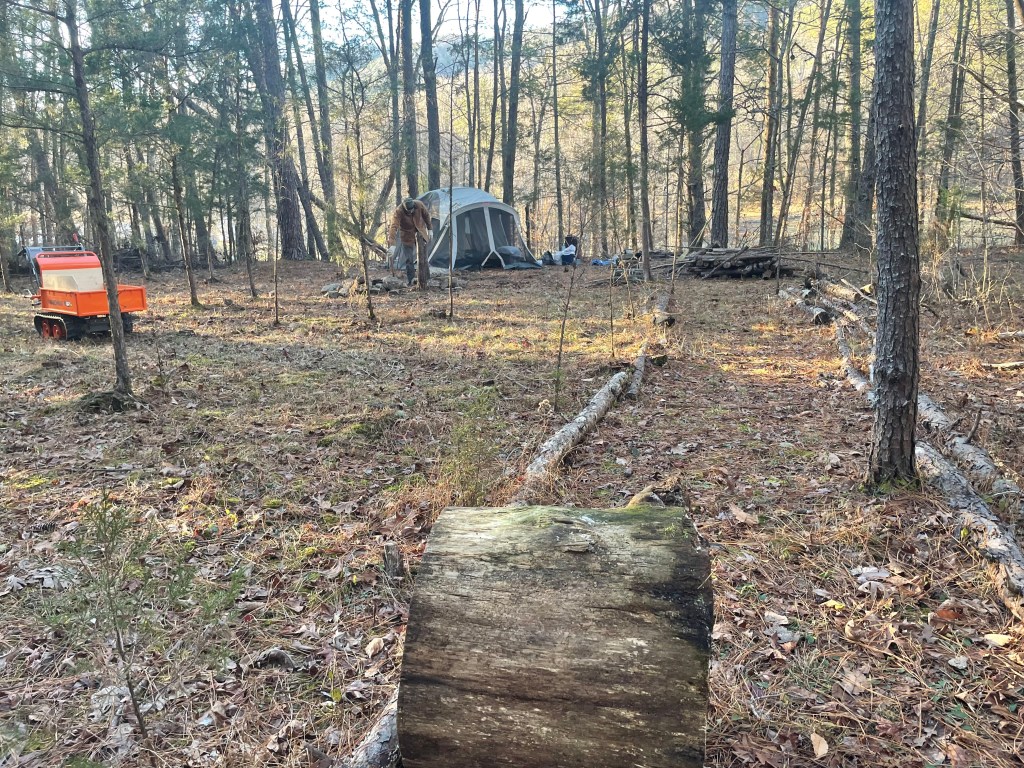
Steve making the camp fire ring When it got dark and we had the camp ready to make a fire we walked back to the truck and went into Blaine for a meal at the Mexican restaurant. We returned full-bellied, started a fire and played two games of chess reaching down to the ground between our camp chairs. When we turned in we didn’t feel the need to bank the fire as it was safe in the rock walls.
It took me three hours to go to sleep which is how long it took for my body heat to win out over the intransigent cold inside my sleeping bag. After that I slept pretty soundly according to Steve’s report of my snores although I felt like I was just below the surface of wakefulness. In the morning I stuffed my down jacket in my sleeping bag to warm it and watched and waited for the light to grow before I rose.
It was easy to build a fire back up from the coals. When Steve woke we went back into Blaine and ate a hearty Waffle House breakfast, came back, broke camp and then hiked up to the top of the knob and came back to camp on a longer path. Driving out with the track barrow and all the camping equipment we stopped at a pond to look at some small birds floating among Canada Goose. We steadied ourselves on a fence to get a good look with our binocs. Ring-necked ducks—another addition to both our life lists.
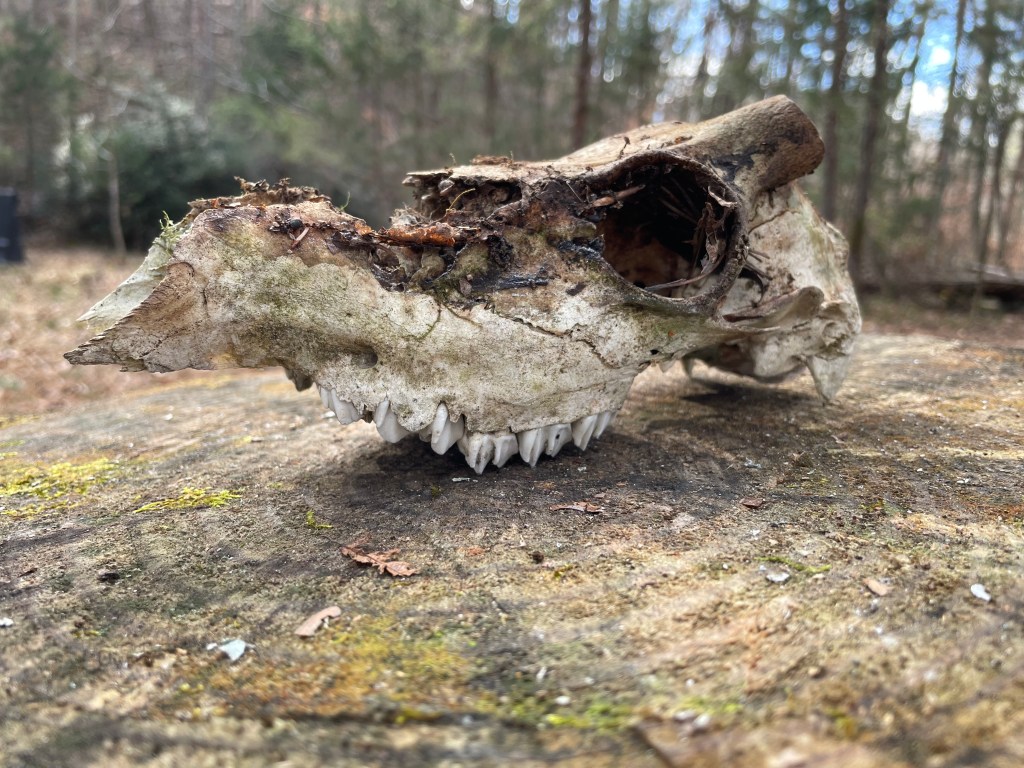
Deer skull Steve found on our hike 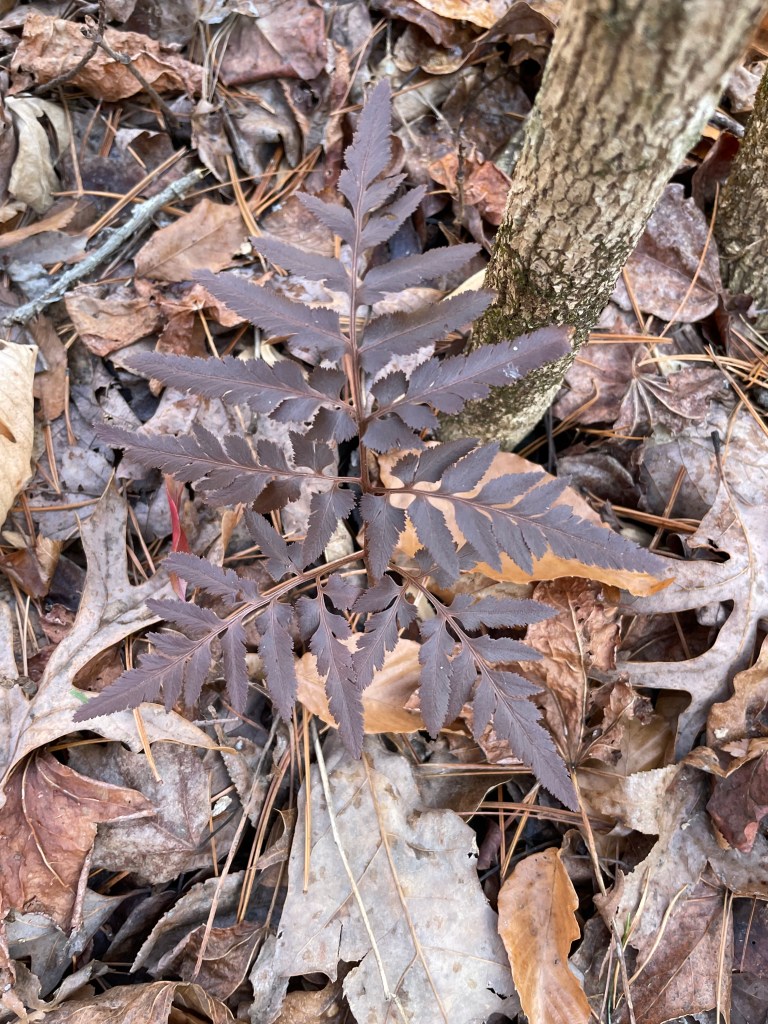
Cut-leaf grape fern Denouement
It certainly wasn’t the highlight of my trip but yesterday, I found a had a stowaway accompany me back from Tennessee. Ticks don’t have necks, so I guess the best way to describe the one found on my back would be to say it was embedded up to its shoulders. (So much for the idea that ticks aren’t active in cold weather!)
It apparently was dead and didn’t wiggle its legs when I asked Jillian to touch it with a hot match hoping it would let go and back out. (No longer a recommended procedure.) While I’d like to believe that my body produces some substance that kills ticks who dive in head first, it probably has nothing to do with any superpowers of mine.
Complete removal was unsuccessful. The head is still in there.
An interesting psychological awareness has come from this. I’ve learned that I’m not freaked-the-fuck-out by a tick embedded in me. I only get that way when I find one crawling on me.
I have a prescription of Doxycycline which I got specifically for this contingency. I’ve taken two doses. Unfortunately it has a “Discard 6/2/24” date on it. An email with pictures has been sent to my doctor.

I think this was coming into Chicago which was 12°F -
November 26, 2025
There is a perhaps unreasonable concern around our house that our dog Sasha doesn’t crunch her food enough. Nevermind that Sasha Moon Piperaceae doesn’t have teeth for grinding—that her teeth, much like a shark’s, are meant for tearing flesh into portions just small enough to fit down a wide throat. We want to hear the sound of her kibble actually breaking into pieces. Somehow we believe, without science or reason, that Sasha needs to chew her food, if not 26 times, at least once.
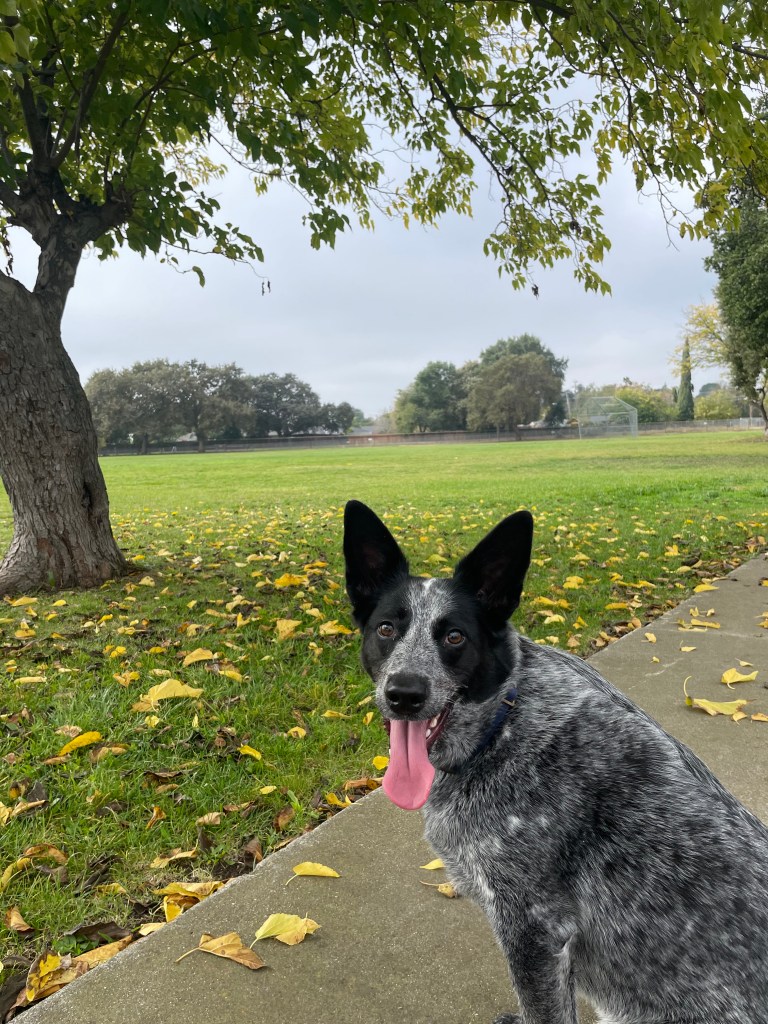
This is Sasha a few days ago at the school which I had to get her to squeeze into through a gate while I climbed over a fence. The powers that be have made is so the school yard is inaccessible to the elderly, families and anyone with a physical disability assuring that only young punks who like to graffiti and break into classrooms can get in. (Okay, there are some good kids that will still climb over the short fence like us, but what’s the thinking here?) In the morning Sasha only gets dry kibble. Then for her three additional daily feedings at 10 am, 2 pm and 6:30 pm she gets kibble with wet food mixed with water.
In the morning—to get her started on a good paw—Jillian holds one piece of kibble at a time and says, “Okay, crunch it. Crunchy-crunch.” Jillian does this three or four times and when she hears a few crunches and is satisfied she says, “Good dog,” and then pours the first of two installments in her bowl to discourage her from gulping it down all at once.
I’m just as guilty wanting our little Piperaceae to have more thoughtful eating habits. When I take Sasha to the small, oval park around the corner to play frisbee we often walk over to our neighbor Heidi’s chain-link fence to say hi to her big, white, shepherd, Abby. Both Heidi and Abby are equally aged and Abby is not in the greatest shape. When they go on walks Heidi reports that Abby sometimes looses her balance, sits down and then slides into a splayed position that she cannot get up from. Heidi has learned to take a strap with her so she can thread it under Abby’s belly to lift her back onto her feet.
Still, despite Abby’s decrepitude, she is better at crunching than Sasha. Part of our visiting ritual is to give Abby a little handful of kibble through the fence followed by the same for Sasha. Abby seems to average about three or four good crunches out of the tiny handful I give her. Then I look at Sasha and say, “Look what a good cruncher Abby is.”
This doesn’t seem to register with the little Moonbeam although she does sometimes turn her head to the side in what appears to be an attempt to understand. The perky ears and noble face are effective in making me think some learning might be going on. Afterall, my comparison of Abby’s crunching to hers is not meant to shame her as much as get her to see old Abby as a role model to live up to in terms of mastication.
When I give Sasha her small handful, more often than not I don’t hear a single crunch. She swallows it down happily but despite her joy and obvious desire for more (if I would only do her the favor) it displeases me that there is no deliberation, no sign of savoring the texture or flavor of the baked-in crumble.
Even our cat Ruby Lou with pointier teeth is better at crunching. It could be there are more chances for a nugget to hit upon a tooth in a smaller, rounder head.
To get my fill of good chewing I really need to head out to the country and be among the horses and cows. I’m going to do that when I visit Tennessee for a few days after Christmas.
——————————
The iconic image of General Ulysses S. Grant outside his field tent keeps popping into my head. It’s not because I think we are headed toward a civil war. A unified uprising is more likely when people realize the scales of democracy have tipped heavily toward a wealthy oligarchy. Things may end up more like the age of the guillotine in France when someone famously tried to say to the poor masses, “Let them drink a double mocha chai latte with oat milk.”
The real reason Grant keeps popping into my brain has more to do with his tent than his position as a warrior. I’m starting to think more seriously about using one in place of a cabin or, at least, as a placeholder to get me more quickly to the real reasons I want to be on the land — for peace and quiet, reflection, to learn about nature and commune with it. Those reasons spiritually, philosophically and aspirationally outweigh comfort but in actuallity it remains to be seen if comfort outweighs them. (I installed a small, window, air-conditioner in Aunt Linda’s upstairs room where I stayed last summer.)
It will be easy enough to test my theories about camping out. I’ve done it once on the land but really should experiment more outside the hottest and coldest times of the year. That will be easier when I retire. The count down for that is a year and a half although I sometimes have a strange premonition that I won’t make it that long, that I will die a violent death or that a disease will latch upon me. Is this merely the next stage in aging—to prepare for one’s own demise or is it a dangerous meddling in self-fulfilling prophecy? Did the crooner d4vd actualize his darkest thoughts put forth in his music videos or is he being set up? For a frightening exploration into dark self-fulfillments this old movie based on the Stephen Crane story can’t be beat: The Blue Hotel
I guess the reason the image of Grant works for me is that I imagine his tent furnished with a desk and chair and other amenitities which might make living out in the elements feel less so. But the reason his persona doesn’t work is because I don’t wanna study war no more although, of course, our society is steeped in the expertise and it’s hard to escape its constant advertising. I should nudge my imaginings toward replacing Grant and his tent with something like a biologist’s which no doubt have been equally accommodating for some. Jane Goodall? Surely there was a time when John Muir had something more than a bed roll and a backpack out in the field.
Lower cost and effort are obvious advantageous to tent living versus cabin living. Effort is debatable, but I think if you compare everything that will go into building a cabin, there are many, many years of setting up, tearing down and furnishing a tent before those lines would cross on a graph.
The lessor environmental footprint is perhaps the biggest, lasting advantage of going with a tent. Although I’ve already invested in some destructive/loud tools like my chainsaws, after thinking long and hard I’m pretty much set to do without heavy equipment like tractors, skid steers or comparatively benign ATVs. My next post may deal with that.
I am thinking very hard about buying this power wheelbarrow although greater acquisitions are a slippery slope. Going the way of bigger, better, and more expensive is dazzling and compelling but ultimately that way is more about chasing a dream that isn’t mine instead of living the one I have.
On the health front, I recently found out I have some beginning arthritis at the base of my left thumb. In the x-ray report it is called “mild first interphalangeal joint degeneration”. Interestingly, it’s not bothered much by indoor bouldering, but hurts a lot (or was) when riding my electric bike. It’s a very specific sore spot activated by direct pressure or a sort of fulcrum grip for instance if I were to lift a tray of food by the edge, one-handed with the pressure of my fingers under and my thumb on top.
I’ve actually been listening to the doctor’s recommendation to rest. I’ve not been climbing or riding my bike for close to a month now. In some ways the less busy schedule has been nice but I’m starting to miss not having a windshield between me and the world and the fun of indoor bouldering.
I bought some rather expensive herbal pills that seem to be helping with arthritic inflammation and some padded bicycling gloves which I’m going to test out when this Thanksgiving break is over.
__________________
Since many of you may have some relaxing time coming up I’ll tell you about what I’m watching and reading (or rather, listening to on audio).
TV
The Change — British comedy-drama about a woman who keeps a journal of every household chore she’s done for the last thirty years and then decides to split and take a break from her family. Written and co-directed by lead actor Bridget Cristie the second season is co-directed by Mackenzie Crook creator of Detectorists, another favorite show of mine.
Plurabis —Vince Gilligan, the maker of Breaking Bad and Better Call Saul created this interesting twist on the zombie apocalypse theme. Funny, frightening and thought-provoking it stars Rhea Seehorn who was the lawyer girlfriend of Saul in Better Call.
Good Cop/Bad Cop — Light, lightly irreverant and comically macabre with a cast of not overly attractive characters who you might get a crush on. Sibling rivalry with sibling love. Cute is a word that doesn’t quite fit but wouldn’t be wrong.
Matlock — Kathy Bates plays a lawyer fronting as a homespun, lovable, story-spinner inside a firm she’s trying to get the dirt on. I like it but Jillian is kind of over the second season.
Man on the Inside — It’s so refreshing to have a mystery/detective show that doesn’t involve murder. Also, it stars Ted Danson and is set in San Francisco. What’s not to love?
Books
The Adventures of Huckleberry Finn by Mark Twain and James by Percival Everett. James was picked for the Pulitzer Prize this year. It is a reimagining of the Huck Finn story with Jim, the slave, as focus and main character. The jacket cover claims it is ferociously funny which is a stretch, but it is certainly ferocious. I don’t think I’ve ever felt so clearly what it might have meant to be a slave in a world surrounded by the enemy. This was the real zombie apocalypse with all whites as the zombie’s. Are we awake yet? It is certainly worthy of the Pulitzer though it didn’t win without controversy.
As for the original Huck Finn it’s clear why it is considered an American classic. I don’t know how much Twain has been studied as a nature writer but I felt it strongly in his descriptions of the Mississippi River. He is certainly a humorist and on par with the likes of modern-day David Sedaris. I don’t get the last fifty or sixty pages of Huck Finn and why Twain decided to give so much ink to the sadistic nature of Tom Sawyer. Maybe someone can explain?
All Fours by Miranda July — a disturbing, dark dive into sex, self-actualization, partnering, parenting, art and public acclaim. It’s called a novel but I’m guessing it’s autobiographical. If you’re a tortured egoist or have done a good bit of navel-gazing you might not want to revisit and if you haven’t you still might…not. Nevertheless, the main character’s misery and trouble are compelling and often very funny. What happens when the Anti manic-pixie-dream-girl becomes perimenopausal and feels like the window is closing fast on her last chance at sexual fulfillment? I’m just two-thirds done so I can’t say if there is a happy ending. (Not that I need one but I’m kinda hoping.)
Phew. I’m glad to finally get out a blog post after so long. It helps me stay sane, ground me where I am, tell me what I’m doing and what I want to be doing.
Happy Thanksgiving!
-
July 20, 2025

I’ve been back home more than two weeks and I’ve struggled to get out this blog post. Everything I experienced in Tennessee now feels like bunched up laundry in a bag and I’m trying to dig through it to find specific pieces. Is there a theme I can work with? What stories are worth telling? What is the overall feeling I came away with?
I think I need to start with this picture of my first piece of sawn lumber:

This measures 2.625” x 5.625” x 6 feet 8.75 inches.
Standard measurements weren’t my concern as much as cutting something square.My whole trip felt like it was leading up to this yet it wasn’t until the last two days that I got it together to actually try out my new equipment.
The Alaskan Mill came in a flat box and I put it together a few days later. For the next two weeks the bulky metal frame sat on Aunt Linda’s living room floor while I got my thoughts and courage together.
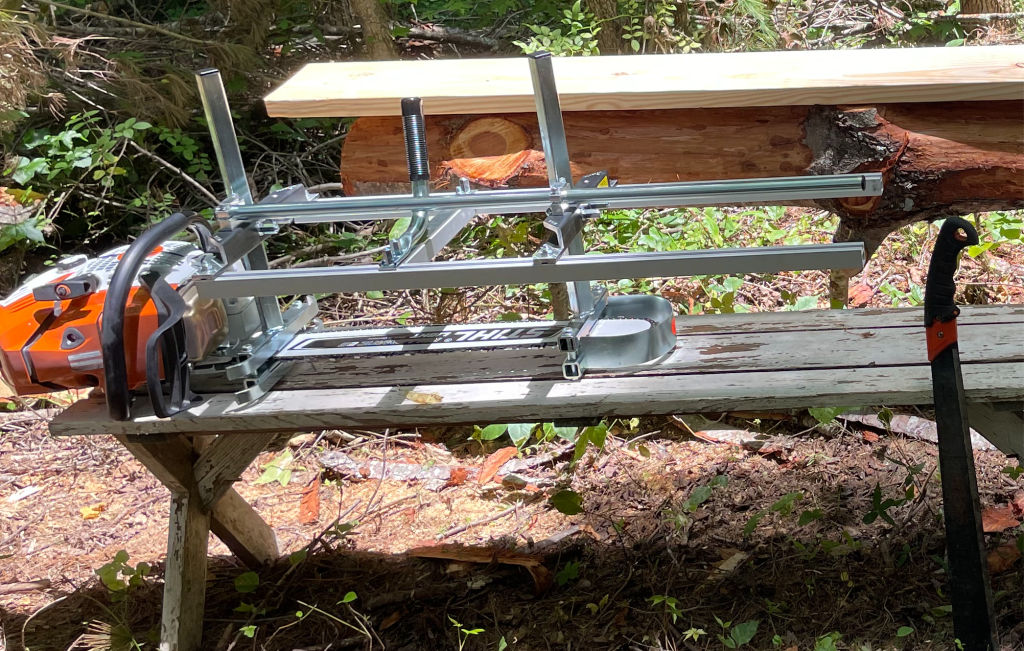
To call this product a mill is a bit of a misnomer. As a noun, the word means a place where things are cut. It goes without saying that the place has to have the machinery to do the cutting. In this case the mill houses the chainsaw and guides it through timber.
I’d finally gotten comfortable using my smaller chainsaw. Now I’d purchased one twice as powerful and I was going to attach it to this apparatus that together would make it all weigh close to forty pounds.
No single Youtube video answered all my questions about using the mill. Most showed people milling sectioned logs, but I wanted to mill directly off the fallen trees. My thought was that cutting a log, then moving and lifting it onto a level platform would be a difficult waste of time.
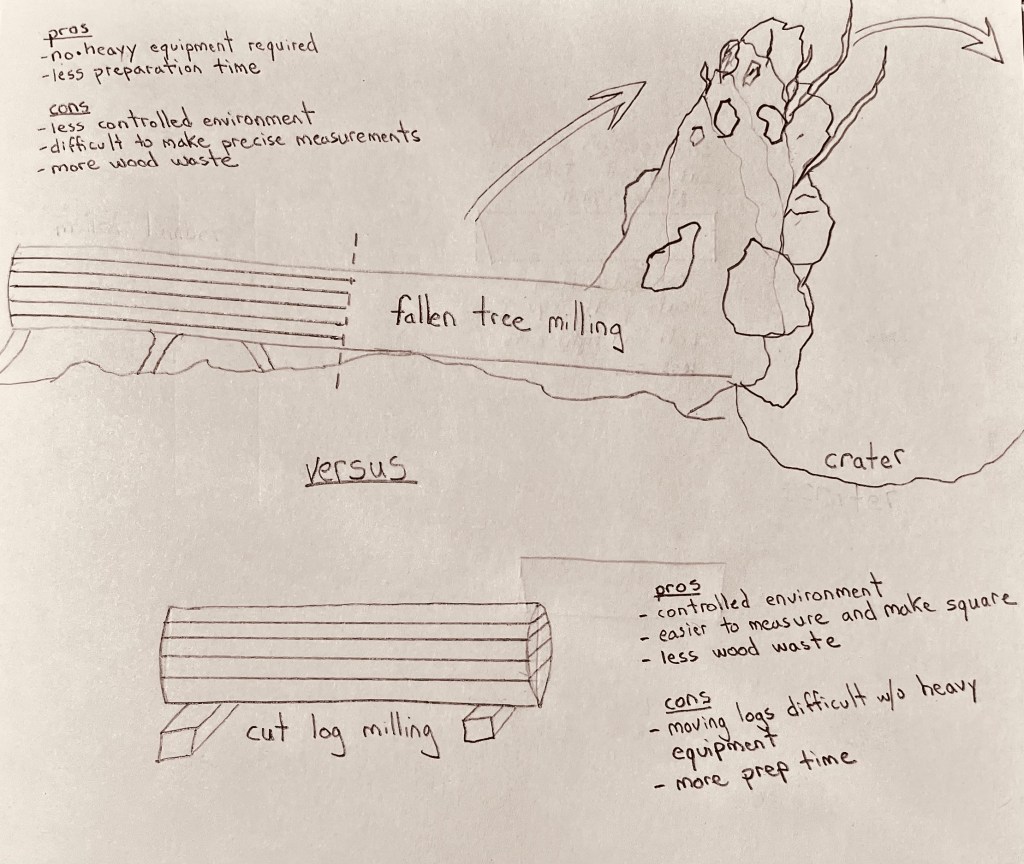
This drawing illustrates some of my thought process for milling directly off a fallen tree. For now the pros outweigh the cons although along with the dangers of working on uneven, hazardous terrain I discovered another threat while cross cutting a small tree that had fallen across a path. After cutting off most of the tree, the remainder, relieved of the downward weight, quickly stood back up. Small though it was, it might have smacked me in the head. Thinking of that same situation with a very large tree, a person milling off the end might find themselves suddenly catapulted fifty yards across the forest. The arrows above are meant to show how a massive root ball could stand a tree back upright into its crater. Youtube has hundreds of videos detailing ways to kill yourself with a chainsaw and most don’t involve getting cut. I ordered a cheap companion mill—a Timber Tuff guide—to square the sides of the downed trees with vertical cuts rather than using the Alaskan Mill which would require turning the log.

It was a lengthy learning process making my first piece of lumber. With experience it might have taken just ten minutes. It took me three hours.
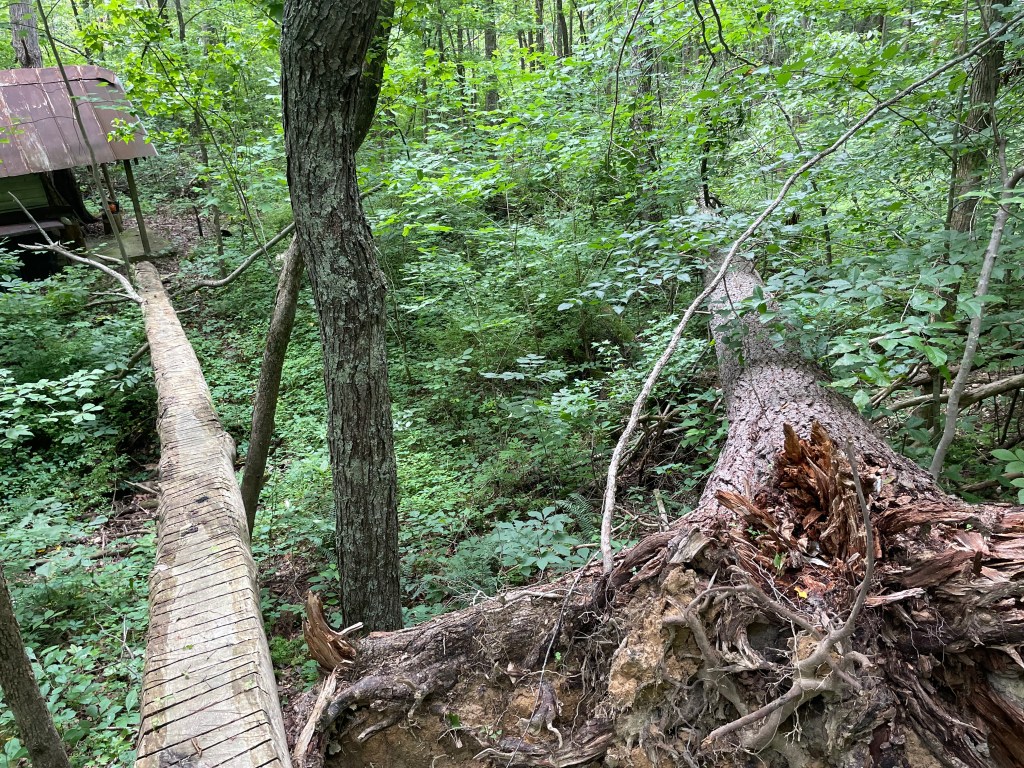
This hundred foot White pine came down sometime after my last trip to Tennessee in January. It was right next to the pine that I cut into a bridge three years ago. I started milling at the other end.
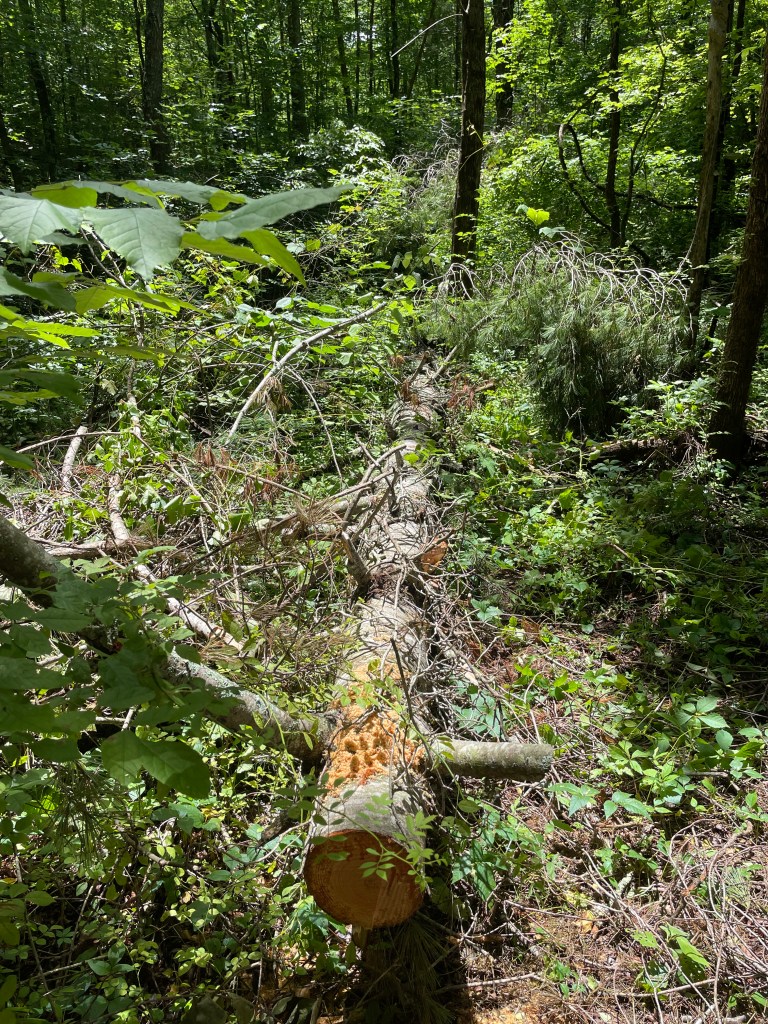

I first cleaned up the end cutting off branches and clearing the area around it.

I used a draw knife to cut the bark. This may have been an unnecessary step but it reduced the sticky sap being slung everywhere during sawing .
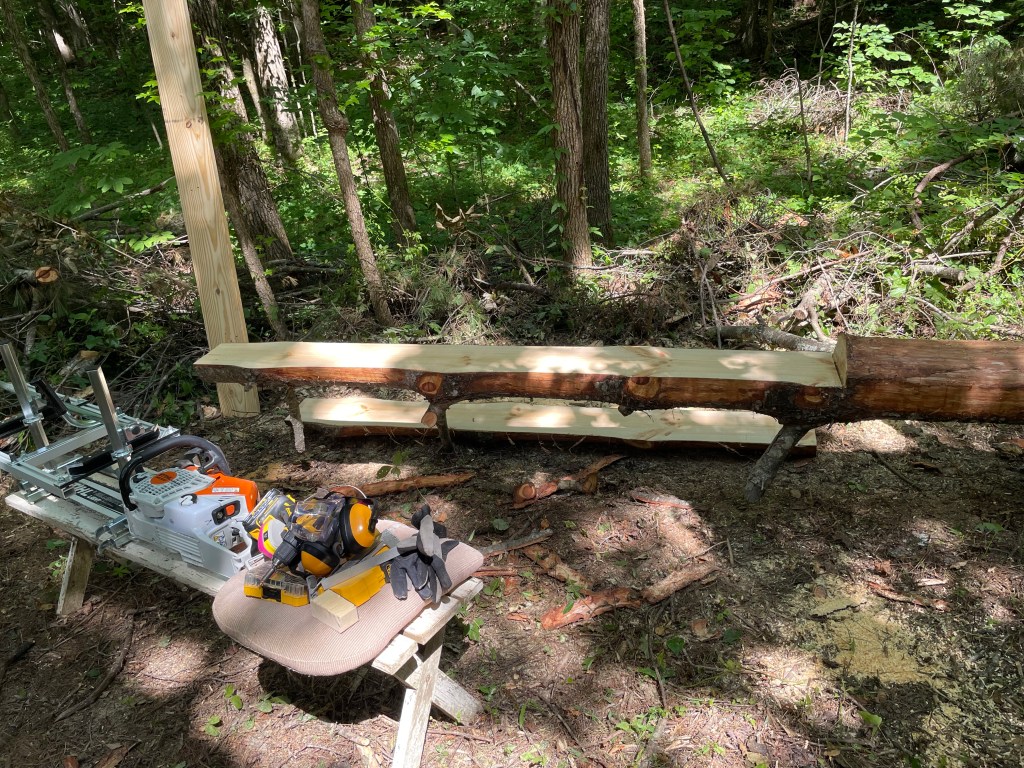
My first cut was too deep but it prepared a level surface for making subsequent edge cuts and the next horizontal plank cut.
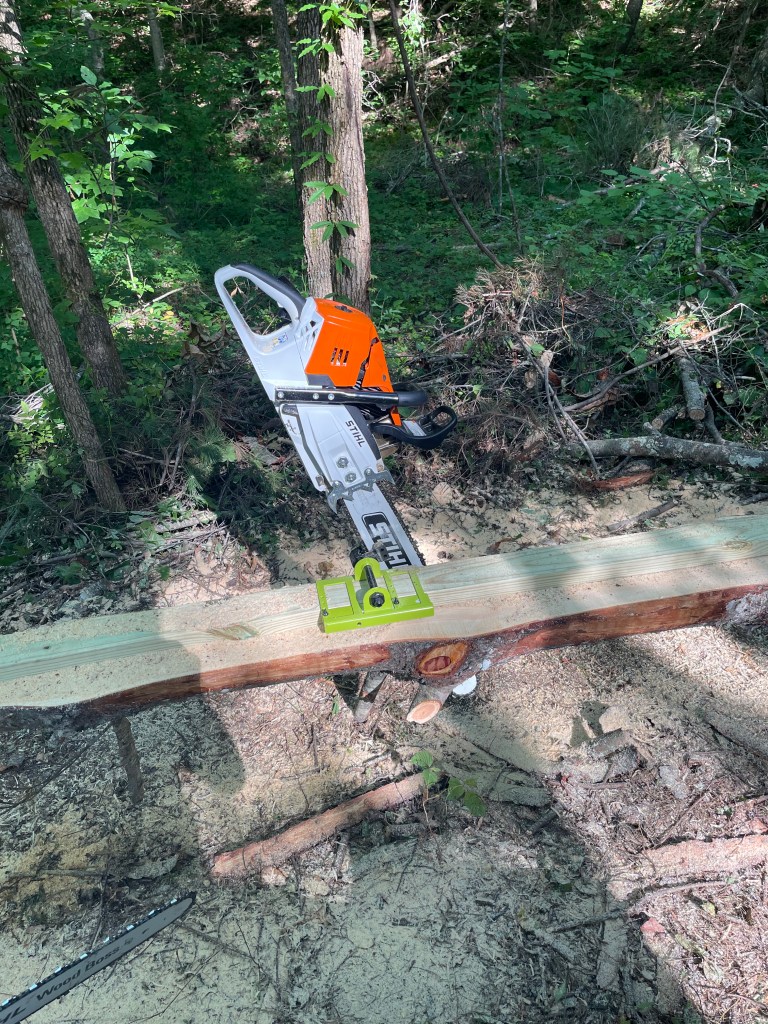

My single piece of lumber was milled off this.

Entirely too many things on my head, but the respirator is recommended because the chainsaw is running constantly when milling and there is a lot of exhaust and sawdust. 
I was happy to find a use for my overzealous first cut. It was much thicker than I wanted because of a measuring error. I envision more benches like this along the walking trails. Why That First Piece of Lumber Took So Long to Mill
*I practiced putting the chainsaw in the Alaskan Mill before leaving home, but this had to be relearned in the field.
*The countersink on my drill bit was not sinking and I didn’t have the right size allen wrench to tighten it. (My chosen guide system uses planks attached to the log. You can also use rail kits designed for these mills or an aluminum ladder.)
*I lost the allen wrench I ended up borrowing from a neighbor and kept stopping to look for it in the same places I’d already checked five times. It eventually turned up in the little watch pocket in my jeans. (When I’m working I try to remember where I put things by repeating it to myself. For example, Machete stuck in ground next to leaning tree. Machete stuck in ground next to leaning tree. Sometimes it works; sometimes my little haiku just turns into rhythmic sounds that fifteen minutes later are a distant memory. In this case I never said, Allen wrench in little watch pocket. Allen wrench in little watch pocket.)
*I only had one screw gun and was constantly changing between using a drill bit and a star bit.
*I was stuck using the scrench (screwdriver/wrench) that came with the mill so every time I had to adjust the mill or move the chainsaw from the Alaskan to the Timber Tuff I had to do the old scrench on, scrench off dance.
*I screwed down the guide plank to use again after the log was squared. (Once the log is flat on top that becomes the guide for more horizontal cuts.)
*More dancing—the measuring marks on the Alaskan are very hard to read causing me to do the ole glasses on, glasses off. (I may try to paint some enamel into the debossed marks on the metal to see it better.)
The next day things went faster when I started working on the fallen oak on the other piece of land. That morning I drove into Halls and bought a set of allen wrenches, another screw gun—an impact driver for versatility—and a ratchet and socket set. Having the correct tools is sometimes half the
battle—when it isn’t all of it.There was no reason for me to move from the pine tree to the oak to do more milling. There was still plenty of pine tree left. I simply wanted to try the new chainsaw and mills on the harder wood and see, smell and feel that different grain.
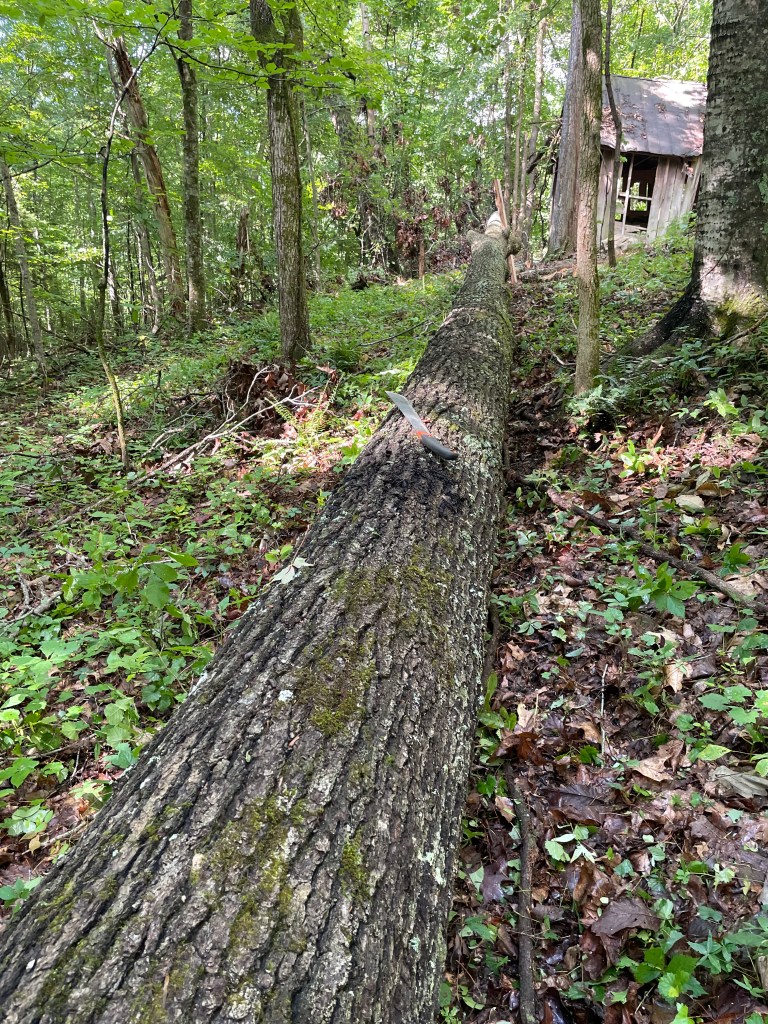
125 foot oak next to the falling cabin 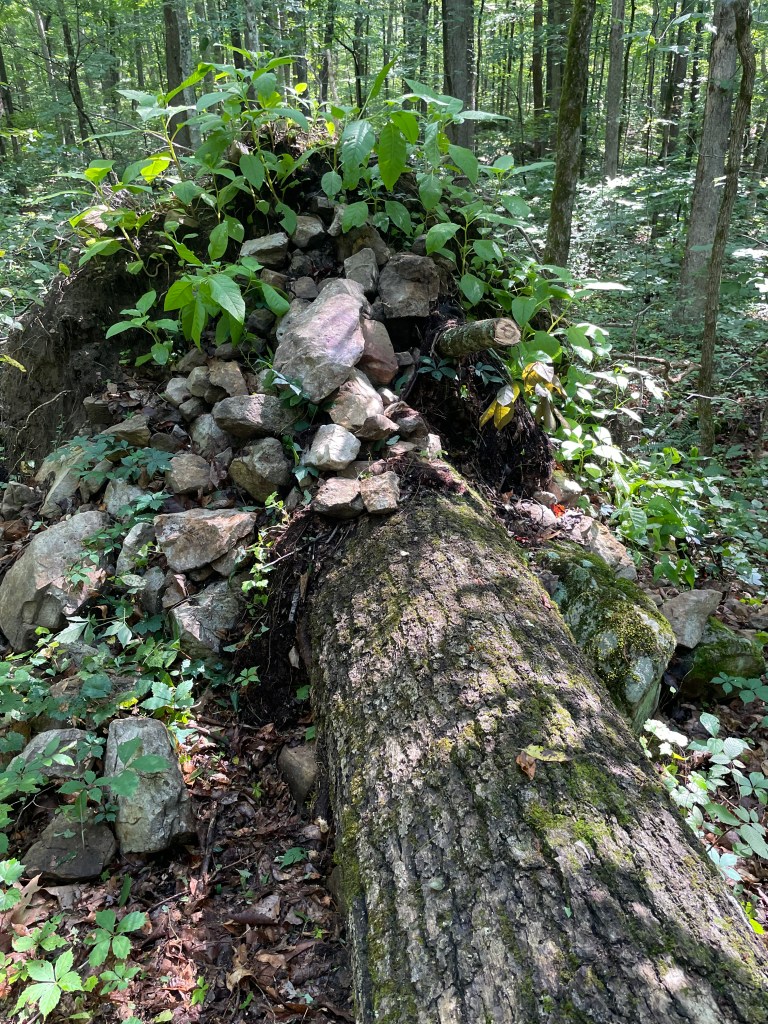
root ball of fallen oak 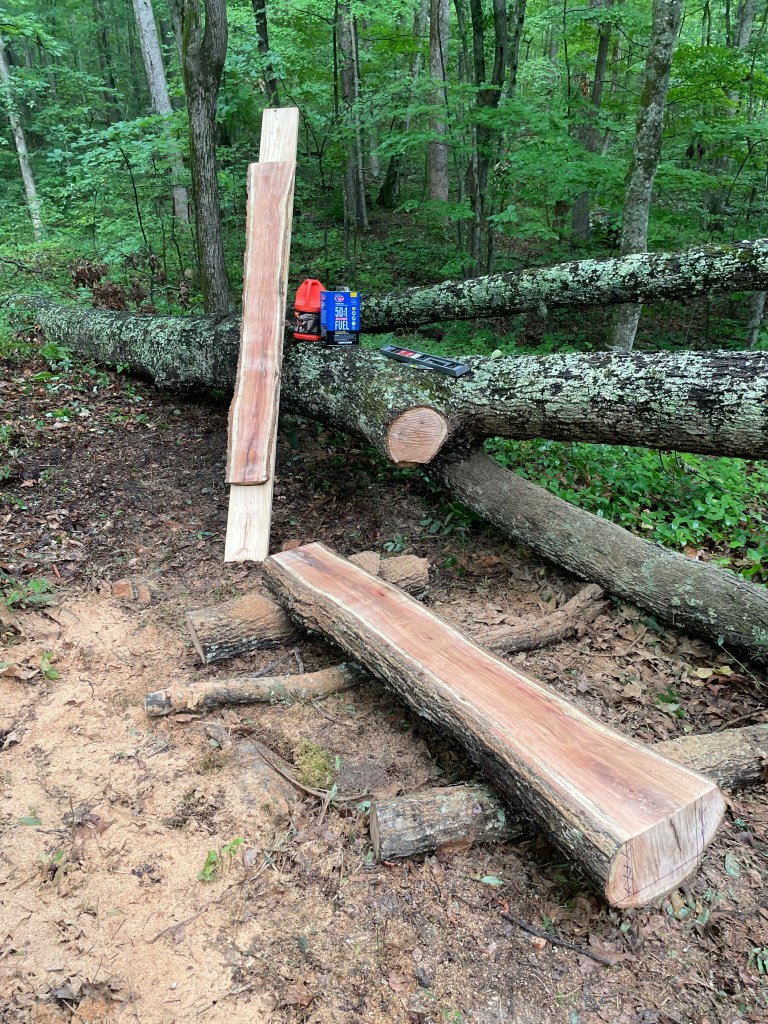
First horizontal cut of oak. There wasn’t enough space to mill this limb and keep it elevated on the tree. 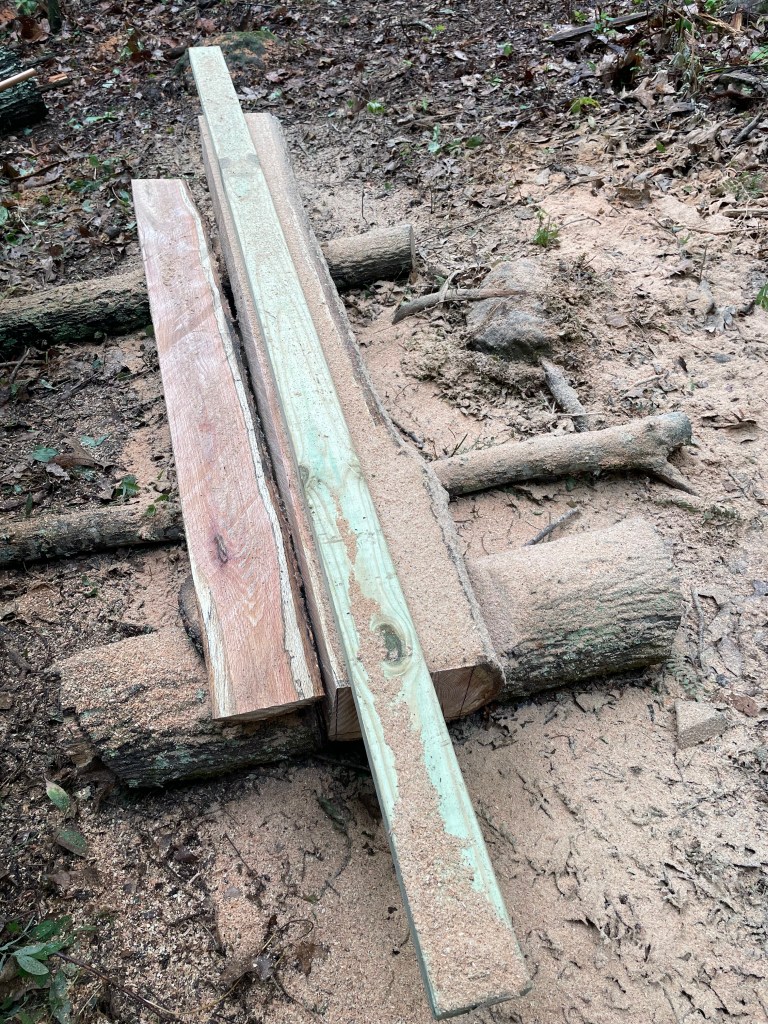
left side edged 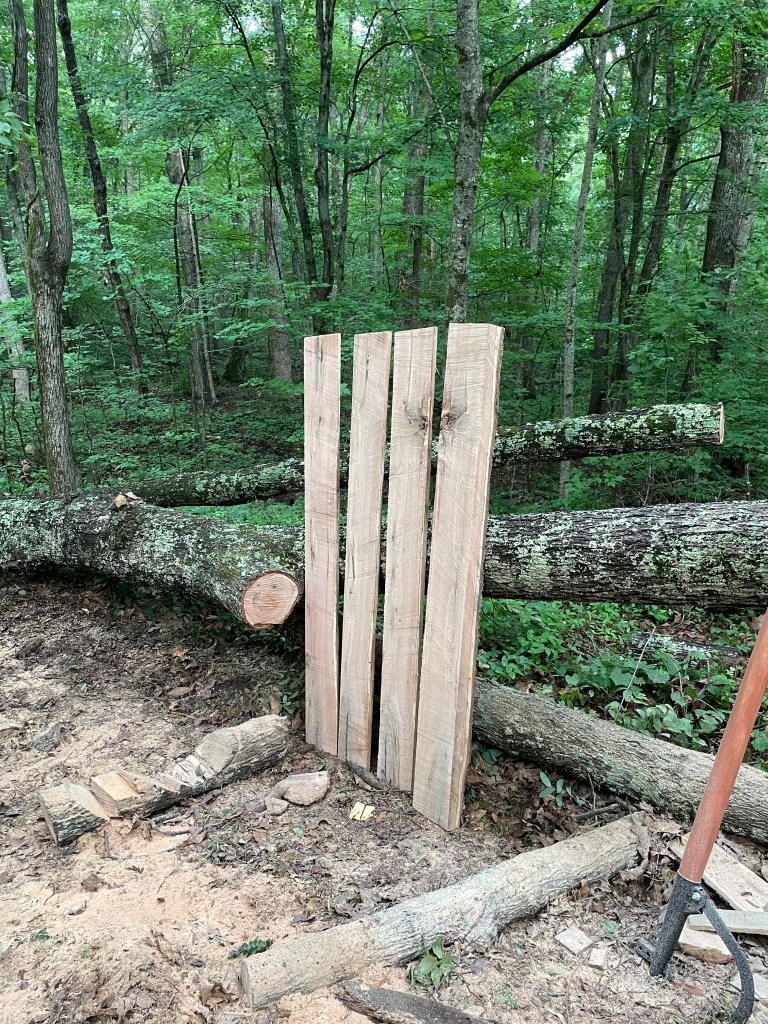
The first three boards are one-inch thick. The last one is thicker because there wasn’t room for the chainsaw motor head to mill another one-inch piece that close to the ground. I’ll find a way to elevate logs and make them level. It’s all trial and error for me now. The tool on the right is called a cant and you really can’t do without one if you are moving logs. It began raining while I was milling the oak and I was able to shelter and move tools into the falling cabin, but the wet oak was harder to mill after that. I think the chain needed sharpening at this point too. Ripping chains dull quicker than regular cross cut chains because they are tearing through more lumber for a sustained time.
On my next trip back I’ll try out another time saver: I’ll get a ripping chain for my smaller saw and see if it has enough power for the vertical, Timber Tuff cuts. If it does I won’t have to change out the big saw from the Alaskan Mill.
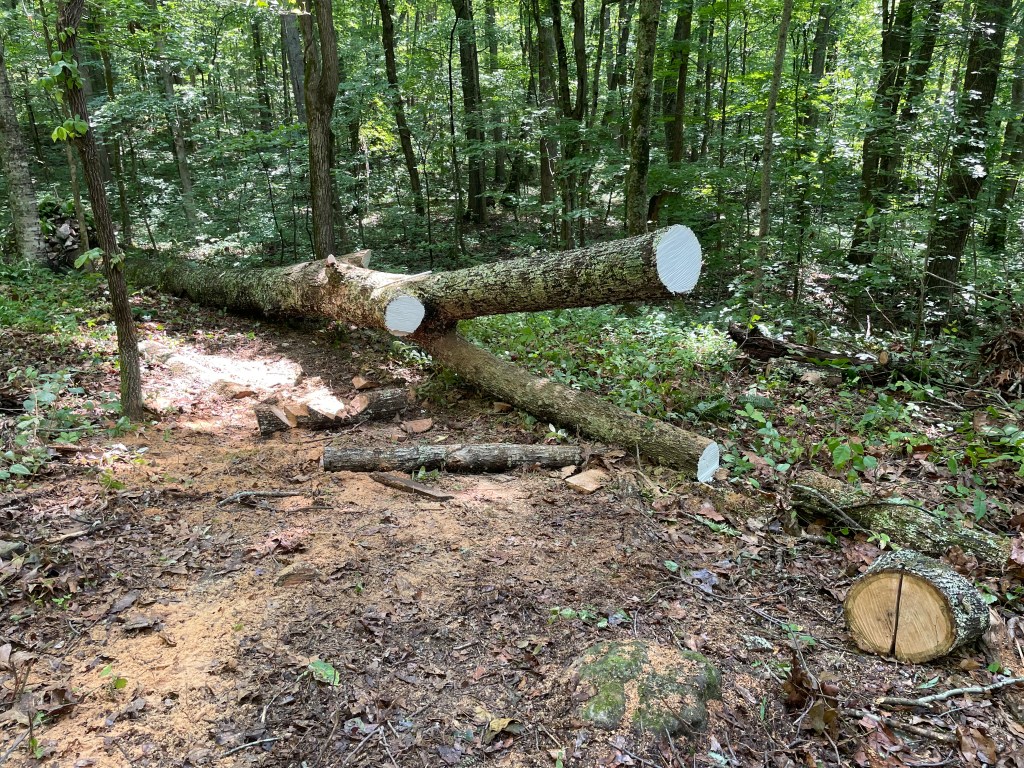
Before I left I painted the cut ends with latex paint to help protect the wood from insects and checking. 
I’m one step closer to believing in the viability of milling my own wood for the cabin project and doing it with my own labor. I need more practice with the Alaskan Mill, but I’ve gotten over the hurdle of using it for the first time and don’t feel overly intimidated.
Along with this big step forward in logistics I got some other work done. I cleared the oak tree limbs off the fallen cabin and put out a large stack of free firewood from the pieces that I chainsawed.
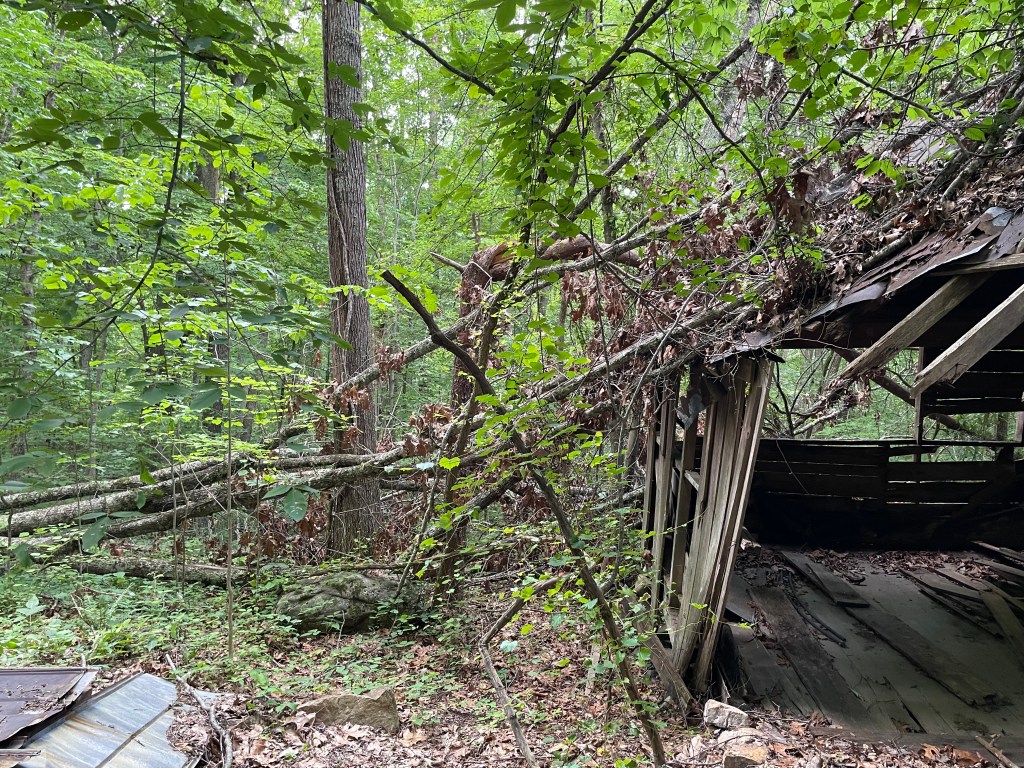
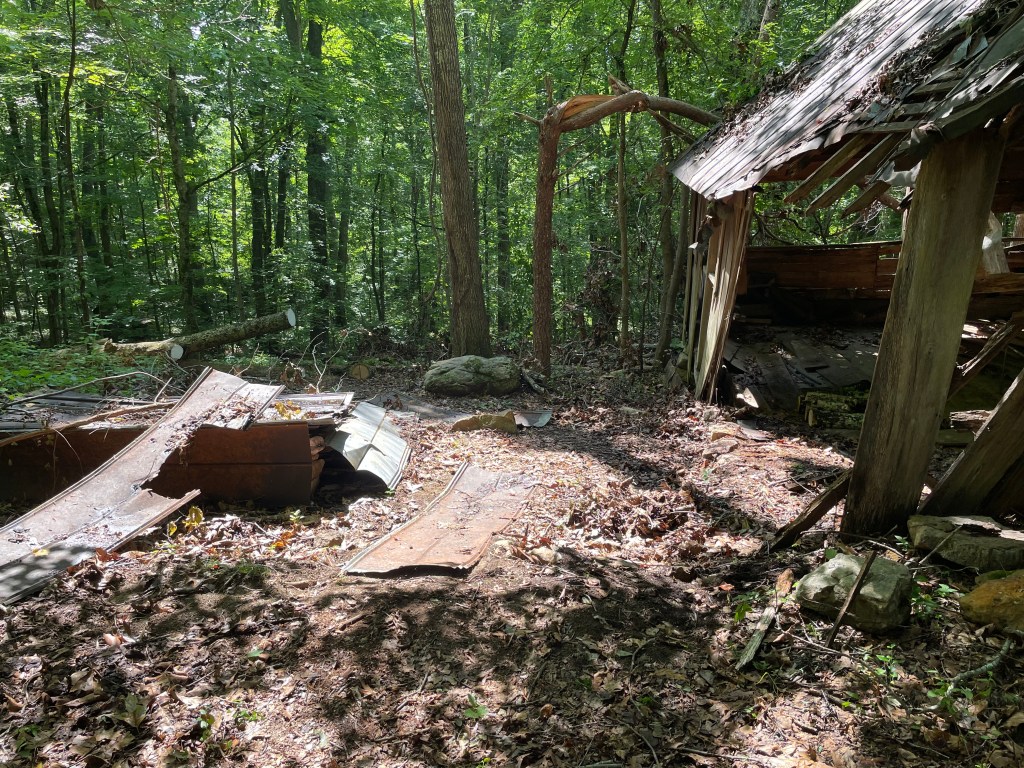
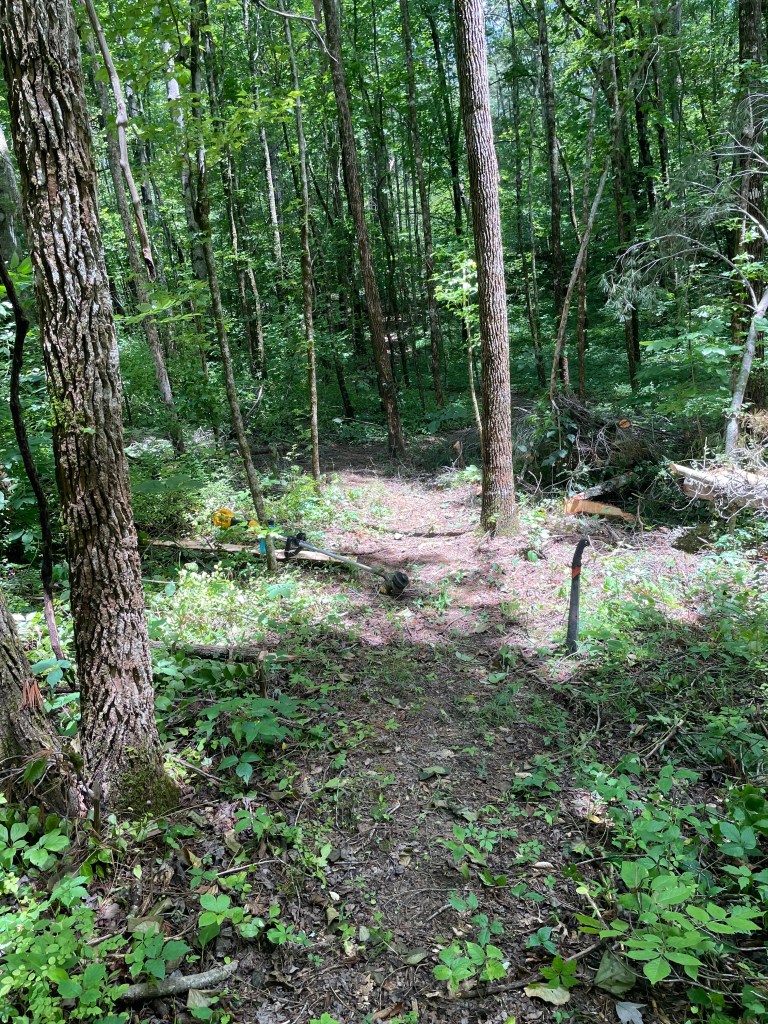
I did the biannual clearing of trails.
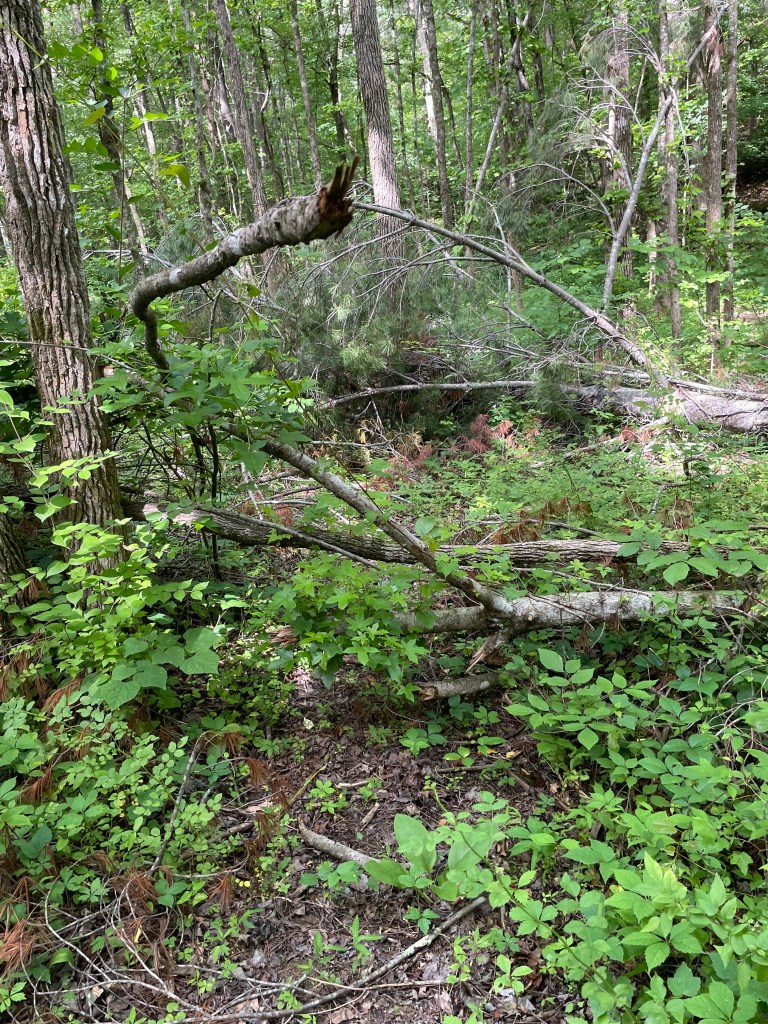
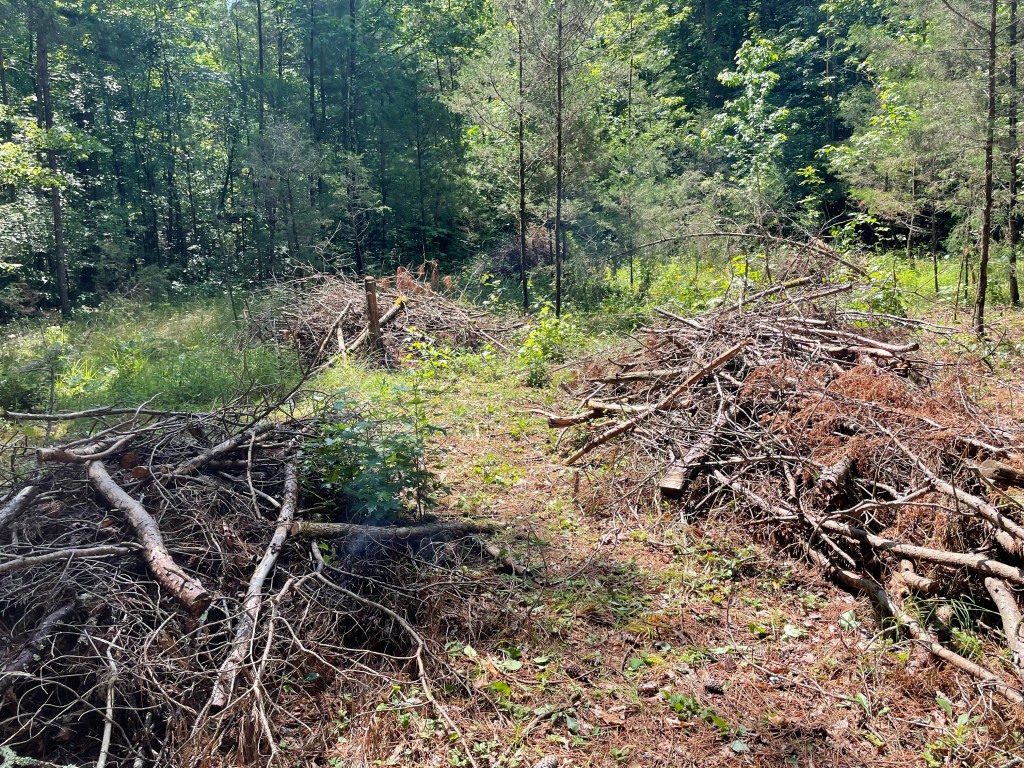
I moved five large brush piles off the cabin site into the woods. In the process I’m providing homes for wild animals that might like to move into the heaps of sticks and leaves.
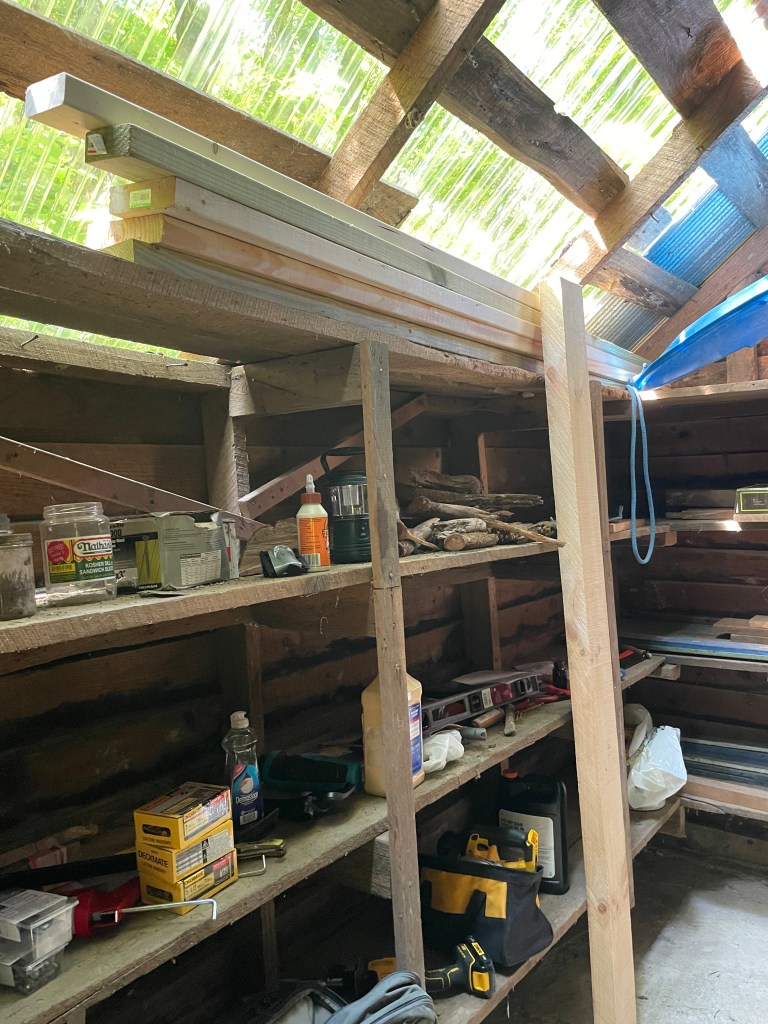
The most immediately satisfying thing I did was replace almost a whole half of the corrugated tin roof of the shed with clear, polycarbonate panels that let light in. The shed has been a dark, somewhat scary dungeon filled with very large fishing spiders, wasps, evidence of mice and, I imagine, the occasional resting place for snakes to curl up. My previous attempt to light it with battery operated camping lanterns was a failure. Most often I just used my phone to spotlight around the room. These panels have brought natural light in. Now I can see every corner of the place without fear that reaching for a hammer might mean grabbing hold of something that will make me scream.
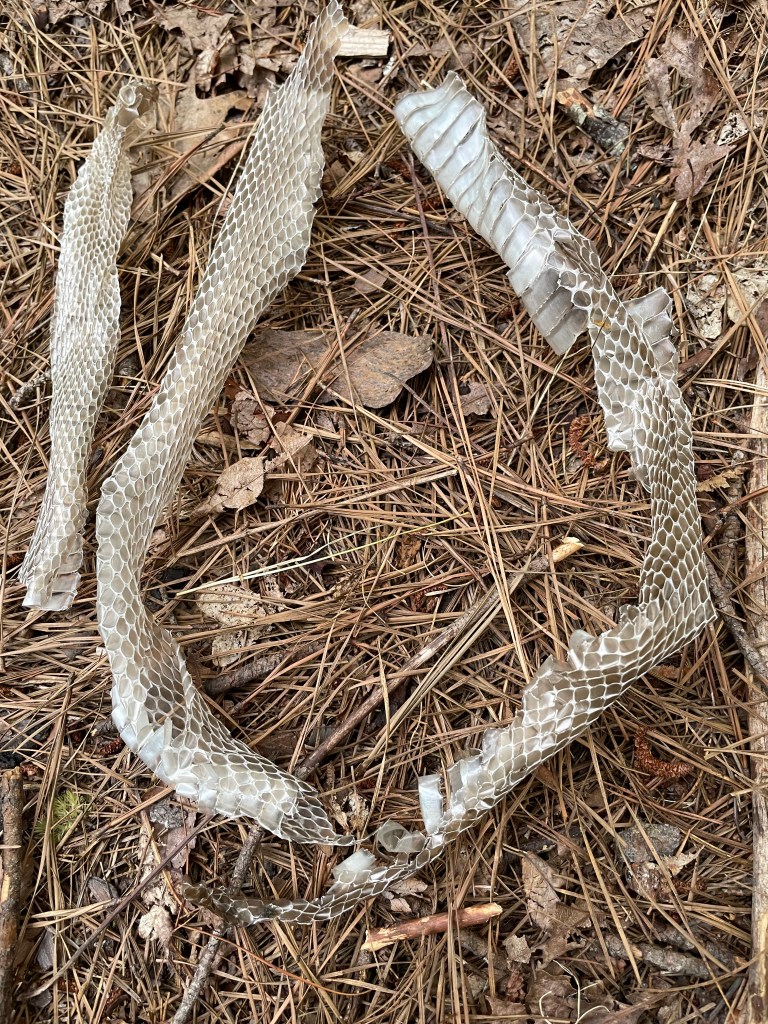
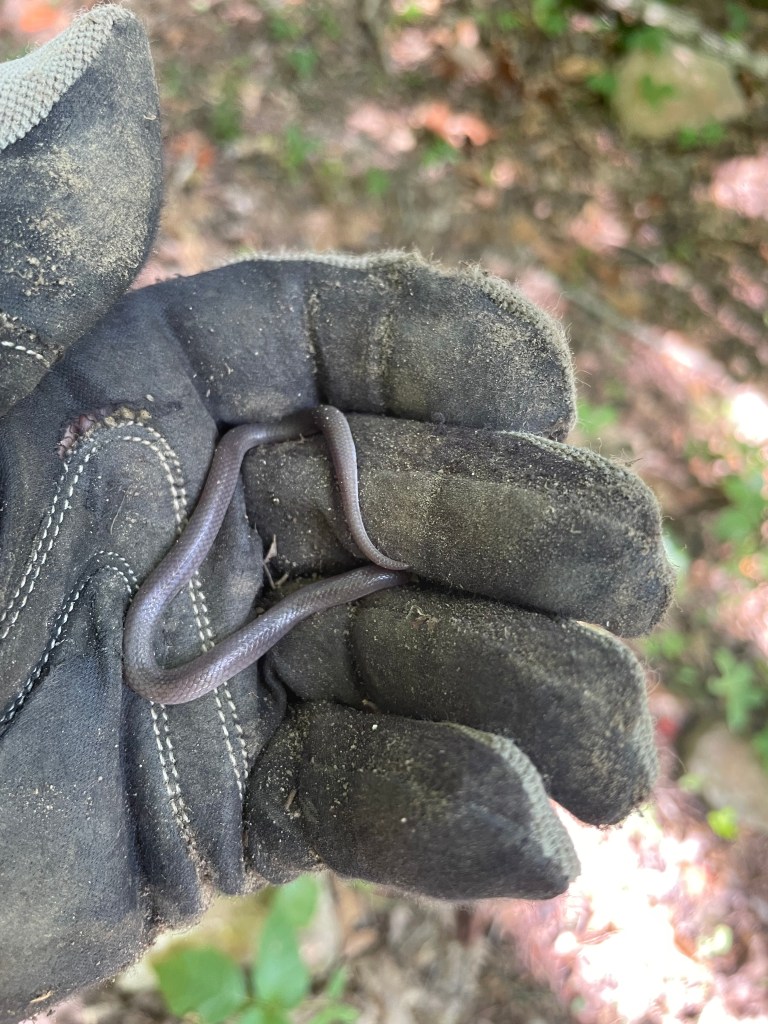
There was evidence of more snakes. This skin was found not far from my previous snake sighting on the cabin site and this small snake at the falling cabin.
I want to amend my previous idea that the black snake I saw earlier was a black racer. I now believe it was a rat snake. I found one newly killed on the road. Its black was similarly lustrous and it seemed about the same size. The belly was completely white — a part I couldn’t see on the live snake.
I was very happy that my old college friend Julie and her husband Dave came for a visit and that I got to show them the land. We picked raspberries and walked through the woods. Julie used her bird call app on her phone to identify several birds including a Pileated woodpecker. Birds are hard to see during summer in these woods because of the amount of leaf cover. Pileated woodpeckers are so cool and I’m happy to know at least one might be hanging around. Here we are sitting on my new bench:
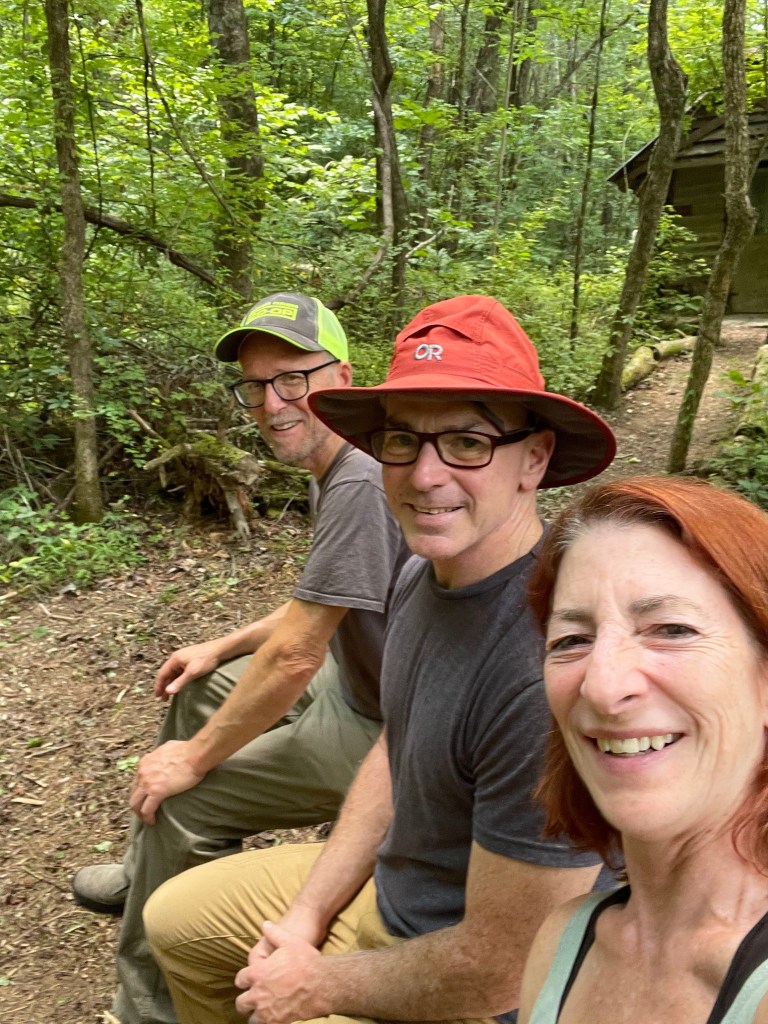
…………………………….
I’d like to end this post with an anti-sentimental song that I found to be absolutely gorgeous and moving. As I was driving back and fourth to the land I found a fantastic radio station, WDVX, out of Clinton, TN.
One morning I was listening and I heard this song, Last of the Better Days Ahead, by Charlie Parr. Maybe because I was a week away from turning sixty and was thinking a lot about Stewart who had died and how you never know how many days you have left…maybe also because I had really stupidly backed into my cousin’s car and done over ten thousand dollars worth of damage and was focused on the money that I’d have to shell out for my increased insurance premiums along with the extra hassle I’d created for people…
this song broke through all that and made me ponder what is most important…
If you clink on the link below, then the black arrow on the Bandcamp website you can hear this beautiful song.
https://charlieparrmusic.bandcamp.com/track/last-of-the-better-days-ahead
-
June 22, 2025

You really know you are in the south when people inquire about the status of your eternal soul. I have answered a question and settled a long-brewing debate for the time being, but it’s not about that. The question has been how am I going to get the lumber for a cabin using the wood on my land.
The debate was between pulling logs off the land to get milled by a professional or milling the lumber myself with a chainsaw. The first will be faster and easier on my body and will likely result in a superior product but it will involve buying or renting expensive equipment and a greater impact on the forest. With a chainsaw and Alaskan Mill I can make lumber where the trees fall.
I might end up doing it the faster way, but for a project that is still more in the dream phase it makes more sense to ease into it with on-site, forest milling.
To do this I bought another chainsaw and ordered and assembled an Alaskan Mill. The Alaskan Mill is basically a metal frame to guide the chainsaw down a rail screwed to the log. It allows the chainsaw to make smooth, even cuts and turn logs into usable building lumber.
I’m more than a little intimidated with the chainsaw I bought. The Stihl 500 is heavier and twice as powerful as my Stihl 251. I take some consolation in the fact that the smaller chainsaw also intimidated me when I first got it. The general wisdom is that you’d be foolish to not be wary.
I had trouble sleeping the night after I bought the larger one. It helped to stop stewing, turn on the light and watch some Youtube videos about it.
You can expect to see pictures and hear more on the process after I practice on my first log later this week.
Another of my purchases was a farm jack. I have a notion that I might be able to lift logs with it and put them on stands for milling to save my back from bending over too far.
I don’t know exactly how I will engineer this but I think it’s possible. I had a good conversation with an old farmer in the hardware store and he had lots of good ideas beyond his most frequent suggestion that I really should just buy a tractor. Still he didn’t give up on suggestions about how to use the jack until he asked me if I went to church and if I’d been saved.
This is always awkward. It seems to happen in the south more than other places I’ve lived. I told him I’m atheist and don’t subscribe to those beliefs hoping this definitive statement would end it quickly. Of course this may have just sweetened the pot if he thought he might get extra points for such a hardened case.
He went on a bit about the big guy on his throne in heaven and I started to get that aching feeling that I really wished he’d stop his pitch. Instead of fighting it too much I waited for the next pause and tried out an abrupt change of subject. Lo and behold it worked. We were even able to continue our conversation a bit more. He talked about Snatch Blocks and Clevis Hooks and other things I know nothing about except that the first step to learning is often just hearing the names.
After shopping there were several hours of sunlight left and I decided I had time to go to the land and do a little more brush-pile clean-up. I’ve decided not to burn but move the five large piles into the woods to rot.
After telling the man at the hardware store that I’ve never seen a snake on my property I saw my first one that evening. Strange how things seem to work that way — or is it because snakes are often on my mind when I talk about the forest the way sharks are on my mind when I talk about the sea?
There were several hours of sunlight left when I made it to the first brush pile to start work. These are mostly pine branches that are matted with wet needles from the recent rains. As I reached for a limb I startled a large black snake coiled on top. It immediately uncurled and slipped into the pile. Of course, it startled me a bit too but I recognized it as non-poisonous.
There are no all black poisonous snakes in North America. The often black Cottonmouth, aka Water Moccasin, has a yellowish belly and from my experience seeing dozens as a kid in Texas, they tend to be tapered and fat in the middle unlike this sleek serpent. Anyway, my land isn’t the habitat for Cottonmouth who like a year-round water source nearby.
I got out my phone and leaned it against a tree to be ready in case of another appearance. I kept my eye out as I worked to see if the snake would slip out of the pile somewhere.
It was disruptive, pulling on the pile, stuffing branches into the rolling trash- tote I bought to accommodate long limbs. I figured the snake would wait until I was taking a load into the woods and then slip out through the weeds, but then again, it might just hunker down. After all, what does a snake know about human intentions around clearing brush?
When I got to the bottom layer of the pile I took the load I had into the woods and came back. I took a glove off and held the camera while I pulled a big log from the pile that I thought the snake might be under. Nothing.
The wet, matted branches lift like shelves and I toed one up with my foot and there it was. I believe it would’ve stayed there and watched me had I not been both unbalanced and surprised and dropped the cover back abruptly. Finding a snake you think might be there is the same as going into a haunted house. You know to expect something scary but it doesn’t keep you from freaking out when you open a door and see a mad clown holding a knife. Besides, black snakes have been known to bite when cornered.
Had I been more careful lifting this bottom layer with a rake pole or stick I might’ve gotten a better shot. When I lifted the mat again it was done with staying put. The race was on. It headed toward the next brush pile and I got four fuzzy shots.
I won’t go so far to say that our human endeavors are anti-nature. We are nature. But, had I approached that brush pile with my powers of observation leading the way instead of my desire to get to work I might have gotten a clear photo of the beautiful creature curled on top.
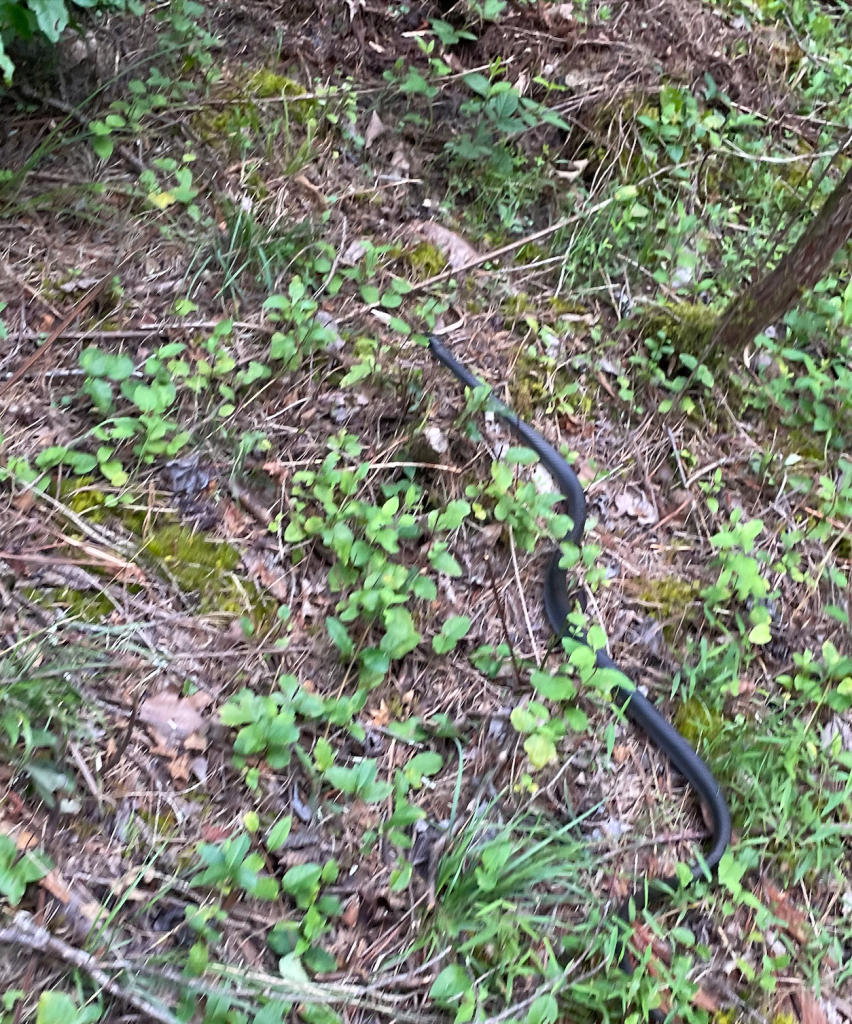
My best guess is that this is a Black Racer but it could be a Rat Snake. A closer sustained look would have helped. I’m more inclined to see a deer while hoeing the trails than using the weed whacker or while swinging an axe instead of firing up the chainsaw. There are costs to efficiency and speed. Even the plants I want to keep pay the price. I find myself cutting down cedar saplings and ferns simply because my eyes can’t keep up with the speed with which I swing the trimmer.
After seeing the snake for the second time and getting my fuzzy photos, I went over to a pile of logs to sit and take notes. As I was quietly getting my thoughts together, a hawk swooped by and landed on a stump 15 feet away.
“Hello there,” I said astonished.
It was a greeting that might be appropriate sitting at a city cafe when a friend walks into view and stops at the nearby cross walk. For the hawk however it was like, shit, who are you? She immediately took off.
Nature requires a certain formality. My introduction to both the snake and the hawk were forward to say the least.
The same day I saw my first snake I got my first tick…of the trip. Yes, I’ve had plenty of these, maybe 15 over the course of being out here (if I don’t count the raspberry picking episode with my nephew where we each got about 10 all at once and saw them creeping everywhere across our clothes toward open flesh).
The number of ticks I get each trip is getting smaller and usually it is caused by a lapse in protocol. In this case I was working with my short-sleeve shirt untucked. (My bare arms where sprayed with Off which does seem to keep them away.)
Ticks still freak me out more than any other animal for the obvious reason that they are gross, blood-sucking vampires that bore their ugly heads into your flesh and because they can carry potentially devastating, disease-causing organisms. The Borrelia burgdorferi spirochete carried by the Black-Legged, aka Deer tick, causes Lyme Disease. They can go into a cystic form that researchers believe may allow them to lie dormant and unaffected by antibiotics until they reawaken later to cause havoc.
I found this tick on my belly as I undressed to shower. It was fastened but came off with a steady pull that left it holding a tiny bit of my flesh in its jaws.
I dropped it in the sink. It landed on its back bicycling its eight little legs in the air. I rushed out of the room with a towel around my waist to get my phone. Pictures are important to identify the species and potential, associated disease.
The phone wasn’t in my room. It wasn’t downstairs. I tenderly hoofed over the gravel to the truck in the garage and couldn’t find it there either. I asked my Aunt to use hers.
This all took less than three minutes and when I arrived back upstairs the tick was gone!
Freak out time! In slasher movie this is the part where a high, screechy note is played on the violin. The killer was just standing behind you. You turn quickly. It’s gone.
Shit!
Now there was a deadly parasite loose in the house. I scanned across the floor near the sink using the phone’s flashlight. I moved items and searched the top. I aimed the light down the drain and in the little overfill hole. Nothing!
I figured maybe is slid into the drain. Ticks don’t seem great about walking up inclined, smooth surfaces. I ran water for a few seconds and then ran it another 30 until it was hot and then ran it some more. Agh!
Surely it fell down the drain.
The next morning I went to brush my teeth, my memory of the sanguivore present but dulled by sleep. I casually scanned the surface again and then my eyes popped, jolted awake.
There it was flagging at the top of the liquid soap dispenser! That little fucker had somehow crawled out of the sink in the three minutes I was looking for my phone. This was equivalent to a sprinter running the length of a football field.
During the night the little mole-mimicker had found one of the highest points and resumed the position to grab hold of its prey.

I think this is an American Dog Tick. They like humans too. Without disturbing it I got my phone in the next room and took a picture. Then I scrapped it in the sink. I tried mashing it with the bottom edge of a glass before remembering how unmashable they are.
I opened a sink drawer and found some long toenail scissors and cut it into little pieces. Then I washed it down the sink for real this time. I ran the water, unreasonably, abhorrently long, letting it get hot, piping hot — letting it stay hot. I was the final victor in the slasher movie where I’d been stalked. I imagined myself in the final scene. I would be yelling down the pipe, screaming, out of my mind — “Are you dead yet fucker? Are you dead?”
Ugh. I don’t like to say it but I hate ticks.
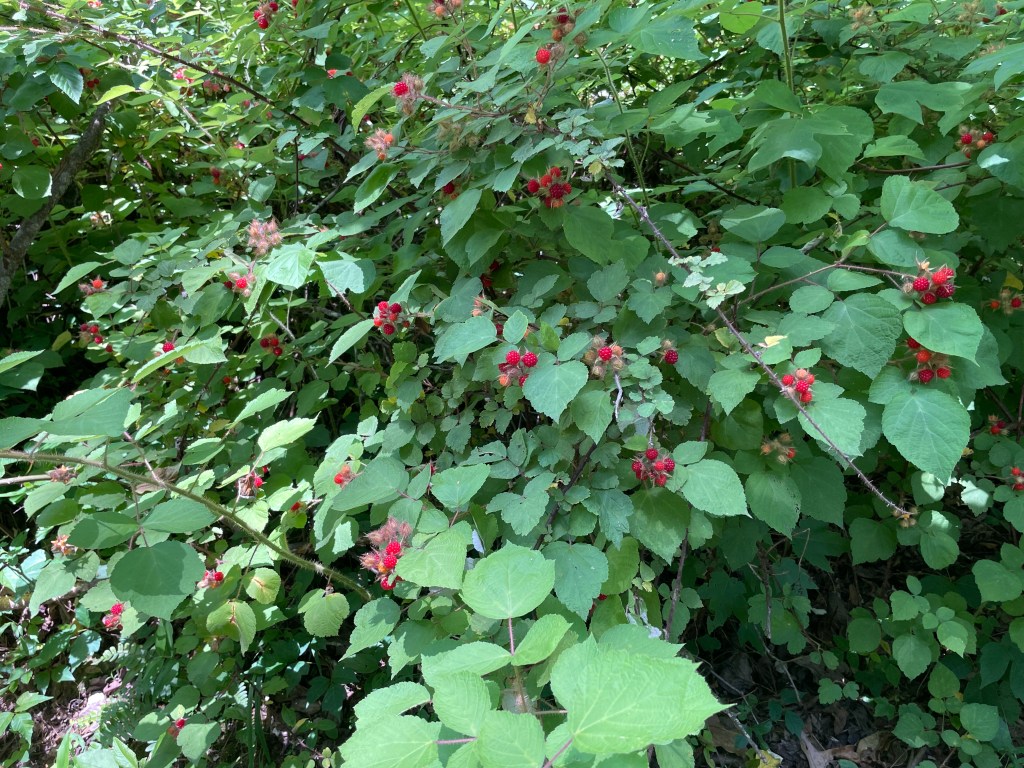
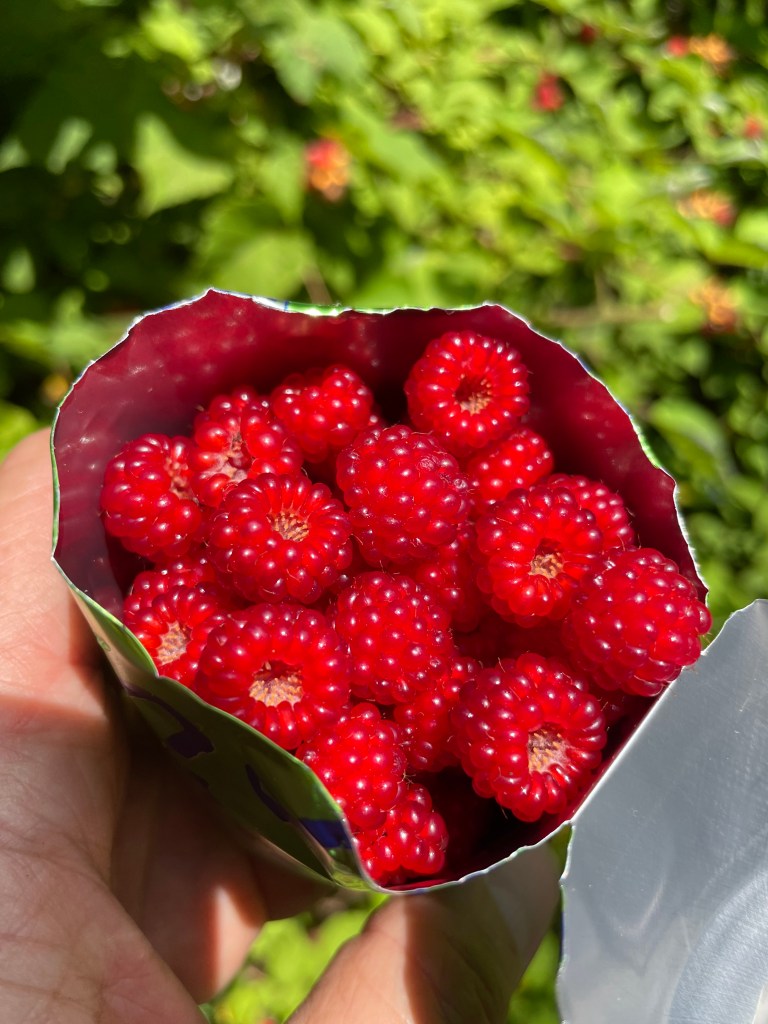
It’s taken a while but I’ve gotten over an incident with my nephew about 17 years ago when we visited the land with my mom, Sharon and Linda and saw wild raspberries growing all along the dirt road to the falling cabin. Anthony and I got out of the car to pick raspberries and about a minute into the activity looked down and were covered with ticks. Nary a tick was seen when I got these a few days ago. So delicious! 
Southeastern Five-Lined skink next to the shed 
String-trimming (a more delicate way to say weed-wacking) is so much easier than hoeing the trails. 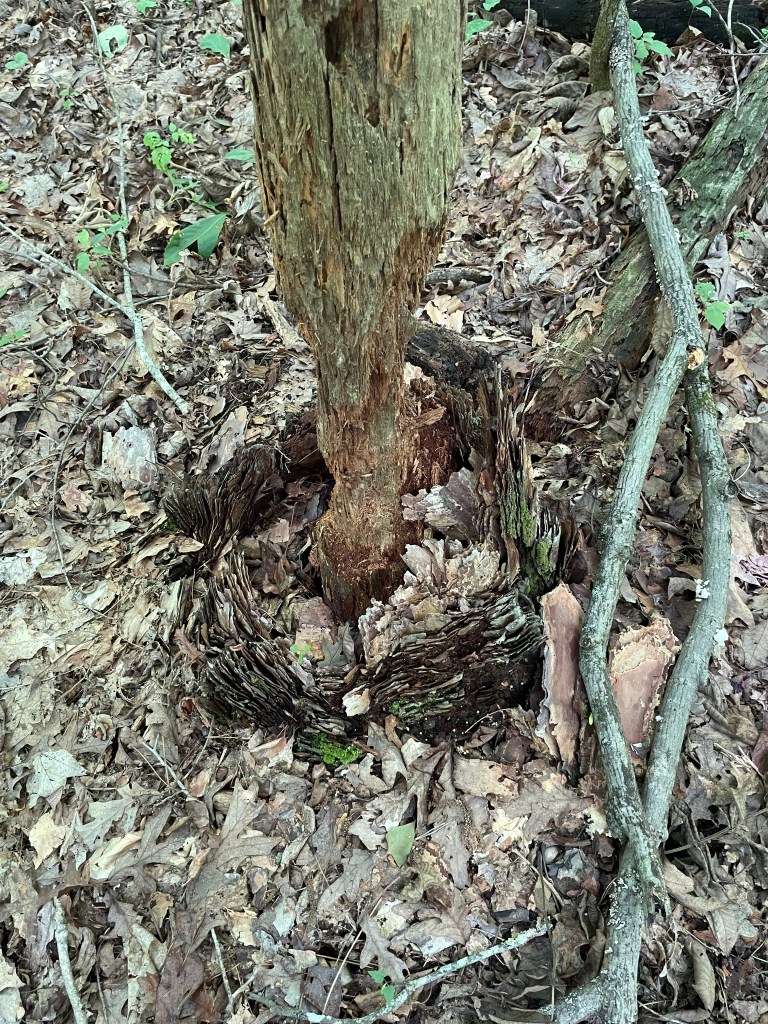
This rotted tree stump had this layered-set of concentric bark rings at the bottom as if the tree rotted or was eaten from top to bottom carrying the more hearty, resistant bark with it as it went down. Who knows how it happened? Other theories? -
June 15, 2025

“There’s a gun I brought over from the condo that I want you to have a look at when we get back.”
Aunt Linda said this when I first arrived over a week ago to vacation with my family in Florida. She brought it up again when we were driving back to Tennessee with Linda’s granddaughter in the front passenger seat and her boyfriend driving.
“All the farmers and anyone who owns land around here have a gun for snakes and to scare off bears and things. I’ve got it in one of those old ammunition boxes and I want to show it to you when we get back. You know you really should have a gun.”
I knew I wanted to see it but I wasn’t sure I wanted a gun. I wanted to think about it more.
The car trip back ended up being kind of grueling — eleven and a half hours with several breaks and lots of rain.
I slept late the next day and went out to check on the land when it was nearing dusk. Even if I wake early it’s hard to get an early start. I like to do my daily partner-write in the morning while I’m fresh. Then I want to read some of the day’s news and there is usually something about logging, building or a tool that I want to research.
On my third afternoon on the land I was working up at the fallen cabin and a man came by on a four-wheeler. He introduced himself as Luke, my neighbor Steve’s son.
“I didn’t know Steve had a son as old as you?”
“Yeah, I’m forty and I have a brother and sister in their 30s.”
“How is Steve?” I asked.
I met Steve four years ago when I first started visiting the land. He’d bought a section near the steep base of the Clinch Mountains bordering my property where the falling cabin is. He’s almost finished building a beautiful home that he’s been living in since he got the roof and walls up. He milled much of his own lumber and said I could use the mill too.
“I’m sorry to tell you that my dad died on March 5th this year,” Luke said. “It was all over the news.”
It was a gut punch. I always had good conversations with Steve. As busy as he was he made it seem like he had all the time in the world to stand there on the dirt and gravel road and talk with me.
“What happened,” I asked?
“Well, it’s a terrible story,” Luke said.
He then told me about how his dad was shot accidently by his younger son, Luke’s brother Shawn, who was handling a gun in the back seat of Steve’s big four-door truck. There was a friend in back with Shawn and Luke was in the front passenger seat with his dad driving. They were traveling locally on the interstate.
I asked if they’d been hunting but Luke said no it was just a gun his brother was looking at.
I wondered if it caused them to crash. Luke said after their ears cleared from the ringing he hoped it had just gone off into the floor but his dad said he was bleeding pretty bad. Luke said it seemed like it took ten minutes but it was only a matter of seconds before Steve was able to pull over to the side of the road before going unconscious.
Luke said he worried about his brother every day and how he was dealing with the guilt.
I googled the news stories and obituary. Steve had told me he was retired but working harder than ever doing some construction work. The oak siding on his house was taking a long time to finish because he was doing these extra jobs. For this reason I thought he’d “retired” from construction but it turns out he had been a captain in the Knoxville Fire Department. He was sixty years old, the age I’ll be in less than a month.
He loved music and was a singer in a band. He told me when I first met him that he’d be interested if I ever wanted to sell my land. He wanted to start a music festival there.
He had a long white beard in retirement. I could see from the pictures on his obituary pages that he’d had a more cropped appearance when he was fire captain. The beard reminded me of the goats he had that came to visit me in my falling cabin. He loved those goats. The billy would sometimes come up and push against his leg while we talked.
When I told him in December I was going to take the cabin down for lumber, he said, “We’ll sure miss her.”
In late March I texted him about a new idea I had about how to keep the cabin up and use it as a place to store lumber. I wondered why I didn’t hear back from him. I just figured he was too busy and had forgotten.
The morning after learning about my neighbor’s death I asked Linda to see the gun. We were sitting in front of the tv and she immediately got up and went to the closet under the stairs.
She moved a vacumme out of the way and handed me a bag and then a box to set on the table behind me.
“Oh lord, what are we getting into here? This is where I keep all my Christmas wrapping,” she said.
“There it is. That grey ammunition box.”
She backed out to let me in.
“Be careful. It’s heavy.”
I went into the triangular space that gets darker toward the back and bent over the metal box.
“Oof. That is heavy,” I said as I lifted it out exactly the way I shouldn’t—not using my legs.
I turned around and set it on the dining room table and unlatched the four metal buckles that held the top down.
Linda lifted out a folded display mat and I unrolled it on the table to reveal about twenty pocket knives of differing size including a stiletto with a six-inch blade making it as long as a ruler when unfolded.
“Oh, there’s two guns in here!” she said, slowly pulling them out and setting them on on the table.
My breath quickened and I felt some extra heartbeats.
It’s different looking at a bottle of pills or a hammer or even the long stiletto which is plenty frightening. All these can be lethal. I guess I’m just not used to seeing guns and considering their power and potential for a serious accident. This was a good time to look at them after learning about my neighbor.
We heard something on the news and went back into the tv room distracted for a moment and sat down in the two big reclining chairs. It’s almost as if we needed a break from finding the guns and having them out.
All Linda’s partners have been gun owners. When I was a teen her first husband Wayne was interested in seeing my father’s family land and he brought along a short black semi-automatic rifle that he wanted to show off. I’d previously only fired a shotgun on a friend’s land in Mississippi.
My dad had a theatre pistol which I snuck into the back yard and fired into the air when he wasn’t there, but it only fired brass caps.
Wayne invited me to shoot his gun and feeling the kick and the ease with which I could pull the trigger was exhilarating. Then I turned while still holding the gun up and accidently pointed it at my dad.
“Whoa, Whoa, Whoa!”, he said.
My grandmother had a pearl-handled .22 which she kept hidden in the long medicine cabinet in her bathroom. When I was a young child I would climb atop the two-sink vanity, slide open one of the long mirrors and reach up for the loaded pistol on the top shelf. Children always find the things they aren’t supposed to.
I’d feel the weight in my hands and then quietly put it back in it’s place. I’d do the same with grandpa’s double-barrel shotgun, slipping between hanging clothes and clear, dry-cleaning bags to the back of the mothball-smelling closet. I’d catch a glint of the gun metal and feel for the barrel, then lift it into the room to get a better look. I had a reverence for these guns. I knew how dangerous they were. It was enough just to weigh them in my hands.
Linda rose from her chair and buzzed off to whatever her current activity was — laundry, dishes, watering plants, cooking. There are always a million things to do and at 82 she is still doing them.
After a breather, I went back over to the table and looked at the guns that had belonged to her second husband Ron. One had a long barrel that made it look a bit like an old west, gunslinger’s or a slightly larger, less ornate version of the pop guns that the character, Mike Teavee, played with in the original Willy Wonka movie. This one was a .22.
The other gun had a snub-nosed barrel. It was a .38 special. It looked more like a gun that a mobster or film noir detective might use.
Stamps on the barrels told me the manufacturer. The .22 was a High Standard and the .38 a Smith and Wesson.
Without pointing the guns at myself I looked at an angle to see the barrel of each—like peering around a corner in a dangerous neighborhood. The bore of the .38 was double the size of the .22 making it twice as deadly I suppose.
I couldn’t see if either gun was loaded. Only the chambers on the sides showed. I aimed the .22 at the floor and pulled the stippled hammer back hoping that would help me see better but it didn’t. Then I tried to slowly release the hammer back into its slot but my thumb slipped and it struck the chamber with force. I grimaced. If there had been a bullet in there it might have gone off.
I looked at the gun more carefully and figured out how to pull the rod that releases the chamber. It opened out to the side. I saw three bullets in there. I was just lucky that I hadn’t put a hole in Linda’s floor. Using the bullets as a starting point it was easy to count the chambers. This was a nine-shooter.
Linda entered the room to see how my inspection process was going.
“This gun had three bullets in it!” I exclaimed.
“Well what good is a gun that’s not loaded,” she said.
I held the gun toward the ceiling and tried to tap out the bullets from the splayed chamber.
“Look, even I know more about guns than you.”
She took the gun from my hands and pushed the chamber release rod the other way and it ejected the lipped shells out of the barrel into her hand.
She gave these to me and walked out of the room.
I pushed the release for the cylinder on the .38. Even though the gun was more compact than the .22, the cylinder was much larger and could only hold five bullets.
I carefully pulled everything else out from the ammo box and laid it on the table. There were rectangular boxes of bullets, several holstered knives, a small leather holster for the .38, a cleaning kit, and two more guns in a single wooden box that presented them on red velvet, yin-yang style. These were tiny, single-shot, Butler derringers that Linda called dueling guns—one with a pearl handle and the other dark wood.
Satisfied that I’d seen everything I packed it all back up until today when I took the guns out again and photographed them.
I watched a video on cleaning the .22 and watched a couple of other videos of a collector shooting both models at his homemade gun range. I gave some more thought to keeping one. Linda clarified that farmers also have guns in case they need to put down an animal that might be sick or suffering.
I considered maybe that I could at least take them out to the land and try shooting them. Then I thought about the noise. Even the string trimmer makes too much for my liking but I make an exception because my back appreciates not having to work for hours to clear the trails with a hoe. I decided the last thing I want to do there is shoot a gun. The bang will echo throughout Poor Valley (not that I haven’t heard it before).
It’s probably silly, but I don’t want the animals to think they can’t call my piece of land home. More importantly, guns still scare me …though maybe a little less now that I’ve gotten to know these better.
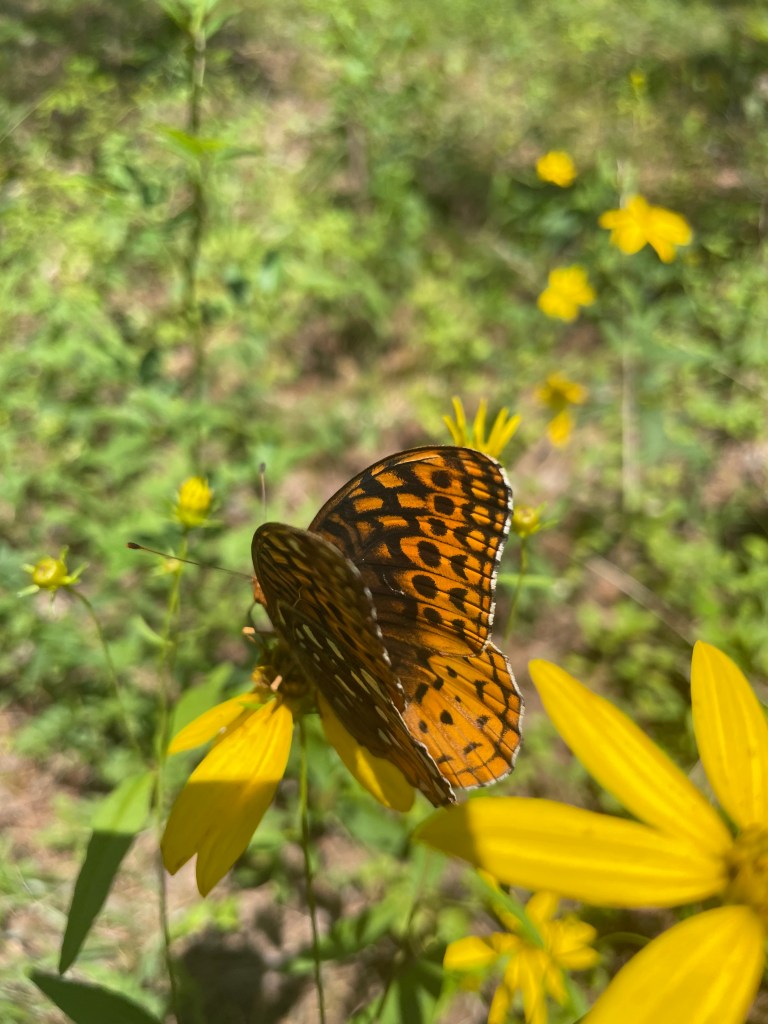
The Great Spangled Fritillary on Woodland Coreopsis 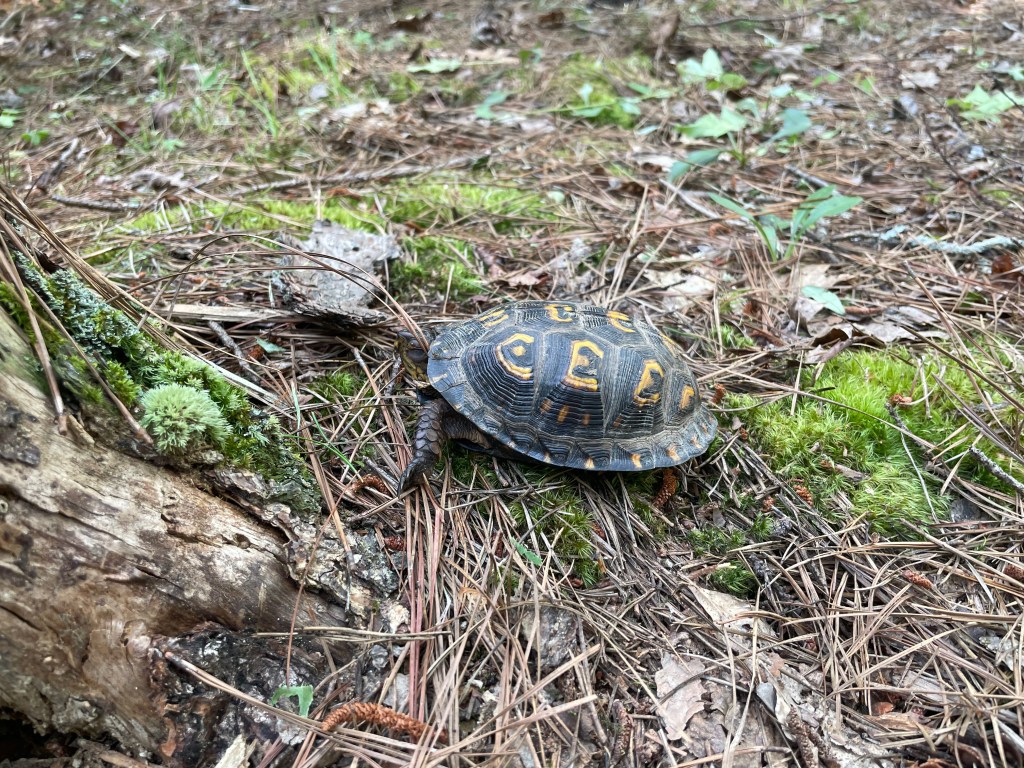
Eastern Box Turtle discovered by Linda’s grandson who was helping me clear brush. I like the letter E. Cee it on the side? 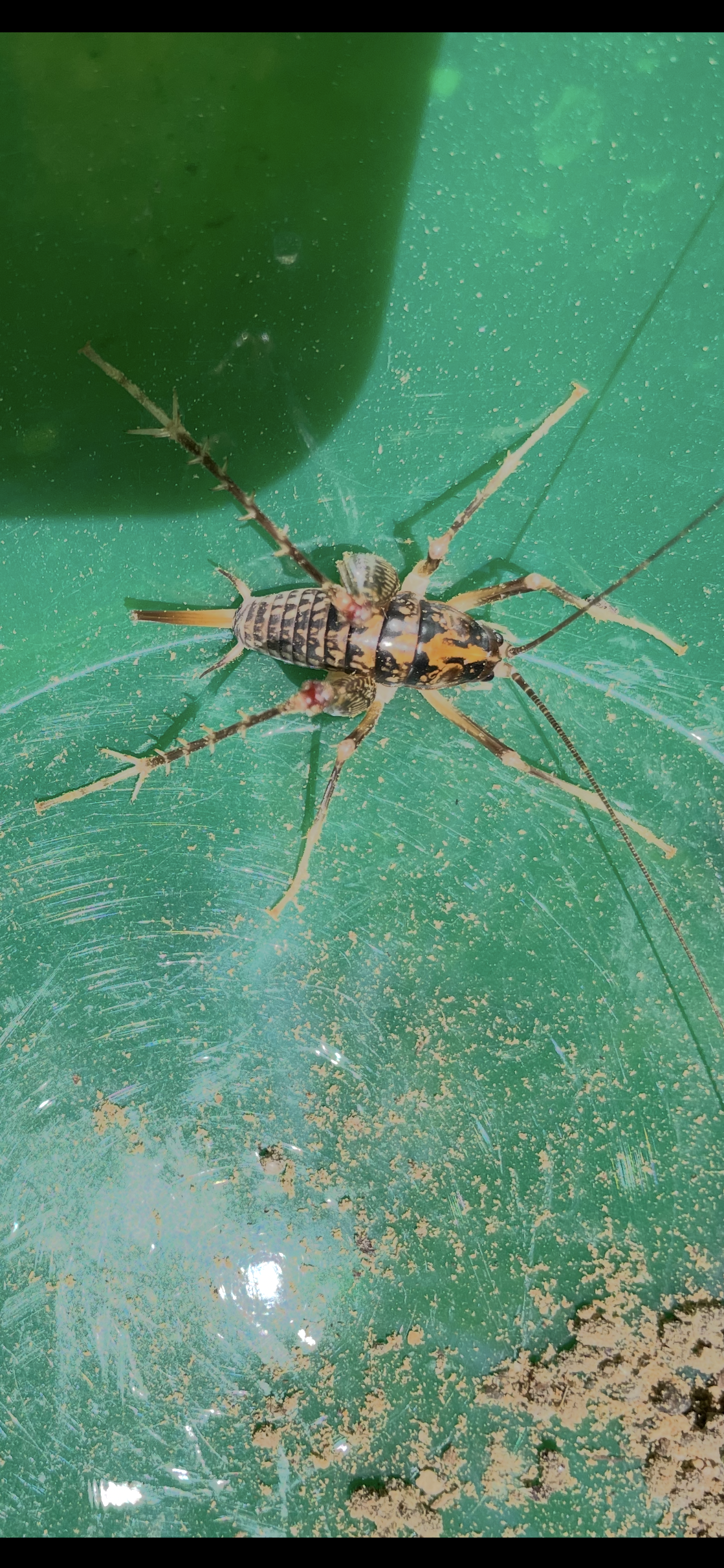
Greenhouse Camel Cricket. I found it in my dark shed which might be the distinguishing characteristic that separates it from the Eastern Camel Cricket which apparently likes being out in the sunlight more. -
June 1, 2025
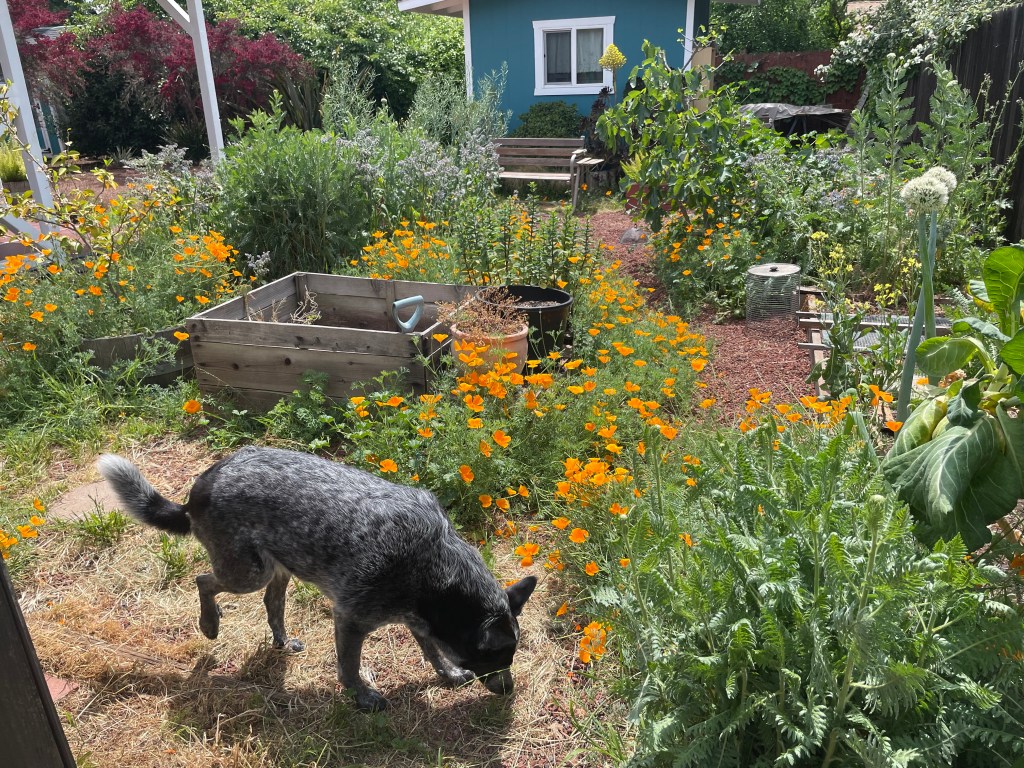
This was about a month ago. The back yard turned into a jungle. The California poppies popped and Sasha had more sniffables to sniff. I set off a chain reaction of tears at the end of school Friday. It was nearing two o’clock and I had already said goodbye to my last group the day before because, at the moment, I had to do a photo shoot with the principal and 12 former “English Learners” now reclassified “Fluent English”. Tuesday is the last day of school but I won’t be taking groups again. Classrooms will be too busy ending the year.
All I had to do was get this group of first graders out the door: Jocelyn, Marina, David, Alex and the only non-Spanish speaker in the group, Hanh, whose home language is Vietnamese.
I was letting all my students know I wouldn’t be returning to the school next year, that I’d been reassigned to three new schools in the district. It wasn’t my choice, but I wanted to say goodbye, give each of them a hug and wish them a happy summer.
Most of the groups I told at the beginning of our last meeting before we started playing bingo as an end-of-year celebration. A few students wanted to play chess so I sat them near me and monitored their game in between calling out numbers unless I was freed up by a student who wanted to be the caller.
For some reason, I didn’t tell my first grade group that I wouldn’t be returning until I had them lined up to leave the class. That was a mistake. More than any of the others, my youngest group could have used the games as a buffer.
As soon as I told them I saw Hanh think and register my words then turn her head down and away. Her long, dark hair covered her face as she began to cry. Her best friend Marina then started to cry followed by Jocelyn who was at the end of the line. It was like watching dominoes fall except the boys just turned down their mouths.
I tried to console them and tell them about the great teacher who was taking my place, but that didn’t help. At the same time I reminded myself that I’d seen this chain-reaction-crying among first-graders before and tried to convince myself that it didn’t hold a lot of stock, but at the end of the day it did.
I love these kids.
Alex who has great number sense but has to be encouraged to not roll around on the floor and sit in his chair and FOCUS. He has his own nurse at the school all day because of his type 1 diabetes that is monitored with something like a pager that he keeps in his pocket, holds in his sweaty hand or spins around on the table top until I take it from him.
Marina who always gives me a hug at the gate on the Wednesday mornings that I have duty. She arrives with her ten-year-old brother who gives me a hug too and is also in one of my pull-out groups. Both arrived in the United States a few months into the school year and they’ve gone from saying nothing to speaking short sentences.
Jocelyn who holds her arms out and flutters her hands down next to her sides when she is excited to say something. It’s a sort of energy release that I sometimes find myself mimicking unconsciously.
David whose seems to hold his breath when he speaks in a raspy, airy voice that sometimes squeaks when he begins his litany of, “Teacher, what that?” at least ten times every session.
And of course Hanh, whose parents gave me a $30 gift certificate to Target for Christmas — a practice that is common at more affluent schools but rarely happens at this title-one school that sits beside an eight-lane highway on the eastern outskirts of the bay area. Hanh who writes as neat as a fifth grader, knows all her numbers, letters and letter sounds. Hanh who is beginning to read and enjoys being sly and can push anyone’s buttons because she’s smart and is going to figure things out with or without my help.
At day’s end I walked to the front of the school in search of the principal again to discuss a kindergartner mistakenly reclassified using a DIBELS reading score instead of an i-Ready. It was 2:35 and Vera, the jolly but perpetually tired noontime supervisor, was sitting on a bench near the front gate.
“Mr. Robertson, what have you done? Why all these kids coming by here in tears?”
“Really,” I said? “They’re still crying? I just told them I wasn’t going to be here next year.”
“Yeah, they still cryin’! Jocelyn is sitting there in that car. You need to go over there and talk to her.”
I approached the passenger window and waved to her mom. She lowered the shaded back window and there Jocelyn was buckled in and crying with wet cheeks that still have some of that kindergartner baby fat. Her legs barely made it over the edge of the back seat. I repeated my reassurances. But what can you say?
Going back inside the gates here comes Marina with her mom, walking toward me and the exit. Marina’s face was red and the tears were streaming as she held her torso stiff to catch her breath. But what can you do?
The mom stopped as I knelt beside her. This pain of loss is inevitable. We all get hurt. You don’t know when it will hit you. For me it was several days before when I was driving home with my first load of boxes to relocate. It came out of the blue. Moving again. New people to get to know. People lost. Only the memories.
A month ago I spoke on the phone with Aunt Linda. I hadn’t talked to her in a while and I wanted to check in. On Tuesday I’ll be flying to Florida to meet her and a bunch of my cousins at the Gulf Coast beach where they’ve been renting a house for more than a decade. This will be the first time I’ve joined them there.
Stewart was in his chair next to Linda. I could hear him commenting on our conversation, Linda occasionally passed on what he was saying. Sometimes he gets on the phone with me and says hi. We had a nice conversation a few months ago during which time Linda took a shower and returned before we were through. This time we didn’t talk.
A few hours later I got a text from my Uncle Johnny. Stewart was dead. He’d gotten in bed and Linda was in the bathroom getting ready to climb in next to him. When she got there he wasn’t breathing. She called an ambulance but it was too late. He was already gone. Gone too quick.
What can you do? What can you say? He will be missed.
There will be an empty spot in a lot of hearts. I don’t think they ever get filled we just learn to live with the emptiness—with the wind that passes through.
The memories win out in the end.
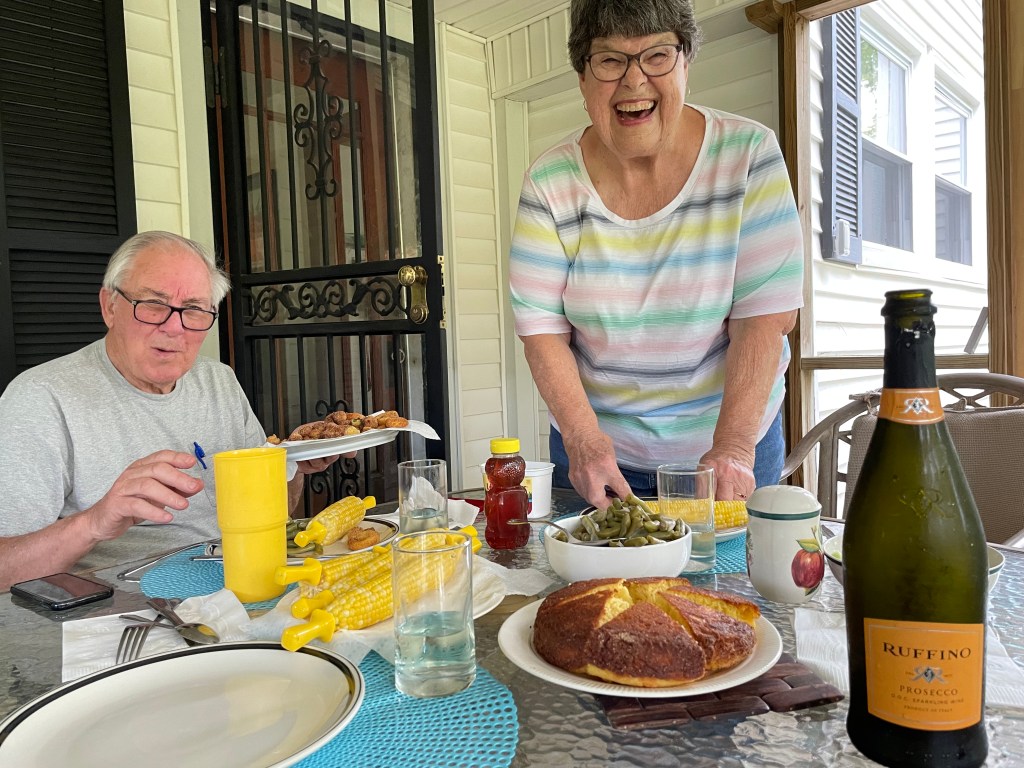
https://www.stevensmortuaryinc.com/obituaries/Stewart-S-Oakes?obId=42256707#/obituaryInfo
-
January 19, 2025

I have a new routine to write when I’m fresh in the morning and look at news when I’m tired at night. I get free library subscriptions to The NYTimes, The Washington Post and am currently paying one dollar for a year-long trial subscription to the SF Chronicle which has automatic renewal at a much higher rate. I bet they hope I forget about that but I won’t. That’s what calendars are for. I probably should support my fellow writers and just pay, but there’s a reason they are free—or close to it—and who am I to try to figure it out?
Together with these three newspapers there is more news than I can look at. I’d be better informed if I substituted one of these papers for a more radical doomsday-type publication and added in a more conservative Tennessee newspaper but my gut is probably going to churn no matter what news I take in.
The Post and The NYT usually have similar headlines. The writing is good in both. The NYT usually sends me three or four breaking news emails every day in addition to The Morning and I have to ask myself how much news can break?
The SF Chronicle seems to have lots of strange gaps in their reporting that often makes me ask “okay, what happened?” but it’s local(ish) news for me even in Concord and I should probably pay attention to that.
I’ve also decided that with all the crazy people in Trump’s junk drawer (Jillian told me people are calling it that instead of a cabinet), it’s probably best not to get worked up every time Broken Stapler #1 says they are going to invade Greenland or Dried Up White-Out says we need to stop requiring vaccines for children in public school. I just can’t be a yo-yo all the time on their rubber band.
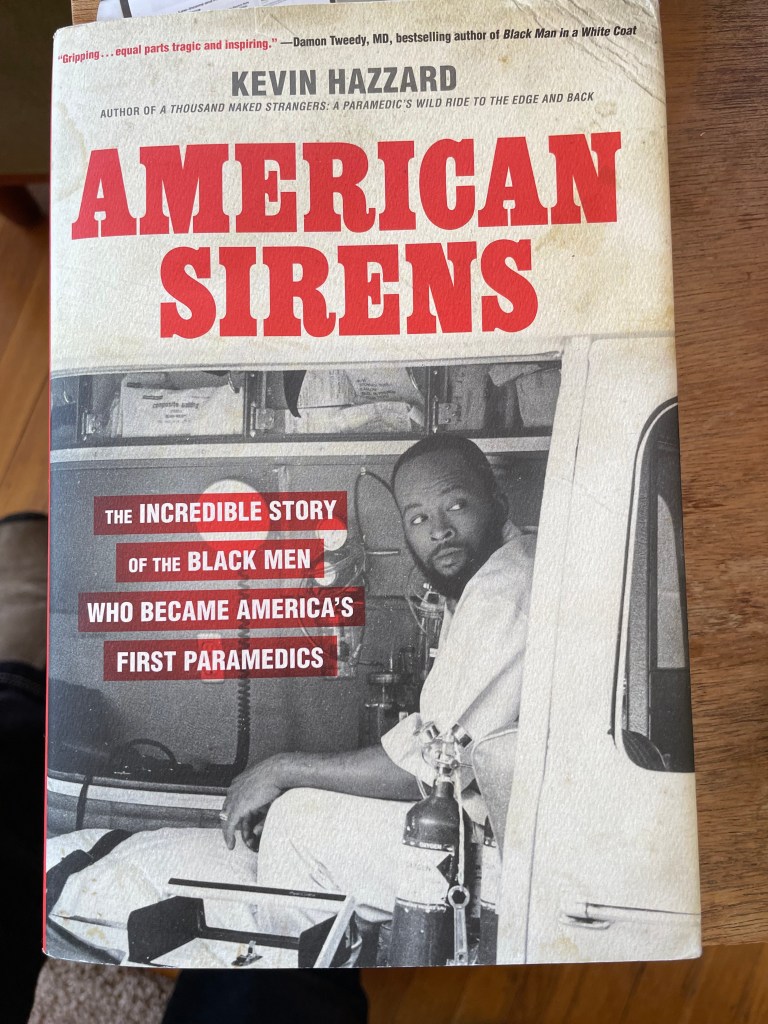
This is my 2025 pick for book of the year (although it came out in 2022). The story is so compelling. It’s heartbreaking at times but there are lots of wait-for-it moments when the soul sings. 
My favorite MLK jr. book that I’ve been reading to students for years. Warning: You will likely cry with joy at the end. Fantastic illustrations. —————
I’m feeling better about the prospect of getting a cabin made. It’s been close to five years since I’ve been exploring this land and it feels, for the first time, like I’m finally getting a good map of it in my head.
For one thing, I found a good place where I can stage logs and then take them out to the road for cutting with a portable mill. I’ve passed by this spot a thousand times walking the trail the 170 yards from the proposed cabin site to the shed where I store tools. It’s flat, close to the road and largely free of any big trees. I think I never considered it before because it’s directly across from my nearest neighbor’s house and in the summer it’s overgrown with vines that offer a visual barrier that I like.

The neighbor’s chickens were scratchin’ around next to the road and stepped into the woods when I approached them. Now, as I’ve gotten to know my neighbors the idea of having complete privacy from the road doesn’t feel as important.There are plenty of spots on this 25 acre lot where I can get that.
Most distant and remote is a little valley on the other side of the central hill and between the next hill which becomes the neighbor’s property after it tops out. This little valley—more of a holler—is almost completely absent of woods. If there were flying fairies, quidditch tournaments or witchy broomstick games this is where they would be played. It would be nice to have a cabin here, but there is no flat spot. Where the hill ends, the next one starts. The valley is a V not a U. A cabin could be built on the hillside with supports like you see in the Bay Area’s Oakland hills but my joy in this place is about the absence of human intrusion not dreaming of what it could be.
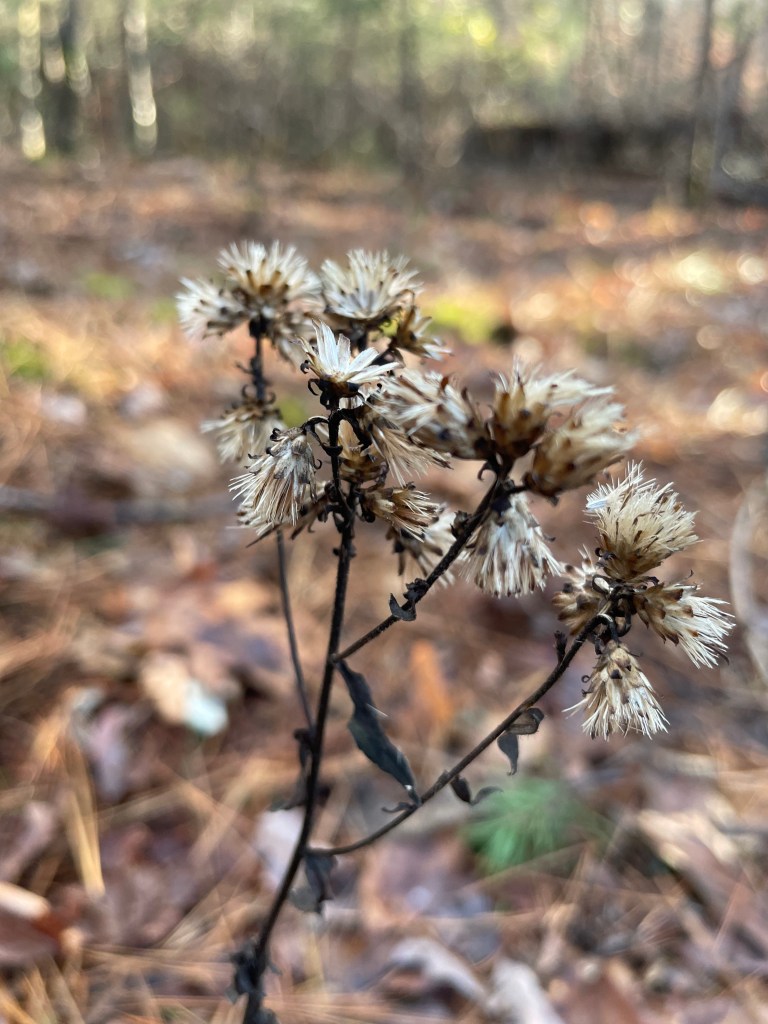
A pretty winter weed that I’m too lazy to try to identify right now. It’s probably something obvious. A while back I named the machete as the most valuable tool in my kit. That remains true even after making trails through the ever-encroaching wilderness. When I go back in six months there will be vines and saplings trying to take over again.
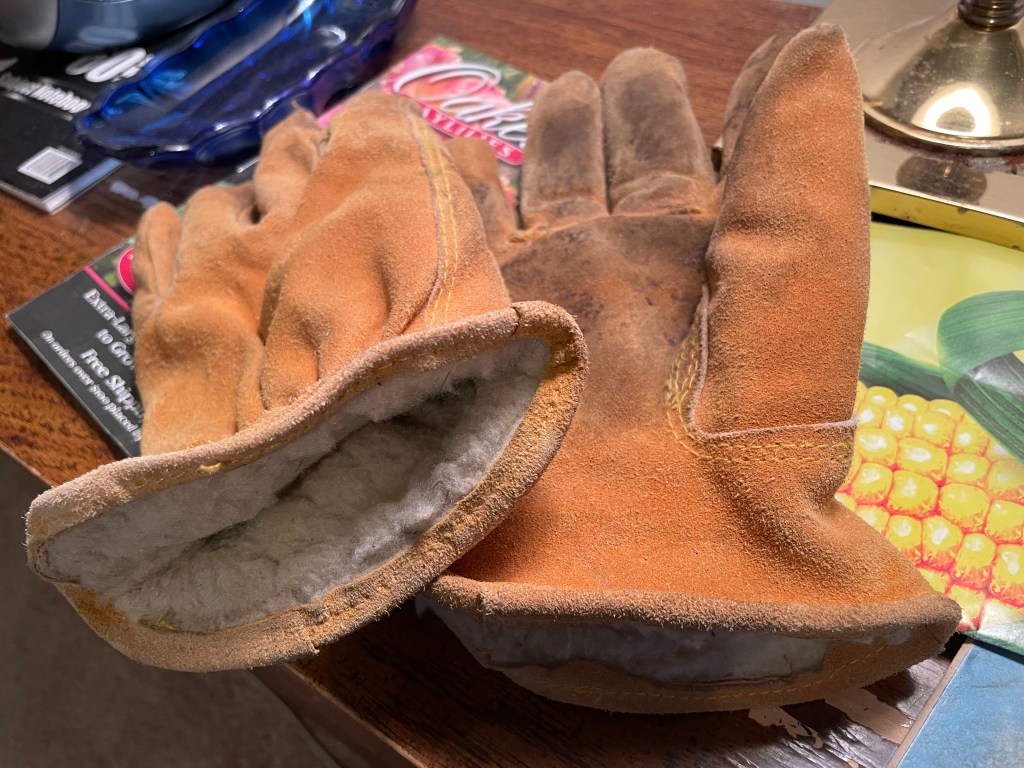
With this in mind I’m offering up another tool that tops the list and was most useful on this last trip. I threw a pair of $15, fleece-line gloves in my luggage at the last minute. I figured they might come in handy if it gets very cold, but that wasn’t why they ended up being so valuable.
It was the extra thickness that offered protection pulling up Multi-floral Rose. I got plenty of practice on that patch of land that I’ve decided is the perfect staging spot for bringing out all the logs to be milled. This species of rose is very aggressive and next to Poison Ivy the most prevalent vine on the land. It grows in clumps that extend out in an exploding firework shape. It grabs hold of your clothes like blackberry bramble and a thicket of it is not something you want to take on in the summer unless Aguirre, the Wrath of God and other Werner Herzog movies inspire you to go into nature and do the most difficult thing you can think of.
Winter is definitely the time to clear Multi-floral Rose. The leaves are gone and you can see where every shoot is heading. Though it still has live green vines, most are brown and dead and if you are lucky, as I was, the soil is soft with recent rains. Some of the clumps I could pull out on my first effort, gathering most of the vines in my hands and leaning back. Any that gave trouble, I’d dig around the edge with my shovel and lean back on the handle to break roots and get some uplift on the ball. This preparation was usually enough. The next time I leaned away with a handful of thorny vines imbedded in my gloves the remaining roots would start popping like a kettle of corn and soon I’d be holding the whole explosion of plant in the air, triumphantly carrying it to a neighboring pile.
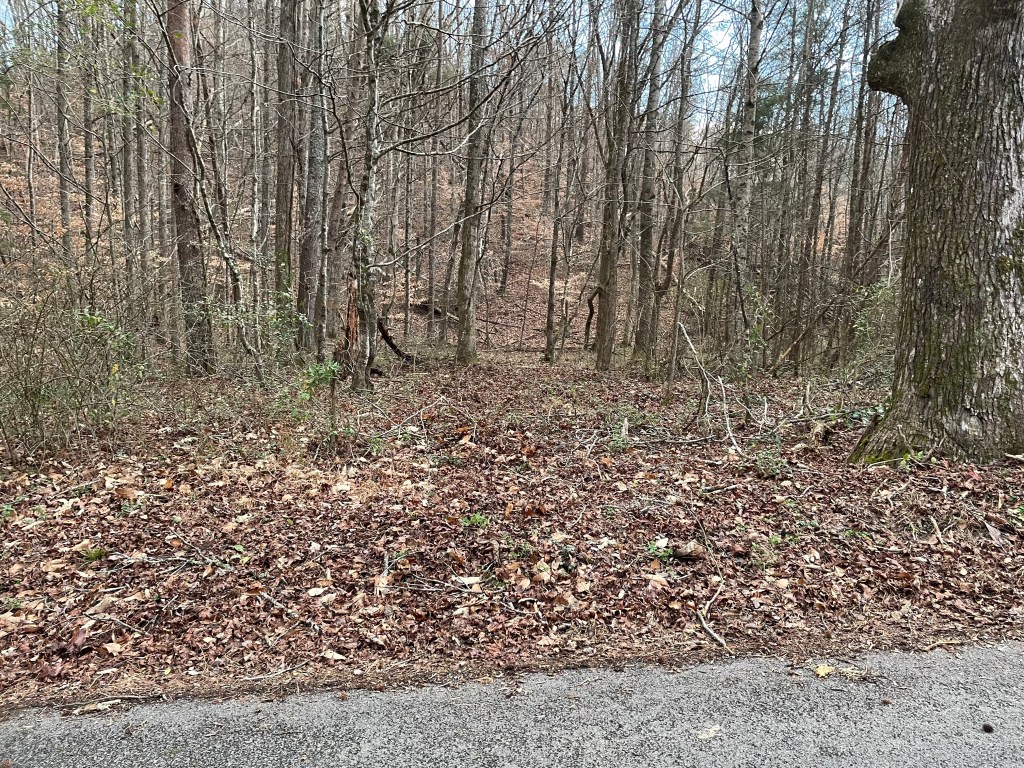
The log-staging area I mostly cleared of Multi-floral Rose The gloves also made it easy to pull up all the Loblolly and Winged Elm saplings on the PCS. It was rare that I had to use the machete on a sapling in this area. The ground is covered with pine needles and moss of varying shades of green and grey. Beneath this is about an inch or two of topsoil followed by white shale and clay that becomes increasingly hard to dig into about six inches down. During wet weather it is a miniature flood plain with much of the water washing off the knob behind it. The moss and top soil make it spongy.
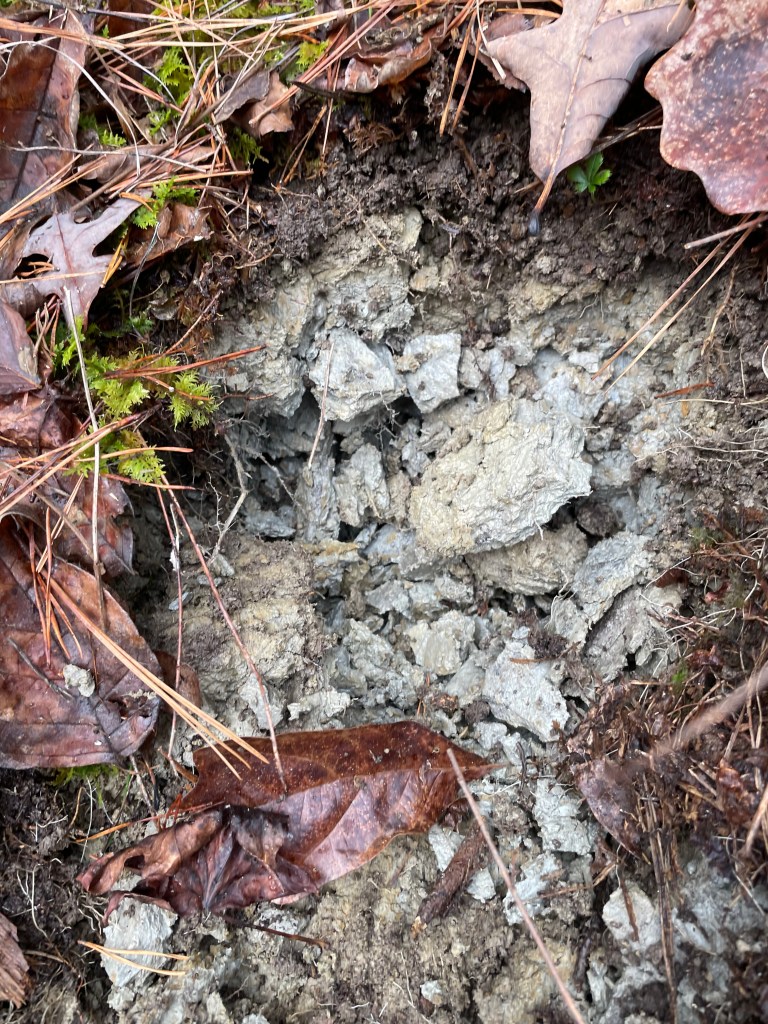
Shale and clay earth just beneath the PCS surface 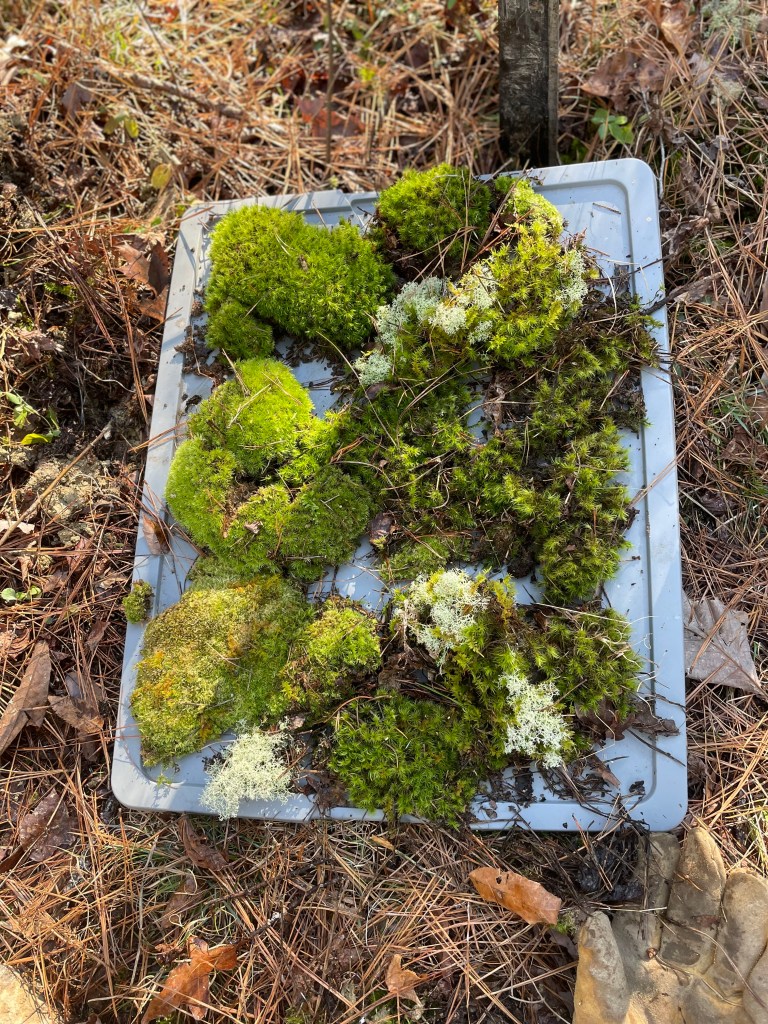
Ground moss collected from the PCS 
I used the harvested moss to line the rock stairs I put in last summer. I’ll see if it lasts but I don’t know why it wouldn’t. The stuff is pretty hardy and there was some in the stair area before I brought all this extra in. The poor quality of soil on the PCS is probably why there are only a few species of trees there — Loblolly, Cedar and Winged Elm. Oaks which start out with a single, deep tap root definitely don’t like it. I imagine the shale is too difficult to penetrate. Those other species have roots that spread wide and shallow—at least in the beginning. I’ve no idea what the root system looks like for some of the older, surrounding pines that top out well over a hundred feet. I imagine when a tree grows that big it must start to have powerful roots that can make their way into deeper territory.
Ideally, I would have a well here on the PCS pumping water directly into the house, but I don’t know how much water makes it through the clay. Neighbors, Chuck and Rhonda, across the road, are roughly at the same elevation and hidden behind a small knob. They told me they hit water at 150 feet but drilled to 200 and take water from that level.
They came by on the day I was cutting up some fallen trees near the road. They arrived in their new, gleaming diesel pick-up and put it rumbling into park. Michigan natives, they had a retirement home built here five years ago and are still adjusting to it. Chuck misses the snow but they have a daughter who lives nearby in Knoxville with her fiancé. Ever-friendly, Chuck invited me up to their place to say hi. I told him I may take them up on that. I’ve been a few times before. Rhonda said, “I’ll give you a piece of pie!”
The next day I called them when I started to get hungry and asked if it was okay if I took my sandwich up and ate it while I visited.
“We have food,” Chuck exclaimed in his cheerful voice that made it sound like the introduction to a Broadway song.
“Oh, thanks, but I made this sandwich and I better eat it,” I said.
“Well, you like coffee,” Chuck asked?
“Sure”
“Well, we can give you some of that.”
We talked more about their water while I was there. Chuck gave me a glass to taste and it was exactly what I would want in drinking water—pretty much tasteless.
Their aging dogs Fatty Mattie, a standard poodle mix and Waggy Maggie, a black lab are slightly mis-nicknamed since Maggie is a bit plumper than Mattie and Mattie is a bit more waggy than Maggie. At any case it was nice to get my hands on some dogs, missing Sasha so much in the short time I was in Tennessee. The feel of a short shorn standard poodle’s curls is a textural delight.
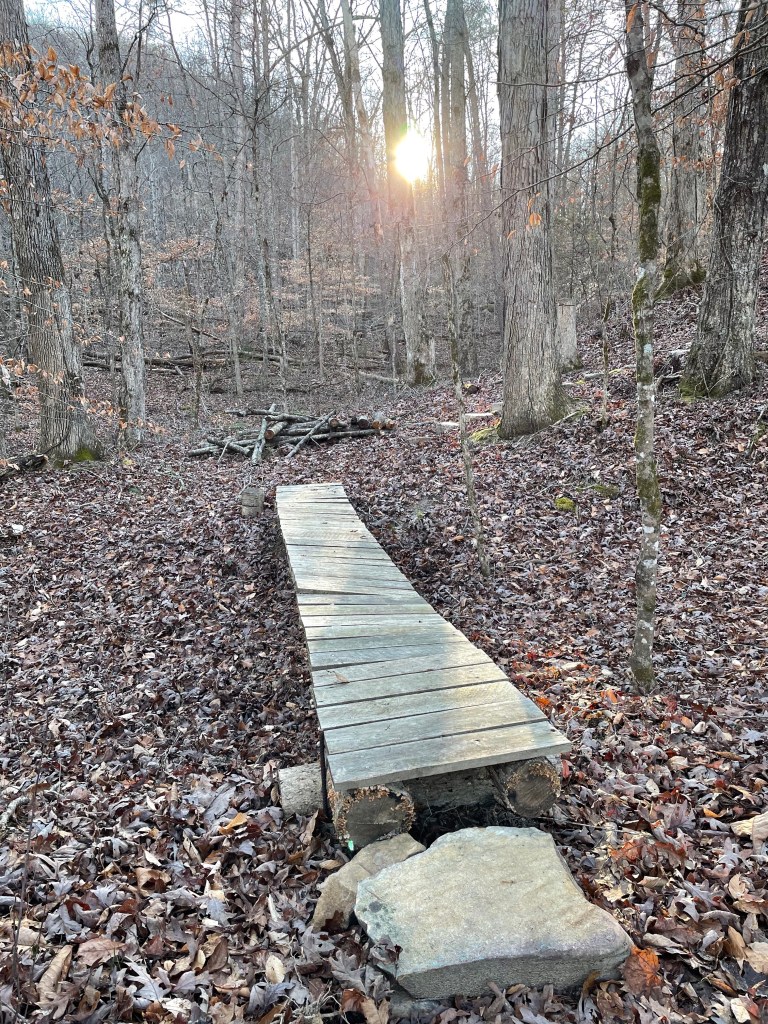
The old bridge is holding up, but growing a carpet of Turkey Tail Mushrooms which I scraped off the underside of oak logs. I don’t want to help the Mycelium network to advance the bridges ultimate failure. 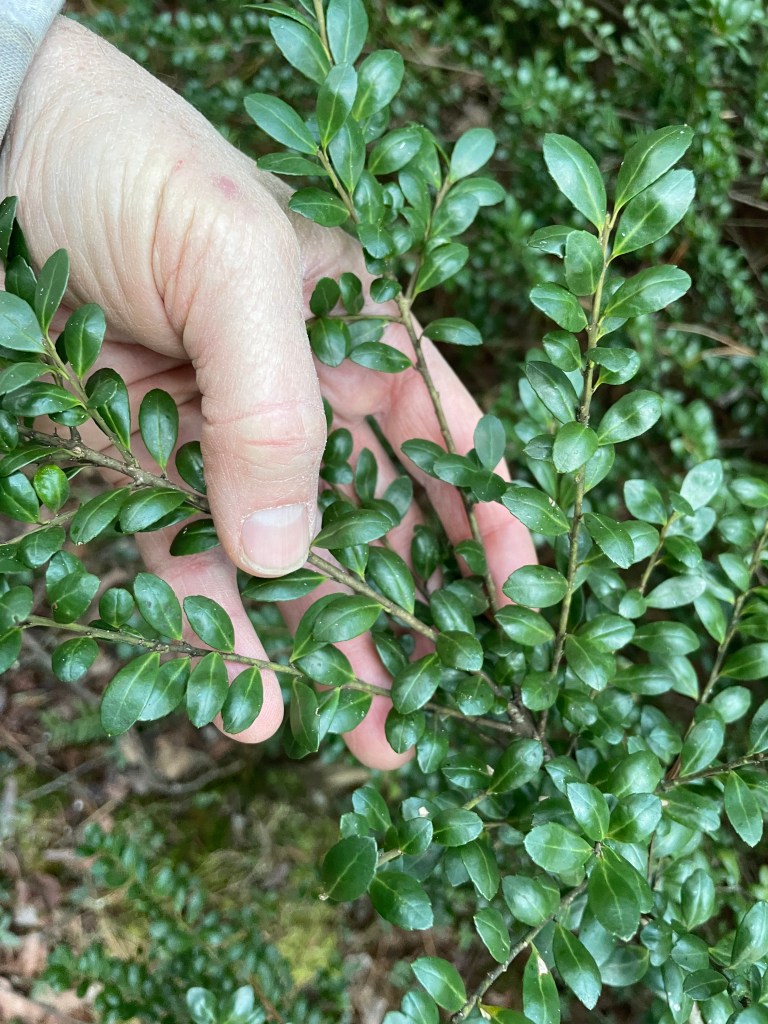
A Google search indicates this is a Japanese Holly, an invasive species. I admit that I’m not as concerned as a should be about invasives. This is a pretty plant and the only one I’ve found on my land. It is part of a big, lush bush at the base of the hill at the back of the PCS. I used the dark green as a backdrop to film the falling snow that didn’t stick. I’m quite fond of it and will keep it until convinced otherwise. 
Numerous trees helped break the fall of this 120 foot, 30-inch diameter Tulip Poplar. Evidence includes skid marks down the side of another big poplar and a Loblolly Pine that snapped 12 feet from the ground. A free fall directly onto the Sheridan cabin would have probably meant its demise. Maybe the structure would have failed without the brace I put on the opposite side and a pole on the inside. My work to do that may have been a mistake if I wanted to have an easier way to disassemble it. 
The tree now laying on the ground is so beautiful and straight. It would be a waste not to use it for lumber. I’ll have to think about how to deal with it next summer. This one is not near the log staging area. It’s on the other piece of land. However, the closest neighbor has said I can use his tractor to pull cut pieces out. He also has a non-automated mill he will let me use. By non-automated I mean it is the kind I would have to push the saw through. 
The top branches of the fallen poplar are big enough to be sizable trees by themselves. 
An eight foot crater was left where the tree fell exposing lots of rocks for harvesting. 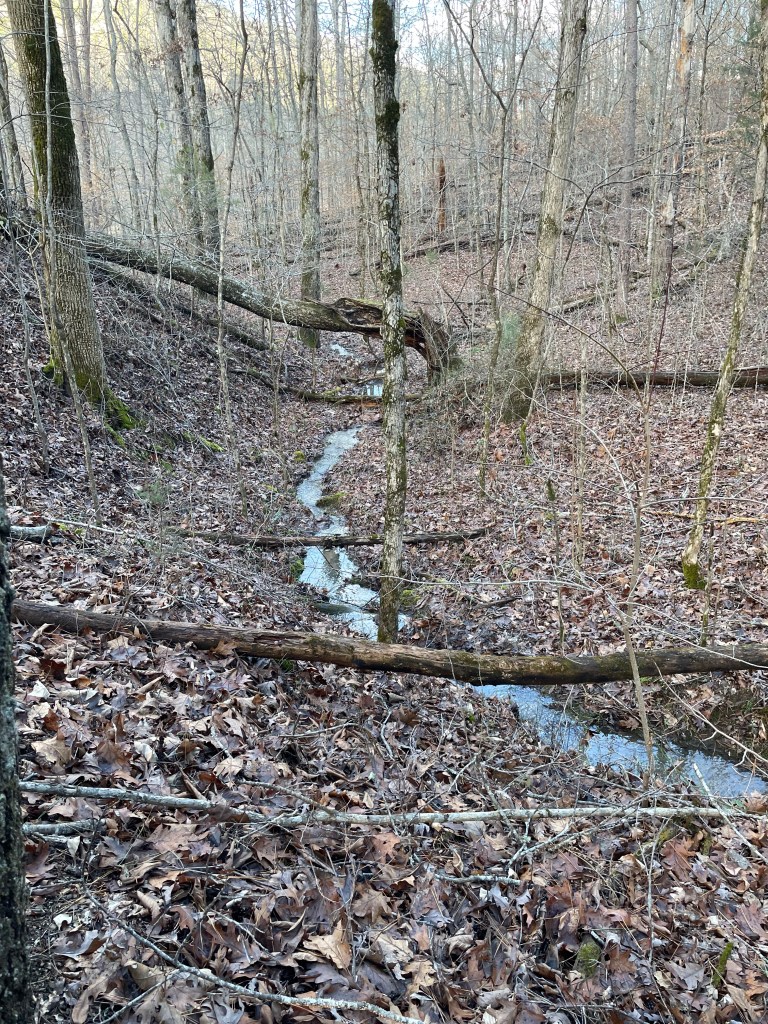
There were numerous wet-season creeks that I saw on the land for the first time on this trip. 
This place holder was on the back of every seat on the American Airlines flight I took home. Was this the idea of a radical literacy advocate bemoaning the state of our video-saturated world or did they just want to make sure you didn’t put coffee cups and snack wrappers in the magazine pockets? -
January 12, 2025

As is always the case, the few things I had on my list to do on my latest Tennessee trip grew into a thousand things in my head.
What I did do was rake a thick layer of leaves off the new gravel driveway. I figure it’s best to minimize the rate at which a layer of topsoil will eventually overtake it given the number of trees and the fact that I won’t be there every week to uncover the grey rocks.

There is a pile of shoved up dirt at the end of the driveway the bulldozer made to grade it. This has become my de facto compost pile. I added all the raked leaves to it. Between wagon loads I threw shovels of dirt on top to weigh them down. I also carved out a channel on the downhill side to make an area for water to escape the driveway. I’ve no idea if this is useful as there are plenty of opportunities for water just to seep into the ground or flow out in all the lower areas, but this type of engineering comes from my earliest childhood instincts to play in the dirt. I don’t think we humans loose that. Same with water. I imagine I’ll enjoy gazing at the ripples of a stream and dragging a toe through a placid pond as long as I live. It’s why I like going to the land. Just to play.
While I was messing around at the driveway I moved a small cedar sapling about three feet away to get it out of the range of car tires. I dug up another from the proposed cabin site (hereafter abbreviated PCS) and planted it in line with several others. There are now four or five cedars lining the drive. I’ve no idea if they will turn into big trees and if those big trees will be full and gorgeous. All I know is I like the smell of cut cedar and I like the beautiful red wood which has nothing to do with why I’m planting them there. Ta boot, I’ve noticed is seems to be a crapshoot whether a cedar is beautiful or scraggly and most of the cedars on my property tend toward the latter.
The driveway and seventy five yards away at the PCS are where most of the cedars grow. In other places, notably on the west side of the property and around the falling cabin on the other property are numerous large cedars in advanced states of decay laying on the ground like dinosaur bones—evidence of a time when they played a more prominent part in this world. I’m not sure if a blight took them out or changing climate or changing composition of soil. Maybe they just all grew and aged out at the same time. Their placement is random so I don’t think they were planted. Most of the cedars I see in this area of country line fields and roads and I suppose were planted (or kept) there as hearty trees, live fenceposts and windbreaks. This lining-along-the-edges is what I’m doing without having researched it or even given it much thought. It’s a wordless tradition passed on by a common landscape template.
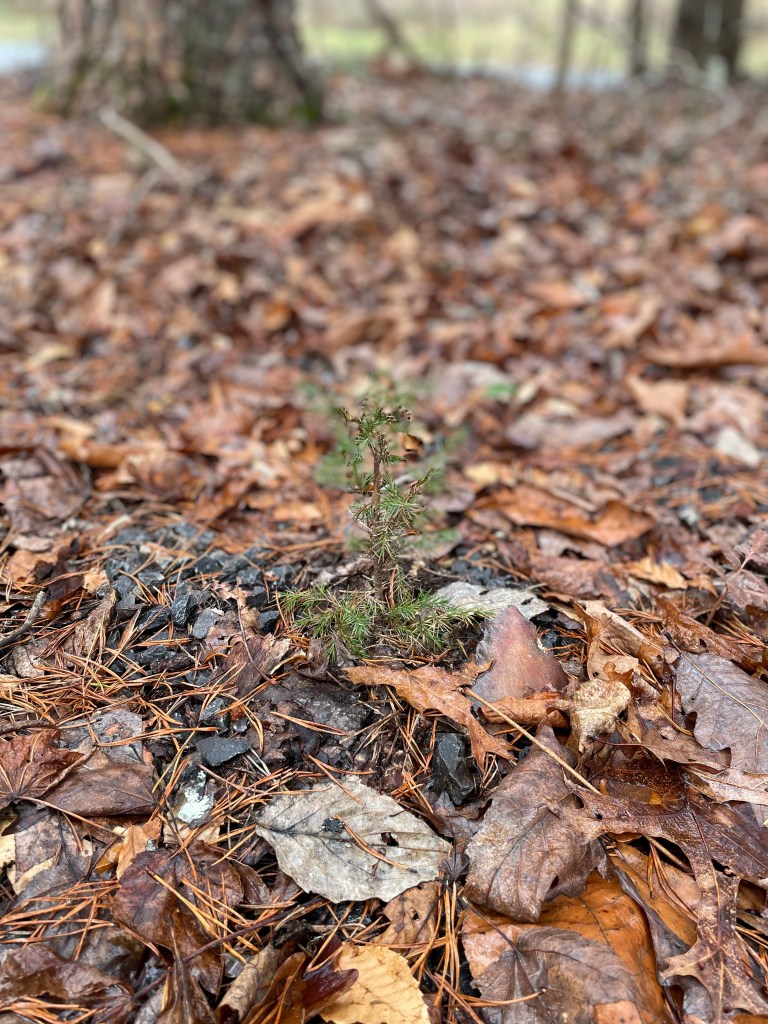
The tiny cedar I moved out of the driveway. 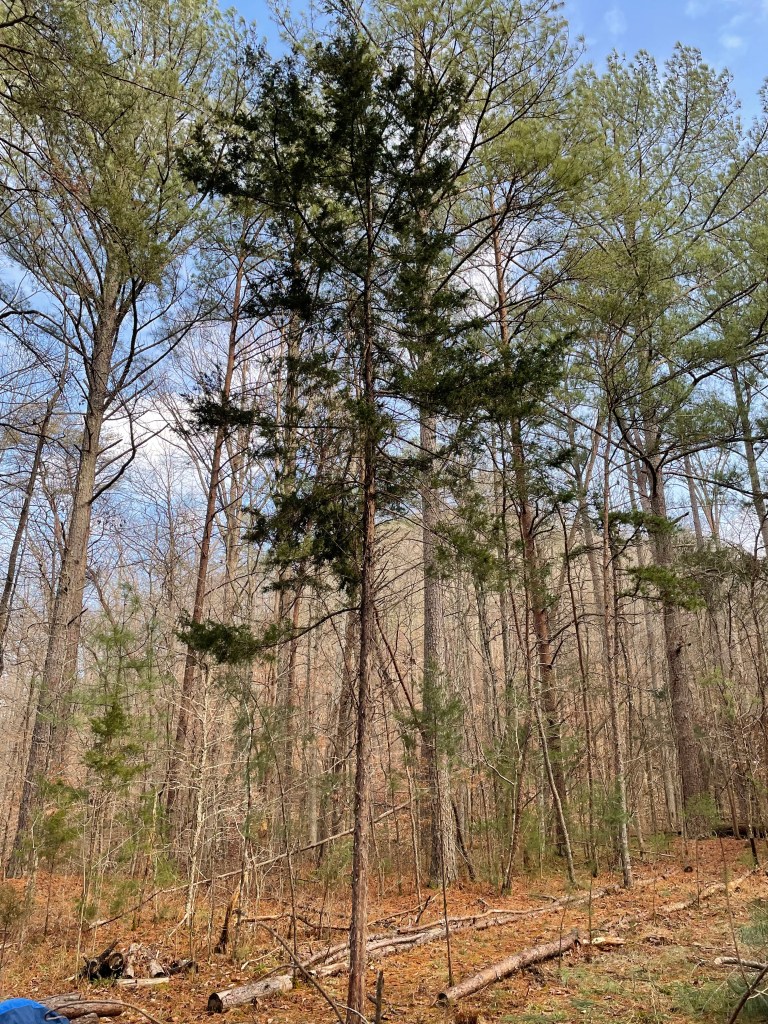
This may be the largest cedar on the property. There is no old growth cedar. I didn’t end up doing a burn. More reading about why winter burns require a state permit convinced me to wait until summer when there is more moisture in the surrounding trees and less chance of them catching fire. I also had the feeling that the heavy, cold air would keep most of the smoke in the valley and that while all my neighbors probably burn wood they prefer it going out their chimney than coming in the front door.
I spent a substantial amount of time further clearing the PCS back to the base of the knob—the high hill that will be in my backyard. I was anxious to get out to the land each day but because of jet lag I didn’t make it there before noon except for the last two days. I didn’t feel bad about it. I’m physically exhausted after four or five hours of hard labor and the sun sets early in the winter. By then my back is aching and I’ve become very sluggish—particularly in the case of chainsawing for a few hours. The chainsaw is heavy and so are the chaps. In fact, it’s debatable whether the chaps that protect my legs add safety or not. I stopped wearing them after the first day. They tire me out quicker and I’m more likely to do something stupid when I’m tired.
Most of the clearing was of Loblolly Pine and Winged Elm saplings just a few inches across with a few larger Loblollies thirty feet tall and not more than five inches across. I won’t cut any of the cedars until I’m sure what the footprint of the cabin will be. I transplanted a few larger ones to line the trail going to the memorial stones. Two I dug up with a ball of earth slicing through any long roots with my shovel in the process. Two others I pulled up with most of the roots intact. (The soil was a wet bog making it easy.) I’m curious if either transplanting method works although I didn’t do a good job labeling which tree was dug up and which was pulled out and by the time I get back this summer my memory will fail. If any are alive I’ll be happy and it will pay to learn which method is successful for the next time.
Winter is definitely the time for clearing but still with all the tangle of vines and saplings it didn’t take long to make a real obstacle course at which point it was important to turn the chainsaw off and clean up. All the small stumps I made were trip hazards enough. The more tired I became the more I stumbled. I can cut the stumps to about an inch above the ground but any closer than that and I risk getting the chainsaw in the dirt which quickly dulls the chain and makes sawing more difficult and hazardous. Stopping to resharpen the chain is about a fifteen minute project. I can do it in the field but it’s best to do it back at home. Eventually I may not have to watch a YouTube refresher course every time I go to Tennessee.

It’s important to keep the chainsaw steady when sharpening the blades. Instead of buying a vice I can keep the chainsaw from moving up or down by pinning it under a couch at Aunt Linda’s using a hammer through its handle. 
This handy 3-in-1 chainsaw file keeps two round files proportionally at the correct distance from a flat file and allows me to sharpen each chainlink of blade with one hand and use the other hand to keep the bar from moving left or right. There is a fairly large and straight Loblolly that only has a slight lean that I’ll remove for space for the cabin and which I may mill for lumber although I’ve not researched its qualities for building. I also don’t know how much lean a tree can have before it effects the grain and causes warpage in the milled lumber. Mostly I’m considering all the large, straight Tulip Poplars for framing and Oaks for flooring and siding. (Maybe I can use Oak for roof shingles but I don’t know if that’s a thing.)
I’ll remove other big pines that aren’t taking up PCS space but lean in a direction and have a reach that might be catastrophic to the structure. The winds were high while I was there and on a day when I was working on the PCS my neighbor said she listened to a tree of mine come down across from her house for what she said was several minutes. The next day on a hike to the top of the knob I found it on the way back down.
( The way the trees swayed in the wind reminded me of wave action and the way plant life can move underwater.) 
This is the pine my neighbor heard falling. This webbing of wood is helping to keep it from going all the way down. 
I used the panorama option on my phone camera to get in the whole length of the hanging Loblolly Pine. There is a lot of potential energy at work in there keeping it taut. 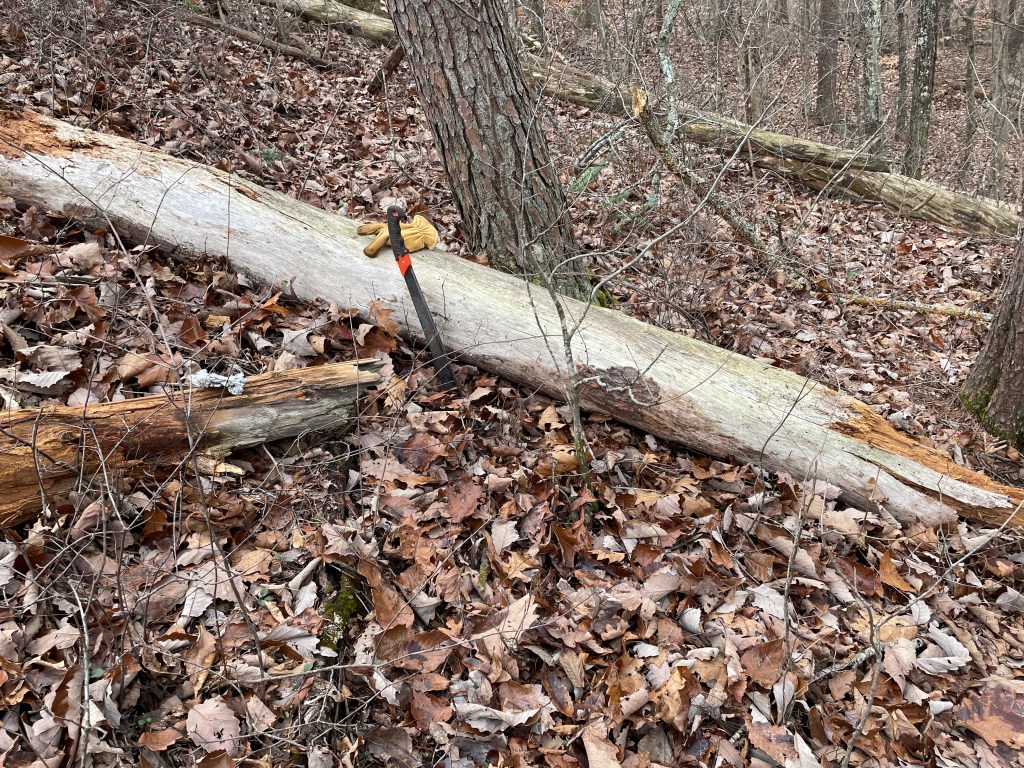
This was a fifteen foot tall rotted stump that I came across coming down from the knob. It was really fun to push it over. It landed with a satisfying, heavy thump and slid about thirty feet down the hill. All the clearing I did on the PCS added three more burn piles. This time I stacked all the larger logs to keep out of the burn. I’ll eventually use them for my own fire place or more likely cut them up and put them on the road for free firewood.

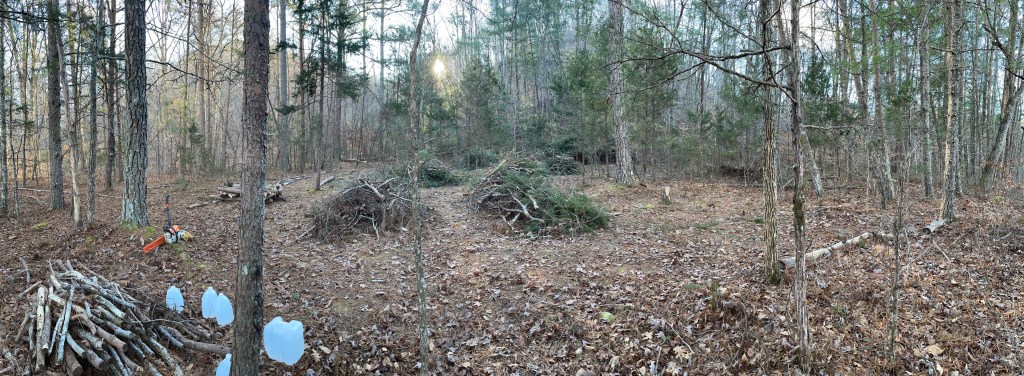
The PCS as seen using the pano feature on my phone One day I saw the neighbors boys, Nate and Charlie, working in the valley across from me. The older boy, a freshman in high school who I’d only met once before, was driving an ATV with the younger, Charlie, a sixth grader, on a wagon hitched behind.
They were dissappearing around a stand of trees and coming back with full loads of firewood.
I’m debating how many trees, if any, I want to remove for a clear view of the valley and Clinch Mountains. A cabin on this spot won’t be visible from the road below but someone could stand in the upper part of the field or behind the tree line and see my structure. The question is how much do I value a feeling of privacy versus having an unobstructed window on this usually serene, pastoral mountain view?

While the boys were collecting firewood, I went over to some fallen trees up the natural embankment near the road and sectioned off two foot logs. I’d been wanting to clean this area up. When I saw the boys go around the stand of trees on their property again I waited for them to cut their engine and then yelled, “Hey Charlie.”
My voice echoed through the valley. It took a moment then I heard echoing back “Yeah?”
“When you guys finish there, come back over here on your way back.”
Again there was a lag until I heard, “Okay!”
It felt good to hear that distance—the voice confirming what the eyes can’t see, to know of space that a city or even a small town can make me forget.
When they came back I asked Nate if he’d like the logs of the fallen tree. Nate is quiet and what I would describe as cautious.
“It’s pine,” I offered before he could answer. “I don’t know if you want it. Another neighbor told me he doesn’t burn it because all the creosote in it can cause a chimney fire.”
Nate looked at the logs and thought for a few moments more. His demeanor reminded me that I might do well to nurture a less impulsive side of myself.
“We’ll take it,” he said. Then the two boys began loading up the logs as I walked up the side of the bank and began throwing more down.

The car windshield on my second to the last day in Tennesseee. It snowed one day but was too warm to stick. The temperature was dropping into the mid-twenties at night but warming to the high thirties in the day. 
Aunt Linda sent me this picture two days ago when freezing temperatures stayed. I was sorry to miss it. -
December 29, 2024 — Somewhere in the Air

I’m heading east to Tennessee. I’ve boarded a plane and I’m sitting on the rainy runway at SFO. It’s still dark at 6:56 a.m. The sun won’t likely be coming up as much as faintly glowing behind these clouds that are low and grey and closed in. I’m guessing we will be above them in the near future breaking through to a strikingly sunny world that appears to be opposite this place below.
I don’t know how many times I’ve started a blog on a plane or in an airport. This part of a trip rarely makes it to the final draft, but I’ve had such a hard time writing anything I want to publish lately that I’m likely just to let it be. What’s that saying, perfection is the enemy of progress? This new year I’d like to embrace imperfection—my own and others.
There is a “particular issue” that the captain has announced “needs to be looked at” so we are getting a late start. I’m all for issues being looked at.
Getting on a flight for me is a bit like being one of those thousands of thirsty, dehydrated wildebeest looking at the water and knowing there is a very large crocodile in there that will eat one of us. It is a sad fact that flying results in plane crashes and that plane crashes rarely end well, but it is the price we flyers pay to get from here to there in a rapid fashion.
Statistically it is still much safer than driving but, to me, pondering the moments of terror before a plane crashes bears a closer resemblance psychologically to being caught in the jaws of an aquatic carnivore. I think we’d all rather take our chances with a car spinning out of control.
It did not help that this morning I read about the Korean airline crash that killed everyone on board except for two people in the tail section of the plane. The tail section, I’m guessing, is the best place to be. I don’t know the physics but I imagine tail sections are light weight and once they are separated from the heavy engines and wings they probably act a bit like a parachute.
Under normal circumstances the tail end doesn’t offer the best ride. Every bump has the feel of riding a broncing buck as it flexes and pops. It is also, of course, the section that takes the longest to get out of after landing, so generally, it’s less desirable 99.99 percent of the time.
I’m sitting above the wings and engine on this flight. It’s smoother here, but this is where these planes usually rip in half. Mine will at least be a quick death.
Four days ago I read about the crash that happened in Kazakhstan. Almost half the passengers lived. I wrote this poem about it:

If I’m lucky I’ll have 3,500 more breakfasts. If I’m very fortuitous 7,000 or more and hopefully without surviving an airplane crash.
Anyway, It’s probably best if I just move along to my Tennessee plans. Better not to harp too much along this line of thought.
I’ll visit family of course. As for the land, I really only have a few things on my list—more clearing of the potential cabin site and a burn of the brush pile I made last summer. It’s probably best to wait on burning any new piles I make. They’ll be less smoke if I give it a chance to dry out.

This sign will replace the Fairyland sign for the next year. Fairyland is a fairytale inspired theme park in Oakland that I took my 1st grade students to half a dozen times over the years. The park changed the sign in conjunction with the Sogorea Te’ Land Trust to recognize the ancestral caretakers of the land—the Lisjan Nation—and reinforce the park’s commitment to amplifying Indigenous voices and stories within its programming. I have a desire to learn more about the people who were on the land I’m caretaking. No local burn permits are required in Grainger County. However, the state requires burn permits except in the summer months. This is counterintuitive to me. I would have thought it’s safer to burn when it’s cooler but apparently it is dryer in these months and therefore more prone to start an unwanted fire.
I recently went on line to get the permit. It was wonky. I couldn’t figure out how to put in a date or the location. Of course, I don’t have an address just a parcel number. Finding the location involves using a zoom function that feels as awkward as trying to pinch a small piece of egg shell out of a bowl of raw egg whites. I just ended the pain early and clicked enter to see what would happen. I was issued a permit for a piece of land that looked to be a dozen or so miles away from mine. I didn’t see any way to cancel it.
My guess is the state doesn’t take these permits too seriously. It is probably a way to collect data and a way to quickly issue a No Burn notice in the case of weather events or conditions that would make burning particularly dangerous.
Anyway, at least I now know that I can register for a permit on the day I need it and I’ve had some practice using the site.

I picked this book up at school. It’s a great read. It’s the first in Wilder’s series of autobiographical stories. A friend said it’s a book hailed by “preppers” (people who prepare for disasters and end time scenarios). Certainly it is useful for anyone interested in homesteading. The detail Wilder goes into makes you feel almost prepared to smoke deer meat, make cheese or tap your maple trees. Apparently the series has negative stereotypes of Native Americans. I didn’t run into that in this first book but I wouldn’t be surprised since the U.S. government had a full scale war going on against Native people at the time when Wilder was a girl. Sounds like these books have plenty of teachable moments for any educators who would like to take them on. I have a friend who would like to do a parody of these books she loves. They do feel ripe for something to contrast the clean-faced, Michael Landon tv version. Environmentally, burning is not the best thing to do. It would be better to wood chip all the brush and spread it out in the forest. But how do you get a wood chipper? Can I rent one and how would I get it up the little hill to the flat spot where I have all the brush and trees chopped down?
This sort of thinking further leads me down the path of getting an all-terrain vehicle. Of course, buying an ATV and using the gas or electricity required to power it would likely negate several times over the environmental benefit of wood chipping all the brush I will ever produce. Where would I store an ATV anyway? Do I build a secure shed at the end of the new gravel drive way? Do I see if I can store it in my aunt’s garage? In that case, can you legally drive an ATV on the roads to get it from point A to B or would I need a trailer and the use of Stewart’s truck to haul it? With all that, wouldn’t it be time to get my own truck?
You can see how the dominoes begin to fall and this is just around the thought of wood chipping some brush? Building a cabin will entail a massively larger set of details.
And to that…about three months ago I had a fall bouldering at the climbing gym. It was a sideways fall onto my right side and I stuck out my dominant hand to brace myself. With a locked elbow my arm became a pole shoved into the socket. I stood up feeling a pulsing, but not unbearable, pain in my shoulder and told the people around me “Well that’s a good way to break your arm”.
After some self-massage I continued to climb for a while. I still have good mobility. I kept going back to the gym and playing tennis (serving underhand) before it became apparent I needed a longer rest. I went in for X-rays a month later. Looking at the black and white prints the doctor showed me something that he said may be a hairline fracture in my collarbone. He said it should heal on its own in six to eight weeks. He even said I could continue climbing if I was careful. I did that for a while but without fail I inevitably moved in a way that resulted in a sharp pain. So I’ve basically stopped all activities that involve any unpredictable motions with my right arm. I even stopped throwing frisbee for Sasha with my right hand and taught myself to throw with my left. I’m still not as good with that side but much better than I was. It’s felt like being six again and first learning to throw. It’s a good reminder of what it takes to build coordination—lots of practice.
A week ago I passed the two month mark for my shoulder to heal on its own. I haven’t seen much improvement. I scheduled an appointment with a physical therapist for when I get back. I hope I might be able to get some advice on how to help move the healing along.
This is all just a long way to say it is increasingly unlikely that I’ll build a cabin in the least environmentally-impactful way. At my age and with slow healing injuries like the one I’ve got, I’ll likely require considerable help from machinery.
Of course the least impactful thing I can do is to not build a cabin at all and to not jet off twice a year to visit this land or my ancestral people. Perhaps writing about these quandries is a sort of carbon offset along with my commuting by bike and the solar I’ve put on my house. I don’t like to think of my life as some sort of accounting tabulation and I’m kind of agnostic about karma or someone with a quilled pen and ledger at those imagined pearly gates. But how can we love life and not look at ourselves as caretakers? I’ll have to just balance things the best way I can.
I was happy to come home one day last month and see the street filled with these bike sharrows. This one is right in front of my house. This was the last phase of the new sidewalk and street paving project that is happening in my neighborhood. ——————-
We’ve been flying in that sunny, strange, high altitude world for a while now. The cloud layer gave out past the Sierras and picked up again above the midwest. I have a two or three hour layover in Philadelphia before getting on a smaller plane to Knoxville. The goal is to get this piece posted in that time and set up a landing for whatever I happen to get done while I’m in Tennessee. If I can learn to throw left handed I can learn to be okay with the imperfect and whatever that means in terms of my writing. Hopefully some of you are still with me on this journey.
-
October 12, 2024
Two Italian-American companies are putting in new sidewalks on my street. Sposeto is doing the sidewalks. Ghilotti is doing the accompanying roads. Taken together the names make me feel like I’ve walked into an Italian creamery. The job they are doing is sweet. The sidewalks have beautiful lines and are clean like a newly frosted cake. The project is moving along quickly. The whole neighborhood is smiles as we see our tax dollars at work.
Concord is a town in what is increasingly less of an outskirt of the central Bay Area. But it is on the edge of country and I often relish the knowledge that I can drive west of here and quickly be in an area that feels like amber waves of grain. If you walk around my neighborhood you occasionally come across a fenced in yard that upon further inspection is really more like a field. At the back of one nearby is an old metal windmill rising up between patches of prickly pear cactus.
My street is half of a large oval. It starts and stops on the same street it curves off of. It’s what’s left of an old horse race track that existed in the late eighteen and early 1900s. The green park around the corner where I take Sasha for walks was the centerfield where the winning horses were given their ribbons and where fans sat around picnic baskets to watch the race.
The margins of the street were all gravel until this new sidewalk started to appear. All told, a peek into a backyard field strewn with piles of junk and blackberry bramble could give a deceptively country feel. But walking in most directions you will find that soon enough the squabbling of scrub jays and mockingbirds is replaced by a yawling white noise as you reach one of the main thoroughfares that flow cars like red blood cells through an artery.
A good portion of the 125,000 residents that live here are commuting in the direction of Oakland and San Francisco. The ones that don’t get there by BART train are doing it in their cars.
Recently I’ve started walking Sasha in different directions to try to accustom her to the sights and smells that surround us in case she ever gets loose. She is skittish around loud noises so it’s hard to walk her along one of the busy roads but I hope that she will build up some tolerance. I’d hate for her to run hairy scary into traffic for being too freaked out.
On our walks I have her sit at cross streets and wait with me to look both ways before we cross. I’m not sure if she’d do that on her own but I want her to know that where a road crosses you have to be extra careful.
On a recent walk Sasha and I stopped by a Little Free Library nearby and found a copy of Mo Willems’ We Are in A Book. I almost never find used copies of his books much less free ones. This title along with Should I Share My Ice Cream is probably the most popular of his twenty something titles.
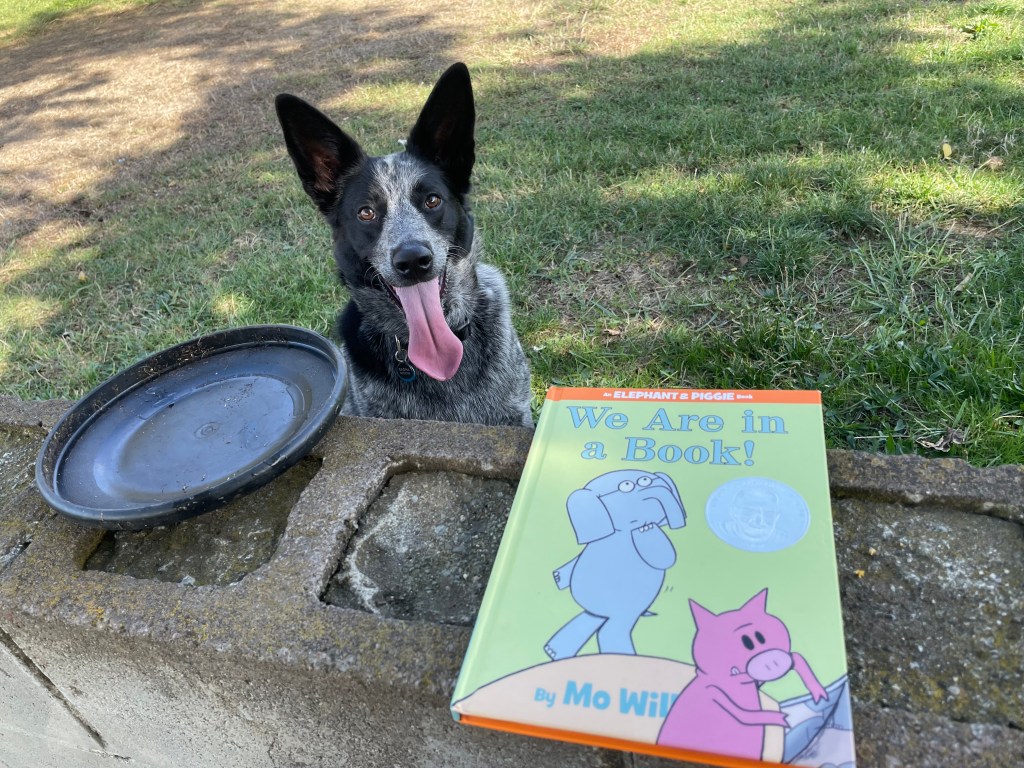
We Are in A Book is funny and profound. It gets you thinking about mortality and what it means to exist. For several of my last years teaching in Oakland another first grade teacher, Ms. Sandoval, and I would act out one of these two books at the school’s annual Family Literacy Night. It was always a hit and we’d have a fifteen minute show within each of the three thirty minute rotations. Several times we got donations of Mo Willems books to hand out. It was so fun! After doing this for a few years we had it down and could get the show up and running with only one or two rehearsals. Ah, the excitement of live theatre!
——————-
I want to tell you about another fantastic book I recently finished. It was recommended by my old friend Elijah. It’s about the Mississippi city he grew up in and where I went to school from 8th grade through my first year and a half of college. It’s called Hattiesburg, an American City in Black and White.

There is certainly something extra special about reading the story of a place where you walked and grew, but this book is also extraordinary because of the way that the author, UNC history professor, William Sturkey, shows the power and framework of Jim Crow.
Sturkey is particularly effective because he manages to resist any discernible ax grinding despite having black ancestry. He lets history itself be the flat stone that makes indisputable facts sharp and painfully apparent.
The book helped me understand better how a boy like myself raised in a liberal, artsy, educated household could not be immune from racist beliefs. It helped me understand how Hollywood may have got it right spiritually and mentally (if not physically) when they sometimes showed southern black communities with white picket fences and children dressed in clean, starched and pressed clothes. And it helped me understand the depth of a brutal social construct that I always felt as a coiled threat beneath the gentle surface of southern hospitality.
Without trying to explain what I mean by all those statements, I want you to know that Hattiesburg is both horrible and hope-filled as it looks at the resilience and determination of black people in a Jim Crow southern town. These are the people that went to Washington to try to get their right to vote enforced. It explains some of the humored looks I got from a few elders when I stepped into the black neighborhood that started across the railroad tracks behind my house, a naive but sincere 18-year-old trying to register voters to support the Mondale/Ferraro ticket in 1983. I had no idea who I was talking to.
It was also fascinating to make a connection with a previous book that I’ve recommended: “Ecology of a Cracker Childhood” which bemoaned the loss of old growth Long Leaf Pine forests throughout the south. It turns out that Hattiesburg was founded and built as the hub of a vast network of lumber mills cutting down those forests. The mills ran continuously for fifty years bringing prosperity to hundreds of thousands of people from the 1880s up through the Great Depression until the last of those great, majestic pines were cut down just like the fictional Truffula trees in Dr. Seuss’ story The Lorax.
Hattiesburg, the book, also ended any misconceptions I had of white Mississippians who tried to wear the banner of proud, self-determined, state-rightist who remained independent of outside influences they thought would sully their whiteness.
The town was established post slavery and grew quickly because of the help and investment of northern industrialists and the mass of low-wage workers. After cutting down all the trees it survived the Great Depression, holding on by its fingernails with federal relief and recovery funds. Then leading up to WW2 Hattiesburg was renewed as an economic hub with the federal renovation and expansion of Camp Shelby which housed and trained up to 40,000 soldiers at a time.
Throughout this era blacks took the lowest wage jobs available to them and during the depression only received federal and NGO relief when it somehow made it past the hands of local authorities who made sure whites got more than their share.
Eye-opening indeed was the extent to which white southerners held a burning cross in one hand fighting off what they saw as federal encroachment while using the other hand to collect federal funds. Socialist-minded Franklin Roosevelt got well over 90% of the Mississippi vote in all four of his presidential elections…and almost all of those voters were white because of exlusory voter registration practices.
In Hattiesburg the racist registrar of voters regularly used the question, “How many bubbles are in a bar of soap,” to exclude blacks who needed something harder than the state constitutional law questions or reading tests required to gain their voting rights.
The unexpected story is the community pride and the black town that grew up next to the white town with its own set of businesses and its own set of leaders. The unexpected story is the way people not only survived but thrived. Even for those who moved away they remained connected to Hattiesburg. Chicago may have been the most popular destination. The latest issues of The Chicago Defender newspaper were regularly passed around until they were worn out and news stories about Hattiesburg regularly made it into those Northern black-owned and operated papers.
Anyway, there is so much more to say about this book but it is better read.
—————
Before I go, I want to show a few things that I left out of my last blog post concerning work on my Tennessee land way back at the beginning of July. (I’ve really missed getting a post out sooner.)
These are the steps I put in to help make the walk easier up the small hill on the main trail that leads to the proposed cabin site. This work is what had me battling the horse fly. (Yes it was usually just one at a time but that was enough.)
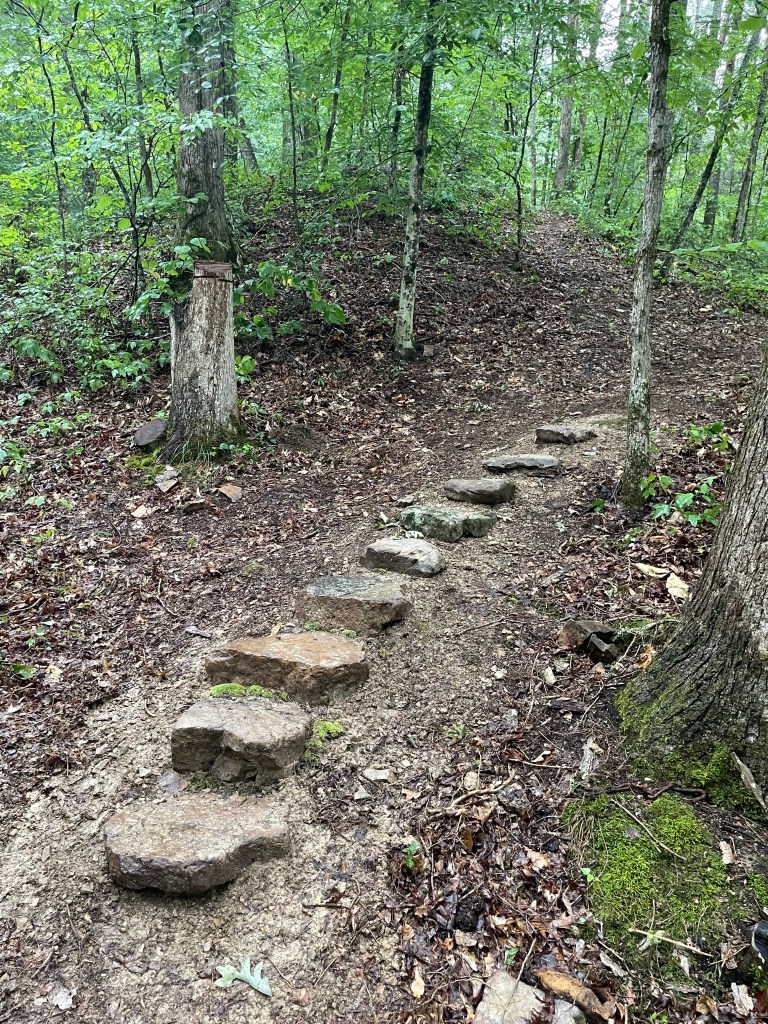
Lower Hill Steps 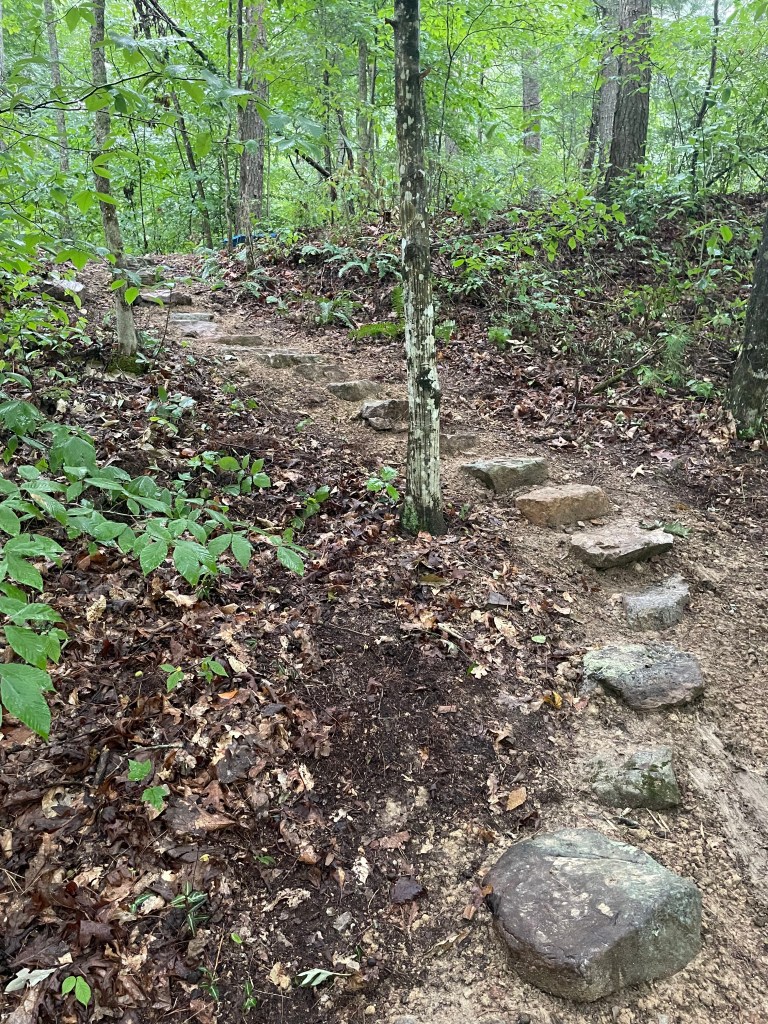
Upper Hill Steps–I had a bad start on these. I was making the gap too wide between steps–trying to go cheap so to speak. I had to remove the ones I set and start placing them closer. 
I got some good advice from a neighbor to keep up with the clearing of the flat spot for the cabin. I plan on burning these piles when next I visit. I may have to get a burn permit if it is winter time. Strangely, burn permits aren’t required in the summer. Apparently trees pull the sap into their trunks in the winter and are more flammable. 
This is the underside of some Winged Elm leaves (still on the branches) I threw into the burn pile. I love their color. I thought these trees had some horrible disease because of the misshaped branches. Turns out that’s just how the Winged Elms fly.
-
Subscribe
Subscribed
Already have a WordPress.com account? Log in now.
 Spotty West Goes East