-
3/20/22
Leaving work Friday I decided on an adventure. Originally, I was just going to go around the block on my bike to check out three sides of my school that I’ve never explored. Well, one really. I was on the neighborhood street on the east side once on my motorcycle. I was wearing a plastered helmet to look like Booster, the animated, robot, mascot for a website called Imagine Learning. Also, I’d driven down the major road on the west side once to do a home visit with the family of a kid who wasn’t showing up on Zoom. It was in the early COVID days way back in 2020. But I’ve never ridden on the Delta de Anza trail that runs on the north side.

During the height of COVID and distance learning, my Bay Point school had a teacher rally to drive through the neighborhoods and spread cheer to the kids who were stuck at home. A lot of schools were doing this. Jillian sculpted my helmet with plaster gauze to look like the mascot for a website my English Learner Department was encouraging our EL students to use. It was fun to drive around on my motorcycle waving at the kids who came out of their homes to see us. I suppose I’m usually too tired for any neighborhood exploration after work. Emotionally it sometimes feels like the most I can do to make my way the half mile to BART. Of the two busy roads I traverse, one has a bike lane. The other doesn’t, but I ride carefully dashing into the car lane to turn at one red light instead of using the sidewalk and waiting through two.
Wariness pervades. I keep an eye out and I’ve begun wearing a neon yellow vest. I still sometimes battle the dangerous sense of entitlement steeped in my critical mass days when once a month we, bike riders, took over the streets in SF and broke car windshields of drivers who dared nose their way into our mass. I didn’t partake in the breaking but watched and stood ground, feeling righteous anger — How dare they threaten our exposed bodies with their 3000 pound machines!!! It’s an anger that can be addictive and lead to bad outcomes if not properly checked. But that’s what war is right?
Anyway, back to the Delta de Anza trail. On Friday, after two years of wanting to explore it, once I was there, I decided not to just go around the block but see how far toward home I could get. I was pretty sure I would be stopped.
Google maps shows no bike link between Bay Point and Concord north of Highway 4 on the bay side. There are, however, links to roads on the south side which go under Highway 4. In fact, Google’s default route shows using Willow Pass Road, but no cyclist in their right mind would do that. The alternative is Bailey Road which I tried — once. Big mistake. It wasn’t so much that I wasn’t in my right mind as much as plain ignorant.
Bailey Road is actually worse than Willow Pass. Cars go just as fast, it’s curvy, and it has even less shoulder — zero in some places. There is the added fun of it being a very steep incline with a resulting decline. It’s hard to think what is worse—being hit by a car when you are struggling up a hill at 3 mph or when whizzing down it at 30?
With all south-of-Highway 4 routes home not viable, I was hoping that on my Friday adventure I might discover some special northern wiggle, not apparent on Google.
Leaving my workplace, the Delta de Anza trail is wide and protected with bollards where it crosses numerous neighborhood streets, becomes lost and found again over two major intersections, passes homeless camps and garbage heaps, playgrounds and backyard fields of a junior high and another elementary school and then, three miles from where I started, arrives unceremoniously in someone’s driveway.
Whoopsie daisy. How many other people have found themselves here? I wouldn’t have been surprised if I’d seen a sign — “Welcome to the Garcia’s. Now turn around and get the hell off.”
So this was my first dead end, but after removing myself from the gates of someone’s private property I looked around and the view was worth it. I had, in fact, with that last crossed street arrived in what could only be called the country. The land was elevated and gave a wide view of Suisun Bay.
It wasn’t even four o’clock. The sky was blue. It was 70 degrees without wind. Everywhere around me golden poppies, purple lupine and yellow mustard were covering the fields. Southward was Highway 4. I knew there were no routes that way, so I let my bike coast north toward the bay and turned west on Port Chicago Highway. Perhaps I’d find a path, but if I didn’t there wasn’t a lovelier day to explore.
Port Chicago looked like any of the other scary roads I’d tried. No margins to speak of and nothing to keep people from going a hundred miles an hour. Not even curves in this part. The only thing — there was no one on it.
Still, I was wary. When a truck finally appeared in my rear view I prepared to veer into the sandy dirt, but the driver gave me a wide berth and passed at a tip-your-hat speed. I started to relax a bit. I’d be able to hear someone coming a long way off and didn’t need to obsessively check my rear view.
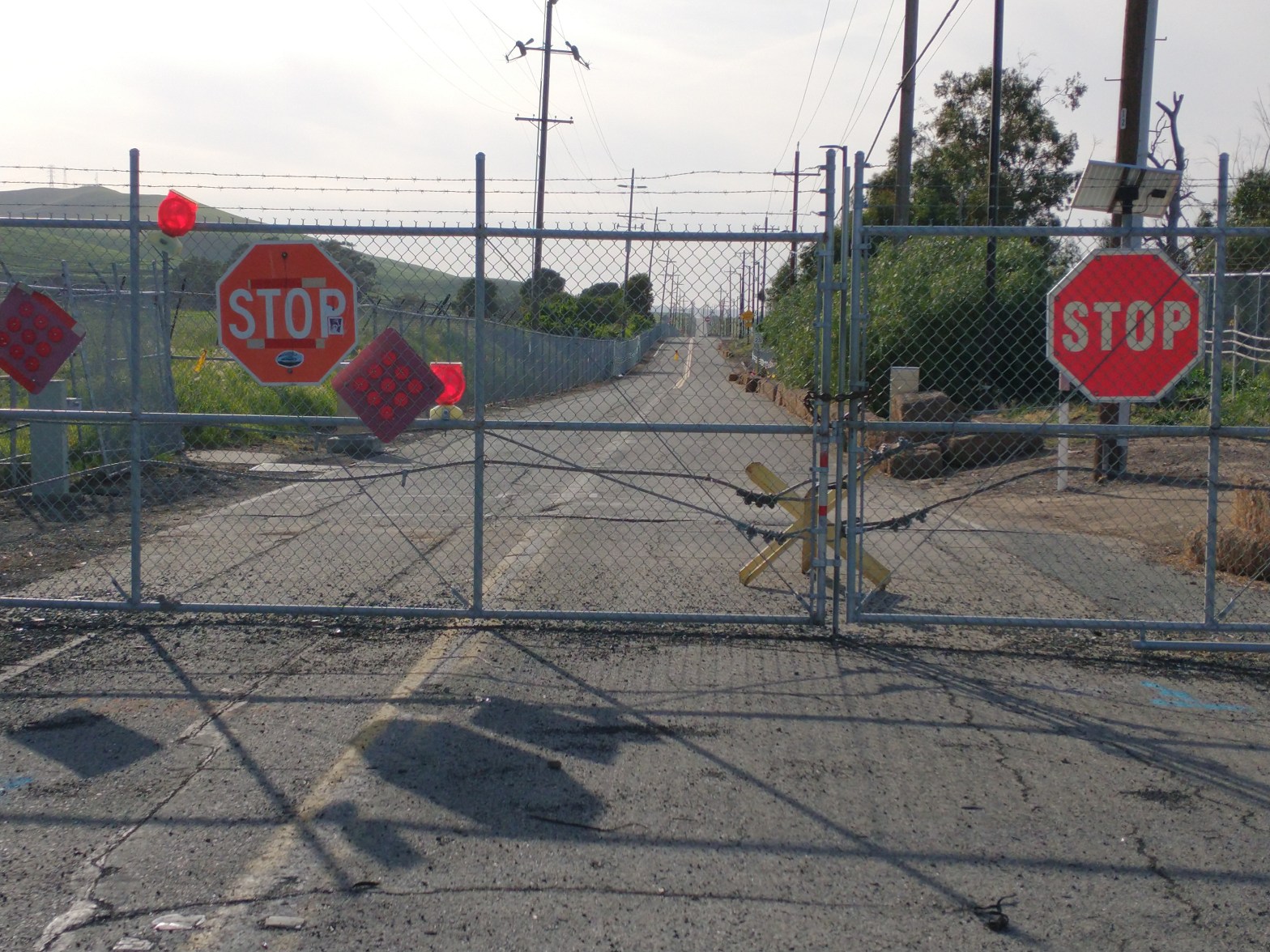
Soon I found out why there weren’t many people on this road:

This is Port Chicago Highway. From here it loops next to Suisun Bay and then comes inland to Concord within just a few blocks of my house. Unfortunately a large swath of it is off limits as it crosses a mostly defunct Naval Weapons station. This is the same station where 320 sailors and civilians, mostly African American, lost their lives with one huge munitions explosion in 1944. https://en.wikipedia.org/wiki/Port_Chicago_disaster) The whole base is fenced off with dozens of these signs wherever someone might think of climbing the fence.

I was worried that I might get shot just taking this picture. Okay, another dead end. So left or right? Those options were still available. Left looked more promising even though that was the direction of the highway. Perhaps a path ran between the green hills.
I started down a narrow asphalt road, pitted and decayed with age. It followed the Naval Weapons station fence. I passed over an old, but sturdy looking wooden bridge that spanned the canal and soon found myself surrounded by green globular hills covered in wildflowers.
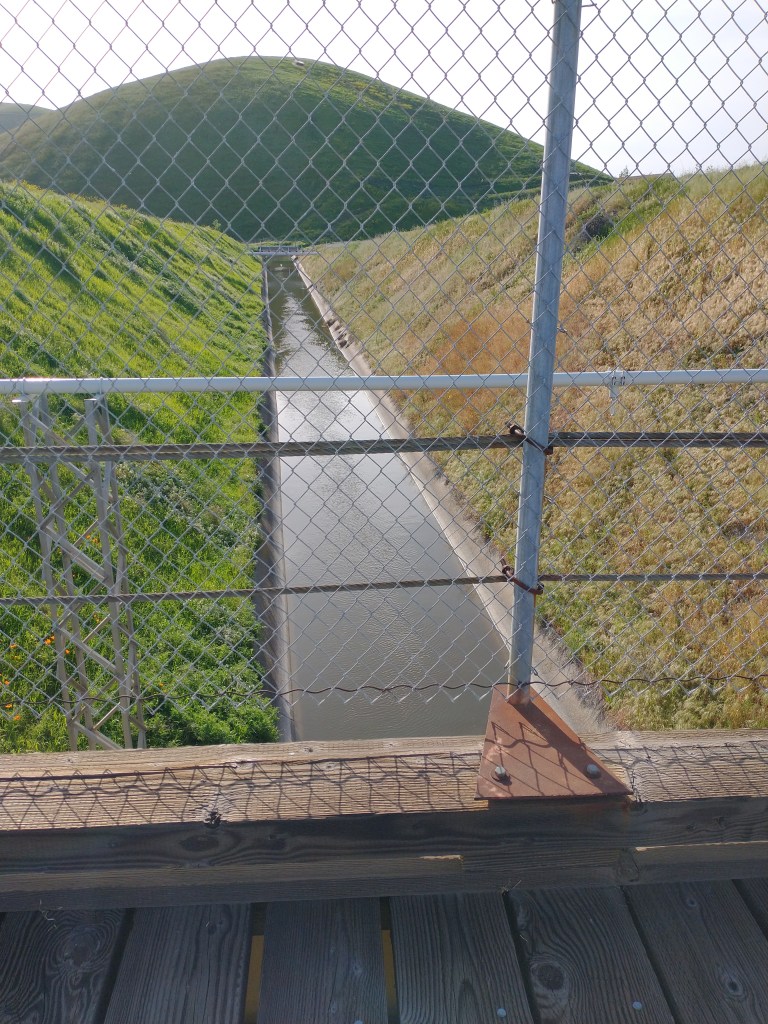
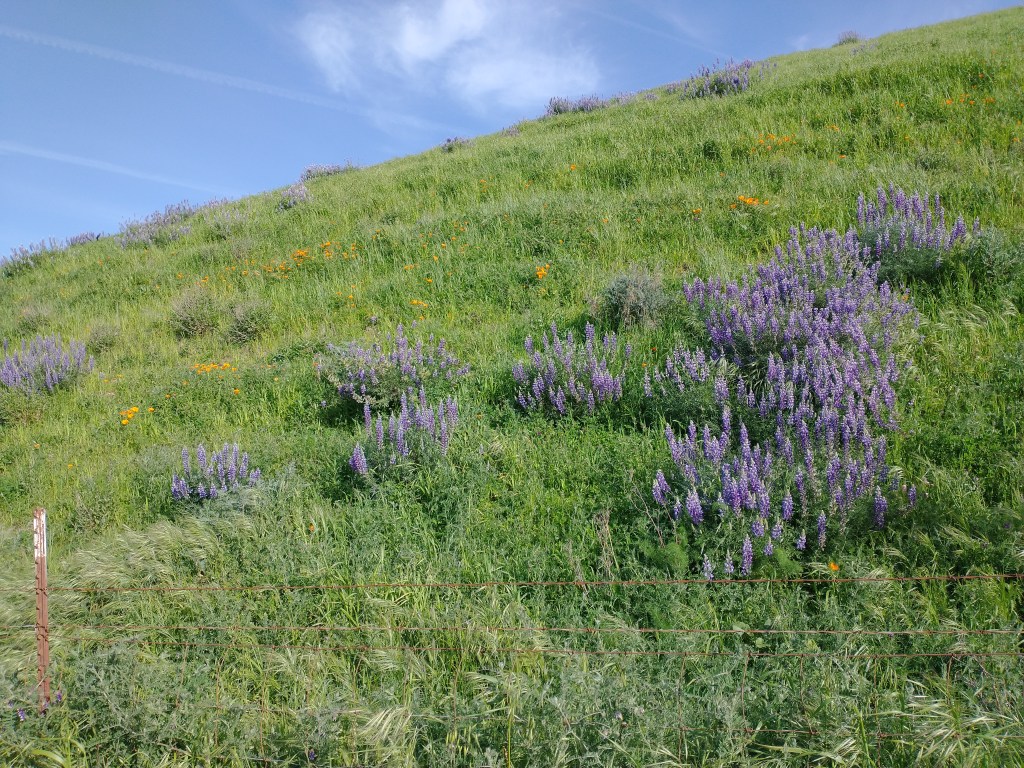
I stopped to watch a Red-tailed hawk making lazy circles over the hillside. Finding nothing she rose to the ridge and surfed the edge to the far end. I followed her up the road and found a cluster of a few houses there and a man getting out of his truck, gathering a lunch box and hard hat from a days work. Perhaps this was the person who had passed me earlier on Port Chicago. I looked up the road where yet another fence ended my advancement.

“Hola,” I said.
“Hi. How’re you doing?” he replied.
“Do you know if there is a way to get to Concord from here?”
“No there isn’t. That way,” he said indicating the fenced off road, “goes onto Chevron land and they don’t let people pass through there.”
I told him my dismay that the canal trail didn’t extend through and he offered theories about why. Then I told him how beautiful I thought it was out here and he thanked me.
When I left, I circled up to the chain link Chevron fence. It was padlocked and unmarked. On the other side was a muddy barnyard and a bunch of goats. Maybe Chevron employs someone to keep the grass down around their facilities or maybe a resistant goat farmer was grandfathered in. Who knows? It was my third dead end.
As I left a few more trucks came up the road. Others probably coming home from work, but my dark side imagined more sinister scenarios. I was, after all, in a cul-de-sac of sorts. Blackwater security? Drug cartel henchman making sure the bike rider isn’t snooping around? It’s always strange to find yourself in a remote place that isn’t actually that remote.
Well, there was only one more chance to find a way through and that was to go the opposite direction at the T—north toward the bay.
I passed back over the sturdy wooden bridge.

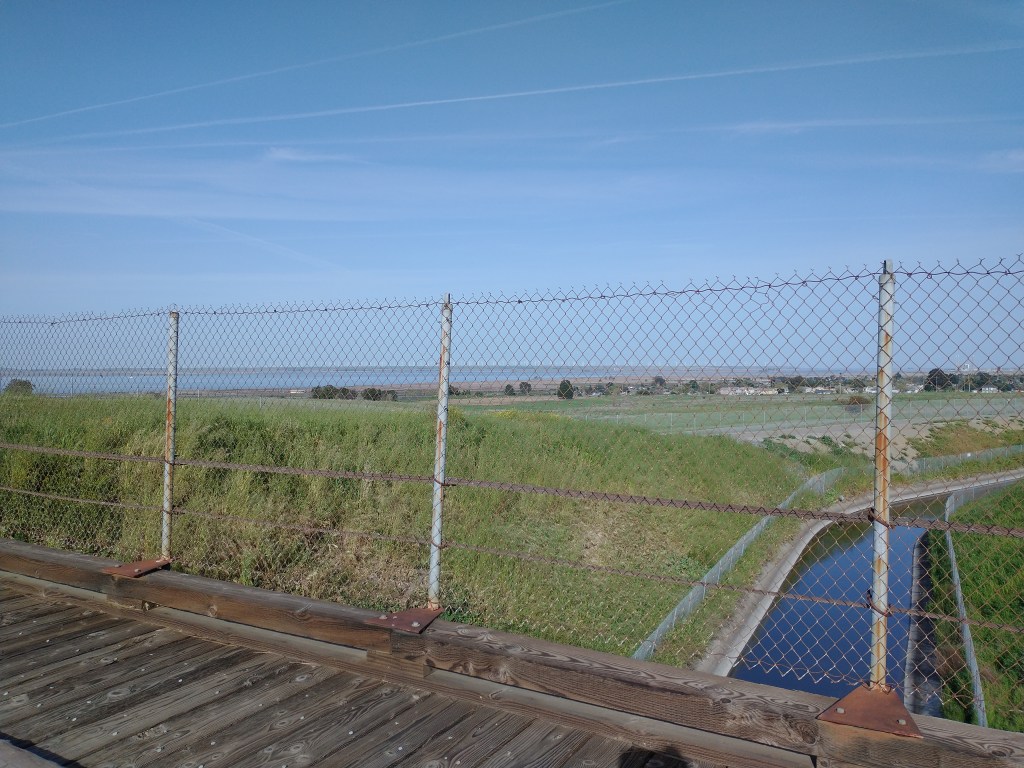
There’s the bay in the distance 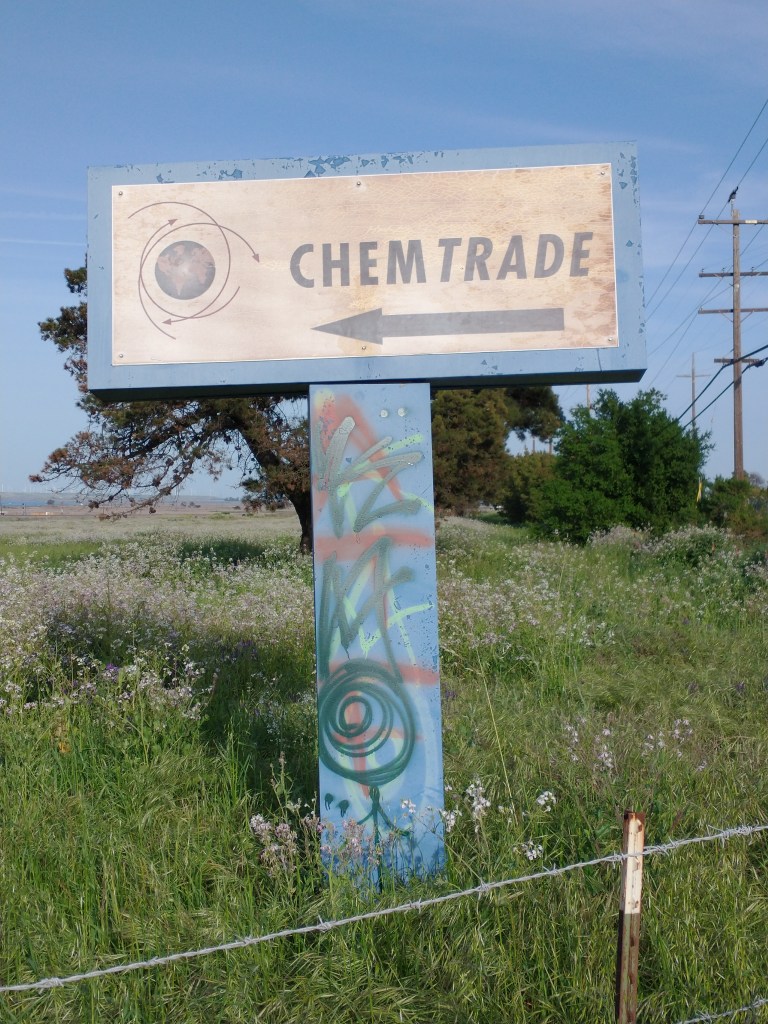
This sign was at the corner. The graffiti strangely went with the arrows and world logo.
I passed a trucking company and then got to the guard house and entrance to the chemical company. It was yet another dead end. My fourth and last. My campaign to find a way through, if that’s what it was, had played its way out.
A loud motor was running in a pavilion-like structure about 50 yards behind the west fence, but there didn’t seem to be anyone around. I couldn’t tell if the place was defunct or if everyone had just clocked out. It was now a little after five. I’d have to ride back in the direction of my school and take the BART home like I usually do.
I didn’t mind. As the old saying goes, it’s all about the journey, not the destination. It’s something good for me to remember when a student is being difficult, when a driver yells at me for no reason, or when I simply don’t get my way. I might be getting better at this. It’s possible the time between feeling anger and acceptance is narrowing. Maybe someday I’ll be able to just skip the anger altogether, look at the situation, nod my head, and say okay. Then get to work on what needs to be done.

Between the railroad, the Naval base, and Contra Costa Water District there were so many signs and not a single gap in the fence. These three entities plus Chevron form a block to the vagabond, cyclist, walker and explorer heading east on the beautiful land next to Suisun Bay. 
There was some particularly nice graffiti along the tracks next to the chemical plant. 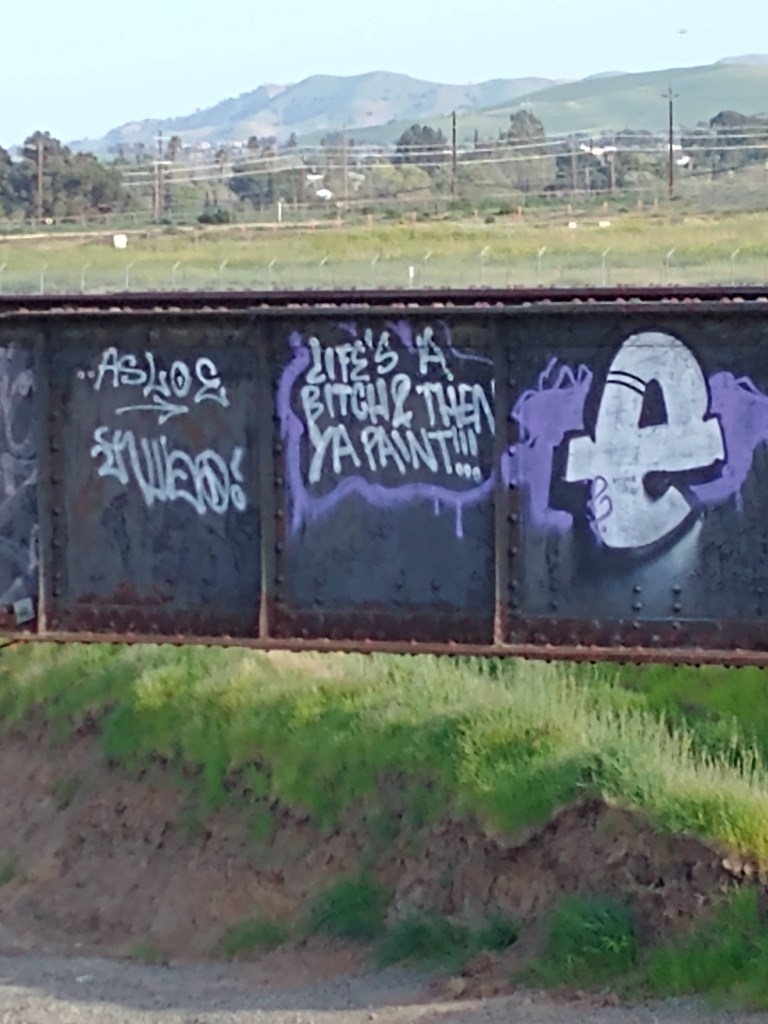
“Life’s a bitch & then ya paint!!!” 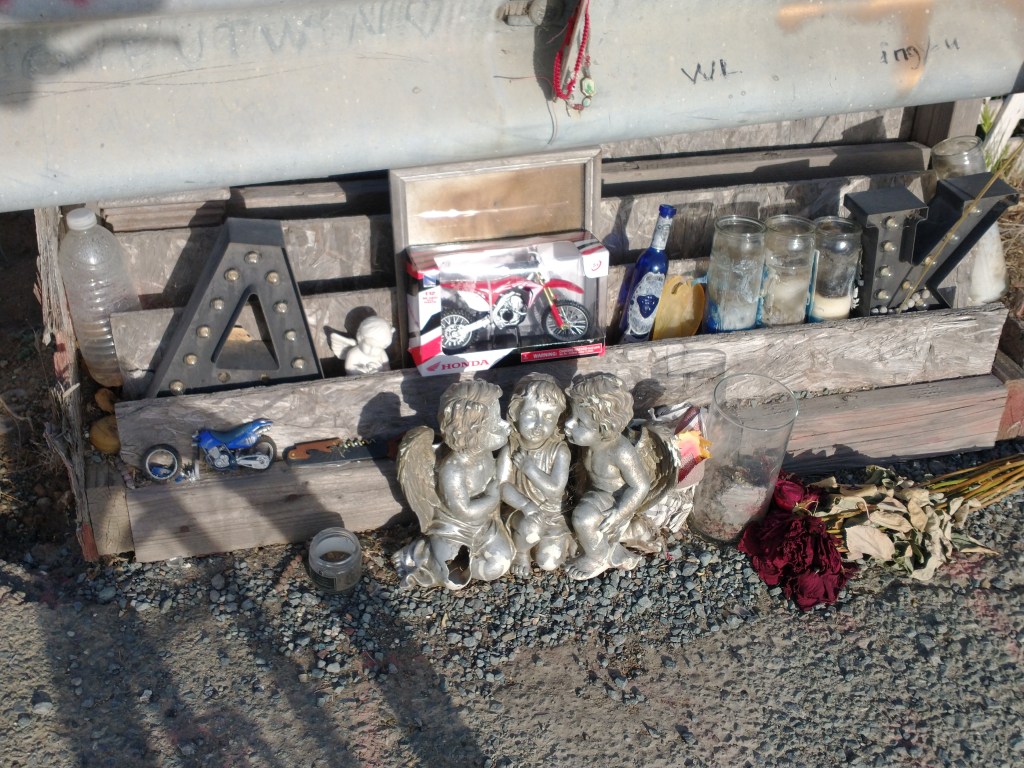
I’m guessing this memorial was for a dirt biker who frequented the area which is ripe with trails and dirt banks for jumps. I have to wonder if this person died doing what they love or if something else got them? 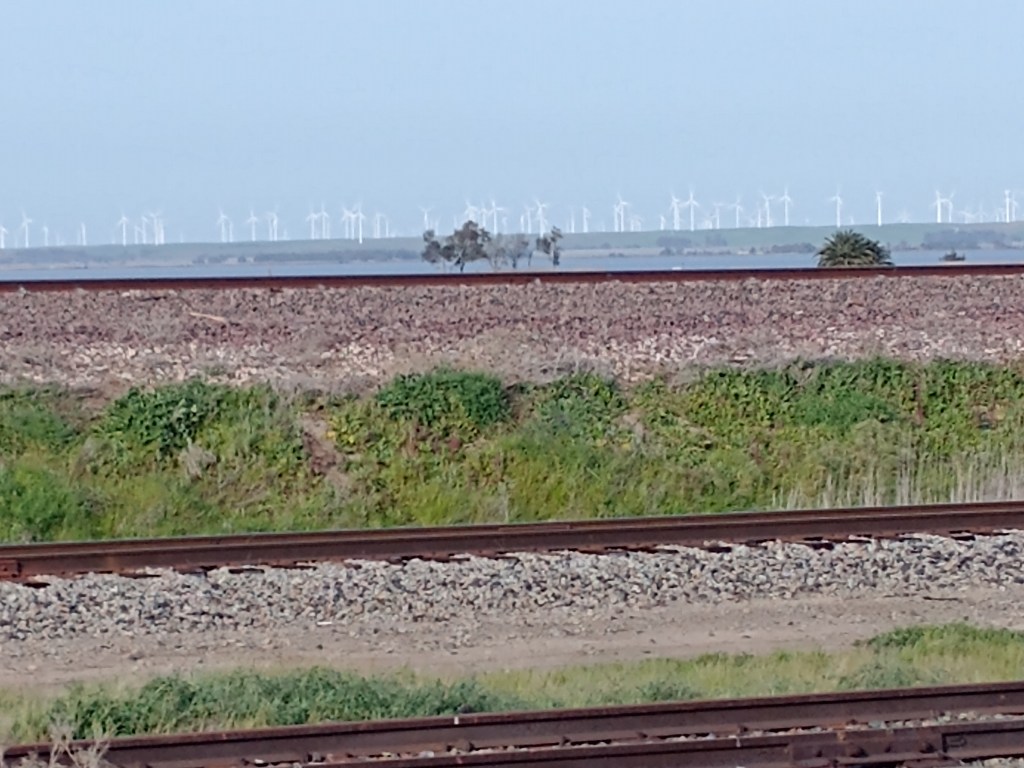
The Shiloh wind farm with 275 turbines is visible across the bay 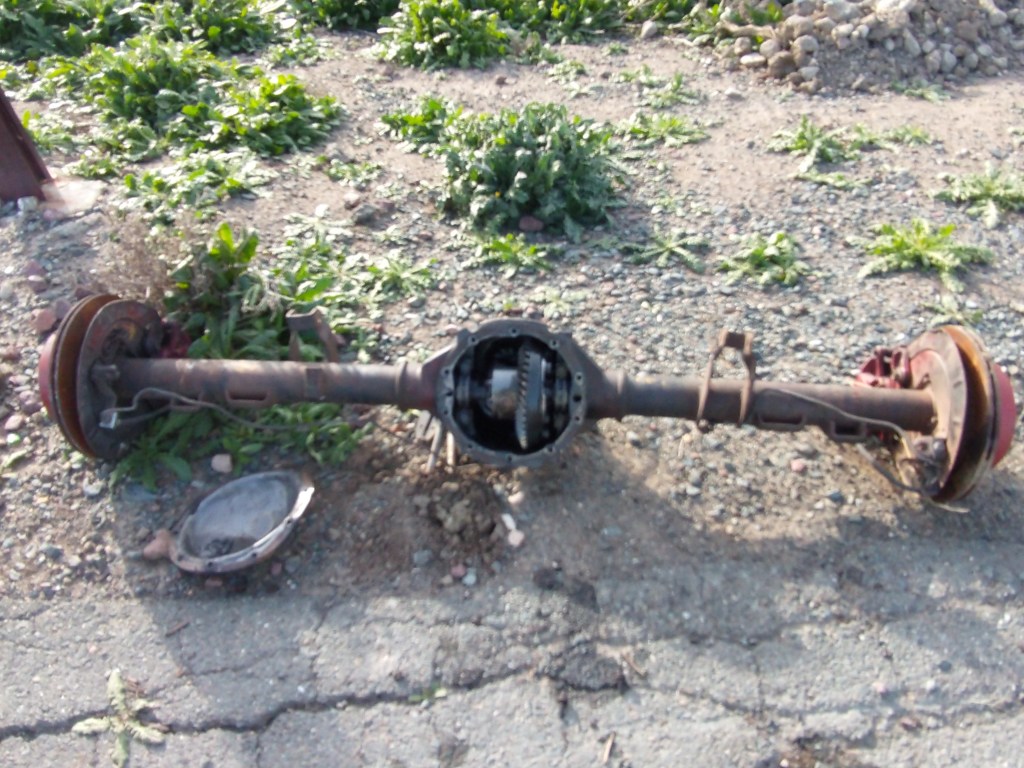
There are lots of places here where people take advantage of the open space to dump things. I came across this car axel. 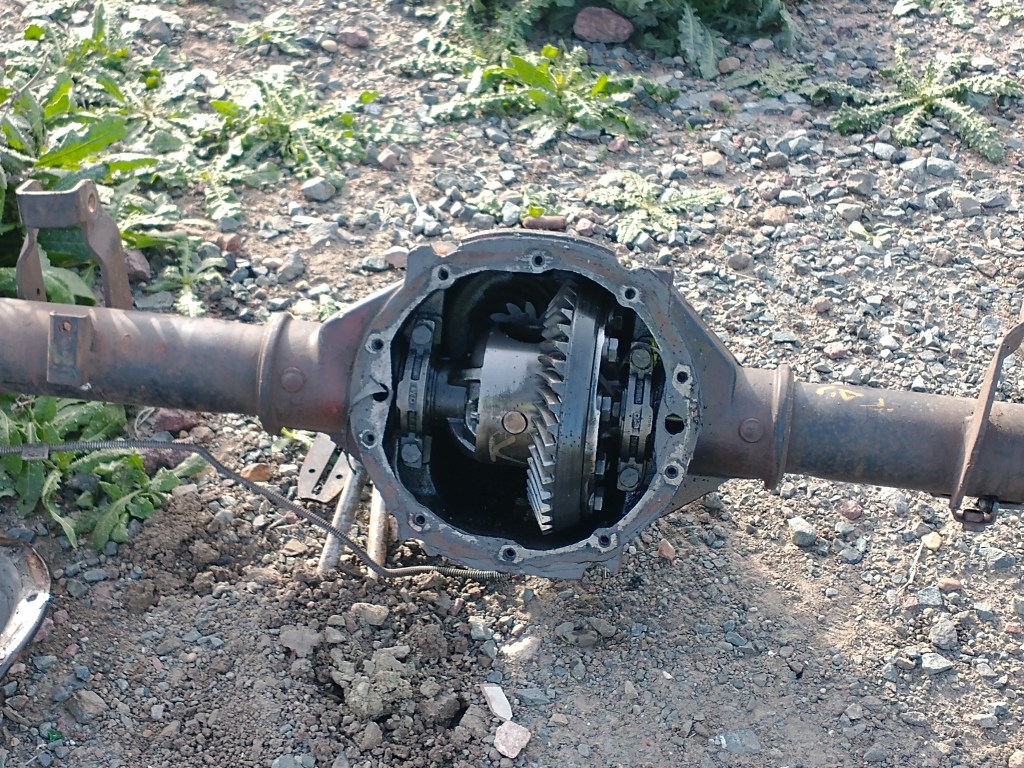
That lump in the middle is called the differential. It’s what allows one wheel to go faster than the other when turning corners. This one is open and gives a good idea how it works with gears. 
This is another memorial I came across at the start of my Friday ride. It is right across from my school. I usually come through the side parking lot, so I missed when it first appeared, but it hasn’t been there too long–probably a few weeks. I found a news link to the name. Sadly, this person died riding a motorcycle. I was just a week into my cross country trip last summer when it happened. _______________________________________
I’ve added to my archives if you are interested in my cross country trip from last summer. I’ve now archived 16 out of the 36 journal entries. To find them simply click on the Archives heading at the top of this post.
-
3/6/22
This weekend, I went down a few rabbit holes reading about psychological tic disorders that are being spread over social media and another topic, Lia Thomas, the transgender woman who is breaking all kinds of competitive women’s swimming records. There seems to be some commonality in both stories —i.e.—that people need to be seen and that we live in a society where people feel embattled to express who they are. (Please do not read into that statement that I think the reason people transition from one sex to another is for attention.)
Lia Thomas’ story is particularly compelling. Does a trans female have the right to compete against cis females? The NCAA has ruled yes — after the person undergoes a full year of hormone replacement therapy. But others claim that post puberty trans females can still have an advantage by having greater lung and heart capacity and a larger size. That is a legitimate criticism to me.
Lia Thomas’ thoughts on this particular point were not addressed in the Sports Illustrated article — it was an informative essay not an interview — but what is clear is that Lia is an elite competitor and that her need to be a competitor at this level is in her DNA. What is also in her DNA is her need to be a woman. I have no doubt that those urges are every bit as strong.
So here is why this is potentially a non-issue (at least for individual competition) and how, everyone — in my mind (sometimes a fantastically delusional place) — can be made happy and whole:
Sports is all about data—most wins, fastest time, most points, etc. Any sports fan knows that there are a million data points to look at, all titillating to that geeky, nerd-self that some fans have inside.
My point is, let things stand exactly as they are, but record wins and other data with notations of sex. Michael Phelps (cis man). Lia Thomas (trans woman). People then won’t feel as if their cis records (fastest time, most hoops) are being unfairly broken.
There is room on the podium to have two gold medals. For anyone who has the innate ability, loves competition enough to train four hours a day, and also feels strongly enough about who they are to have sex reassignment surgery, there has to be an arena for them to show the world what they can do.
Cis women will still have records for cis women. Cis men will still have records for cis men. Trans men and trans women will have records too. And for the elite athletes who are the top in the world, there will be an arena for them to be seen on a grand scale.
I suppose for some people this will be too much like giving out participation ribbons. Where do we stop? Will there be nationally broadcast competitions by age group? Basketball associations for players five feet five and under? 55+ gymnastics? Swim competitions with fins? I guess I’m being a little bit flippant, but at the same time I think, why not?
What about coed teams? Why is it that women’s teams still don’t get the level of attention and coverage as male teams? It seems like a good time to completely rethink competitive sports. Judging by the new categories being added to the Olympics, it is already changing.
I read an article that the Eophoria actor, Hunter Schafer, wants to be identified as a trans girl not as a cis girl. I admire her for that and wonder if that is common among transgender. So what’s the matter with categorizing sports people and their accomplishments by gender, especially since we already do that. It may satisfy all the people that are worried about the ethics of allowing transgender people to participate in gender segregated sports and maybe it will satisfy transgender participants as well.
___________________________
I guess if my blog has a theme, I’m blowing it out of the water this week by going on tangents. Still, gender identity definitely relates to place and having one in the world, as well as my next topic — accessibility to the streets.
Locally, there was a violent incident in Concord that has shaken and angered me. Last week, a fifteen year old boy was killed on his bicycle about eight blocks from my house at the corner of Galindo Street and Clayton Road. One person is being charged with vehicular manslaughter.
I was on my way to the climbing gym a little after four o’clock when I saw his covered body being loaded into the ambulance. The whole block was cordoned off. A half dozen police cars had their lights rolling. All major corridors were jammed with vehicles.
At this intersection, Galindo is a two-way street with seven lanes and Clayton is one-way with four. Neither have medians which would have likely prevented this accident. It’s just a wide swath of asphalt without a safe place to rest or barriers against crazy driving. Concord is filled with similar intersections.
This accident comes just two weeks after I witnessed the driver of a new Dodge Charger become impatient at a red light, make a sudden left turn from the far right lane and T-bone a woman turning onto the freeway at Bailey Road in Bay Point. A month before, I came across a concrete mixing truck that had turned over a few feet from this same spot and destroyed the concrete barrier between the on and off ramp.
I turn my bike lights on at all times now. I’ve taken to wearing a yellow safety vest given to me by my old principal, Mr. Ruiz, who could barely see me riding in the fog one day.
We desperately need traffic calming here—bulb outs, medians, bike lanes, sharrows, no parking zones, signage, etc. It’s easy for car drivers to make the case for the city to not do these things. After all, very few people ride bikes. To this argument I say, “Have you seen the movie Field of Dreams? Build it and bicyclists and pedestrians will come.”
The truth is, most municipalities in the United States do very little to make walking and riding easy or safe. Cars have owned the culture for a long time.
Things may seem to be getting better. Motor vehicle fatalities peaked in the United States in 1972 with 54,589 deaths. In 2020 there were 38,680—and this with a hundred million more people. Still, I wonder how much of this is primarily due to seatbelt laws and air bags—measures that do nothing to improve the safety of bicyclists and pedestrians?
The streets feel more dangerous than ever to me, but I’m getting older. Danger is around every corner. It might not be long before I no longer want to go out at night.
-
2/20/22
Yesterday I sat down on a low, rather ugly cinder block wall that separates my neighbor’s yard from mine. The wall is made less ugly by the fact it has been painted red and somewhat matches my front door and the red walkway tiles that lead up to it. Sitting on the short wall made leaning over to pull weeds out of the gravel drive a bit easier. My neighbors are selling their house and I don’t feel obliged to make my place look nicer as much as to protect my investment – as in, I don’t want the property values around me to come down because I have a weedy front yard.
Moments like this invariably bring up that Talking Heads song, Once in a Lifetime, and I ask myself, How did I get here?
I also often recall a short story I read during my college days that features a neighbor who runs out of his house whenever a leaf falls on his perfect lawn. Not that I keep an immaculate yard, but it can lead one to wondering what’s the point?
The tent encampment around the CVS pharmacy near here has been removed, as well as the ones on the open land near the skatepark and along the aqueduct under the highway 242 overpass.
I’m not sure where the people went who were there. I don’t have a lot of firsthand information except for two unhoused women who I spoke with that were charging their phones at an outlet next to the water machine in front of the CVS. They were sitting against the wall eating Chinese food out of large Styrofoam clamshells when I pulled up on my bike. I asked if they minded if I locked up next to them there on the curvy S-shaped bike rack that is coming unbolted from the cement. Bike racks are a rarity in Concord so I appreciate this one despite its tenuous hold on the ground.
The younger white woman, wore a pink, midriff, short sleeve knit that showed off a slight, pale paunch. She spoke so fast it was hard for my brain to process her words but what I could gather made sense. It wasn’t salad talk. The shelters were full.
As she spoke her eyes darted around and she turned her head this way and that as a grass-eating animal might between bites. The short, older black woman (whom I’d had occasion to speak with before) contrasted her friend’s quickness with sad deliberation.
I can’t say I have her pronoun right. I didn’t have occasion to use it, but, dressed to hide her sex in an oversized, long-sleeve oxford shirt tucked into baggy chinos, her story makes me think she might prefer to identify as him/he:
“I had to leave a shelter because this one woman didn’t like transgender people. She told everyone I exposed myself to her. Now why would I do that? I hate my body. I’ve always hated my body. I’m not proud of it. Why would I try and show it to somebody?”
I had met her this past summer before leaving on my cross-country road trip. Same place. Then, she was distraught over CVS not allowing her to put money on a phone card. I heard more of her story when she told me she was trying to get money together to go on a bus to visit her son in Las Vegas.
The website Next Door has one of the longest threads I’ve ever seen on the subject of unhoused people in Concord. There is a very minimal amount of Not in My Backyard comments and the concern and thought people have put into the conversation is heartening. There are even a few unhoused people who have shared comments or given a glimpse of their story.
I ride my bike by the concrete aqueduct under six-lane highway 242 two or three times a week on the way to the climbing gym. The former camp was there along the dirt bank above this human-made floodway but below the sidewalk. It was accessed by a big hole cut in the chain link fence. It’s usually night by the time I come back from the gym. Sometimes I would see the glow from a phone or light inside a tent or hear soft voices. Around Christmas, when it was easy for me to believe in Peace on Earth, I found myself feeling envious of these nomads. It’s easy to make up stories and romanticize from my privileged position… and perhaps there is some joy in these campers who can set themselves apart from the thronging mass of people who seem to carry on with a sort of hive-like mind.
No doubt, I feel some pride and superiority myself–being one of the few people to dare ride a bike in this car-dominated, concrete town. Being outside of that car-bubble makes me closer to these castaways. But yeah, I’d rather have a bikeable city and they’d probably rather have a place to live.
So back to protecting my overpriced investment—the current value of my small, 800 sq. ft. house is likely great enough to buy a whole apartment building in some other parts of this country.
The truth is, I’m not only trying to maintain the house’s value. I’ve grown to like weeding. It’s meditative. When my mother was dying of lung cancer, I spent many hours at my home in San Leandro pulling burr clover from the large grass lawn, foolishly imagining I was helping to eradicate her disease—as if each plant represented some fractional part of the malignancy that I could psychically obliterate. I just had to put in the time and be thorough I imagined. We do what we can to cope.
My ex-wife’s mom had taught me the name of that particular weed. On one of her first visits to our new house she had disappeared for some time on her own pulling this clover with burrs from our front yard. She suggested it was the bane of homeowners’ existence though I think she might have also gotten some pleasure out of the pulling.
Most weeds come up nicely if the soil is moist. Burr clover spreads out low to the ground weaving between the blades of grass but if you gather the spread and pinch the central tap root, the whole thing comes up like a scribble scrabble overlay that once lifted reveals the fine, symmetric teeth of the lawn.
We don’t have grass here. In the back is red lava pebbles and black, wood chip with more wood chip in front. There is chunky, gray gravel along the road and as a second parking area next to the concrete drive. All of these areas still manage to get weeds even with a groundcloth underlay.
I’d guesstimate I spend 30 to 40 hours a year weeding. This could be cut to two or three hours if I did what many do and just douse the areas with glyphosate–the main ingredient in Monsanto’s popular weed-killer Round Up. Or I could do what neighbor Phillip does down the street and just let the weeds take over. Depending on the time of year, he has wild fennel taller than himself and yellow grass up to his waist along with enormous prickly pear. In the back yard, the aptly named succulent, mother of millions, have mostly taken over except for a garden bed of healthy-looking marijuana plants. The seeds apparently run about $10 each for this crop.
It’s all sort of a secret garden for the birds which seem to be very fond of his place and why wouldn’t they be since he also puts out bird seed on plates set atop large ceramic, glazed pots arranged one atop the other in an hour glass shape that makes climbing the slippery surface impossible for squirrels.
He still has Bernie Sanders signs up in his front window as well as the listening hours for different programs on KPFA. I can count on him as an ally in braving these mean streets by bicycle. There is a contingent of us here. I want to give a celebratory wave each time I see another bicyclist.
A man named “Smitty” often posts to the Concord bike group on Facebook. I spoke to him at the bike valet parking and pop-up repair shop he helps with at music events at Todos Santos Plaza. I’m interested in doing some bike advocacy work with the city, but it’s not for him. He simply likes getting bikes into people’s hands.
It’s important for me to remember that there are good people in the world otherwise my misanthropic side starts to creep in. Maybe the meek will inherit the earth and maybe we will get some bike lanes out here in Concord and maybe some small homes too for those people who must be hiding now in some areas that I don’t have occasion to pass by so often.
——————
I’ve begun archiving some of my summer trip on this website, so you can go there if you have an interest in reading about my adventures visiting the fourteen places I lived as a child. My visits to my old home states of Texas and Mississippi are now posted. Also, the internet helped me locate one of the few places I lived in Texas that I wasn’t able to find when I was there. I found the address on an old drug store photo processing envelope. The photo below is a screenshot from a Google cam. (Now the only place left to find is the Shady Oaks Ranch.)
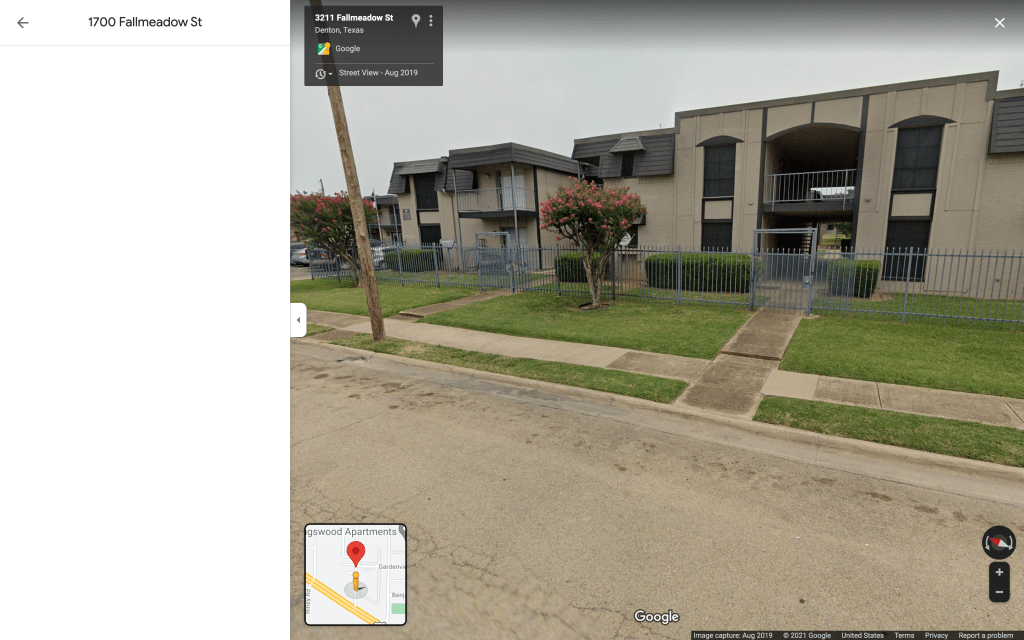
I don’t feel compelled to visit this place in person. There is nothing too special about the Fall Meadow apartment complex except that it was the first place we lived in Denton. It’s also where I lived when I first got glasses and could see the world clearly for the first time in several years. (I believe I had pretty good vision until I was about seven and then there was a steep decline until I got glasses when I was about nine.) Another fairly clear memory from this complex is learning the song Delta Dawn which was popular on the radio at the time. My sister and I got in the habit of singing it over and over again. My favorite line: She’s 41 and her papa still calls her baby.
-
2/6/22
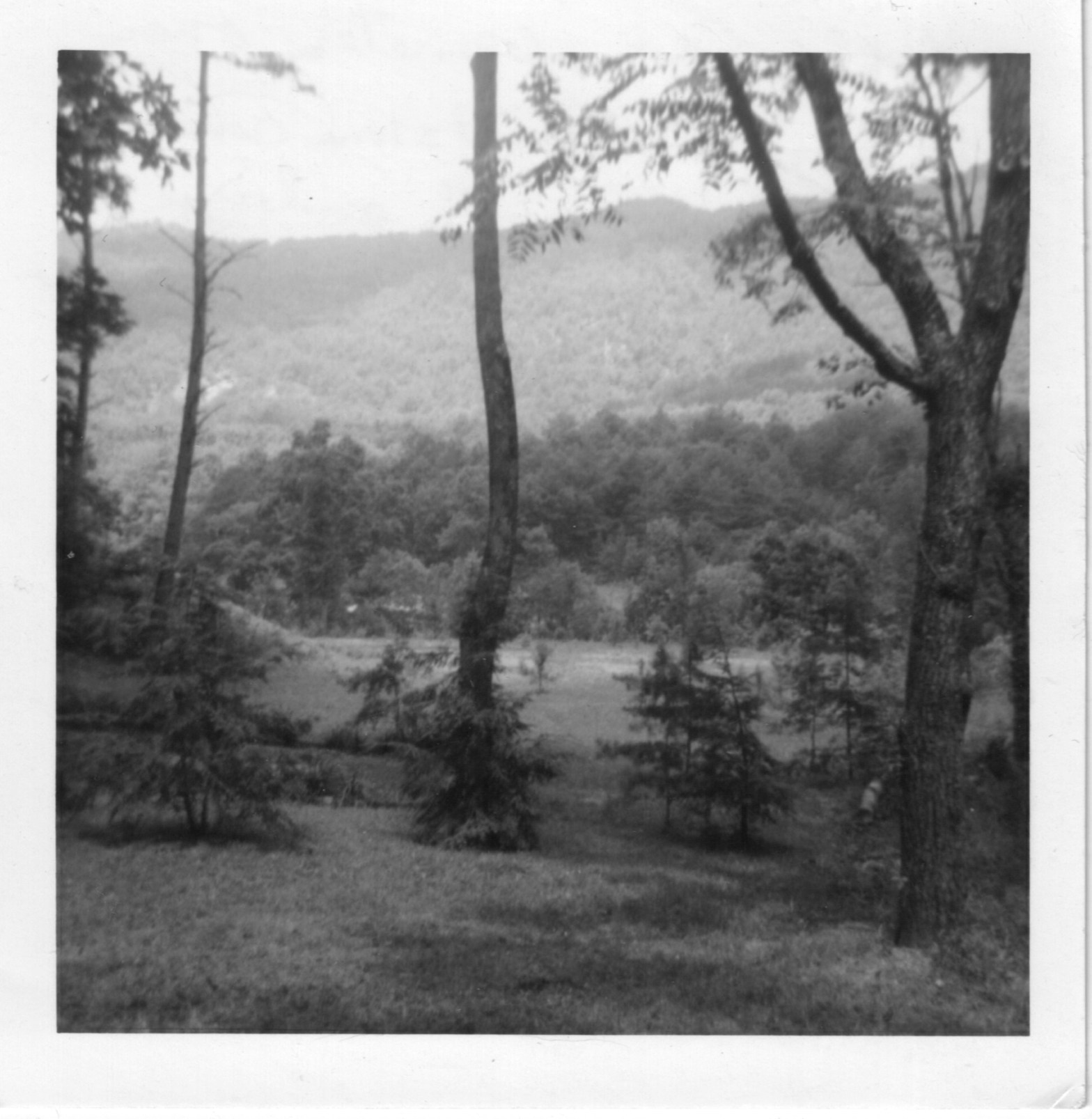
Much of my time these past few weeks was spent thinking about what I want to do on the land in Tennessee. I’ve talked about the cabin idea, but I’m also bouncing around the idea of just pitching a tent whenever I go there. It’s low impact and a hell of a lot easier. I did it a few days last summer borrowing a wildly luxurious 10-person tent of my cousin’s. I guess I need to think more along the lines of “What do I want to get out of this?” If the biggest part is “roughing it” and being close to the land then the most I might do is dig a decent latrine.
Along the low-impact line of thought, if I do build a cabin, concrete would not play a big part in its foundation. I would get some treated wood for a rail foundation or possibly a post and beam. I’ve read a study about treated wood which says it can last a hundred years or more if it is laid on a bed of gravel and has good drainage. You’ve seen the stuff—sort of reddish brown with indentations all over it where, presumably, horrible chemicals are steam-injected or somehow introduced into the lumber. It’s what I used for the foundation of my COVID 2020 summer shed project.
I’m also pondering how to cut, transport, and mill the lumber for a cabin. I don’t want to build a driveway to it. I’d rather the cabin be a walk-in. I’ve even pondered building one on the highest knoll which would have a hell of a view, but would require a ten or fifteen-minute trek on a steep trail that would likely need stairs cut into it.
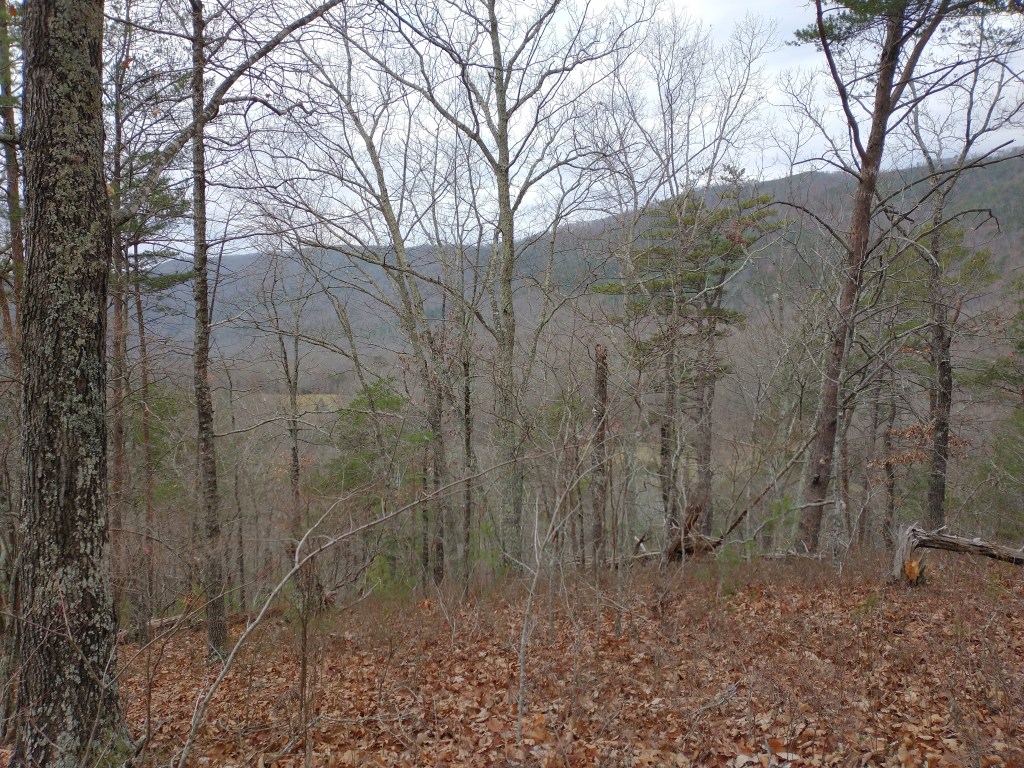
Looking northwest from the highest knoll. Clearing some of these trees would give a nice view of Poor Valley. Dead center may be one of those tulip poplars that are good for lumber. The best spot remains the one near the memorial stones. Still there is the question of how to get the logs out of the forest and onto a trailer to take to a mill. Building a sled to drag them would serve the dual purpose of helping to make the trails more defined. I was also thinking of buying or renting a mule or horse which I could strap with a harness to pull the logs. Would a neighbor allow me to keep this animal on one of their fields? If so, what is the going rate for fielding an animal?
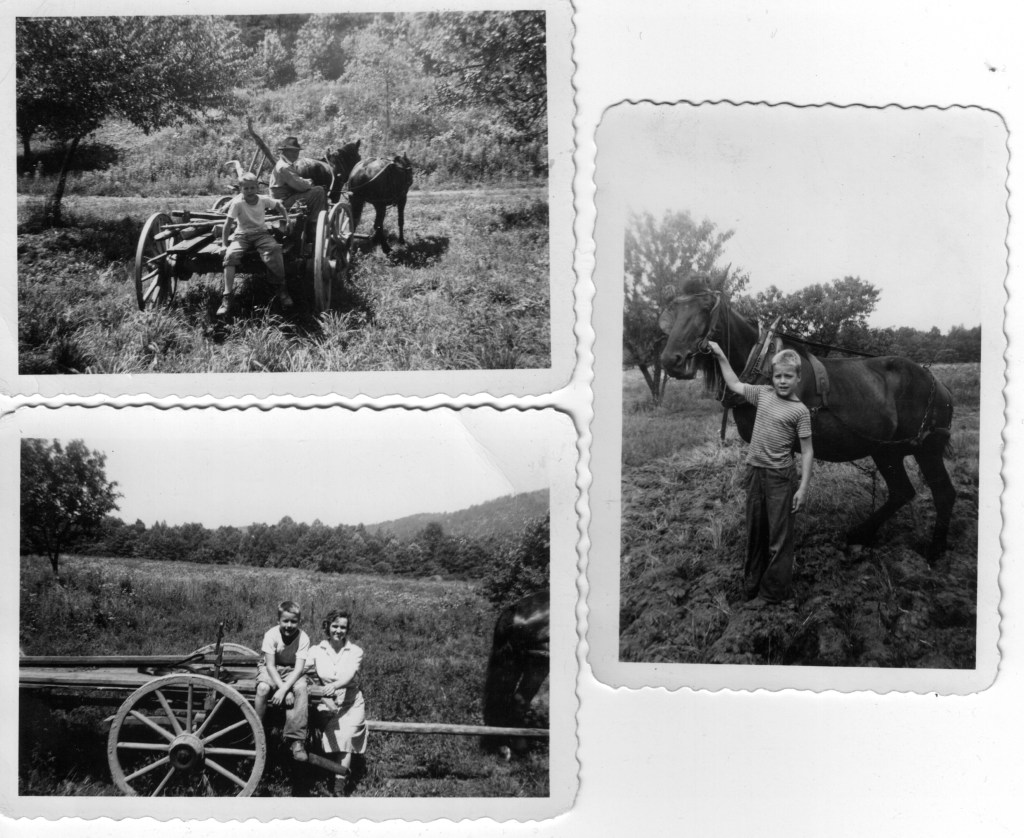
Horses were used for farm work when my dad was a kid. The farm is no longer in our family. It’s across the road from the wooded acute triangle. 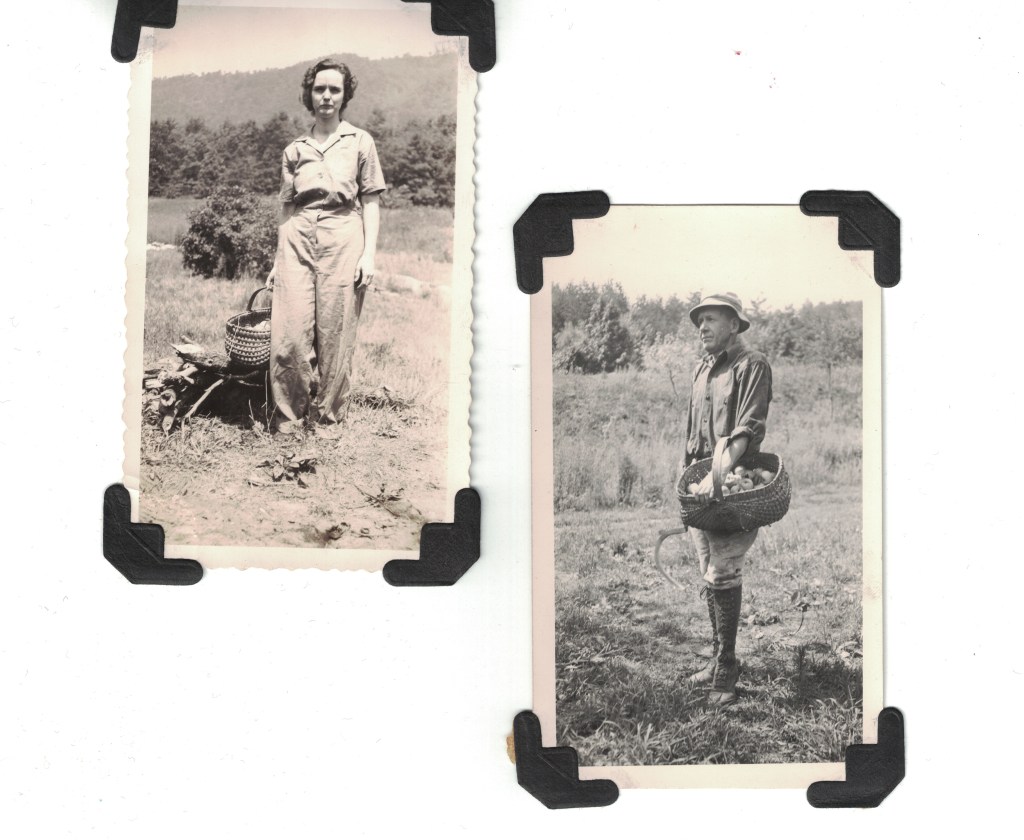
My grandparents were gentlewoman and gentleman farmers who went to the land on vacations and weekends. Farming had nothing to do with their subsistence. I suspect my grandfather, a UT professor, made extra money running tests and devising systems for local industry and government. Another bonus to having an animal–donkeys and goats eat poison ivy. (I’ve heard.) Not sure if a mule or horse would. Could a donkey pull a log? I’m thinking some will need to be 12 feet or more for the posts I want to cut. Wet logs are heavy. Could I dry them on the land before moving them?
One neighbor has a wood mill that I might be able to rent. It is the kind where the operator pushes the blade down the log. Stewart’s son-in-law has a fancier one that has a drive that pushes the blade by itself. The advantage of using the neighbors is that it is close, but if I’m going to have to age the wood somewhere, like in a barn for instance, I’ll have to move the wood off site which would make the automated mill the better choice since I’d have to transport the logs a few miles anyway. Lots of questions here.

My grandfather was 45 years old when my dad was born in 1937. Photo 1941. 
This is dad with his oldest half-brother Gilbert, a WWII pilot who flew over the farm buzzing the family during a training mission from a local air base. I never met Gilbert that I can remember, or his other half-siblings, Jack and Mary Elizabeth. I started clearing a spot for parking during my December trip. I cut some small trees, pulled up saplings and shoveled dirt to start to even out a place. I was desperate to get a little work done before my plane was to leave at two o’clock from Knoxville. I arrived early that morning and in the few hours I was there two neighbors came by and generously offered to clear the spot for me with their machines.
Tobi stopped to talk to me in his big red truck that seemed to have the pulse of an underground Morlock factory thrumming beneath the hood. I raised my voice a few decibels to tell him who I was and we decided to exchange phone numbers. He invited me to get in the truck to go back to his place to get his phone.
“I can’t remember the number,” he said with a happy demeaner. “I’ve been hit in the head so many times I can’t remember anything.”
He and his wife Jean bought land about five years ago after he retired from the demolition business in Ohio. Their land is across from mine at the east end. They had a prefabricated house put up behind a knob where it isn’t visible from the road.
When Tobi brought me back he parked his truck and got out so I could show him the parking spot I was working on.
“Five minutes on my Bobcat, I can do what will take you an hour to do by hand,” Tobi told me.
I think he meant he could do in five minutes what would take me five hours to do by hand but he probably didn’t want to sound too boastful. I asked him if he’d like to see where I was thinking of putting a cabin.
“I’d like to put a little wooden bridge here,” I said as we walked through a dip.
“Oh, right there is where there was a driveway before,” Tobi said, pointing to a long, gradual ramp that went below an incline we were about to walk up.
I’d never seen it before, but he was right. It takes practice to look at wooded land and see the marks of former development. When we came back we walked to where this drive had started from the road. I could see that it would take more shoveling and tree-cutting than the place I’d begun working on. Studying it more I could see that it was originally a half-circle drive that went through the woods and came out in a different spot. It must have been made for visits to the memorials and to bring in the heavy granite slabs in the first place. Sixty years had turned it back mostly to woods.

Before beginning to clear space for parking on the land. 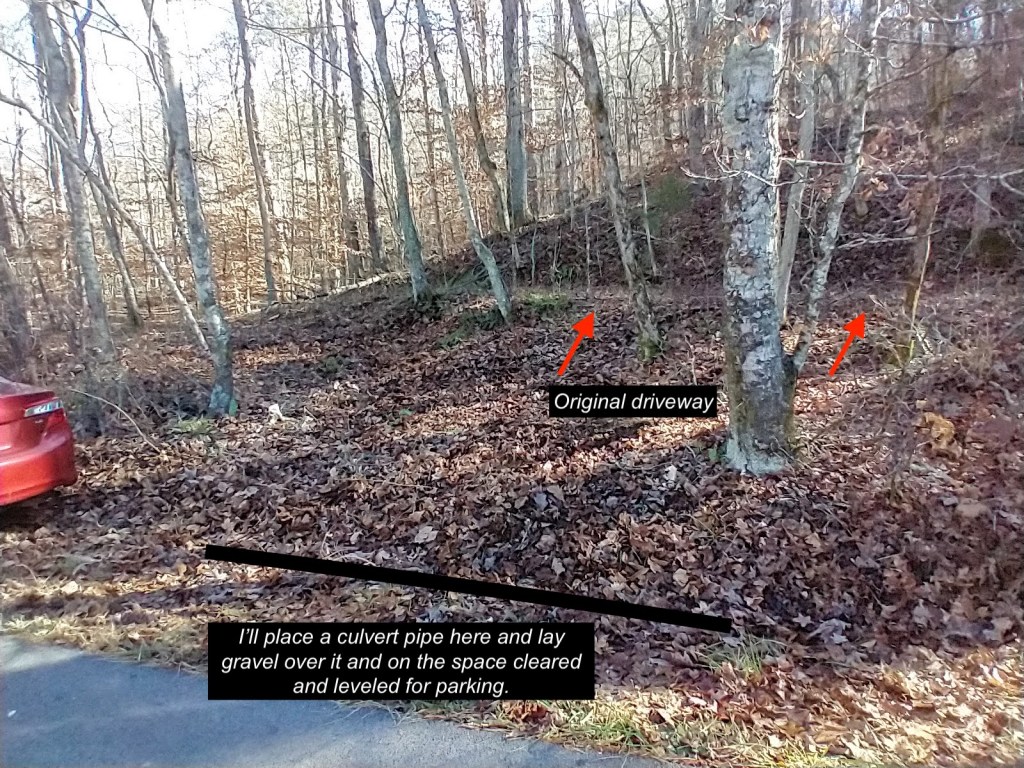
After beginning to clear a space for parking. While we were standing there talking, another person, Steven, my eastern neighbor on the same side of the road pulled up in another big truck. They are popular here.
I’d met Steven when I was finding the corner boundary marker with the forester Jeff. A local guy, both military men–Jeff a war veteran and Steven a careerist–they talked about how the local sheriff’s department had come mostly from the high school football squad. Standing there in the cold with these dudes was more masculinity than I get in my normal life with the exception of the occasional proving-ground scenarios that arrive at the climbing gym—just as often with women as men. Not that these guys were trying to prove anything.
“Mark out where you want the parking space and I’ll come by with my tractor and clear the area,” Steven said.
“Tobi was just offering the same thing,” I told him. “Thank you but I think I’m going to wait on making any decisions. I want to look at the space more first.”
There were several reasons why, beyond readiness, that I didn’t take these neighbors up on their offers. I had asked Tobi what he would charge and he said he didn’t hire himself out anymore.
“I just likes doing things for people.” I’m a bit like that myself sometimes so I could accept that, but I’m also wary.
Tobi had already asked me if it would be okay if he hunted deer on my land and I’d told him I didn’t want that. While Steven didn’t ask, he is a hunter on his own land and has a tree stand on one of our common boundaries. I would be surprised if he didn’t take a shot at a deer that happened by. I can’t help but think that a favor from either of these guys might make them feel I owed them. Anyway, I’d be happy to trade for their services I just want to clarify what that trade would be before we do it.
It could be that I’m making things unnecessarily complicated. I tend to do that. If anyone could change the quiet country life into the noisy inner workings of an overthinking brain, that would be me.

This photo was taken from the gravesites out toward the road and Poor Valley in the early 1960s. The viewpoint is from the opposite direction of those photos above and shows how the land was tended and cut back near the memorials when my grandfather’s stone was first laid. The red car would have been behind that incline on the left. ———————————–
Over a month ago I received an email from a group in my union that wants to take up the issue of racism and have an open discussion with teachers. They recognize that we, as teachers, must confront our own personal bias on a daily basis to be effective educators. Teaching brings out every skeleton you have in your closet and if you don’t want to deal with it then it’s better to slam that door and go into some other profession.
Anyway, this union group put out some videos, papers and a book to delve into as points of discussion for our first meeting. They were giving away copies of a book by Ibram X. Kendi, Stamped From the Beginning, The Definitive History of Racist Ideas in America—a daunting title for sure given the nature of this emotionally frail, white male. Nevertheless, I signed up to get one with an interest in being part of the discussion. The 511 page book (590 with index and bibliography) came to my school mailbox just a few days before the first meeting. Knowing there was no way I could read the whole thing by then I just flipped through different sections reading areas that interested me.
Having lived in the Bay Area for 31 years (and worked 20 in Berkeley and Oakland) I turned the pages like one might look around a corner into a dark alley anticipating that the woke police might be waiting to hit me over the head.
When I read the following passage–the italics are mine–I was getting ready to slam the book and run:
During America’s first century, racist theological ideas were absolutely critical to sanctioning the growth of American slavery and making it acceptable to the Christian churches. These ideas were featured in the sermons of early America’s greatest preacher and intellectual, Boston Divine Cotton Mather…Cotton Mather was the namesake and grandson of two of New England’s intellectual trailblazers…
Greatest preacher! Intellectual trailblazers!!! So that is how he’s going to position things? I didn’t mind that he was calling out the church. I already knew it was the glue that kept racist ideology together for most Americans, but giving racists the title of intellectual trailblazers! Okay, now I know where this guy is going!
I went about flipping through the book looking for how he was going to dismantle every piece of history. My page turning became equivalent to stomping down a hall despite the fact that this author’s intellectual credentials make me look like a Kindergartner. (I know nothing about Cotton Mather and only the basics of early American history).
I was prepared for him to call Dr. King an assimilationist and then I really was going to throw the book across the room, but I calmed down and the more I read the more I saw that he really wasn’t trying to bludgeon anyone. I started thinking, maybe I am an assimilationist. I certainly know a lot about trying to fit in. Is that such a bad thing?
Well, yes and I won’t go into all the somersaults I’ve gone through over the years walking a tightrope between my racists and assimilationist tendencies, which he groups together, and anti-racists beliefs on the other side. It’s pretty clear my head has been messed with growing up in Tennessee, Florida, Texas, and Mississippi. And BTW… Jeez I’m touchy.
Wary, but interested, I decided I would go to the first zoom meeting of the discussion group. Then life happened. I had a very difficult week in which I felt suddenly at war with a coworker who I normally don’t have much to do with. Leading up to the meeting I was in a very I don’t give two-fucks mood. Needless to say this was not the headspace I wanted going into a meeting to discuss racism. So I skipped it and went online to look at more cabin-building videos.
Yesterday morning I read about the controversy with Whoopi Goldberg. You’ve probably read all you want about this. I’ll just say that one of the more salient comments I saw was that if you can’t have this type of discussion on The View maybe it should be named something else.
Another thing that it brought up was what I read years ago which has stuck with me. That is: race is a human construction. It’s just skin color. Race doesn’t actually exist. Our real differences are cultural. Race is just a convenient way to lump everyone into the same group. It was a convenient way for Nazis to kill whoever they wanted.
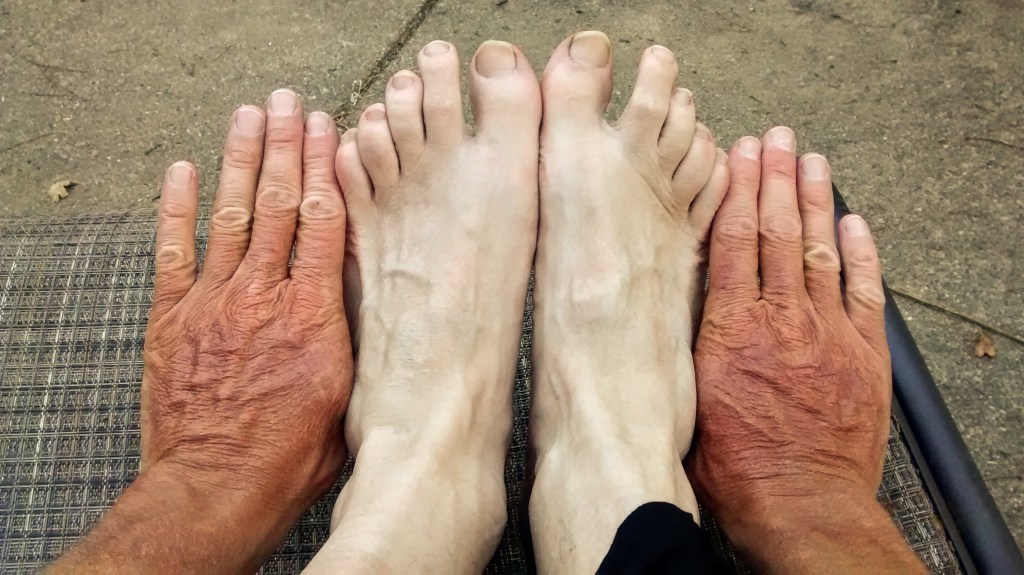
These are my hands and feet from a cross country motorcycle trip in 2015. My uncovered parts got a good tan. In bygone days genteel men and women stayed out of the sun. Whiteness said as much about socioeconomics as race. -
1/23/22
I feel very lucky to have land I can dream about going to. I did nothing to earn it. This land was walked on, dug in, slithered across and flown over for millions of years before I existed. It comes to me through the ambitions of my grandfather, a long-time chemistry professor and head of the department at the University of Tennessee. He was likely able to acquire the land at a good price during the great depression. Other people’s hardships worked in his favor.
Before him the land was taken from the original people through occupation, trickery and force by the mass of European-Americans who arrived to this “new world” which was for everyone else very, very old.
According to a neighbor there is the largest black bear he has seen that calls the “cute triangle” part of his territory and I would do nothing to take it from him.
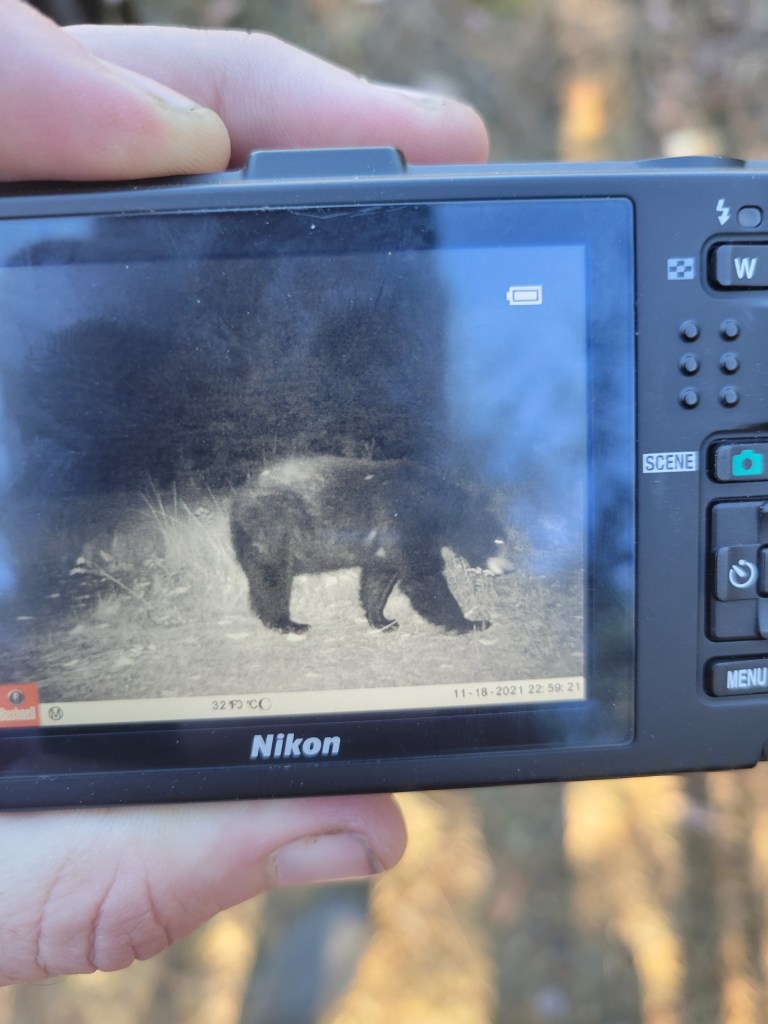
My neighbor, a deer hunter, has cameras set up around his land, mounted to trees. This is the bear that calls the cute triangle part of his home. We are all occupiers on some level and it seems to me it is best to learn to share. What we do on land does not stop at fences. Clear cut forests erode neighboring lands and choke rivers. Oil extraction pollutes ground water. Non-native species can destroy habitats. Relocating people, not to mention killing them, creates societal disharmony for many generations to come. Such was the case for the Cherokee who resided here before the European-Americans.
——————–
It is not a metaphor to say I couldn’t see the forest for the trees this past summer. The only boundary I knew was the one that ran along Poor Valley Road. The green briar, poison ivy, downed trees, saplings, vine and bramble made walking through the forest a chore. To avoid a face full of spider webs I had to carry a stick and wave it about like Harry Potter continually casting spells.
My one attempt to start to discover where the boundaries lay was given up after ten minutes of crawling over downed trees, scrambling under overhanging branches, and trying to shake off vines that grabbed my legs like monster tenacles trying to pull me to center earth.
Winter is a better time to walk untended land. The overgrowth is died back. On my recent trip all the leaves had dropped except for the beech saplings whose leaves seemed to hover like drifting copper fog.

This is a sapling of the tree that Budweiser ages their beer in. The forest was mostly brown. Splashes of green came from lichen and moss on tree trunks and higher up, the needles of various evergreens – loblolly, Virginia and white pine, cedar and around the memorials, hemlock.
More green lived around the memorial stones, in the form of Vinca minor, also known as cemetery plant. It was seeded by my grandmother Robbie three decades ago.
Seemingly absent, but just hiding in dormancy, was the sea of poison ivy that predominates during the summer. There was Christmas fern and a plant with dark green leaves with white stripes called pipsissiwa—a fun word to say.
I learned these plant names from Jeff, the forester I hired to tell me about the land and what was growing on it. I hardly knew where to start when I met him at 8:30 the morning of December 20. The wonders of the internet meant that all I had to do was give him the address of the nearest neighbor.
Back in the 1970s when I first visited this land with my family, my father had a hard time finding it. He’d probably not been back since his father’s burial in 1962. On subsequent trips, every decade or so, it was the same thing. He’d squeeze his eyes peering out the dusty front windshield, mouth agape, then mumbling, now where is that road? It was like the place he’d known intimately as a child and teenager had disappeared with the death and dispersal of his family.
Going to it makes me feel like I’m resurrecting something that my father was unable to. By the time he introduced me to this place it may have only contained ghosts of what seemed to be a dream-like childhood obliterated by reality. It may be why he went into the theatre—so he could always have fresh dreams.
This was the first winter I’ve ever been to this place. It was not until I was traipsing through the forest with Jeff that my worries were eased about how he would identify trees without leaves. The bark and branching patterns were enough for him. It’s a bit like birders who use wing flap and silhouette to identify species without relying on color patterns or call. Yellow poplar, commonly known as tulip tree is abundant on the property. Jeff showed me how to identify it by the seed pods that hold on high in the limbs. Fortunately tulip poplar is a good wood if I decide I want to mill my own lumber for a cabin.
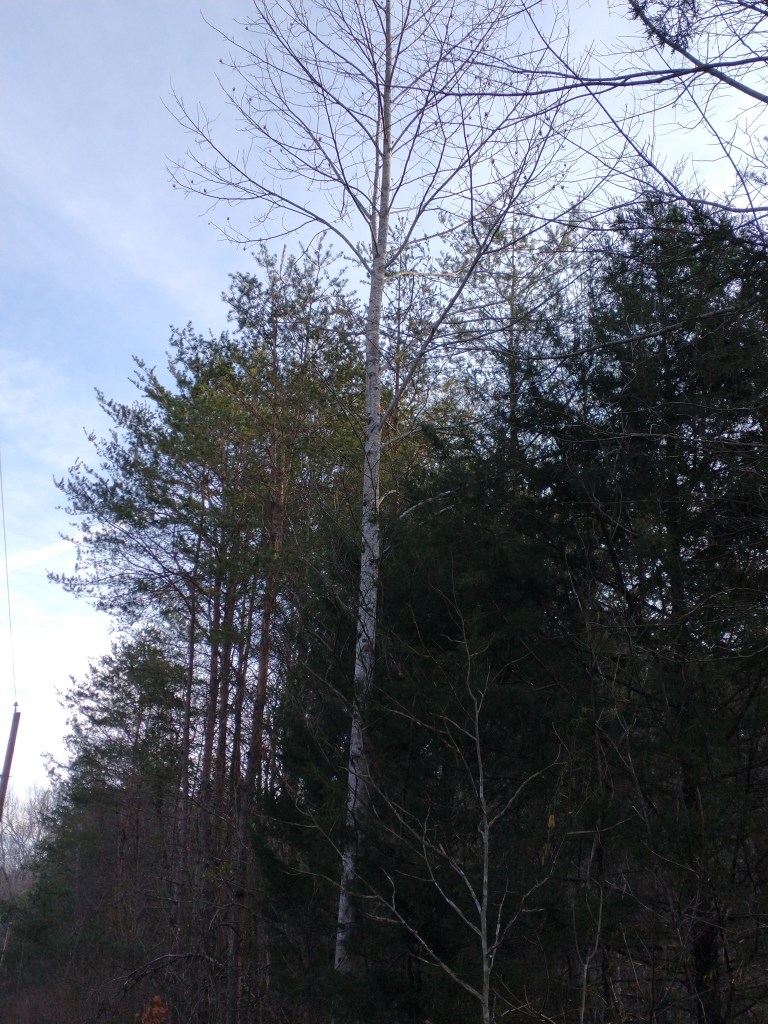
Tulip poplar grows straight and has few knots making it good for lumber. It is one of the softest hardwoods. After watching numerous YouTube videos, I’ve decided I don’t want a log cabin but would rather have a stick or timber frame. Stick frame refers to the most common building method used today with lots of 2x4s. Timber framing uses fewer but more substantial pieces of lumber like 8x8s.
Other species identified on the land include four or five types of oak, red maple, hickory, dogwood, eastern red cedar, and gum.
The largest tree we found was a 42-inch white pine not far from the old shed.
Beyond the lesson of tree and plant species Jeff gave me an introduction to compass reading. I have a long way to go before I figure it out. The survey maps I have give compass readings from established points on the boundary. While I didn’t learn enough to use those I took a closer look at markers on the map and was able to use a downed barbed wire fence to establish a close approximation of the boundary line for the longest side of the cute triangle. Elevation maps also helped me estimate boundaries as well as another tip from Jeff about how to use a consistent stride to measure distance—something that is easier done when the winter die-back doesn’t require as much vertical leg movement.
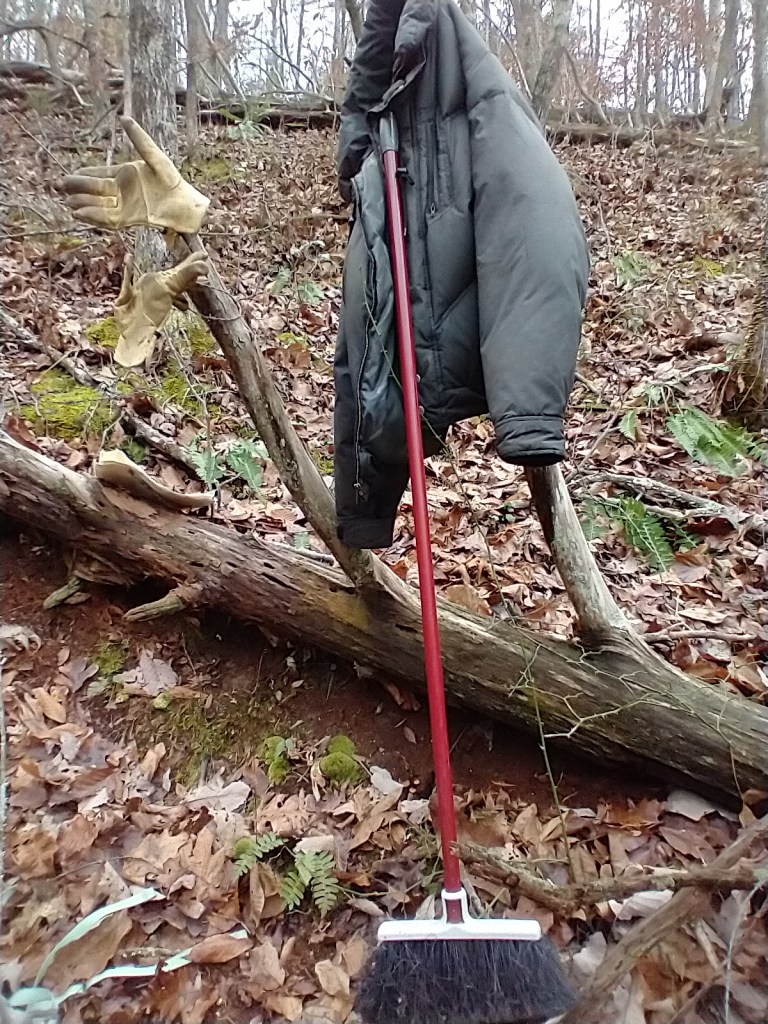
Trying to find the southern boundary line of the cute triangle I found it useful to have a coat and broom I could use to mark known positions while I went back or ahead to find more points. I walked this line three times on different days–losing the gloves one day and then finding them the next. 26 acres proved enough space for me to get lost for a few minutes coming back from the deepest point one evening at dusk. I want to take my time getting to know this land. It seems like a large percentage of the harm and waste of resources that we encounter in the world has to do with our rush to get things done.
Jillian is a big fan of British narrowboats—a pretty slow, but relaxing way to get around. Yesterday morning she turned me on to the Falkirk Wheel. This is an amazingly engineered lock that can lift 600 tons of barge and water eighty feet in the air using roughly the same amount of energy it takes to boil eight tea kettles of water. It takes five and a half minutes. Five and a half minutes is like sitting through three or four red lights—something that feels interminable trapped inside a car but a whole different thing if you are being lifted heavenward in a boat.
It’s easier to go slow when you affirm that it’s all about the trip, not the destination.
——————-
One last thing…if you look at the “about” section of my blogsite I’ve said “A journal of nature, race and place.” That’s a pretty grand statement and I don’t know how true I will stay to it. My original summer journal had a clear directive to find all the places I’d lived growing up. Travelling back to those places I realized how intertwined they were with our American notions of race. Talking about my experience with race is a big interest to me and it feels somewhat safe here where I can control the narrative and choose who it goes out to. Perhaps it is an indication of the unsteadiness I feel that I have set these parameters, but confronting issues around race is something I deal with on a daily basis as a public school teacher on a campus with such a wide variety of children from multiple backgrounds.
Rarely are the issues directly about race although sometimes they are, like when I had a discussion with two students who together decided to tease a child by equating racial identity with a sport. I’ve often had to talk to children about making fun of how someone speaks. I suppose this is more about nationality than race.
Mostly I deal with the legacy of racism which involves issues of poverty, privilege, and long-standing hurt. One of my favorite things to do with a kidney-shaped table full of newcomers is to look into their Yemeni, Guatemalan, Salvadorian, etc., eyes and sing “This Land is Your Land” pointing back to them with each “your” and back to myself with each “my”. Six-year-olds know what it is to feel like the land is not theirs and I like to disrupt the narrative that makes them feel this.
Next up: More cabin and land plans. A continued exploration of the history?
-
The Winter Trip, 12/27/21
Happy New Year friends. I’m just back from a visit to see family in Tennessee and meet with a forester I hired to walk with me on the land I became enthralled with while writing my summer travelogue.
If you are seeing this for the first time and wondering what travelogue? Let me explain: In June, I left California with an outfitted camper on my truck with the intention of visiting and writing about every place I lived with my family growing up. The result is a 43,000-word journal which I will send in a separate email at your request. The pictures have lost a lot of quality in its current, compressed PDF form, but the writing is intact if you’d like some cozy winter reading.
The land was not one of the places I lived, but has much family lore associated with it. Just 23 miles northeast of Knoxville, it was acquired by my grandfather starting in the early 1930s. For the next decade he continued to buy contiguous pieces until there were over 100 acres. I’ve been looking through old photos taken before I was born and comparing them with photos I took this past summer.
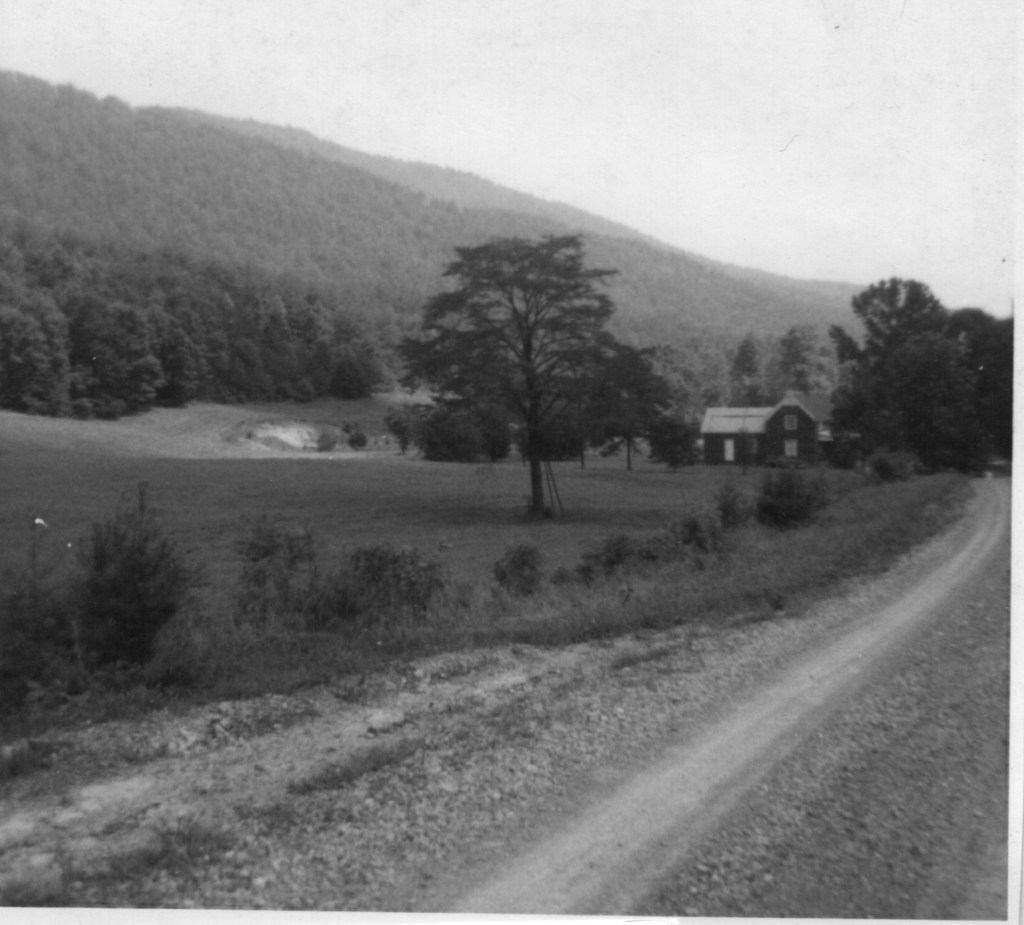
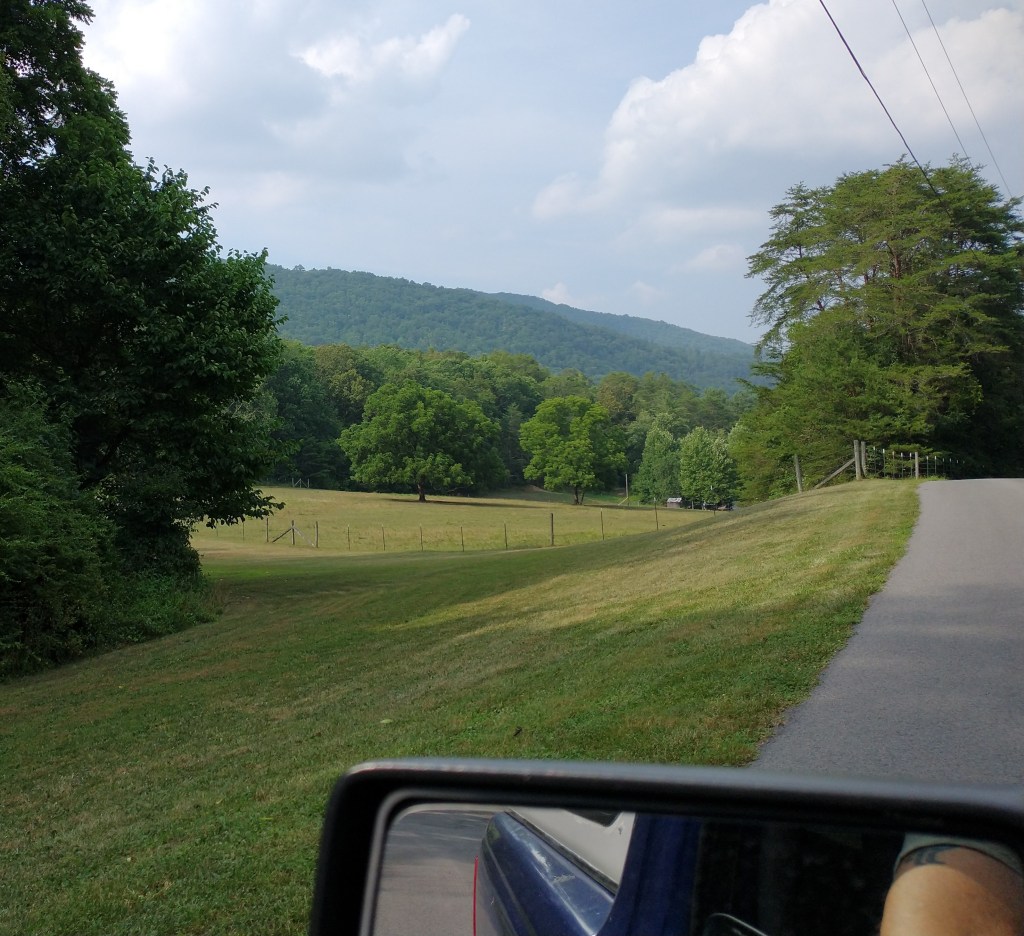
This road dissected the original piece. The farm house is visible in the old photo. Now the family property only includes what is on the south side of the road and a piece north of the road but not touching. Both are heavily wooded areas.
My grandfather Judson was a University of Tennessee chemistry professor. He bought the land and farmhouse as a place for his family to spend weekends, holidays and long summers playing, farming and exploring the woods. His plan was to eventually retire there.
My father, born in 1937 and the youngest in his family, had many memories associated with this place. Some of his stories include being snowed in and carried out on his father’s back to go get help for everyone left behind, getting buzzed by his half-brother Gilbert flying low over the farm during training to be a WWII pilot, and breaking his leg in a homemade box car ridden down one of the hills with his brother Clifton.
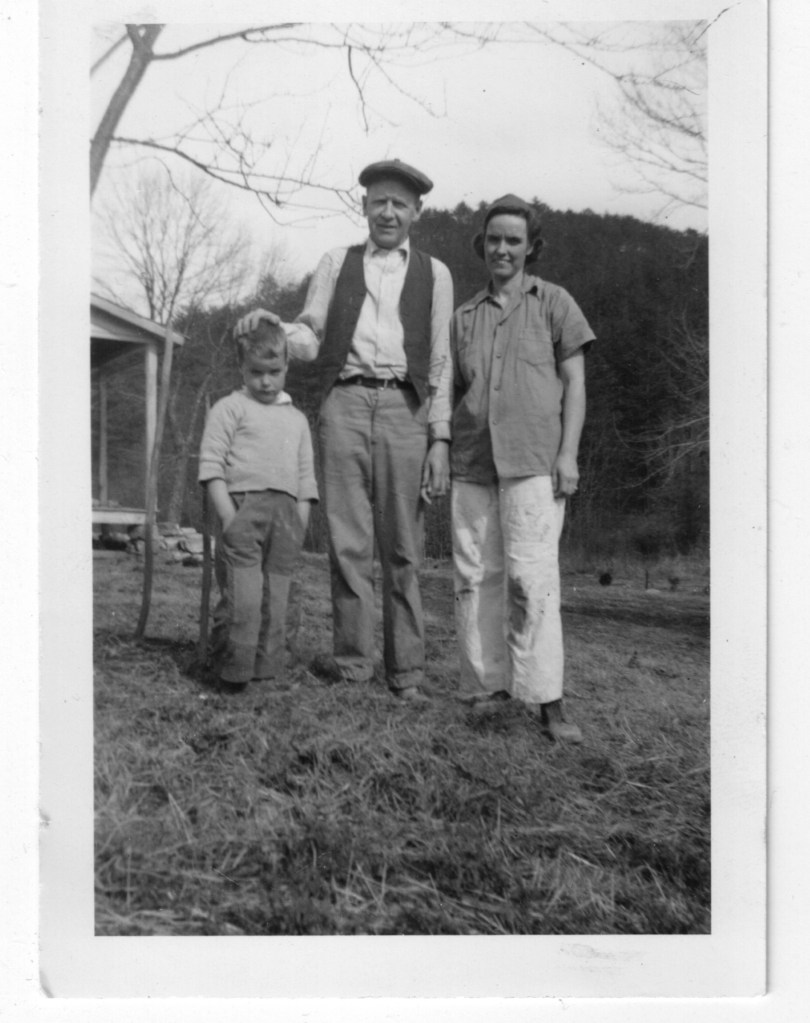
Dad with his parents at the farm. Judson was 15 years older than Clara–he born in 1892, she in 1907. Picture circa 1942. They were married in 1930. 
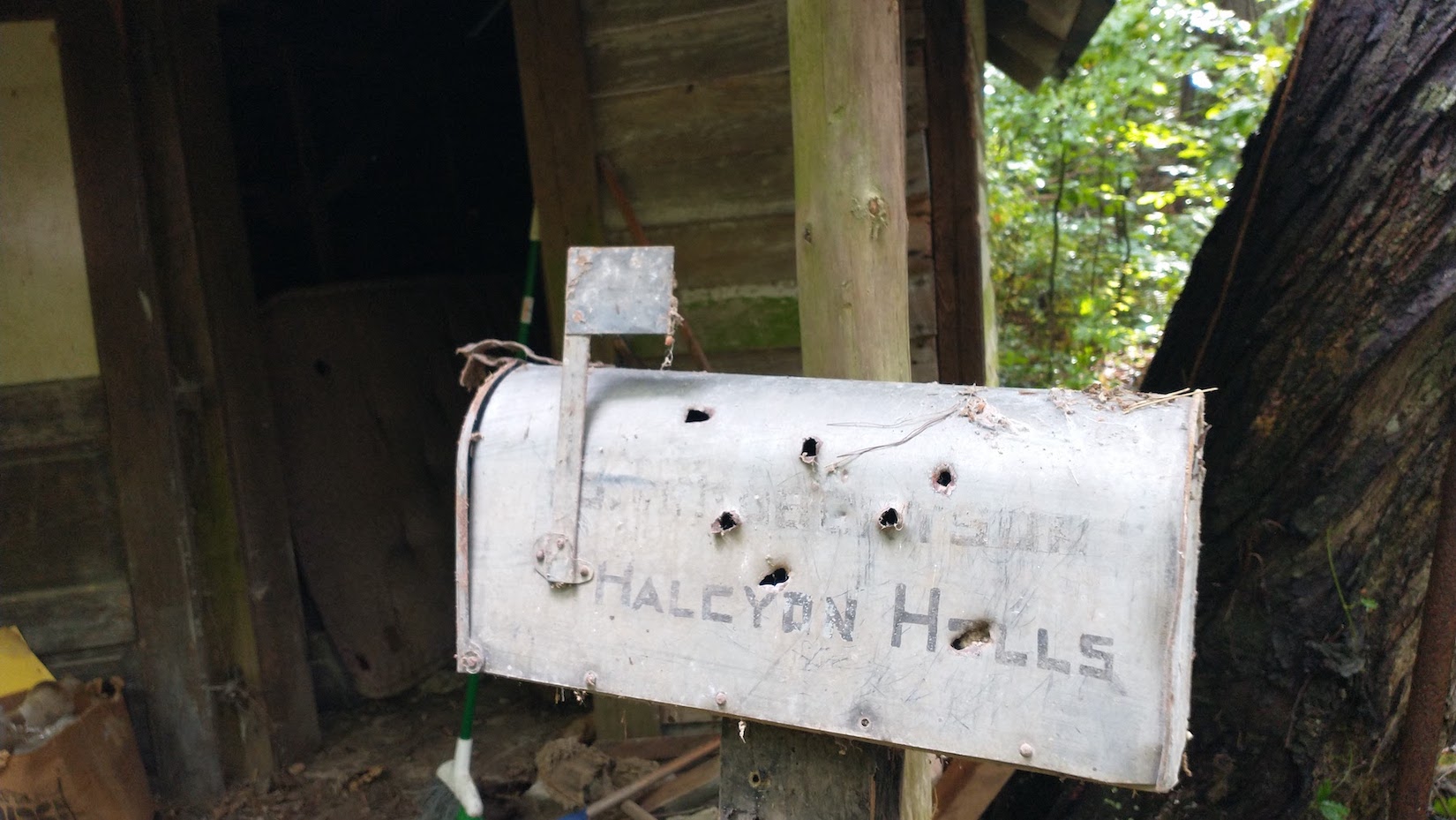
Dad, circa 1955, leaning on the same mailbox I pulled out of the shed this summer.
My father had not been long out of the nest when after 42 years at UT my grandfather died in his doctoral cap and gown at what was to be his last graduation ceremony before retirement. I never met him. (A rather astonishing photo shows the exact moment of the heart attack and the pained expression on his face.) My young parents had just left from a visit and were on their way back home to New Orleans where dad was attending Tulane. Mom was six months pregnant with my sister. They were stopped by a state trooper in Louisiana and told they needed to call home.
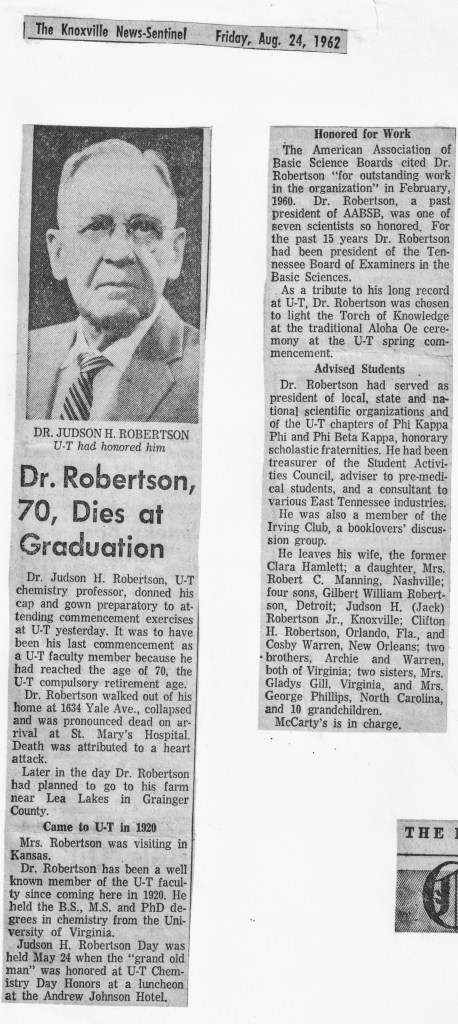
My grandmother Clara started selling pieces of the original acreage in the 1970s. The old farmhouse and sections of cleared, farmable land were the first to go. What remained was divvied between interested children. Today what is left in my family is a 26-acre section with borders in the shape of an acute triangle and a 12-acre piece in the shape of a rhombus. The two do not touch. The triangular piece is where my grandfather is buried and also where I might like to build a cabin.
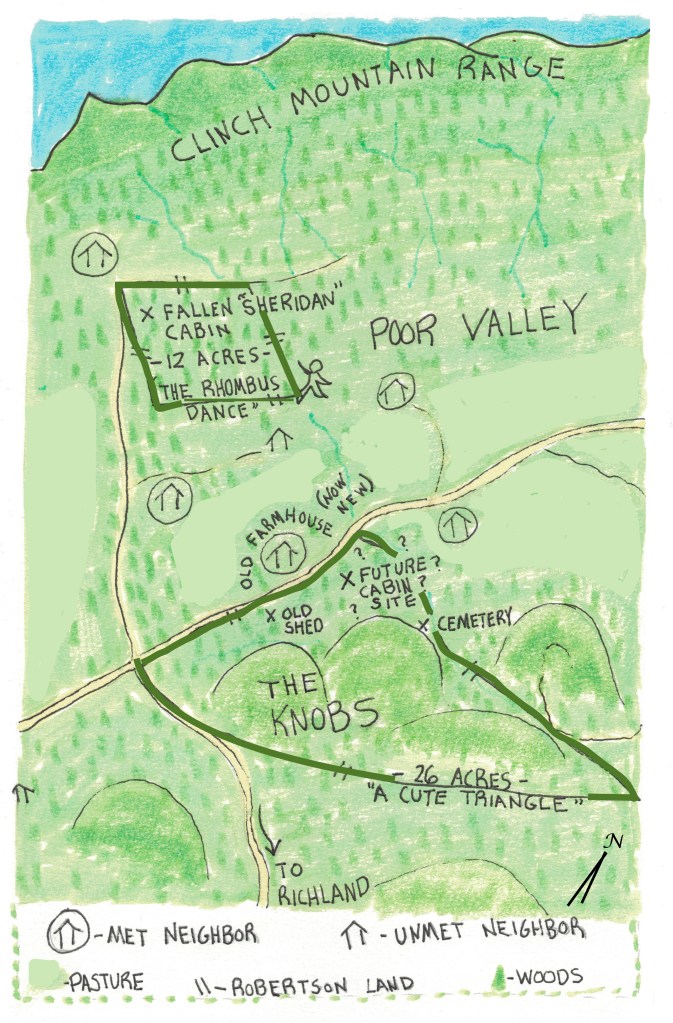
The rhombus sits closer to the base of Clinch Mountain, first ascended by some Paleo-American predecessor to the Cherokee, but credited to Daniel Boone and William Bean in European-American history. The ascension may not be noteworthy as a purely physical accomplishment. The 150-mile mountain range is 4,600 feet at its highest but just over 2,000 feet near the land deeded to me and perhaps human/animal trails were already in place. However, the Clinch range along with higher Appalachian mountains mark western expansion of European-Americans into territory previously unknown to them.
From a wooded access road the 12-acre piece drops away gradually and then dips into a slanted bowl. Overall, the elevation changes are less extreme than the triangular piece which is further from the mountain base and characterized by several high knobs. The rhombus is also more open with large hardwood trees and less green briar and saplings. A few rather dramatic boulders of both the spherical and chunky type are lodged in the thawed, winter loam. One looks like it would make a nice picnic table. I imagine these boulders coming loose from the mountain top eons ago and thundering down the steep side snapping trees and throwing up wedges of earth until reaching their final resting place. I like the feeling of permanence these big rocks engender. I don’t like the idea of anyone moving them.
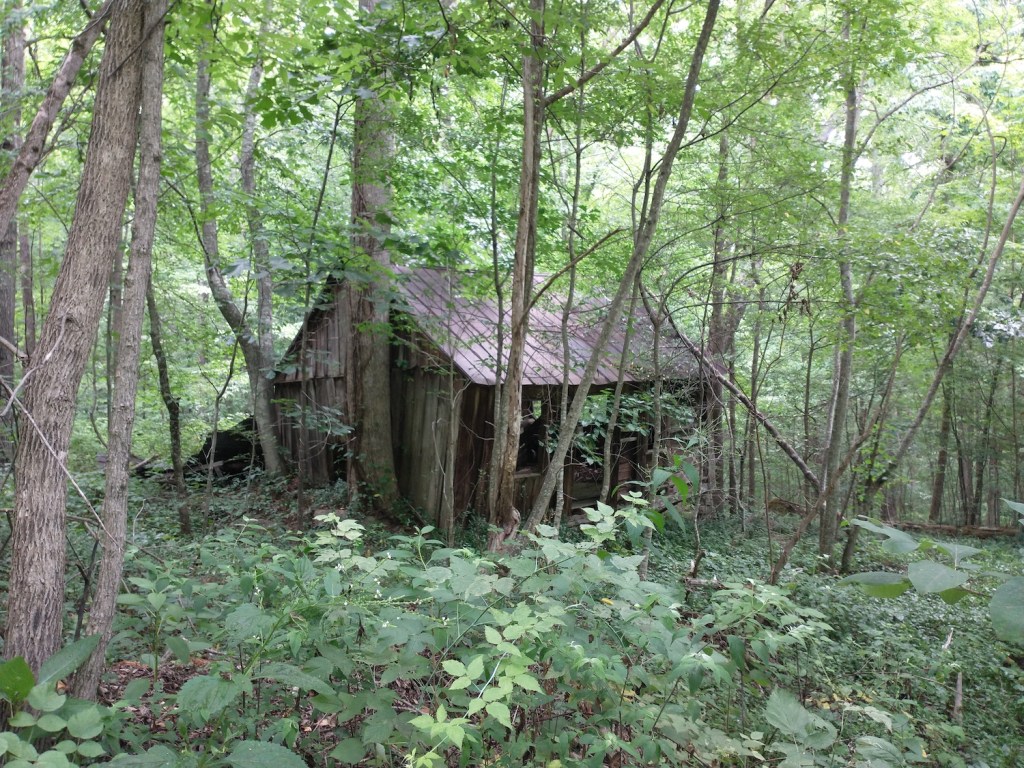
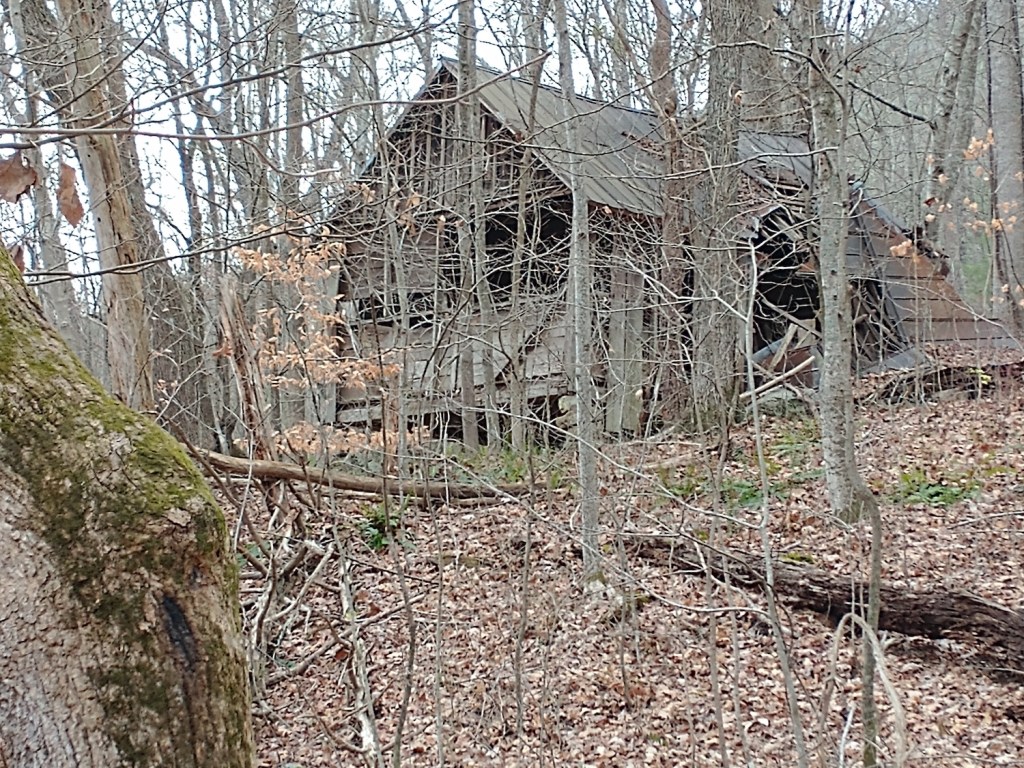
The Sheridan cabin, two-rooms with a metal roof sits near the south west corner. One room has collapsed and much of the walls of the other are open. I intend to salvage the roof of the fallen section and take it to the other property where I have my sites set on a flat shelf that juts out from the tallest knob. It is here I’d like to build a cabin that overlooks the little valley between the knobs and the mountain on the other side. Both pictures above were taken this year—the first in summer and the other in winter. The summer shot is on the uphill side and the winter on the downhill side. Note the visibility afforded during winter time. The time to walk land, find boundaries and plan is after leaf fall.
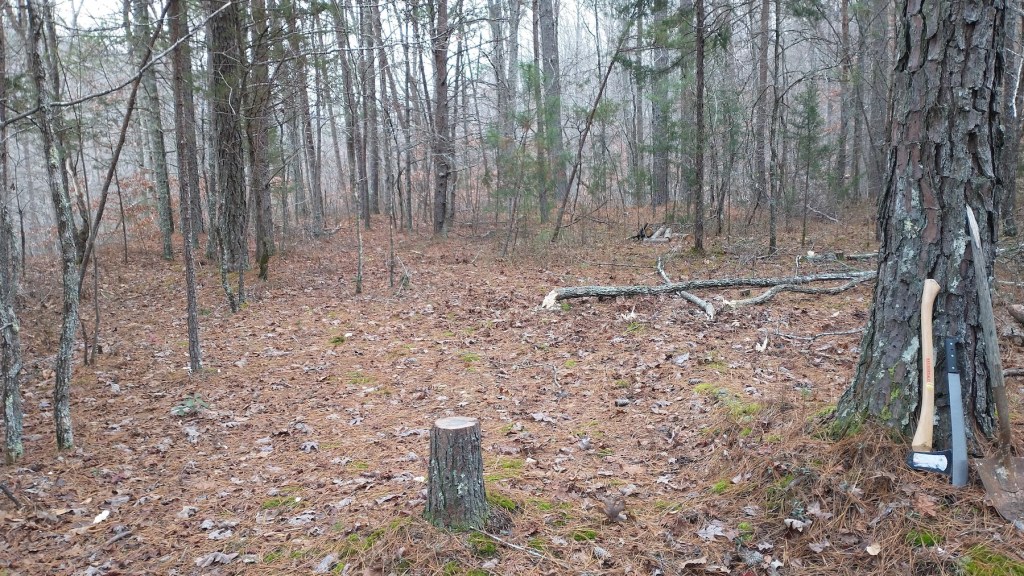
Future cabin site about 50 yards away from the cemetery. Lots of pines in this area—mostly Virginia and loblolly. Incidentally, the land between the knobs and Clinch Mountain is called Poor Valley. My father talked about how this land wasn’t much good for farming. On the other side of the knobs, closer to the Holston River is Richland which is superior for growing food. I mentioned the poor soil to Jeff, the forester, owning the same lamentation that my father seemed fond of, but Jeff had a different take.
“What isn’t good for vegetables isn’t necessarily bad for trees,” he said. “It’s all dependent on what you are growing.”
The shelf that extends out facing the mountain–the place where I’d like to build a cabin–begins to tilt around one side of the knob where the family cemetery is about 50 yards away. Three seven-foot granite slabs make up this small family plot at the base of the two-hundred foot knob. During this trip I added a marker for my mother. My parents had been divorced for 20 years at the end of their lives, but I don’t think mom would mind being memorialized alongside her in-laws.
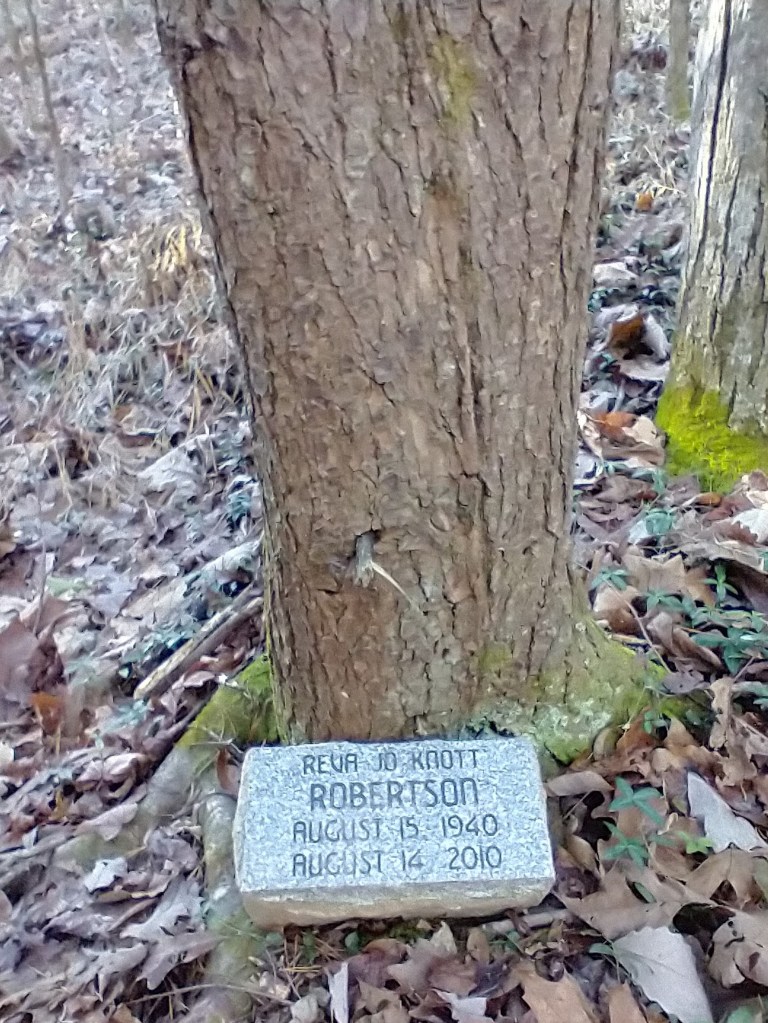
I placed my mother’s memorial stone at the base of a double hemlock. Mom’s favorite tree was a Weeping Willow. There are none of those on the property. Hemlocks are a little weepy though so maybe that’s good enough. Eventually I may plant a Willow tree.
Although these recent photos make the woods look pretty tidy the summer foliage is gone and overgrowth died back during winter. Saplings abound and if I’d had more time I would have pulled a bunch from the wet soil while it was easy to—primarily along possible walking paths. Unlike the old photo you see below, the cemetery area has been left to go wild for many years now. I’m not necessarily a nice-and-neat lawn type person, but this land could definitely use some pruning. I’d like to make walking paths throughout with stopping spots for—as the forester suggests—places to take tea.

Picture with Bob Manning senior (dad’s brother-in-law) and his son Jeffrey at the cemetery site, before markers had been placed. Jeffrey’s older brother Bob jr. road with my grandfather in the ambulance when he died. He was 16 or 17 years old. His inability to do anything inspired him to get certified as an EMT later. CPR had not been invented at the time. To my great sorrow, Bob junior died during covid this year. 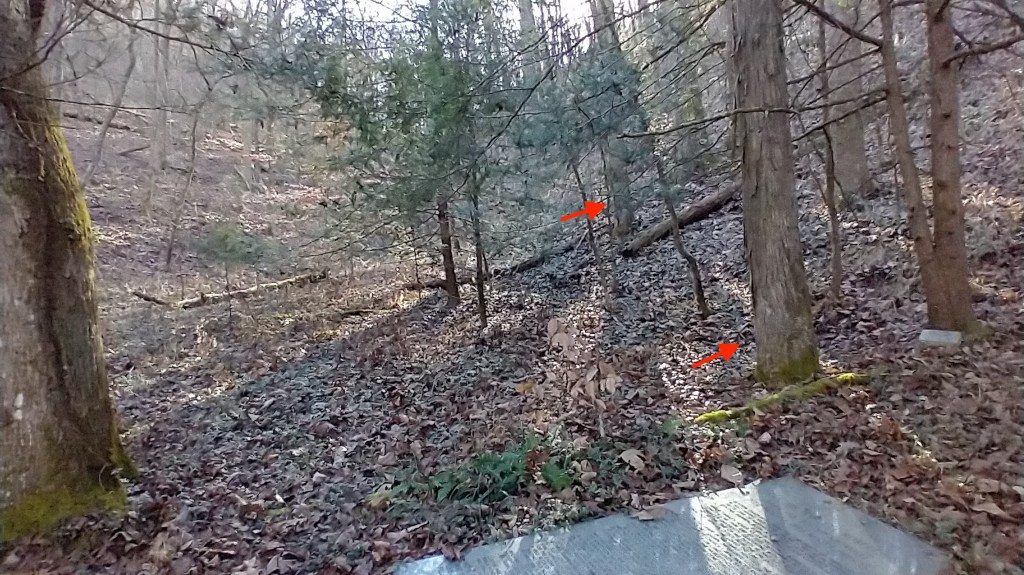
This is a photo of the same location at a slightly different angle taken a few days ago. The two arrows show the same two trees. The closest tree, a shagbark (or shellbark) hickory hasn’t grown a whole lot in the 56 years since the first picture was taken. Mom’s memorial stone is under the double hemlock behind the hickory. On the opposite side of the knob the shelf slopes downward in a sort of ramp and near its lowest point next to a gully sits an old shed.
This is the same shed I spent many days cleaning out this past summer. Among other things it contained dishes, clothes, shoes, books, photos and memorabilia, skis, bat boxes, whisky stashes, tools, hardware, and games, most in their final stages of deterioration. Extra mattresses and old army bed frames were kept there during its heyday to be pulled out for guests at the farm house. Much of the mattress batting had been relocated by mice to make a well-constructed miceopolis that has grown up this past half century while humans stayed afield.
The bat boxes were sort of mouse high rises filled with the soft cotton. Three wooden chests were apartment complexes. The high and low shed shelves had corners filled with mouse material making me wonder if mice real-estate values are based on elevation and view just like humans’. There was chewed up paper and batting in shoes and I imagine the mice had fairy tales about the old mouse who lived in a shoe and had so many children she didn’t know what to do—except being a mouse she knew exactly what to do and likely moved up to one of those deluxe apartments pretty quickly with that kind of progeny.
Three blind mice is the worst sort of horror story here except for me who—in a matter of days—came and destroyed the years of work by these Lilliputian-like beings. I’ll never forget the tender eyes of one that came out from the soft fluff inside a wooden crate, looked at me, and then dove over the side before I started cleaning it out.
Next up…my walk in the woods with the forester.
-
Day 49 – Amarillo, TX
August 3, 2021
I was thinking about that term, People of Color this morning. There is really no way to talk about race without it offending someone. In this case, myself. People of Color is fun. What is the opposite?People of no-color? White and black are useful terms in language I suppose. They are short cuts. I always make a point of telling my students that I’m called white, but I’m not really white. I then hold up a sheet of copy paper next to my skin to prove it.
Also, People of Color sets up this all-encompassing dichotomy. You have People of Color and then you have white people. It will be a good day when we live in a world where we understand that we are all blended cups of coffee, some with extra cream and some with spices of cardamon or cayenne.
Coffee. I’m in McDonald’s trying to get a post off before I hit the road. (I just figured out the other day that I can get a senior cup of coffee at McDonald’s!). I’m shooting for Flagstaff tonight. Jillian has a friend seven minutes off of Interstate 40 who is going to let me park on his land. It will be nice to meet him and his family. This is an old boyfriend she hasn’t seen in over 20 years. I get to see him for her.
It’s a lot of miles. I can’t futz around too much with this posting like I tend to do noticing imperfections for hours like the it’s/its thing that is the bane of my existence. Okay that’s extreme. Water incursions are that. I had a few drips the other night. Saw a new leak when it rained in Little Rock as I was going to bed.
BTW, Cracker Barrel is being good to me. Another one with free overnight parking here in Amarillo. Oh, and it wasn’t the sewer after all that smelled! I gave my feet a good washing last night. I likely built up a host of smelly bacteria wearing the tick-repellant rubber boots I borrowed from Stewart for tromping on the family land in Blaine.
I’m going to post a few more pictures from there and hit the road. I camped only one night on the old Halcyon Hills land but it was sublime. According to the Fitbit my Uncle John got me for my birthday, I got 7 hours and 7 minutes of sleep in the tent. That’s the most I’ve gotten since I’ve been recording it for over a week now.
This morning deep, fun dreams with a host of family and odd ball characters from my past—case in point, Jerry, a guy I worked with at the People’s Library in SF Tenderloin. He may have been telling me about one of his movie script ideas in that excited, jacked-up-on-coffee way he had.
One day I came to the library and someone had written some graffiti on a brick at the entrance of the building. “Jerry, take a chill pill it said.” But I loved that guy. Hope he is still around. He was living with HIV and camping under bridges—often with a transvestite girlfriend who’s voice was a deep, slow Texas twang.
Okay, pictures:
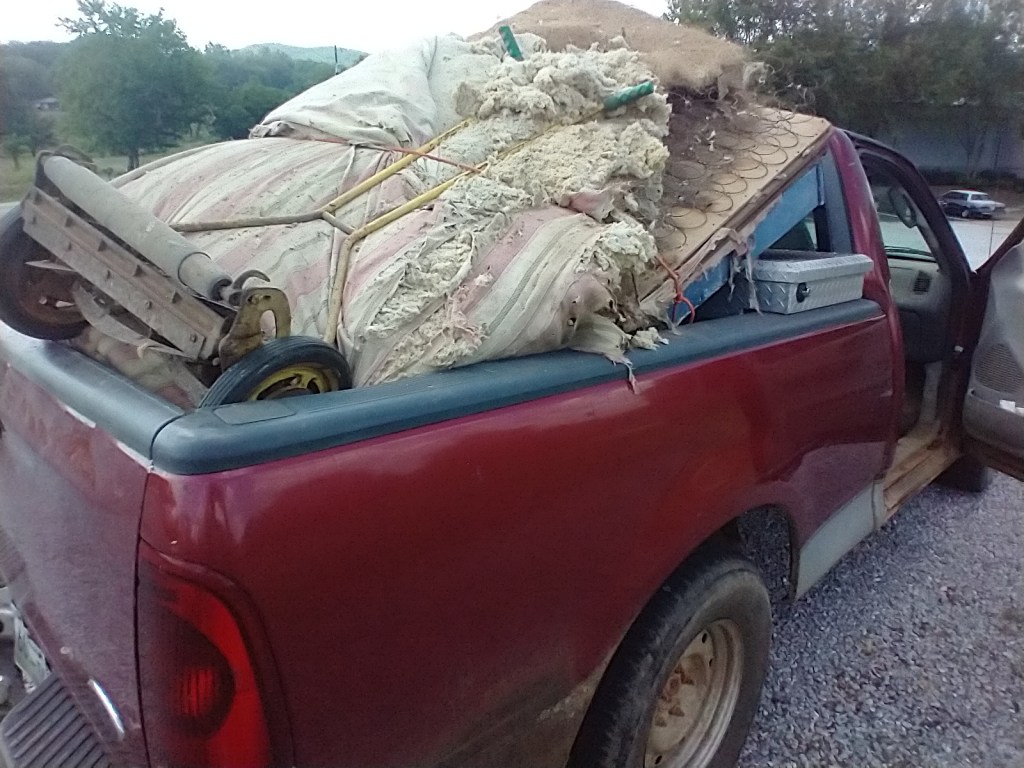
Some of the shed contents on a trash run in Stewart’s pickup—local plates. 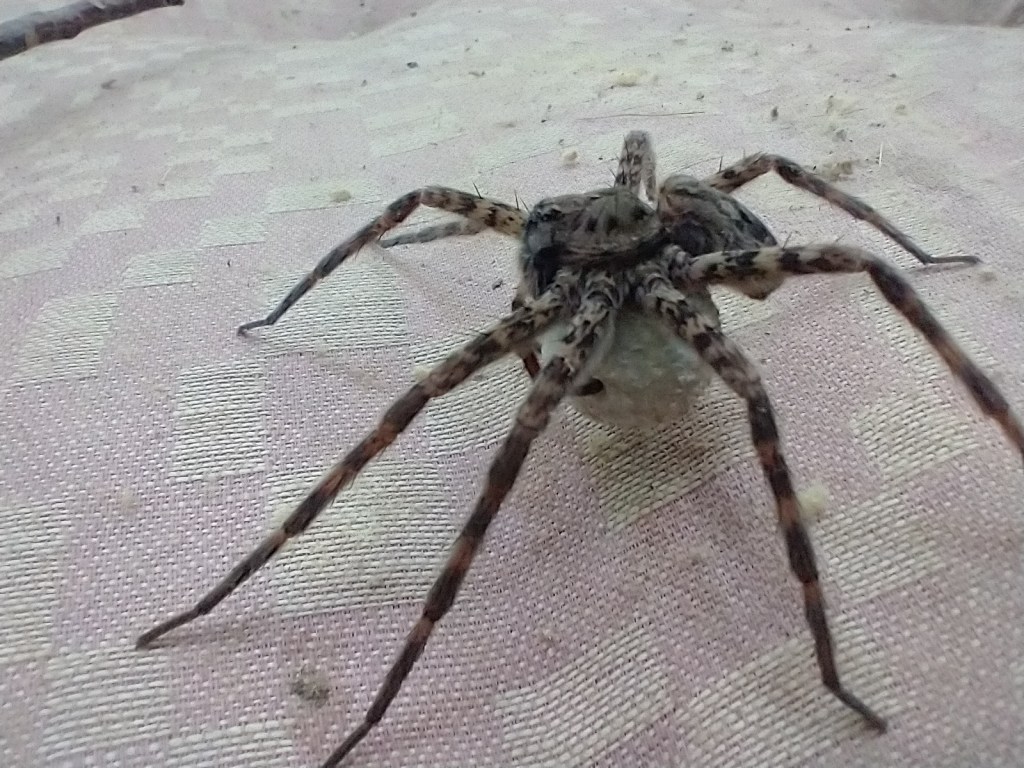
This lady just didn’t want to leave her mattress home. This is a week after I saw her the first time still carrying those eggs. 
I found this almost full bottle of whiskey stashed with another bottle and two beers. I washed off the bottle and tasted it. Seemed fine but I didn’t want to take my chances. 
Those Shlitz can tops have no tab. A church key was needed. It dates these to pre-1962 at least. Likely the 50s. One of the cans of beer was 3/4 full. I didn’t try that. 
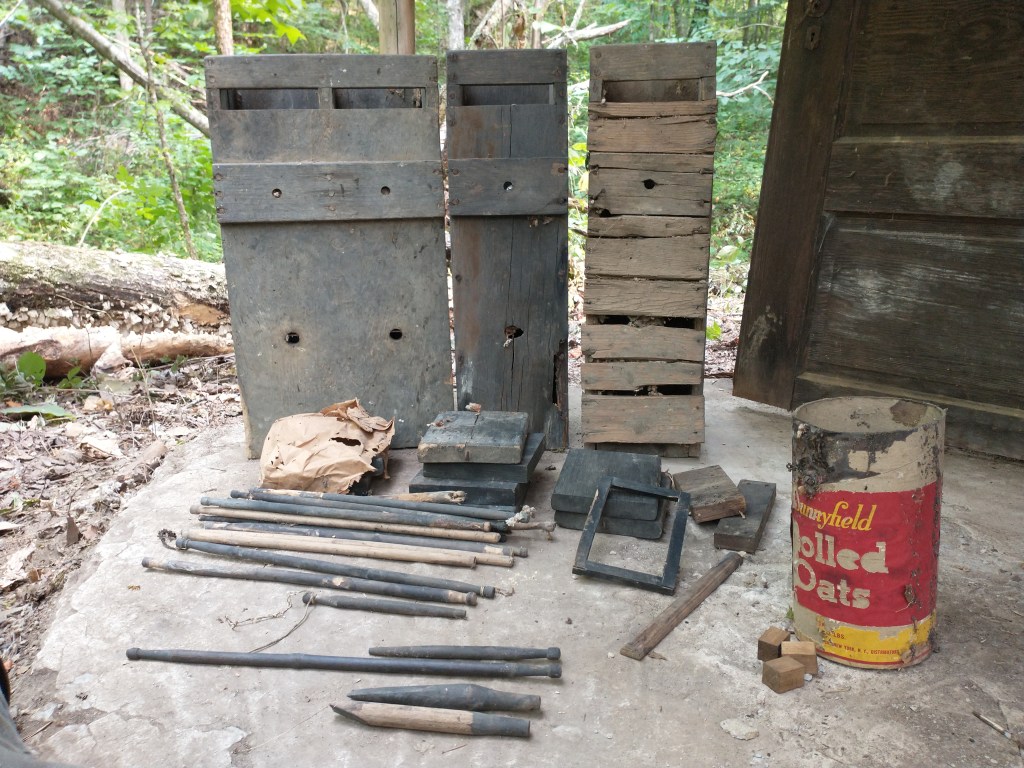
I found the alcohol stashed in one of these boxes. Any idea what they are? I was thinking bat boxes. Those wood dowels are finished with notches at the end. Hanging perches to be set in drilled holes in the boxes? The rectangles kind of fit in those square slots at the top of the boxes. 

Kind of a gruesome find in the shed. Top pic shows the opossum in the shed and bottom is outside against leaf and pine litter. This carapace was like a flat piece of cardboard. I found the top section of the skull about four feet from this possum leather in the shed. 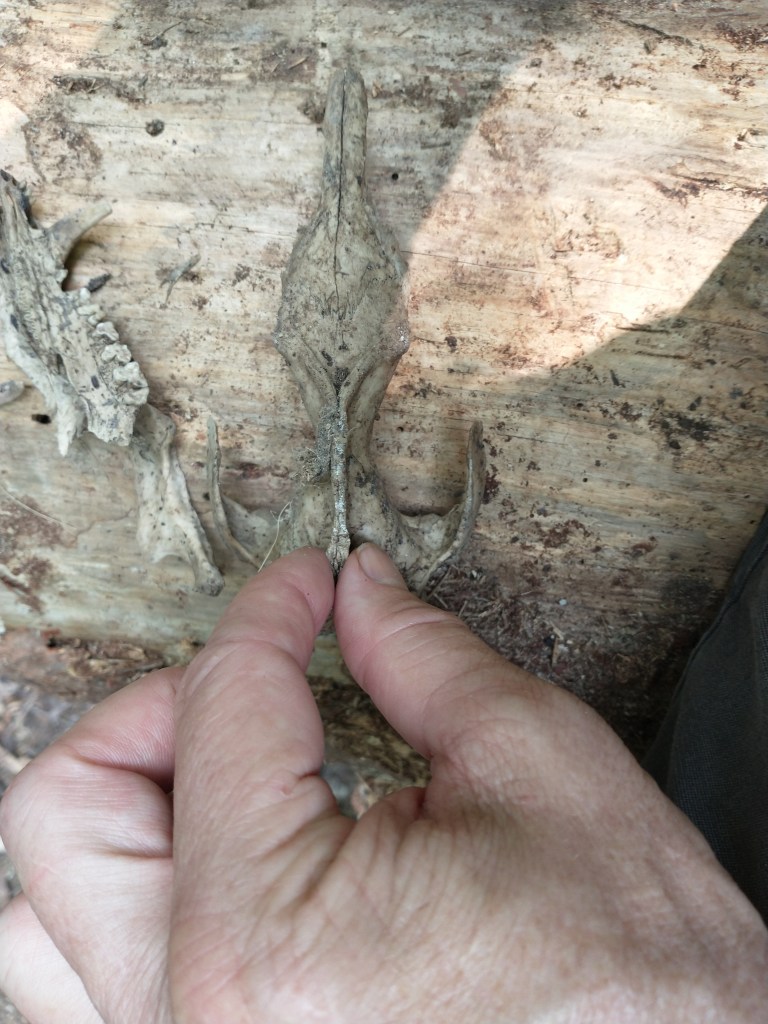
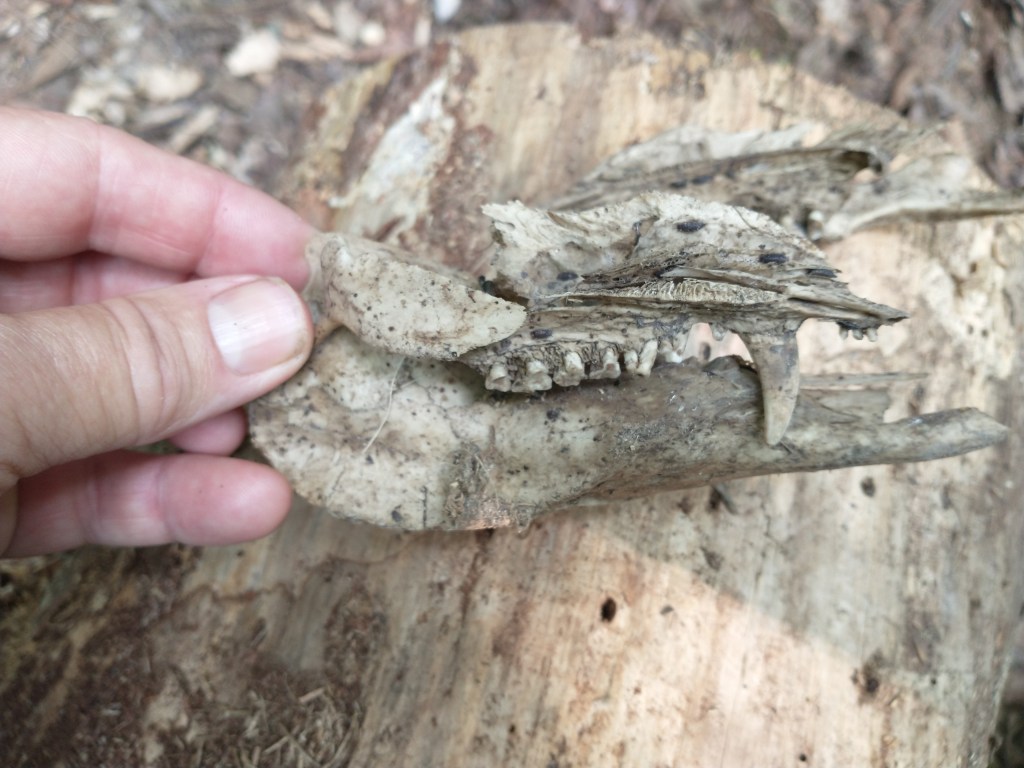
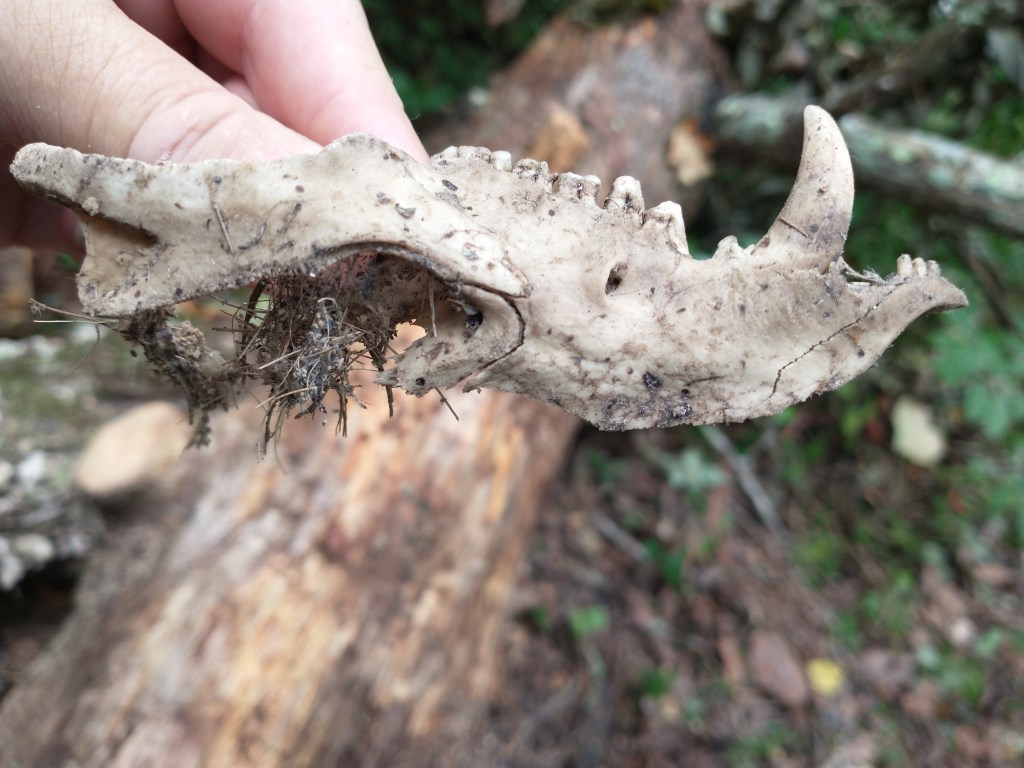
I had to look on the internet to figure out that the top piece—center cranium—and the bottom—right top jaw went together with the left top jaw to form the top of the skull. I was inaccurately trying to put the pieces together like in the middle picture.
A visitor outside the shed. It took a while for her to come out of her shell once she knew I was looking. 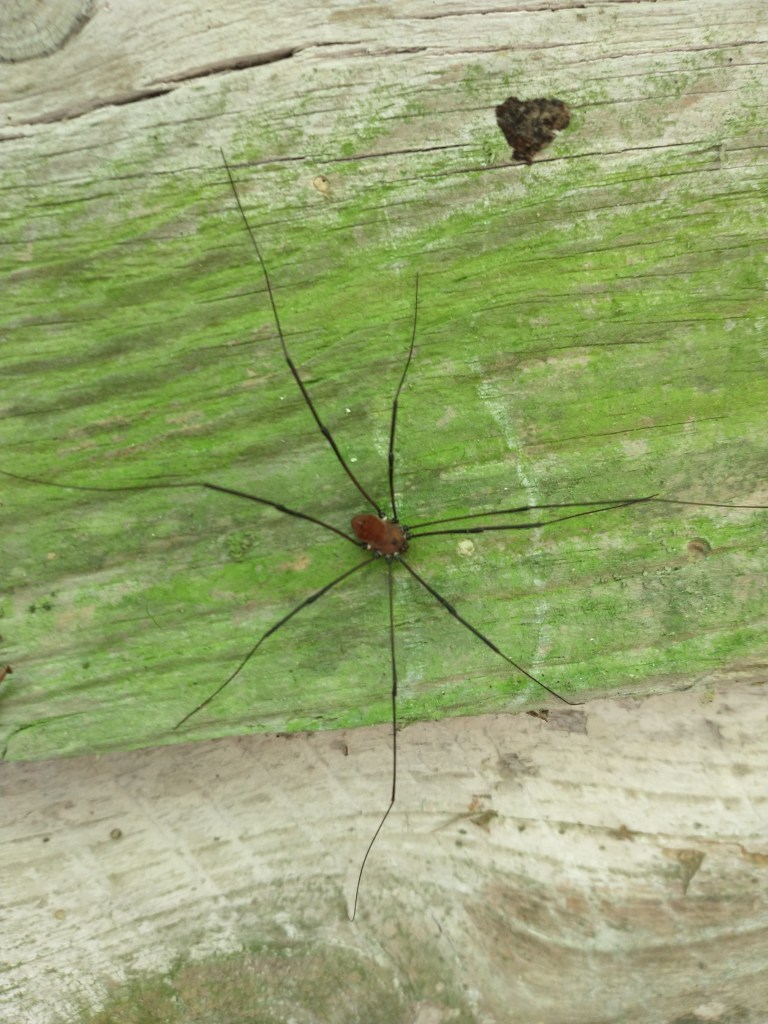
Daddy longlegs 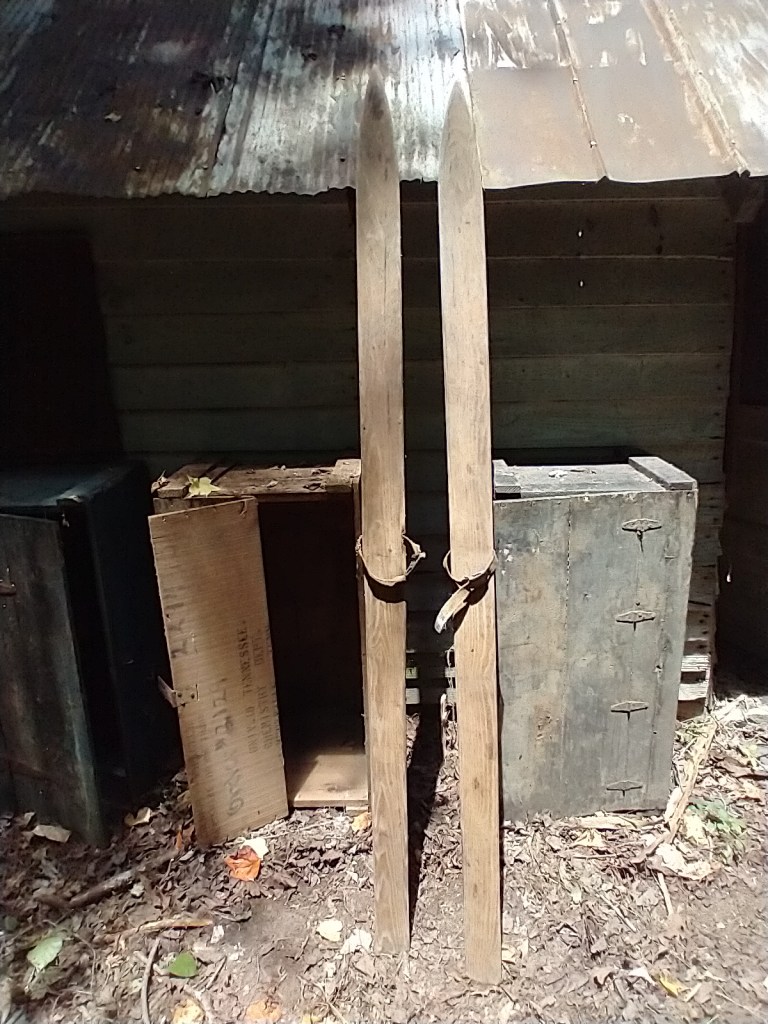
Wood skis in need of a polish. The wood crates used in the shed were stamped U.T. Department of Chemistry. 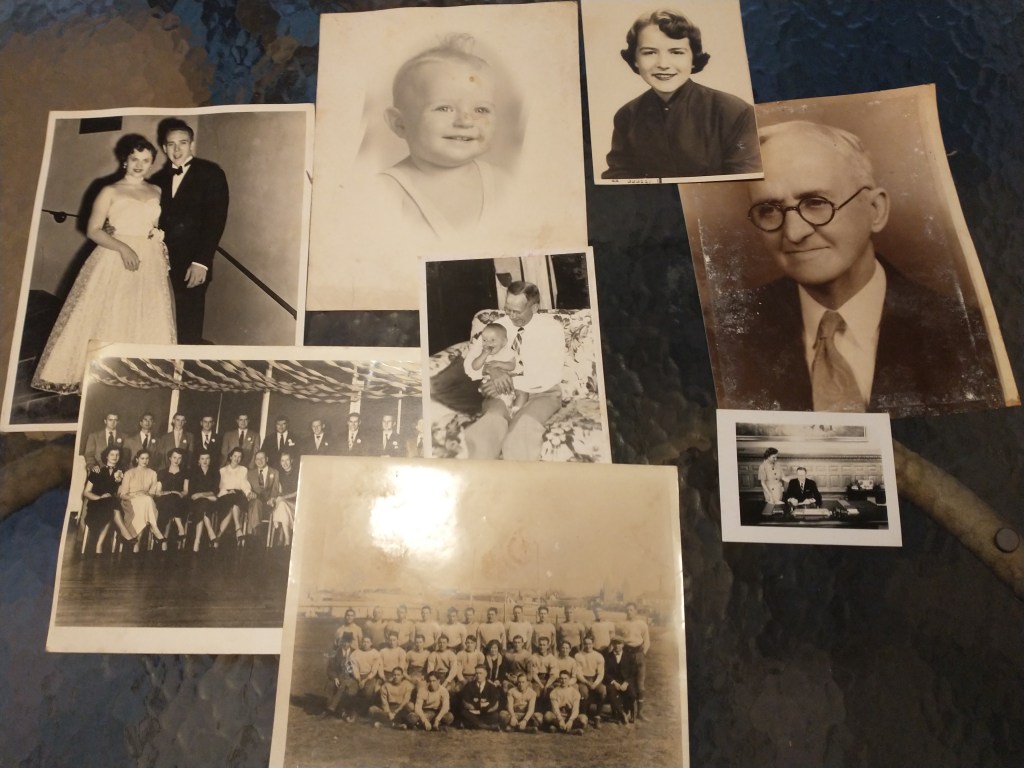
More family pictures found. The guy on right was my grandmother Robbie’s dad. He had a successful mortuary in Bristol, TN. I don’t know the cute baby or lady top right, but I recorded the names written on back with my phone. Handy to have a computer in your pocket. 
This is the first tree I ever chopped down. It fell the opposite way I thought it would. My Youtube self-teaching obviously didn’t work too well. Hint—the angle of the chop is important. Actually, I got the saw stuck in the tree. After trying to loosen it I gave up and went back through the woods to try and find a neighbor with an axe. I was almost to the road when I heard that splintering wood sound. I walked back and it was down. These woods are very rough with many fallen trees and many standing dead. This one was dead and near where I was putting up my tent. It was 40 years old according to its rings. I was surprised it was that old because it was so skinny, but it was about 40 feet tall. 
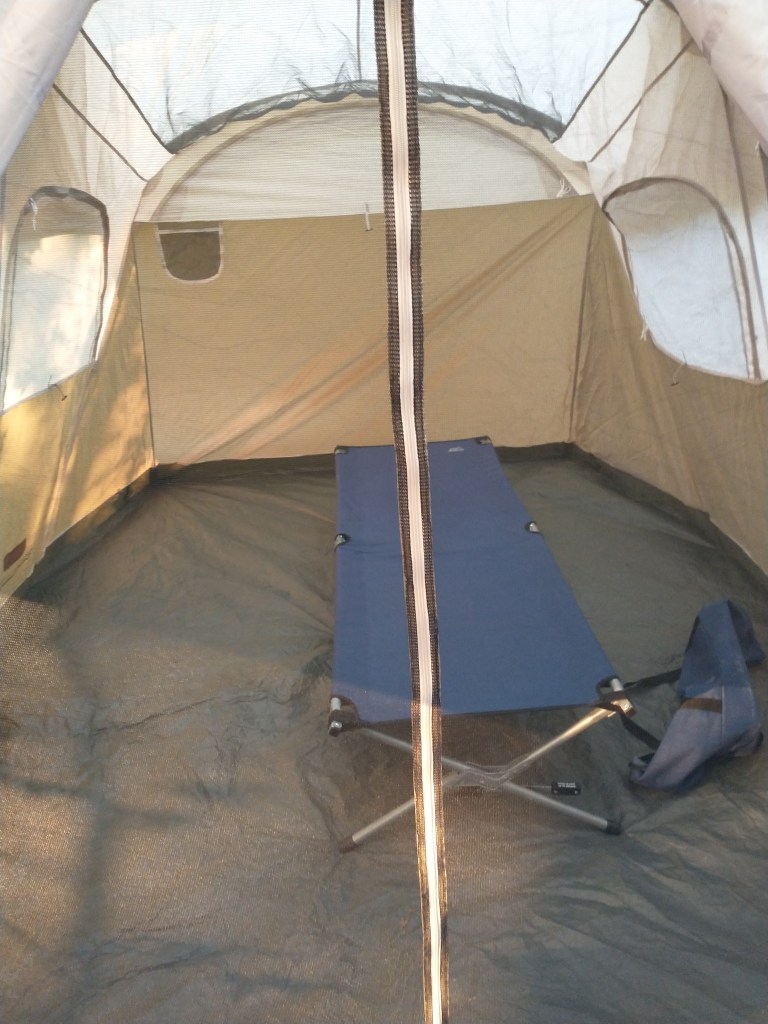

Love this tent lent to me by cousins Tommy and Kim. Very spacious. I could have lived the whole summer in it. 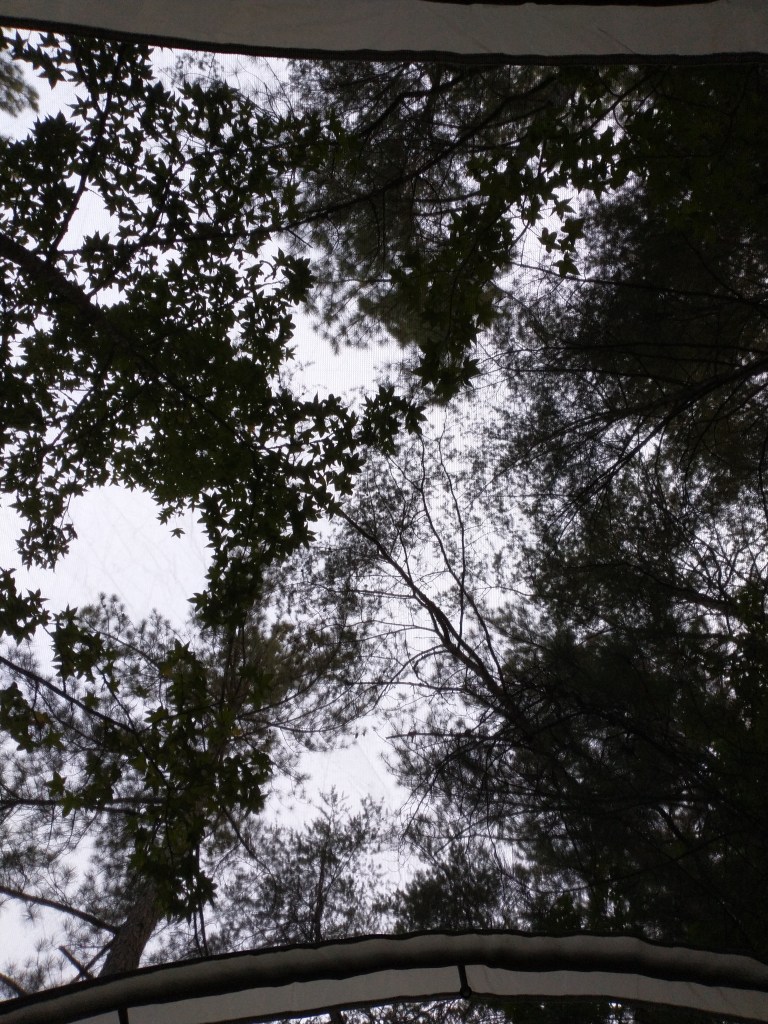

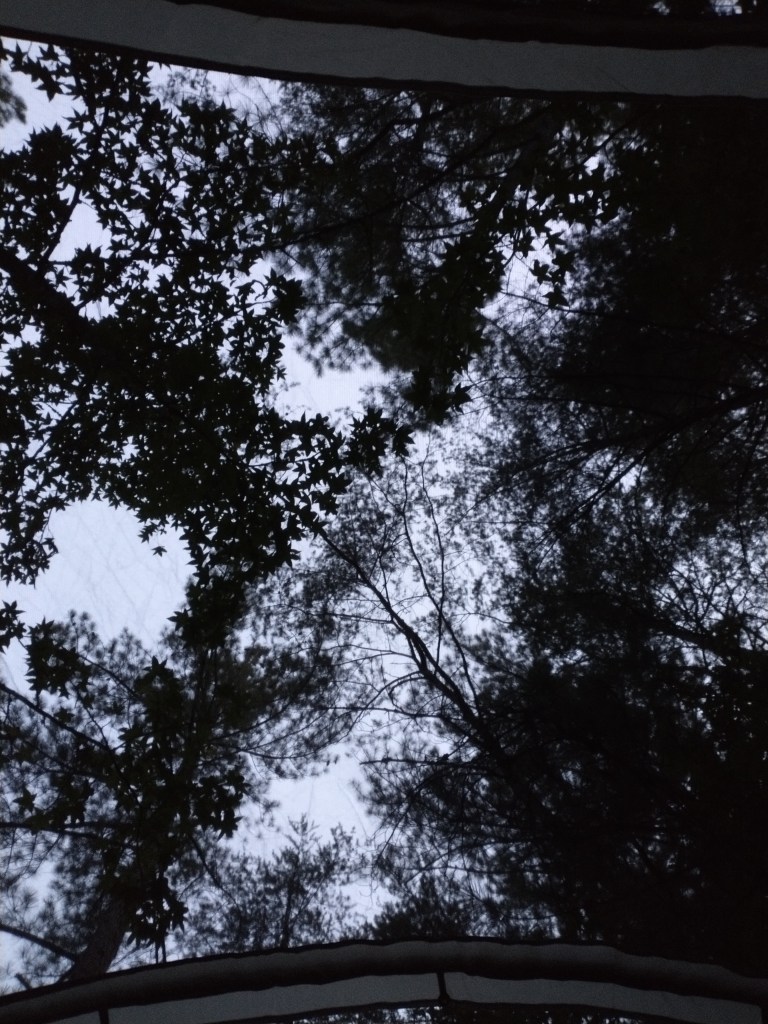
(This series of sky pictures was taken inside the tent-10 minutes apart at sunset.) 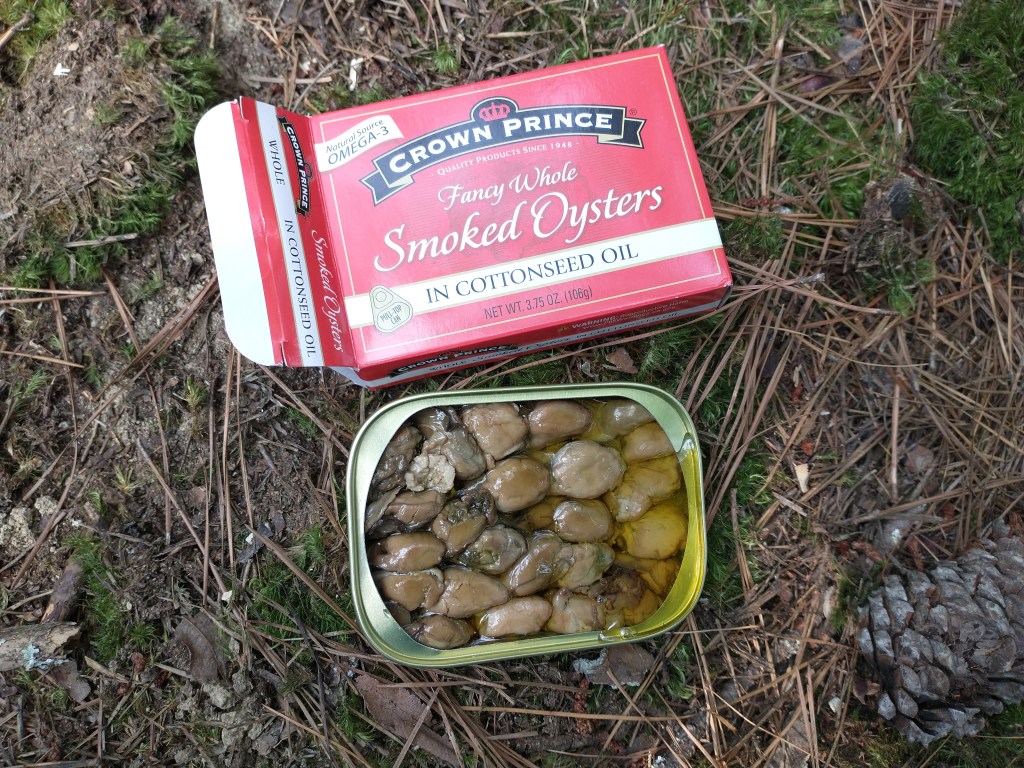

The crown prince were a little small—too many to the can but not tough like those I had in Denton which were tiny and too chewy. The Sunny Seas looked premasticated. I ate them anyway; it’s just their condition took away a little of the pleasure and I wondered what had happened to get them in that state. BTW, I was calling these clams at the beginning of my travel journal. They have always been smoked oysters. I haven’t even seen smoked clams. 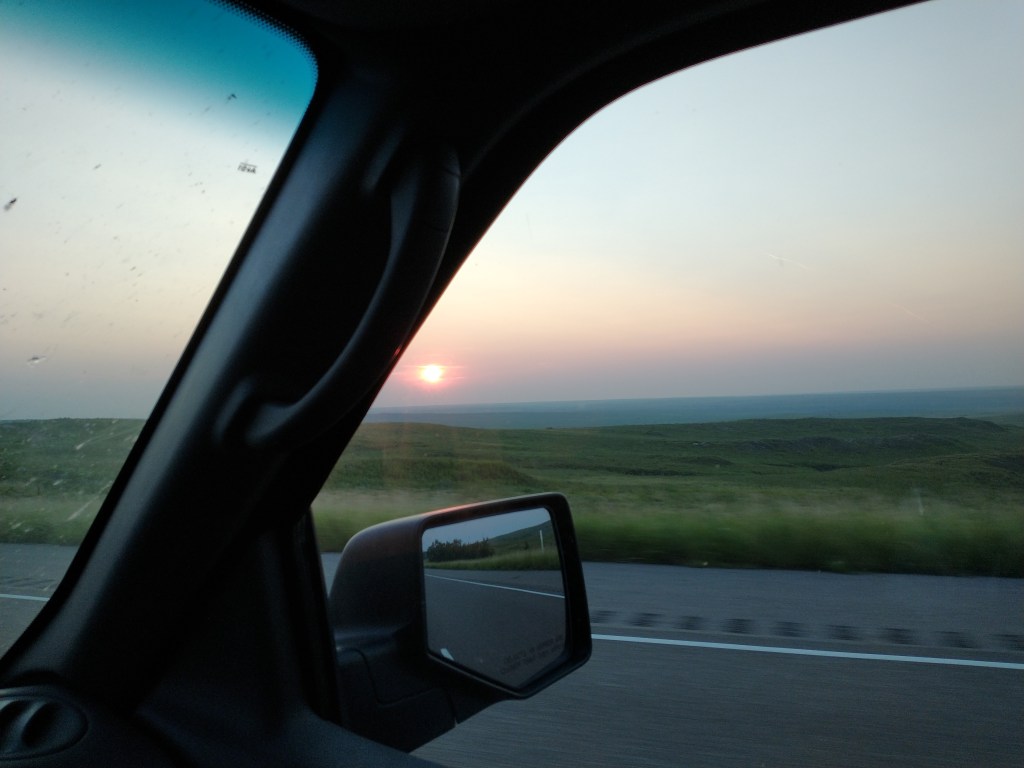
Sunset in the Texas panhandle. 
Need a job? -
Days 45 – 48, Little Rock, Arkansas
August 2, 2021
I’ve started my trip home. I left Corryton yesterday at noon. I just lucked out ending up at a Cracker Barrel in Little Rock that allows overnight parking. I was actually just looking for a motel lot when I came across this. It was nice to be able to pull in and get my bed ready without having to be sneaky. A motorhome is parked nearby.
It’s been a slow learning process, but at some point it hit me that I need to stuff as many of my things as possible into the cab while I sleep instead of trying to share my bed with a piece of rolling luggage and a large duffel bag.
I had to move the truck after sitting on the tailgate and smelling a rather foul breeze. At first I thought it was my feet but then I looked down and saw I’d parked right in front of a large sewer grate on the grassy median between the Cracker Barrel parking lot and a Marriott extended stay.
The more days that pass between posts the harder it is to write. It makes sense; more days means more experiences to choose from—more birds. Movement and nightly boondocking seemed to provide a rhythm and the appropriate level of spontaneity to get a daily post done. Now I feel like I have all this material bunched up. I’m like a baby in a pile of clothes.
Speaking of which—Sewanee:
One of my earliest memories is laying on a big green lawn on campus and watching frisbees fly overhead against the backdrop of a blue sky. I also remember my mom coming into the kitchen crying one morning. When I asked her what was wrong she said, “Daddy won’t go to the store and get me a coca-cola.” Bizarre! I’ve pondered this over the years. I think she was crying over something real and tried to put it into terms I might understand. Then again, she was in her mid-twenties with two small kids. Maybe she just wanted a coke.
Other memory: the Lowes were family friends—the father a chemistry professor. Their house had the wonderful smell of his pipe and the wood fireplace in the living room. I was very much in love with the older girl, Leah, who was pretty and had long blonde hair, but the younger girl Sarah was who I bonded with. My mouth was head level with her chest and I often placed it there and bit, trying to get a purchase on that flat surface. I seem to remember the wet spots I’d leave on her shirt.
Finding my old house was a challenge. I was half-a-year-old to 3 when we lived there. Additionally, the house had been moved down the street while we were still in it. I imagine us sitting at the windows waving during the process but, no, we moved out. The house was put on a flatbed pulled by a semi. A special wide pallet was made to support it extending beyond the edges. I have a picture somewhere of it in creeping-transit as it was moved down the street. When I say I lived in fourteen places, I count this house twice.
I’ve searched for the home in past decades circling in and around campus without luck. The last time I saw it was on a trip with my parents and sister. It was the last time we were all together—probably around 1987. We visited the Lowe’s. The girls and parents were there. Now I was in love with Sarah! I guess that biting bond was the real thing.
Having searched the campus several times in the past I knew it was best to take a different approach now. I started with the buildings and grounds department. It was a little foolish imagining that there would be a 75-year-old maintenance worker there who would remember a house being moved back in the mid 60s. A office worker sent me to university leasing. (All the land and many of the houses around the campus are owned by the university.)
The leasing office was in a small bungalow near the edge of campus. I sat down in front of the desk of a nice woman and explained my quest giving her my father’s name. She did a search on her computer.
“It was nothing fancy,” I told her. “Kind of like an old farm house. But it had three floors.”
“Do you know what the address of the home was,” she asked pausing between key strokes.
“No, but I know it was close to the center of campus. In fact, it was either moved off-campus or vice-versa.” I related how the semi flatbed was used. “I seem to remember my dad saying it was moved about a thousand feet.”
After a few minutes clicking on her keys she said there wasn’t data going back that far. She wanted to check some files and offered me a book of local historical homes to look through as she left the room. No luck.
On a table near the front window an aromatherapy machine quietly released a stream of “seafog” vapor next to a 5 x 8 picture of a man in military uniform. About ten more photos of a yellow Labrador Retriever were around the room, posed and impromptu, on the wall, desk and bookshelf.
The woman returned unable to find anything and after a few more helpful questions she recommended that I go see the people at University Archives.
The archives were next to the Jessie duPont library in a lovely, single story rock building of the unifying architectural type ubiquitous on campus. Rocking chairs lined a front porch and I imagined a couple of aging alums sitting there taking in their old alma mater.
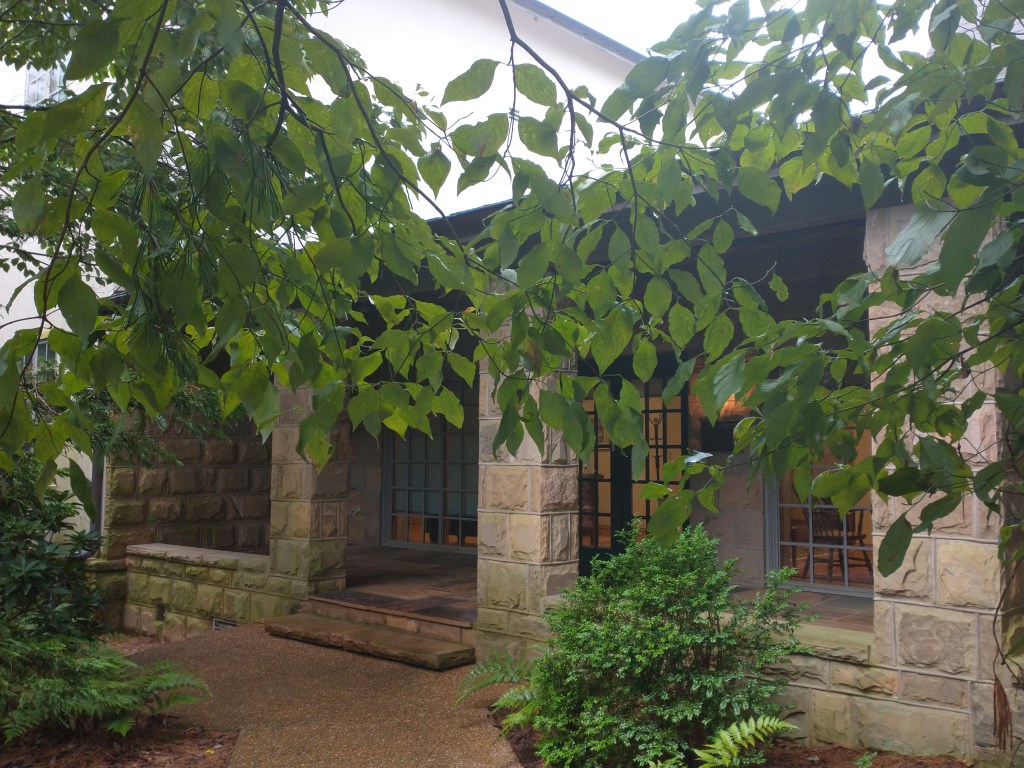
Sewanee University archives 
Front porch of the archive building In the lobby there was a reception stand but no one there. I saw movement through the door to several interior offices and soon a woman came from there, introduced herself and listened to my request.
“I’m going to go see what I can find,” Jenny said. “Oop. I haven’t even opened up the gallery. You can go in here and wait if you like.”
She opened two French doors and turned on lights. I walked into a large, high-ceilinged, rectangular room with two upholstered benches facing opposite each other at center. Evenly spaced around the four walls were black and white and color photos of landscapes and other natural elements. Three artists were represented with work ranging from the last decade to the early 1960s.
I slowly walked the perimeter looking at the photos, stopping to study the ones I liked to determine what it was about the composition that attracted me. After completing the circuit I took a seat on a bench and began to rummage through my backpack like the boondocker I am, forever trying to arrange things into some meaningful order and keep things clean. Jenny returned.
“I’ve found a file on your father that I thought you might like to look through,” she said leading me from the room to an alcove off the lobby. (In a distant room I saw a person wearing white gloves and carefully turning pages.)
“This doesn’t have any information about an address,” Jenny continued, “but you can look through it while I do some more searching.”
She set the tabbed manila folder on a desk and left. The service I was receiving at Sewanee felt like something out of a Hollywood movie. I felt like Tom Hanks in the Da Vinci Code, but I wasn’t trying to solve an ancient conspiracy, just find out where my little three-year-old self lived 53 years ago.
The file was thin but I slowly turned over each sheet reading the contents. There was a faculty data form filled out by my dad, a university photo, a media release to The Winchester Herald-Times and two newspaper articles from The Nashville Tennessean and The Sewanee News.
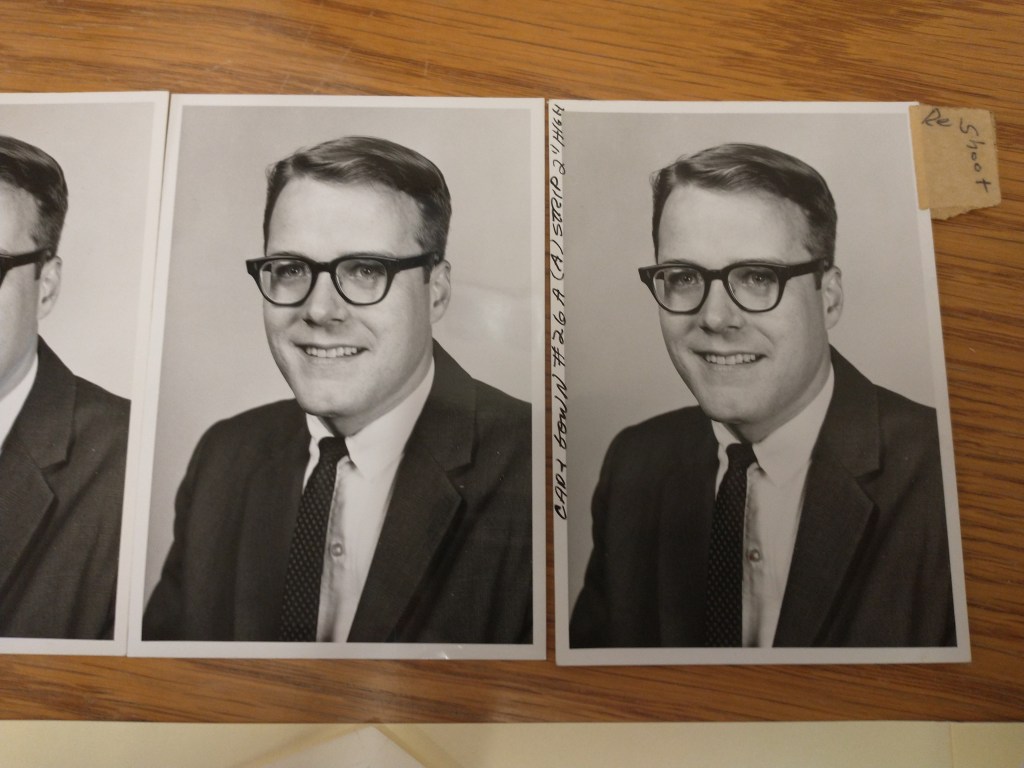
1965. Dad was 28. 
Mom and dad moved to NYC soon after they were married. Dad had hoped to break into theatre on Broadway. Writing for Equitable was his day job. Mom worked as a secretary–I can’t remember where. Pregnant with my sister she said she got no breaks squeezing onto the subway for her commute. In 1965, Sewanee didn’t have its own theatre department. It was part of English. Yet dad directed three full-production plays each of the three years he was there. The university was also all male and dad had difficulty casting women’s roles from the sparse selection of faculty and graduate student wives and local workers. He played a part in a movement to make the school coed, which it did in 1969, a year after he left. Later, Theatre and Dance was established as its own department.
When Tennessee Williams died he bequeathed his entire estate and literary works to Sewanee to be made available upon the death of his sister Rose. When she died in 1996, the university received seven million dollars along with the additional millions that would roll in from royalties. Williams is probably the second most-produced playwright in the world—after the English bard. If ever there was a well-endowed university theatre department, Sewanee now is it. Dad would sometimes kick himself for ever leaving.
Jenny arrived back in the alcove walking quickly.
“Okay, I’ve found your dad listed in an old phone book,” she said as she went to a low table in front of another upholstered bench. I moved from the desk to sit next to her and she opened it to a bookmarked page. She scanned down with her finger as she caught her breath.
“It’s right……here,” she said with a final exhalation. I looked and saw Ala Ave after my dad’s name.
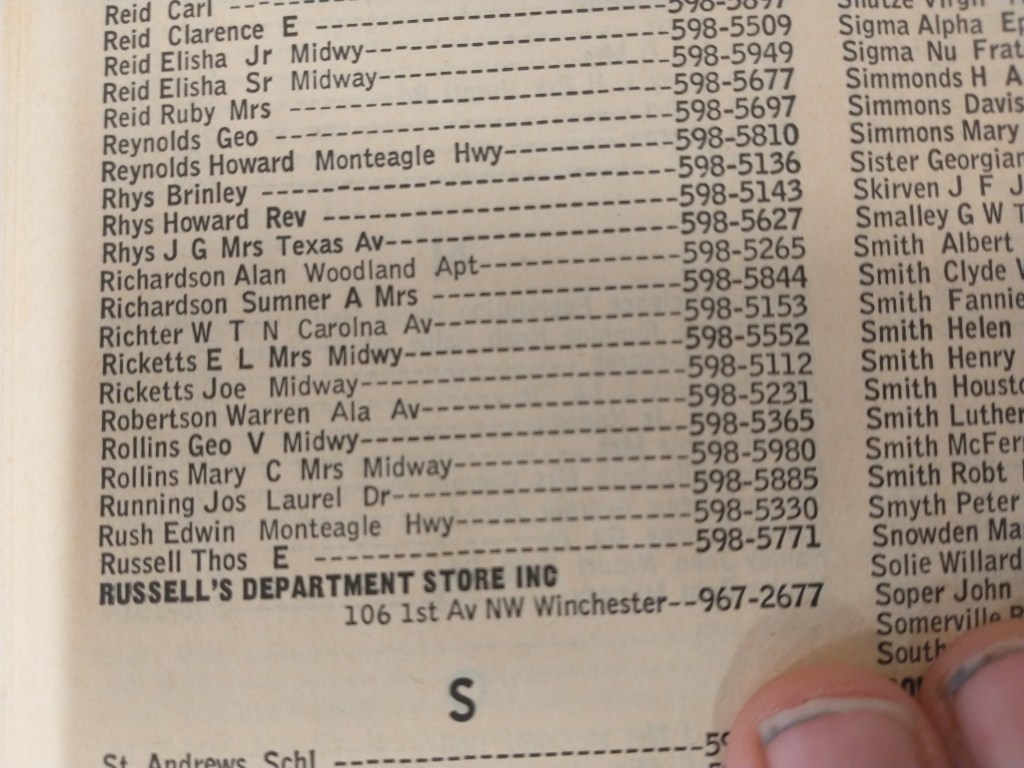
“The names have streets attached with them but no number address. Alabama avenue was actually where the sidewalk is right outside our door.”
“Oh my gosh really!”
“I know, right?” she said.
I was amazed at the coincidence but also suddenly frightened; if there was no street then there was likely no house. Then again, the fact that they were doing away with the street might be the reason the house was moved. Jenny stood and closed the book.
“I think I have an idea where the house may be because the street starts up again where the sidewalk ends.” She continued with some elaborate directions that I had difficulty following.
“You know I have a better idea.” She led me to a back door that looked out over a parking lot.
“Go around this way,” she indicated. “When you come out on the other side of that building you will see it. Let me know what you find.”
The first house I came to had possibilities. Something about the back was familiar. I remembered my father telling me that there was a boogieman who lived in an outside structure, but that structure, a well-house or something wasn’t there. I pondered the front, then turned onto Mitchell Street.
Maybe it wasn’t moved down the same street but to an adjoining one? There was a large three-story house tucked into the woods on the corner, but I decided it was way too big. Across the street was another house, also in some woods, but it was too modern. I walked to the top of the street and there was a demolition site. Maybe it had been torn down?
I walked back to Alabama and went along it for what I guessed was more than a thousand feet but none of the houses fit the bill. Returning, I stopped again at the first house. I pondered the front again. The porch was familiar but the house looked too big. There was a beat up sign laying on the stairs that said, “Community Engagement House.” I went to the front door and knocked. No one answered so I tried the door. It was open.
“Hello. Anyone home,” I called out. “Hello,” I said again louder. “Anyone here?” In a distant spot of the house I heard a door close.Emboldened by my memory of living at a university coop and not caring too much who walked around, I entered.
Something about the main living space seemed familiar—the wood floor and wood paneling, but there was nothing definitive. I was three years old after all.
There was a bulletin board. On it was a flyer with the face of a young African American man. Hello my name is….I am your resident advisor for CEH… Okay, this is definitely some sort of University housing.
I peaked my head down a hall that led to a kitchen. Then I turned and saw the stairs. As soon as I stepped onto them I remembered. This was my house! My strongest memory of it was those stairs with a small landing that turned for a few more stairs at the top.
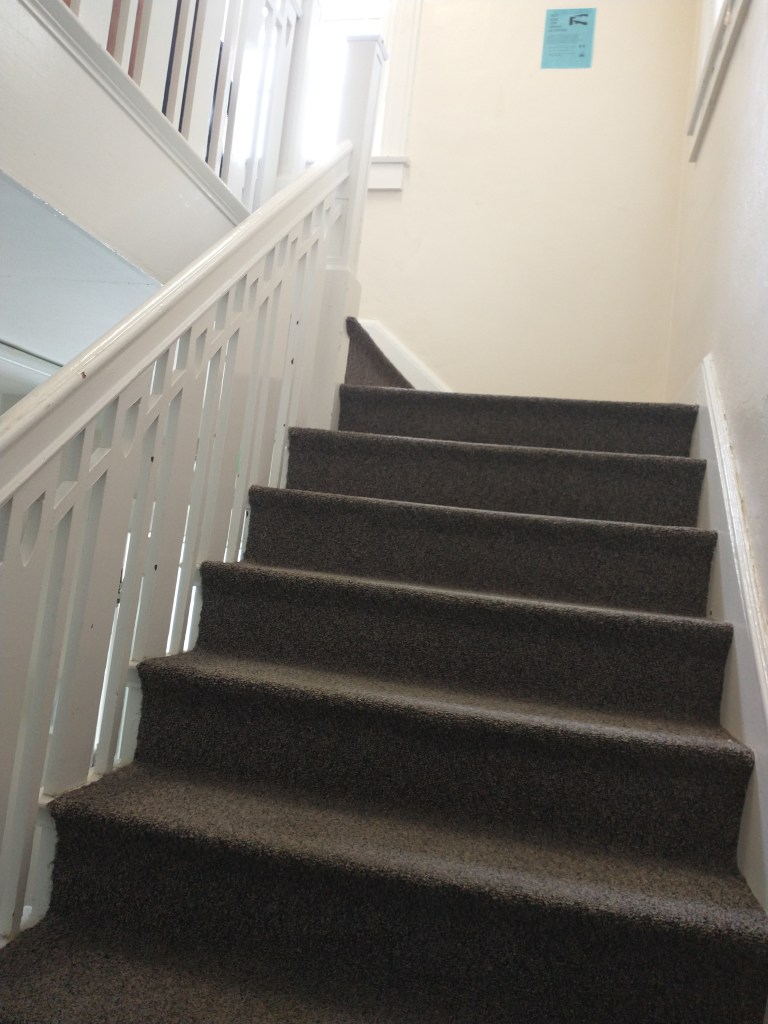
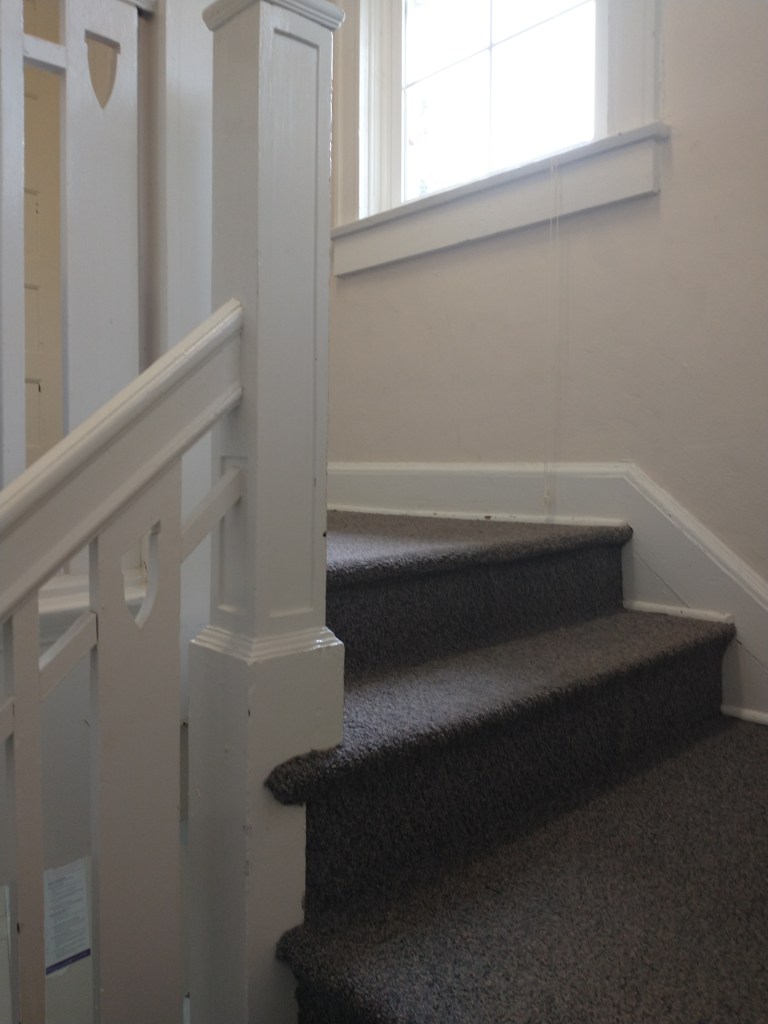
These stairs were uncarpeted wood when I was small. I believe they were painted red or had some sort of colorful bordering. I crept to the top and looked at the door that I believed was my room. There were three other doors up there each with little brass numbers—1,2,3,4. I thought about knocking on the door of my room but then thought better of it.
I went back down the stairs quietly. Back outside I made a half circle taking pictures. I then realized why the house hadn’t been more familiar. There had been additions added on. It had just been that central, basic, Salt-box, structure when I lived there.
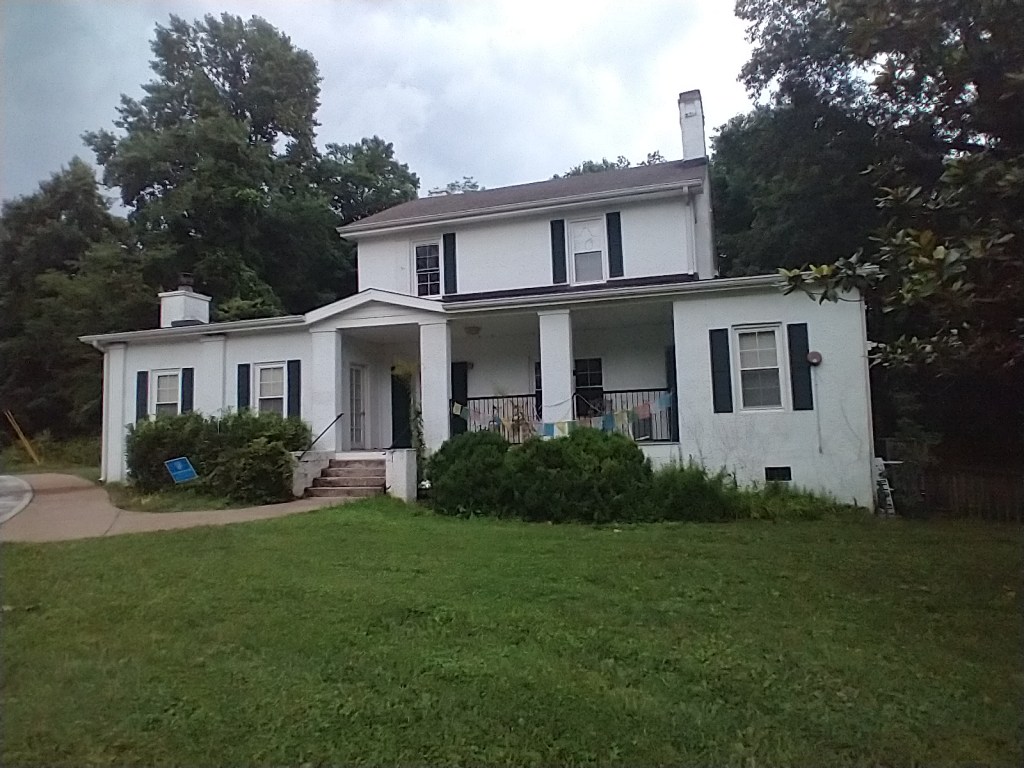
Take away the left and right additions and that was the house I lived in. 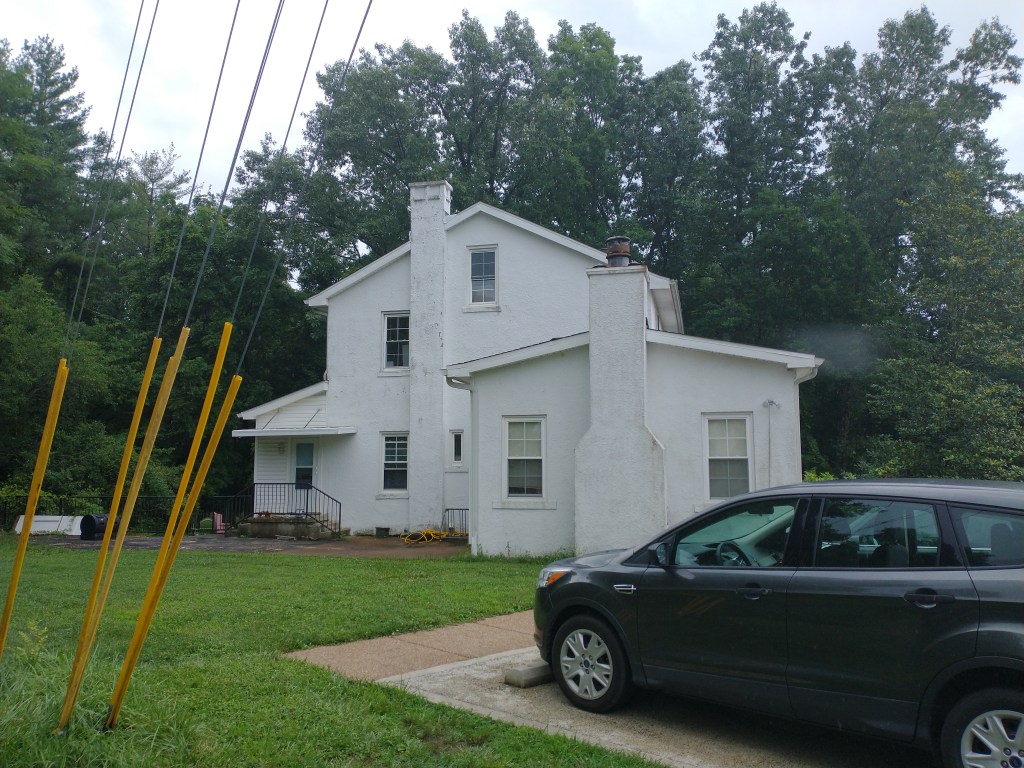
There was a boogieman on this side of the house in a little shed. 
When I returned to tell Jenny that I found my old house she showed me this lamenated, archived map of the campus when I lived there. My finger is where we believe our house was and #27, an inch below, where it was moved to. She had also found an article about the relocation of the home. The duPont library was completed in 1965. The house had sat directly across from it. I’m sure it was moved because it didn’t fit in with the rest of the campus and the desire for expansive lawns. Where it sits now is on the outer edge of campus and does not offer an interruption to the stonework aesthetic. 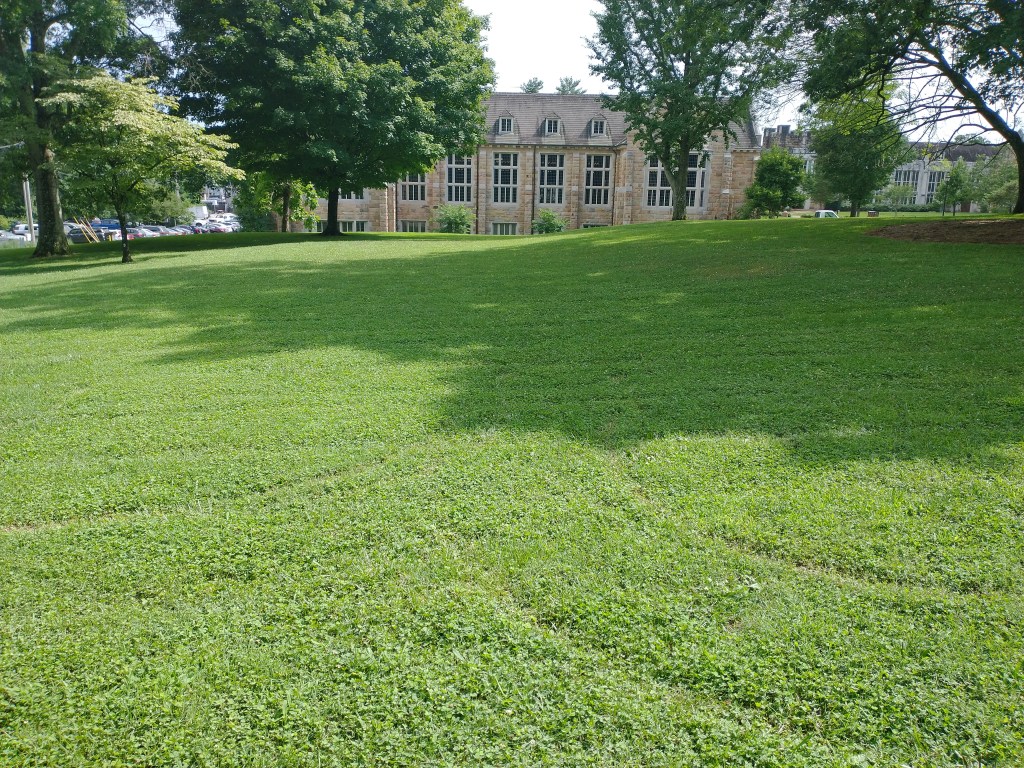
This lawn is where I believe the house originally stood. It may have also been where one of my earliest memories watching frisbees fly overhead took place. The Jessie Ball duPont library, completed during the year of my birth is in the background. I don’t know the relationship between Jessie Ball duPont and Sewanee. It isn’t easily apparent from the university website or her wikipedia listing. Apparently she was a big philanthropist. However, there are disturbing racist quotes associated with her on the wiki site.
As a University, Sewanee has some heavy lifting to do to deal with its past. Founded by slave holders and leaders of the confederacy, I’m curious how it handles this legacy. The cornerstone for the university was laid just before the beginning of the civil war and then blown up by occupying union forces.
While I was walking on campus, a large percentage of students I saw and some older people, who may have been faculty, were African American. It may have been some sort of summer orientation program for students of color or a true representation of the student body. Either way, representation is key to change and I was impressed.
As I continue to write and focus on race I have become aware of how my very focus on the issue might be viewed as strange by a younger generation, especially being so removed from these places of my past. When I become excited and say, “I saw a black person!” what does that say about my mindframe concerning the South? But honestly, it wasn’t a black person, but very many people of color—perhaps 50%!
I know there are young people today growing up who do not view others through the lens of race. I envy them. I’m still working on that.
-
Days 39 to 44 – Johnson City, TN
July 29, 2021
When I stopped in Tehachapi, CA to do my first post for this trip I became one step closer to the dubious milestone of having been to every town in the song Willin’ by Little Feat. I still lack Tonapah. Now with my journey almost done, the question is, Am I still willin’?
I’ve used a number of metaphors for my writing process on this journey and now I’ll add another: rabbit hole—as in—I went down one. I’ve been caught up trail blazing, shed improving, tent readying on that land in Blaine and my writing has taken a backseat. Case in point—my first post in almost a week.
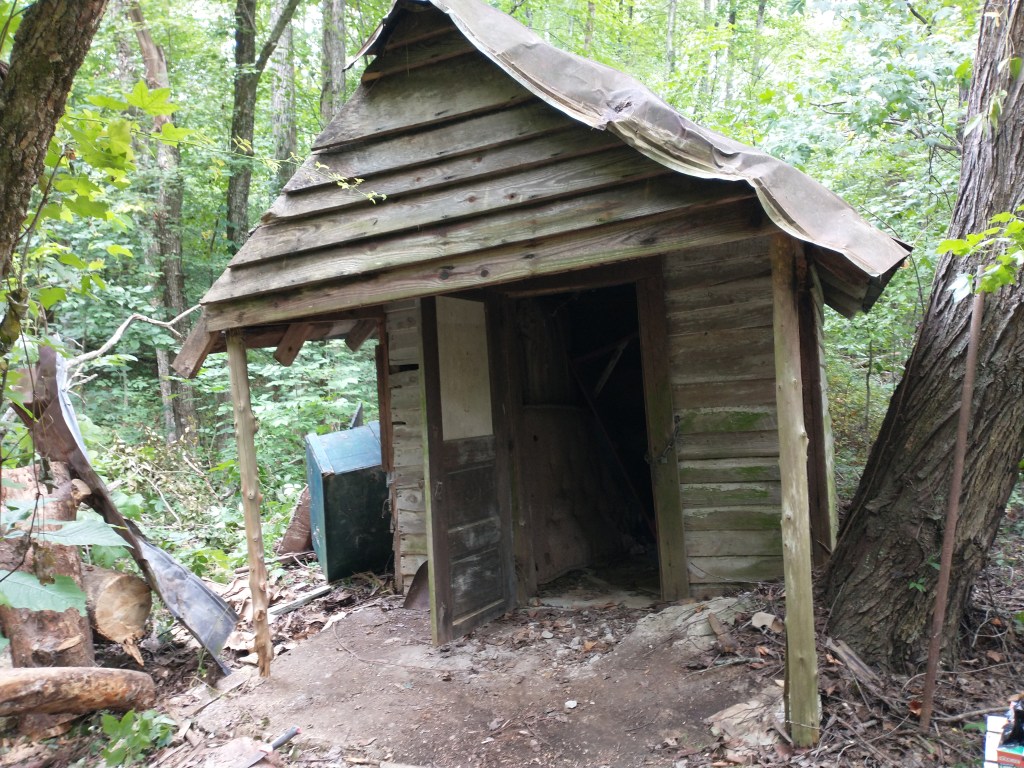
Jillian sent me a song yesterday which references the place from which I keypunch these words: Wagon Wheel by Old Crow Medicine Show. Have I said I cry a lot during this trip? Okay, so I’m going to embrace it just like I did with quiche in the eighties — bucking the trend that real men don’t eat it (or make it).
Anthony needed to cancel our plans to get together. I couldn’t get a refund on this motel room where we were going to stay one night—so I’m using it as a retreat from the retreat.
Johnson City is about two hours northeast from Corryton. It’s also the last town my dad had a full-time teaching gig in before retiring from East Tennessee State University. I never lived here but visited a number of times over the years, first when my parents were still together and lived in Jonesborough and then later when dad and Sharon were married and lived in Johnson City proper. (FYI, Jonesborough is the oldest town in Tennessee and where the National Storytelling Festival is held each year.)
The first place dad taught was Sewanee. You might remember that my family’s train was hitched to pop and his teaching jobs though I can’t say whose train we were hitched to within each town. (Moving six times in Denton still baffles me.)
I was born during rehearsal of dad’s first production—Desire Under the Elms, by Eugene O’Neill. We hadn’t moved the 21 miles from Winchester to Sewanee yet. Dad said I was often on stage in a bassinet during rehearsal—I suppose a place holder for the baby that is killed by his mother in O’Neill’s modern tragedy. (I’m not going to take it personal.)
Sewanee—The University of the South is a place of great privilege. I’ve often thought that living most of my initial three years there gave me the mistaken impression that I was part of a royal family living in a magic kingdom. Indeed some of our close family friends at the time were named the Royals. We lived on the campus of this wealthy, private, endowed institution with it’s beautiful, castle-like stone structures and impeccable lawns. Of the nine plays my dad directed at Sewanee six are period pieces and three depicted the inner workings of English royal court — King Lear by William Shakespeare, Henry IV by Pirandello and A Man for All Seasons by Robert Bolt. I was actually seeing people dressed up as royalty. Is it any wonder that (according to my mother) I acted like a little king and demanded things be brought to me and threw down my fork when I wasn’t happy with the fare?
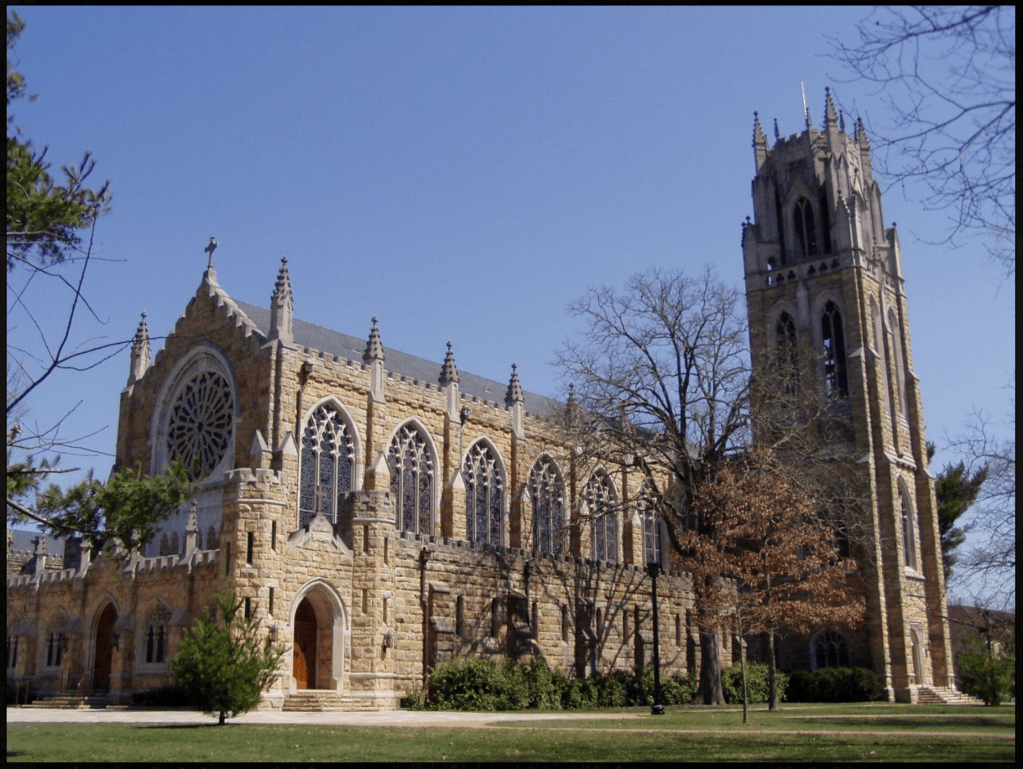
All Saint’s Chapel on Sewanee campus 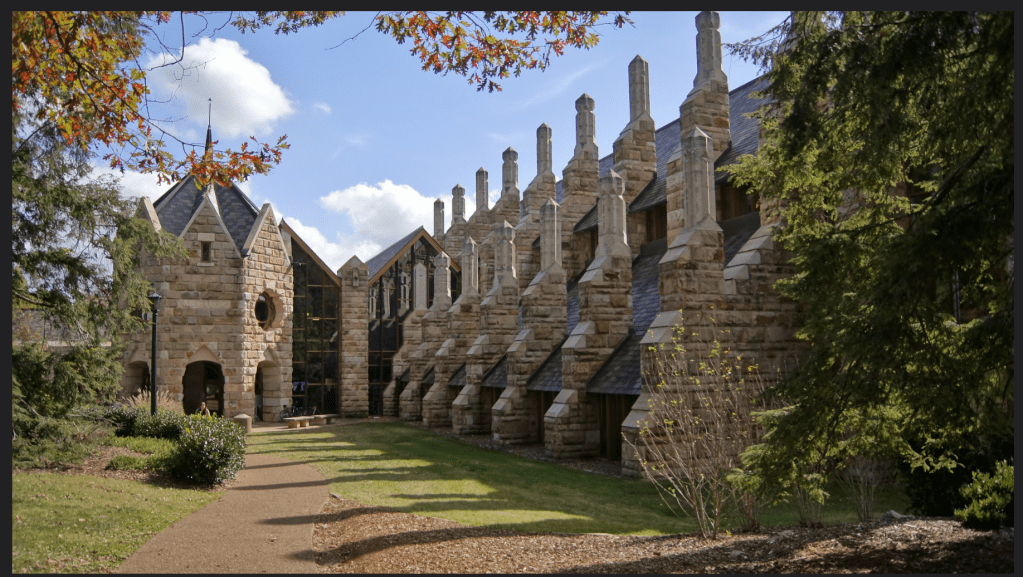
The McClurg Dining Hall is relatively new but in keeping with the gothic architecture of the campus.—both these pics were stolen from the web. Why do I bring this up now? Because along with race, this thing—privilege/entitlement—has been one of the biggest challenges in my life.
Anne Tyler, in her book, A Spool of Blue Thread, narrates the thoughts of the Whitshank family and relates how they believed they were different and more special than other families. The author suspects a lot of families have this somewhat deluded notion. I’m sure I did. I was steeped in entitlement. It may be the thing family’s do to mask all their failings, but for me it meant never feeling that I belonged. It meant always feeling like an outsider.
I think my father suffered from this as well and fought for much of his life to lose himself of those constraints. Perhaps this phenomenon is common for the children of University professors. You know, professors are supposed to be smart; they are supposed to be the ones who know. It can be a painful process reckoning with all the things you don’t.
I imagine dad bucked against the feeling of privilege and entitlement when he canceled his wedding planned with the daughter of another UT faculty in Knoxville four years before I was born. You have to like yourself to be with someone like yourself.
When he ran to his friend, my mother, I wonder if he was attracted to someone from a family less possessed of themselves—less attached to position and stature? This is not to say there was anything simple about my mom. She was, in a way, a creature that was self-invented. (When she was a teen my grandmother insisted she be part of some sort of debutant ball. I have newspaper clipping which shows all the girls but one in white dresses—my mom wearing black.)
But mom came from a small town, Winchester, compared to his Knoxville. She viewed life from the ground, not those gilded towers of higher education. Her mom was a second grade teacher. Her dad was a printer.
As I’ve said, dad often joked that he came from a long line of cold, distant and aloof people. They had lofty ideas about who they were in the world. I’d forgotten that the Robertson’s called their country retreat Halcyon Hills.
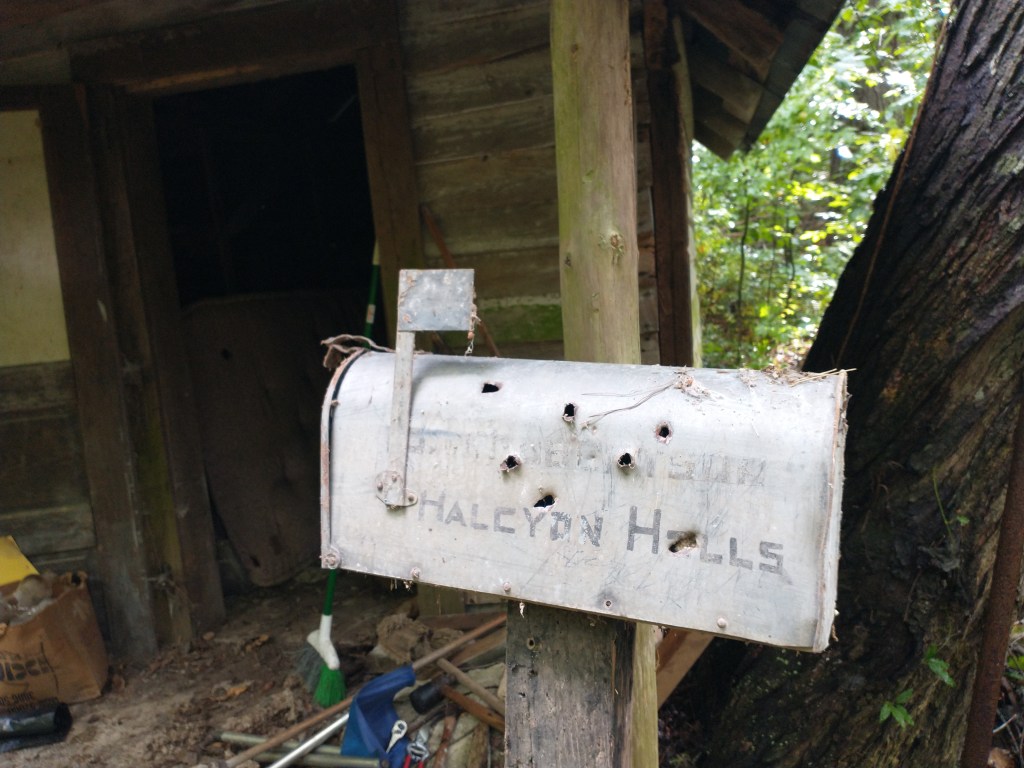
(I pulled this mailbox from the shed.)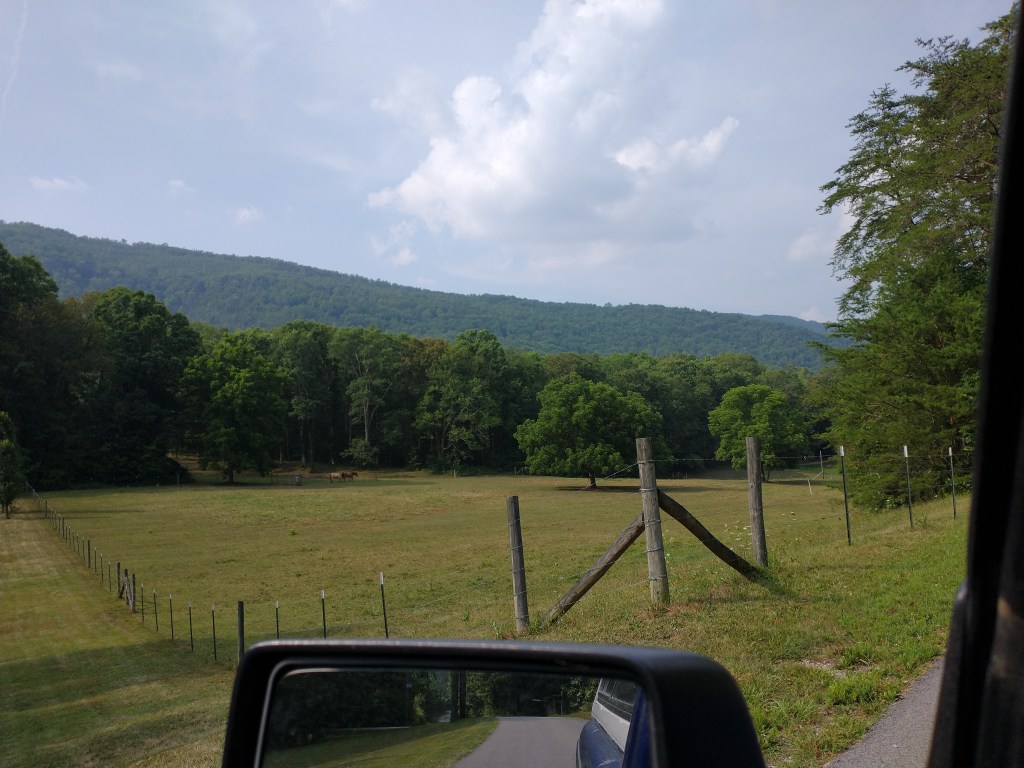
This field was part of the property attached to what was the old farm house where they stayed and enjoyed family time together in Blaine. It was sold by Grandma Robbie in the 1970s. Across from it is the 26-acre wooded parcel containing the shed and memorial stones. On one of their vacations out to the land, when dad was still a boy, he walked into a country store somewhere nearby and had the notion to mock the locals.
“I’d like an RC Cola and mooooon pie,” he said to the attendant in his best country accent.
Somehow one of his older brothers—he had a full brother and two half-brothers and a half-sister—found out about this and reprimanded him severely.
Dad always told this story for the humorous effect but his face would contort into a sheepish grin with the painful memory of trying to find his place in the world.
It’s a long process. I guess I’m still working on it.
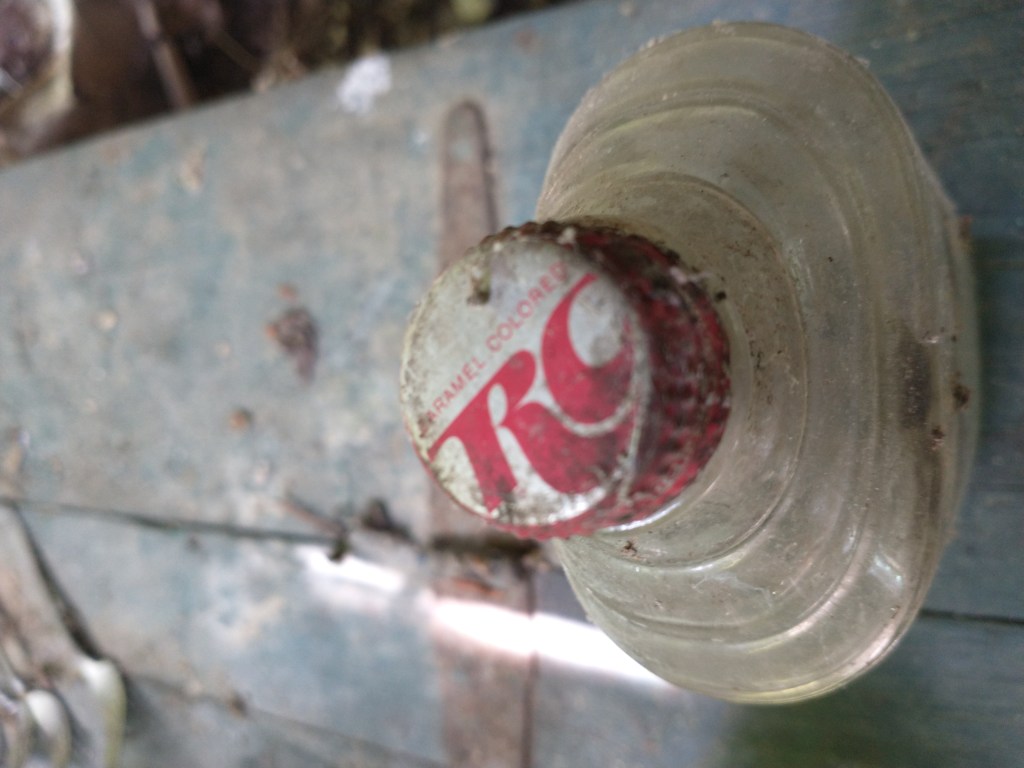
I found this old RC Cola bottle at the shed. It has a strange oval shape. 
Moon Pie’s are still made in Chattanooga, TN. 
It’s just a 20 minute drive on Emory Road and State Highway 11W from Corryton to the land in Blaine. The Clinch mountains seen in the distance are what the Blaine land in Poor Valley back up to. -
Days 37 and 38–Jasper, TN
July 23, 2021
I started doing some work on the land in Blaine—clearing a path to the granite markers that sit on a three acre portion of the land identified for tax purposes as a family cemetery. I’m not sure how long it would take for my relatives to fill a three acre cemetery, but there is no one I know on the Robertson side doing the procreation required for the opposite result.
I also started some work on making the shed useful again. I will pick my nephew Anthony up from a train station in southern West Virginia next week and bring him down to camp on this land and help with taming the wilderness—at least a little. The camping will be what is called primitive—no water and we will have to dig a pit toilet. There are cousins here in Jasper who have lent me a tent cabin which I may set up before Anthony arrives. (I’m in Jasper after attending Virginia’s funeral.)
Survival is its own occupation. Camping won’t be that extreme as I have access to a credit card and grocery store about five miles away. It’s really about making the land more hospitable. The seed of an idea germinated and began to grow as I picked my way through the forest knocking down spider webs and looking up at the tops of trees. I’ve begun to think about building a cabin here.
For all the joy the land brought to my father’s family in the 1940 and 50s, my father spoke discouragingly of the land that is left. My grandfather pieced together close to 200 acres of continuous land although in my search at the register of deeds I was only able to find the two parcels that are still owned by my family (Sharon specifically). There are 12 acres with the Sheridan cabin on one side of Poor Valley Road and 26 acres on the other side where the cemetery and shed are. The 12 acres are relatively flat with a gradual slope toward the road. The 26 acres are what my dad called knobby. The parts best suited for farming were sold off in the 1960s after my grandfather died.
“My mother was afraid I was going to start a commune on the land,” my dad used to say with equal parts whimsy and bitterness. He claims this was Grandma Robbie’s reason for selling off the land, but it was more likely that she just wanted cash to lay down as many of those granite slabs as she could and travel around the world a few times—which she did. Truth be told, the land was never considered good farm land and my dad was quick to admit as much.
“There is a reason this is called Poor Valley. You can’t grow much here,” my dad told me a number of times. He said Richland nearby, just like Poor Valley, has a reason for its name.
I don’t know enough about geography or soil science to know why, but it may be that Richland is rich because of its closer proximity to the Holston River. Grainger County tomatoes, which seem to have some level of fame in these parts, are grown there.
Beyond poor soil quality, the other thing I heard most mentioned about the land was that it’s snaky and full of ticks and poison ivy. The ticks I can confirm and the poison ivy may be the most prevalent ground cover.
Apparently copperheads and rattlesnakes abound too though in the four days I’ve spent exploring the woods I haven’t come across one…and part of what I was doing recently was clearing timber and logs on the ground where they would normally hide.
I don’t have much fear of rattlesnakes. All my encounters with them in the past involve hearing them before I see them. Copperheads are a different story though. One of the nearby land owners say they are more aggressive and hold their ground during encounters whereas rattlesnakes retreat. Both snakes have bites that are painful but rarely deadly.
What I fear more than either is ticks which can harbor pathogens. Five or six years ago Anthony and I visited the land with Sharon and Aunt Linda. There were bushes of lush raspberries along the road up to the Sheridan cabin and we got out of the car to pick some. We were not more than five minutes at this task. Before getting back in the car we did a tick check. I found nine on the outside of my clothes and Anthony found a similar number.
Aware of this, I dressed appropriately this time. My first three days of exploration I wore my blue rain jacket zipped to the neck with a bandana tied above it. I closed the velcro fasteners tightly around my wrists. Underneath I wore a long-sleeve shirt tucked into long pants and had the long pants tucked into rubber boots that I borrowed from Aunt Linda’s boyfriend Stewart. I topped my head with a ball-cap and sang the wonders of not seeing a single tick during any of those days.
But sealing myself up like that came at the price of being hot so, two days ago, when I did the log cutting work seen in the photos below, I chose to forego all the precautions.
I substituted the boots with my regular walking shoes. I tucked my pants into nothing—not even my socks. I wore a long sleeve t-shirt untucked without the jacket.
At the end of the day, after finally applying the Wet and Forget to the granite markers, I found two ticks crawling on me—one on my shirt and the other on my ribs when I lifted it.
When I got home and took off all my clothes for a more thorough check I found one that may have been attached but not completely burrowed on my back in a place that I could just barely reach.
At this point, a rather large dose of heebie jeebies took hold. I started feeling things crawling on me that weren’t there. I took a shower washing my hair and checking the crevices of my body where ticks are known to hide.
When I was done I dried off and went to my bed with my computer to check emails and catch up on the day’s news. A dark cloud began to form over the ideas that I’d begun to nurture about the land and building a small cabin for writerly retreats and nature studies in which I would learn every species of tree.
As an afterthought I began running my hand through my hair and checking the terrain of my scalp. Damn! Damn! Damn! I found a bump and knew immediately what it was—another damn tick! I pulled it off and went quickly to the bathroom where I put it in the sink, unfolded a blade from my Leatherman and chopped the tick in half as I’d done with the one before. Later I kicked myself for not taking a picture of it.
It’s been two days now. I have a red spot from the bite on my back which surprised me because it had come off without much effort. I’m watching it carefully and asking relatives to keep an eye on it too. My dream has had a good dose of realism burrow its way in (to use the obvious metaphor). Still, I’m not giving up on the little cabin idea. Knowledge is power! The next tick I see is going under the magnifying glass and you can bet I’ll be buttoned up tight for coming excursions to tame a small part of this little wilderness.
Here are some before pictures:
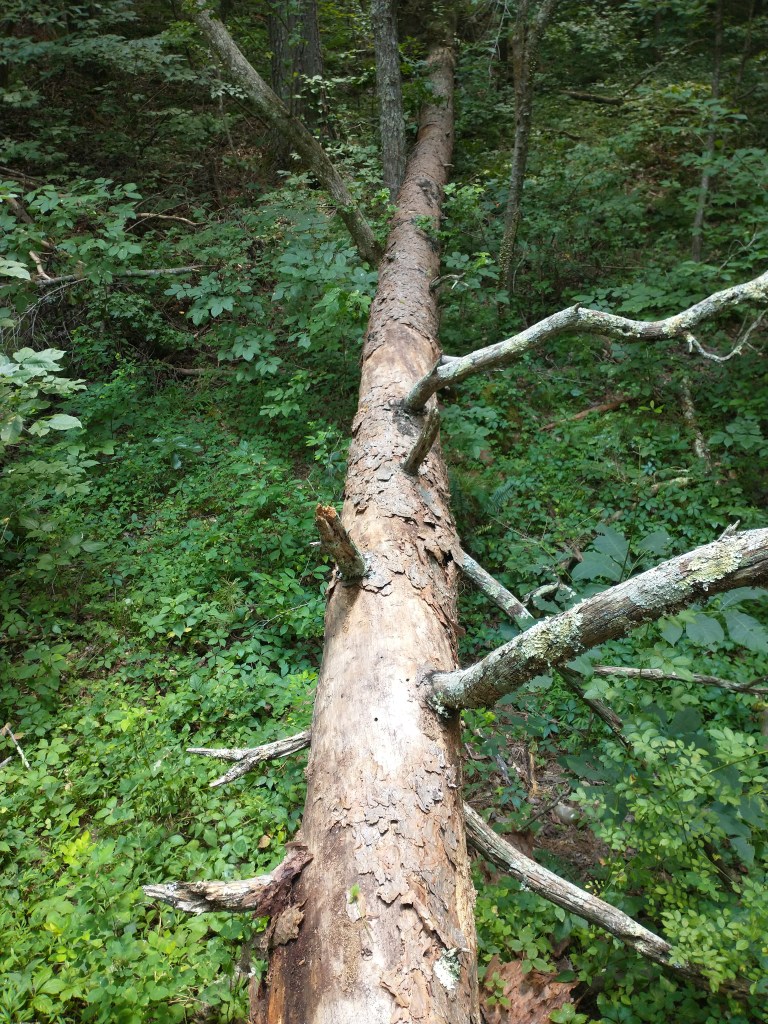
This large pine tree fell and made a natural bridge over a gulley to the shed. 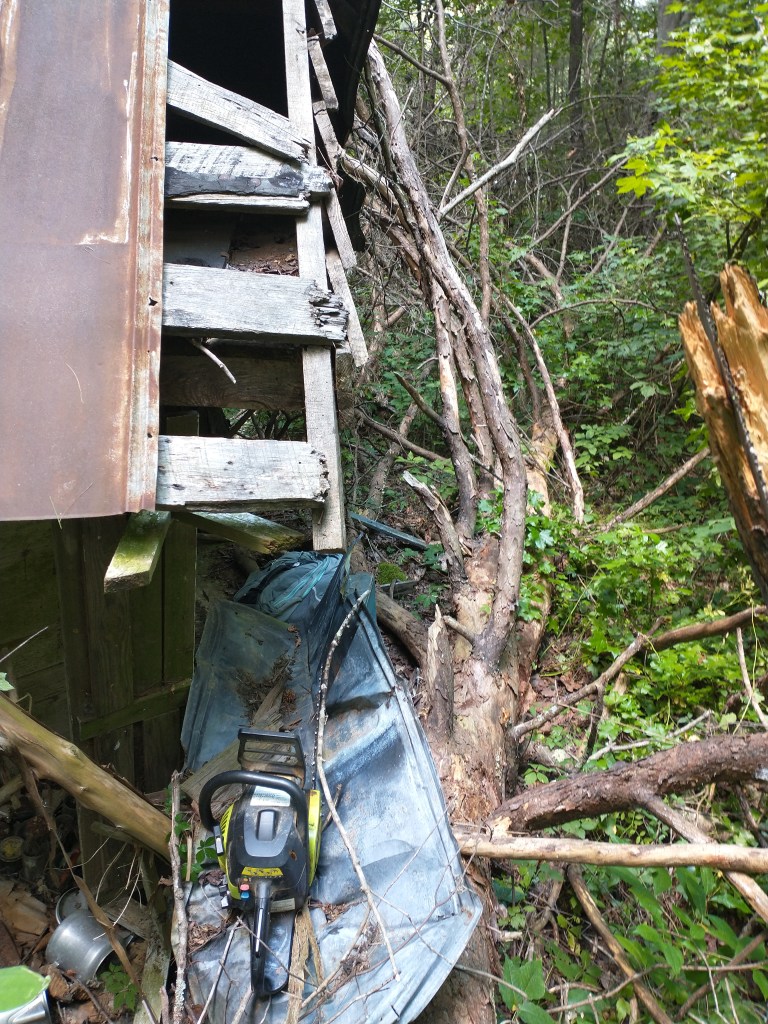
It also took out a porch, corner post and roof panel. Here are some front views:


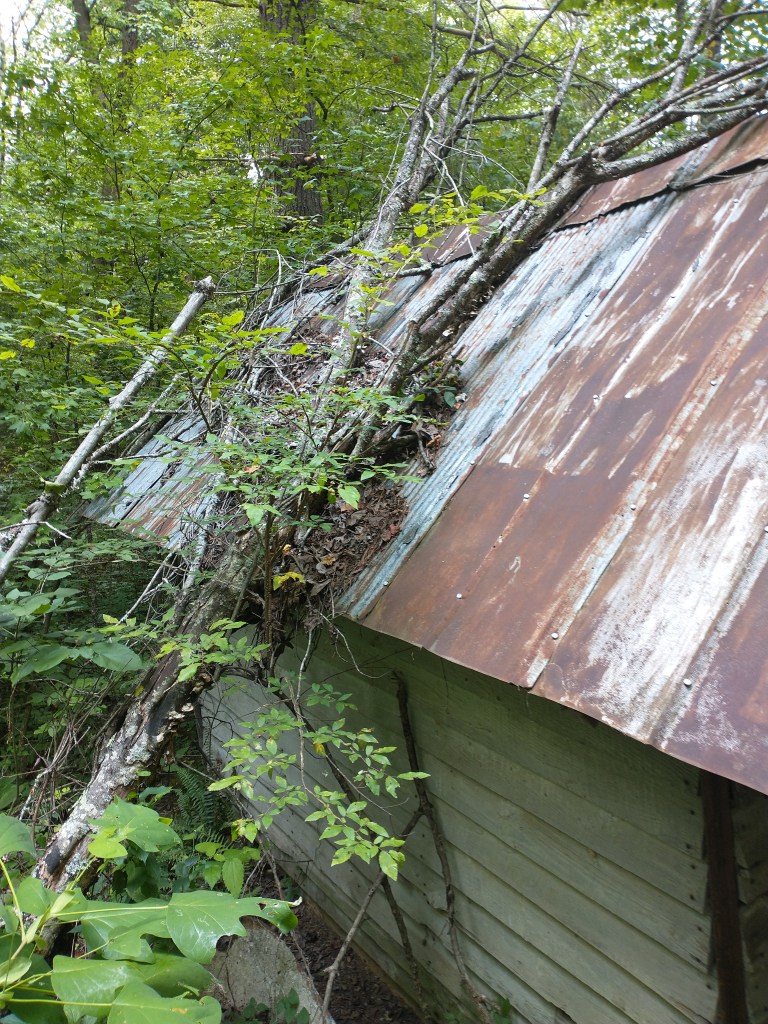
A small tree fell on the same side without damaging much. 
This was my first time using a gas chainsaw and it really made me feel like a lumberjack. Here are some after photos:

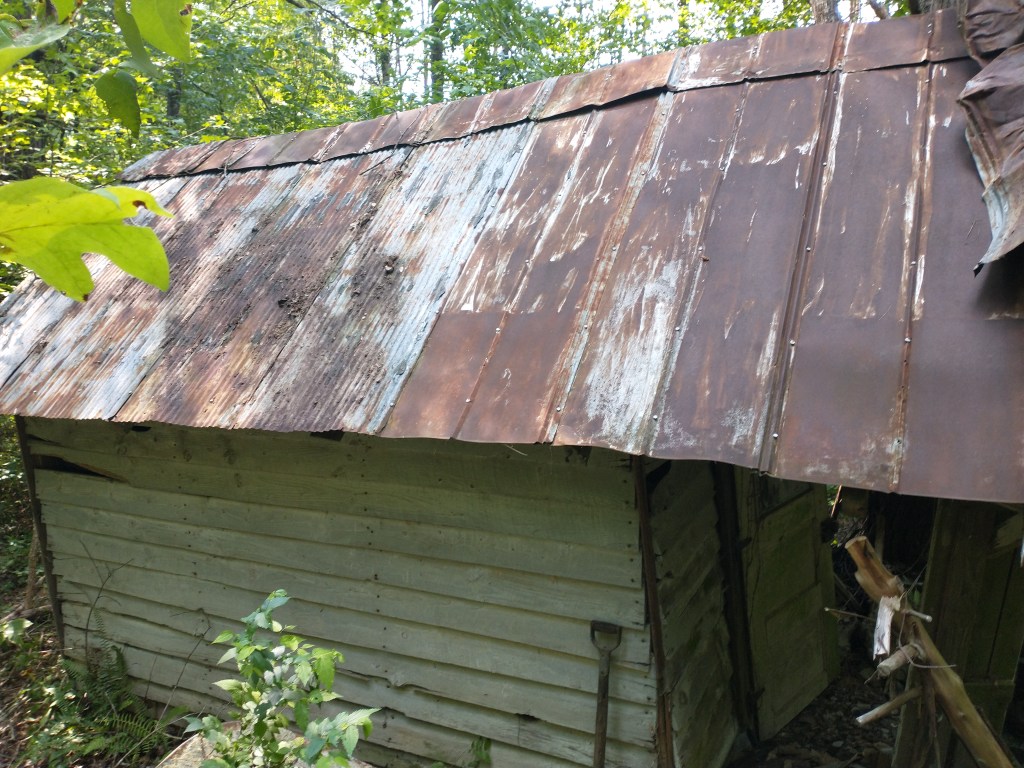
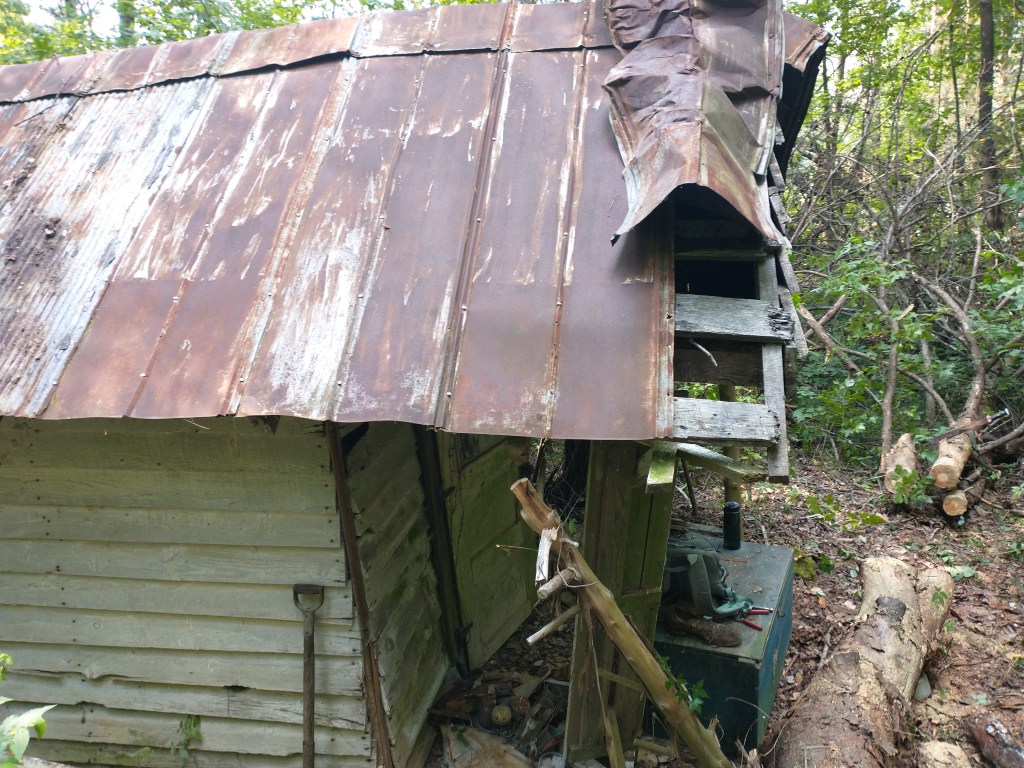
I need to flatten and reattach this piece of tin. 
The fallen pine snagged this sapling and pulled it over into an arch. I’m going to try to find a way to stake it or bury the top and see if it will continue as a living arch to the shed. 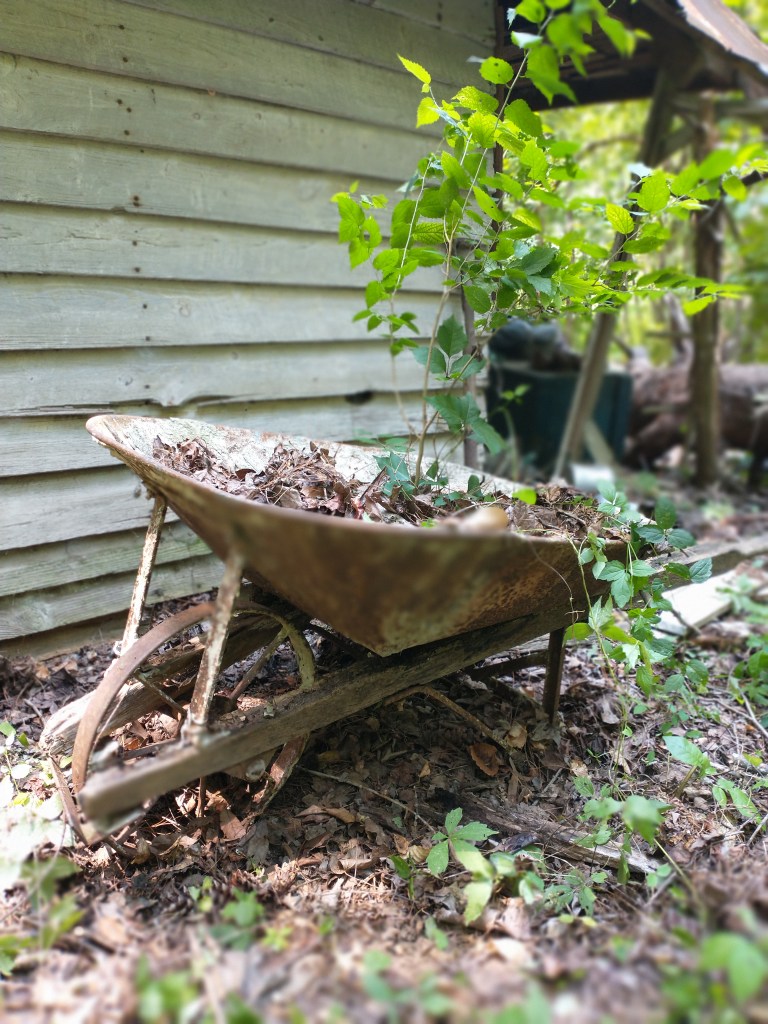
Are trees growing in old wheelbarrows a photographic cliché at this point? I still like them. 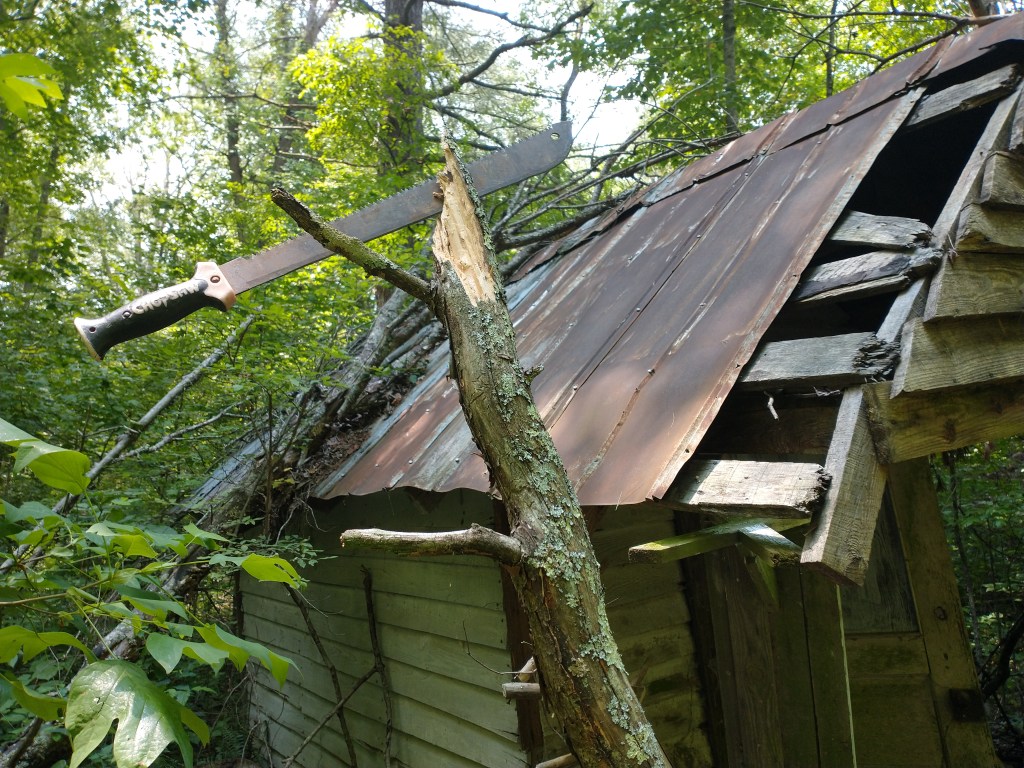
The machete is a good tool for path clearing. I’ve learned to chop at an angle—an effective method for removing trees and limbs up to 3/4 inch thick. 
Lest anyone think that Corryton, TN doesn’t have a decent beer selection, I submit evidence.
-
Subscribe
Subscribed
Already have a WordPress.com account? Log in now.
 Spotty West Goes East