-
Days 35 and 36–Corryton,TN
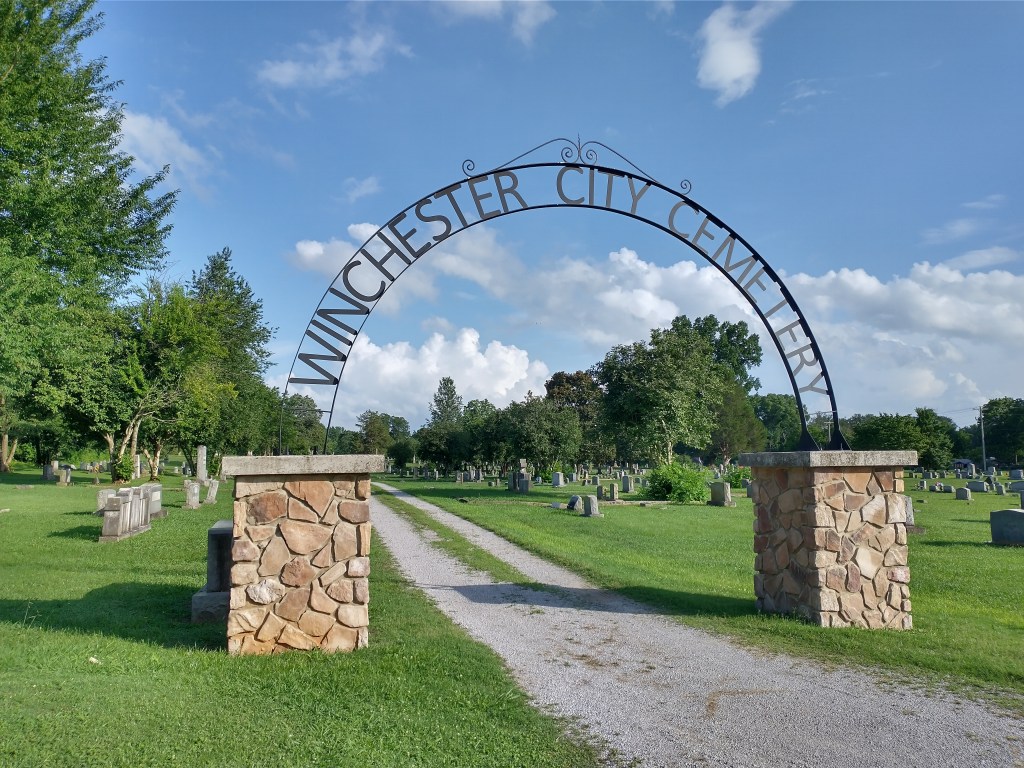
July 20, 2021
I’m up to my eyeballs here in tombstones—physical, literal, metaphorical, allegorical, you name it. Last night I watched “Five Guns to Tombstone” on this cowboy movie channel I’m a little hooked on. It was a C minus in acting but a solid B in plot. After that I couldn’t stick with, “The Toughest Gun in Tombstone”. It was taking its time to get up to speed. I turned it off after 15 minutes and went to bed.
Still, I wake up with tombstones. I have my mom’s here in the garage at my Aunt Linda’s. More accurately, it is a memorial stone.
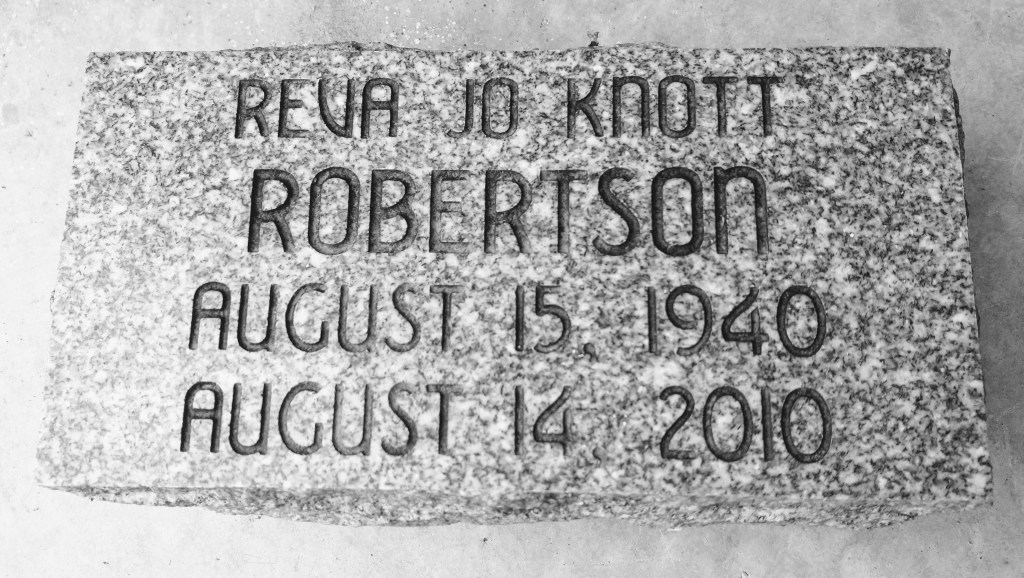
It’s my job to find something to do with it since it’s been displaced from the river house my Uncle John sold. I’ve put it upon myself to see if my mom’s partner of 14 years has a marker that I might be able to place it beside. I’ve left a message at the girl’s camp where Marrietta had connections stretching over 60 years, but my guess is there isn’t one. Granite markers are expensive and it’s usually only family that bothers with them. I’m not sure she had any family she was close too.
When I was in Winchester I washed my Grandma and Grandpa’s grave. After scrubbing away the first day I came back later and used a product called Wet and Forget which, supposedly, over time, eats away any moss and lichen and keeps the marker clean for a year or two. It takes it a while to do it’s job which is why my grandparents markers don’t look so clean.
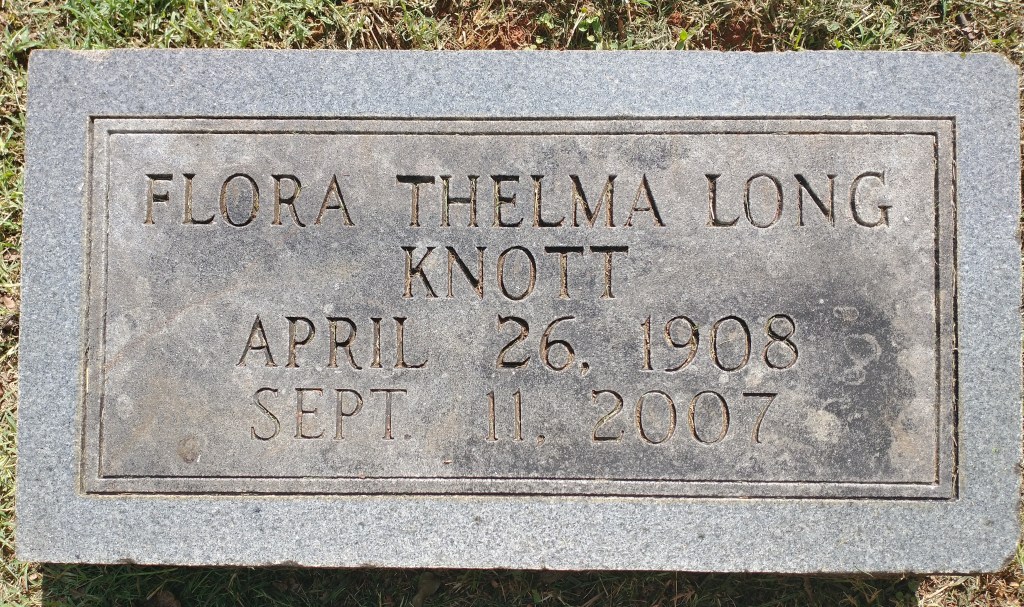
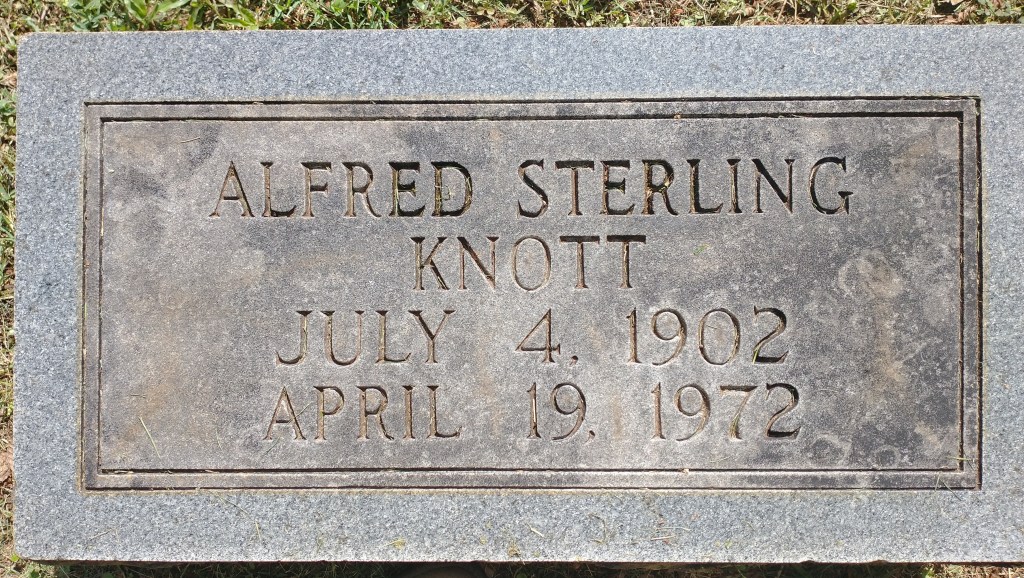
“I thought you would like moss and lichen,” Jillian said over the phone.
“I do, but I guess the point of a marker is for people to be able to read it,” I answered.
I was still of the mind set my cousin Chuck left me with at the Cracker Barrel when he told me that markers were useful for genealogist.
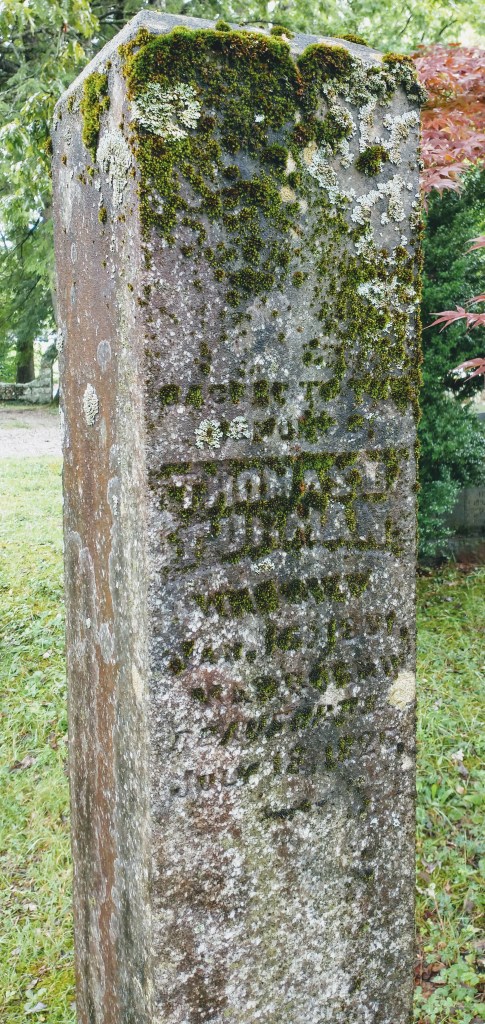
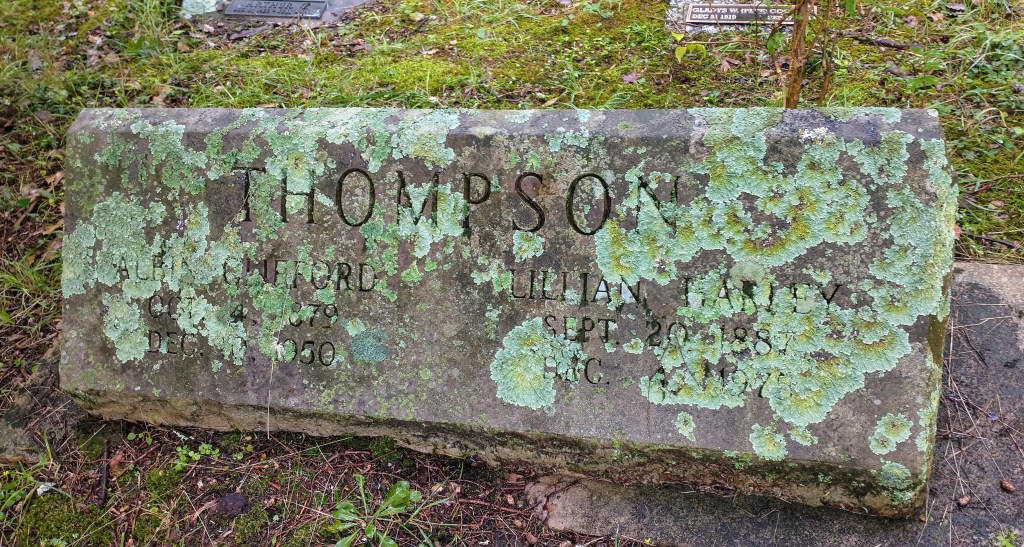
Jillian was right about my aesthetic though. I much prefer the natural look. Here are a few favorite markers I found walking through the University cemetery at Sewanee.


Then there are the three 4 x 7 foot slab markers out on the old Robertson land. They remain on my mind too. My Robertson grandfather, who I never met, bought a 25 acre tract of the land in Blaine, TN back in 1936. He paid $75 for it. He bought another 35 acre tract across the road in 1947 and paid $650. (I went to the county office to look up the deeds.)
When Judson Robertson died he was buried there because of all the good memories the family had on that land. A UT chemistry professor my dad’s family spent summers there, 25 miles from their home in Knoxville. Dad’s dad died at his last University graduation wearing his professorial cap and gown.He was retiring the next day. I have a picture of him somewhere mid-heart attack.
My genealogy-loving grandma Robbie put an enormous slab marker for him in the woods there and one for herself and son Clifton. Today I went back with the Wet and Forget. What still needs to be done is to decide whether or not to have her 1996 death date added to her marker.
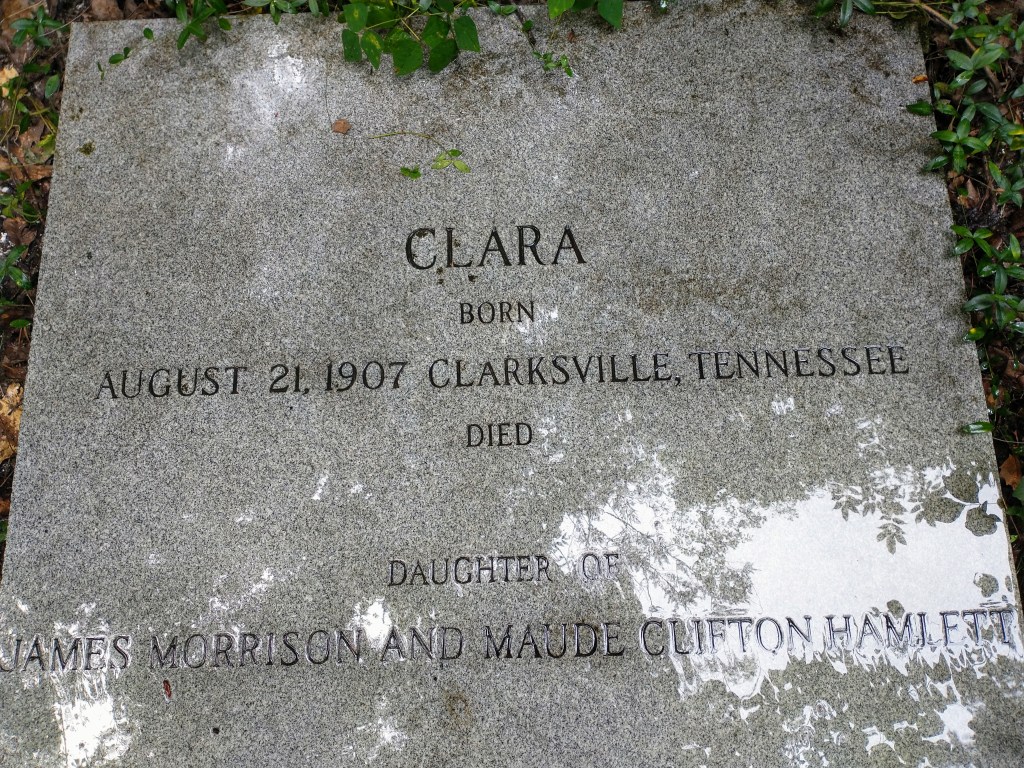
A preliminary inquiry of engraving looks like it will be around $2000 to get someone to trek through those woods and sandblast or chisel it into the granite. There isn’t nearby access to electricity, so they’ll have to haul a generator out there if sand blasting is the method to be used. My step-mom Sharon has offered to pay for this.
She also texted last night and asked if I think my dad should have a marker out there with them since he would be the only one of that nuclear family who didn’t.
“No, I don’t think so. Where would it end?” I texted back.
It’s a valid question I think and I guess the answer is when the last Robertson, Knott, Long, Rothwell, etc., drops dead—basically when climate change kills off the last human on this planet.
I suppose my interest in genealogy waxes and wanes. At the moment, adding more tombstones to the family legacy seems of dubious value. The whole point of this trip—to discover what I can about myself and what makes me who I am—seems to have little imperative since this rubber tramp has parked his wheels.
My cousin Bob lived the last of his days in Long Island New York before dying of Covid last February. He might have been able to guide me. Like my cousin Chuck, he was the one most interested in genealogy. In fact, on the Robertson side he was the only one I knew who gave two shucks about family history. I suppose I do, but he really did. He was even into finding family on those DNA websites. He’d actually go visit people he’d never met. He also visited all the slab markers my grandma Robbie spent the last of the Robertson fortune placing all over the Southeast.

(Granma Robbie’s verbosity, not being confined to the spoken word but also to those carved in granite, spent a small fortune on my Uncle Clifton’s marker. At today’s prices, the engraving alone would have cost around $30,000 at the going rate of $20/letter…and she did several of these rather wordy markers in other places.)
More importantly to me, Bob was the last living relative who really knew and loved my dad. He looked up to him like an older brother and could tell me stories about him—real stories not just genealogical relationship stories. We exchanged long emails together for more than twelve years after my father died in 2009.
When Bob died last February we were in the middle of a long email discussion that could have been subtitled, “Is our family crazy or do all families have this?” I was leaning toward the first while acknowledging that all families are touched by mental illness. Still we seemed to have more than our share—Bob’s branch in particular. His mother killed herself. His first wife killed herself and one of his two brothers killed himself. Then there is the rampant alcoholism. It was almost easier to name who wasn’t than who was. It seems to be part of our genetic code. It’s one of the reasons I never wanted to have kids.
When Bob died I was on a camping trip. He had included me in a group chat on Facebook but I wasn’t looking at Facebook much anymore. The chat explained that everyone in his household was sick with Covid. The next day he said he needed oxogen and couldn’t get any delivered and that he had terrible diarrhea. The next day, the one on which he died, there were no comments, only questions. I didn’t see any of this until it was too late.
What I got instead was a voice message from the only other person I’m in contact with on the Robertson side of the family. She said, “We closed on the house. By the way did you hear cousin Bob died?”
I was devastated. I didn’t know I contained such a well of tears. In fairness to my other cousin, she wasn’t aware that I had become so close to Bob. And WTF cousin Bob? Have you ever heard of calling an ambulance? I still don’t have the full story.
Anyway, tombstones…
I’ve actually thought of putting my mom’s marker in the Robertson family graveyard on the land in Blaine—so let’s see what that would look like: markers for my grandparents Judson and Clara (hers w/o a death date); a marker for my Uncle Clifton, their first son together; no marker for their second son—my dad; finally a small marker for their in-law, my mom, divorced from dad almost 20 years at the time of his death—maybe not such a good idea. Her tiny marker would also, physically, look like a foot note to the three giant slab. I do kind of like the absurdity of the whole idea though.
We scattered dad’s remaining ashes around the markers when Sharon and James were here and I think that is good enough for him. He’s already had his main wish fulfilled by Sharon. Theatre ham that he was, he wanted his ashes in an urn placed on the mantel piece for everyone to see and talk about along with a short poem he wrote. Sharon did him one better and put some of his ashes in three urns keeping one for herself, sending one to my sister and one to me. We don’t have a mantel at my house but we put him on a shelf.
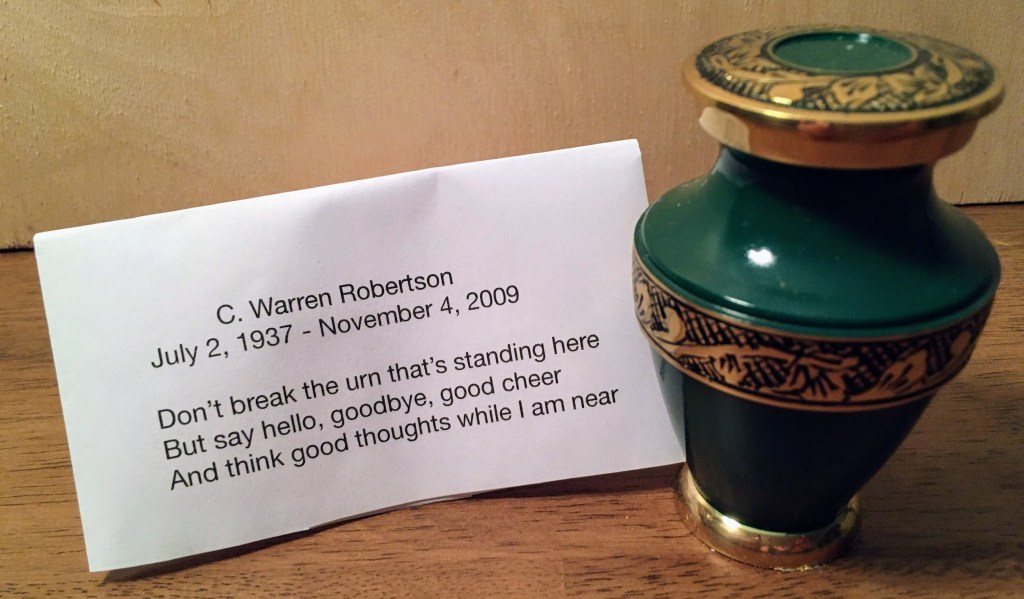
(Although dad’s isn’t a curse, he was inspired by the one Shakespeare wrote for his tomb. We had a framed rubbing of it in my childhood home(s). Shakespeare’s went “Good friend for Jesus sake forbear to dig the dust enclosed here, Bless be he who spares these stones and curse be he who moves my bones.”)
By the way, getting back to the topic of absurdism—it was one of my father’s favorite types of theatre. He loved Samuel Beckett and one of the first plays he directed at his first college teaching job at Sewanee was Rhinoceros by the absurdist Eugéne Ionesco.
My mom’s folks, dad’s in-laws, wanted to support pop’s efforts at his first big gig and a number of mom’s family regularly made the trip up the mountain from Jasper to see the plays he directed. My short, little Aunt Berniece was one of them. Aunt Linda, a young woman fresh out of college accompanied her to the Ionesco play. Aunt Linda reported to me the other day that coming out of the Rhinoceros production way back in 1966 Berniece said “That’s the most ridiculous thing I’ve seen in my life”.
Death, and how we memorialize it certainly seems to have a good dose of ridiculous mixed in with the serious. It just sometimes takes a while to get through the mourning to see it.
What I’ve suggested to Sharon is that instead of purchasing any more heavy slabs of granite that we instead start a family non-fungible token or NFT. This is as good as granite and quite possibly will outlast that hardest of rocks by millions of years (if there are any humans left by then). Also, because its digital, all kinds of information could be added to honor, explain, or celebrate the life of the deceased.
Here are a few people I could add to the blockchain:
Clara Hamlett Robertson
Died: June 19, 1996, Johnson City, TN
Robert Manning, Jr.
Died: February 28, 2021, Cedarhurst, NY
and of special note,
Virginia Powers
Died: July 21, 2021, Chattanooga, TN
Virginia, the grandmother of my cousins Kim and Trae passed away yesterday at 94 years old. She was a lovely lady. Virginia was one of ten Tennessee relatives that came to visit me at Christmas time in Berkeley, CA in 2007. We all bombed around northern California seeing the sights in a rented van with Celeste the Parking Goddess treating us very well. Virginia and my oldest living cousin Patsy, who is now 89, bunked together in a motel on University Avenue, near where I lived. By all signs Virginia and Patsy were the perfect roommates and could be seen giggling like teenagers everywhere we went, from Alcatraz and Fisherman’s Wharf to Napa and Muir Woods. One of our favorite non-touristy things was visiting tree sitters in a grove of old oaks on the UC Berkeley campus. Virginia will be sorely missed.
-
Day 34 – Corryton, TN
July 19, 2021
“But I have a black friend, I can’t be racist.”
This notion of course is absurd. Furthermore, it has been my position now for a long time that a person cannot grow up in a country with institutional, systemic racism and not be racist to some extent. Becoming unbrainwashed in the very system that has done the brainwashing is not an easy thing.
Still, I’ve always hated that quote (but I have a black friend) being thrown back in the faces of people who use it. Certainly it is naive, but I guess it’s because friendship is such a sacred thing I believe it should not be denigrated. Friendships are what we need.
One of the friends that read my post yesterday was a little stunned that I had not had a sleep over until 11th grade with Sande. I just want to clarify that for the sake of this travel project, race is one of my subjects and for that reason I chose to focus only on my friendships with those that are other-than-white during my nuclear family years. I’ll break from that a little today.
I have been blessed to have friends at many ages and accompanying sleep overs—including a deep though brief friendship with Mike in the 5th grade, Jeff in the 8th grade, and a longer friendship with the Davis brothers in 8th through 10th grade until a fist fight with the younger brother ended things. Funnily enough, it was a fist fight with the older brother in 8th grade math class that had begun our friendship.
There were other boys I had meaningful friendships with but without sleep overs—the same with girls. In fact, I did not see girls outside of school except at parties or school engagements. The fact that I didn’t have a friendship with a girl outside of school feels like something I could do a whole other travel log around. Certainly, gender would be a worthy topic.
But before I get too far afield of the far field I am already in, I want to go back to the Davis brothers—the ones whose friendship started with a fight and ended with one as well.
I drove by their old homestead when I was in Hattiesburg and cried. It appeared to be abandoned. The windows were boarded up and the front porch was missing a whole wall. A blue plastic tarp on part of the roof was weighted down with bricks. Seeing it in such disrepair tore something loose in me.
I’d spent many hours there with those brothers after school and sleeping over. Their dad often took us to buy a dozen glazed donuts on weekend mornings.
As I looked at the home I remembered the last time I was in it. I had been standing in the room just inside the door facing my friend whose face I suddenly resented and hated for reasons I won’t go into. Others were at home in the den watching tv. There was a smug expression on his face that made me sick and I snapped a fist into his mouth. He’d taken a moment to dab his fingers in the blood and then delicately lick his lip to taste it before pummeling me into blindness. The first few punches had me seeing stars before I managed to feel my way to a nearby lazyboy chair and stick my head into it while he continued to throw haymakers at the sides of my head. Soon the oldest of the four brothers pulled him off me.
Months later he came to my house trying to sell me an old coin of his mother’s. I couldn’t tell if it was a peace offering or if he was up to no good. I declined it and that was the end.
Seeing the house in such bad shape was so emotional I think because it was a visual representation of how our friendship had been left.
——————
If you have been following these semi-daily posts you may have noticed that there is one childhood home still left on the inventory. I’m not saving it for any particular reason other than it is the last home I visited during these travels. It also represents the most magical place I lived. If I’ve ever seemed to have a sense of entitlement, surely Sewanee, TN and the castellated and castled stone world of the University of the South has something to do with it.
I may have made promises to you that these entries would end when I had visited all my childhood homes, but I feel this story is still backlogged a bit. It may be that it doesn’t feel complete until I roll back into my driveway in Concord, CA toward the end of the first week of August. If you stick with me I will feel honored, but of course, there is no rush. It will all be available for later reading if you like or to throw in your email trash. It is what it is.
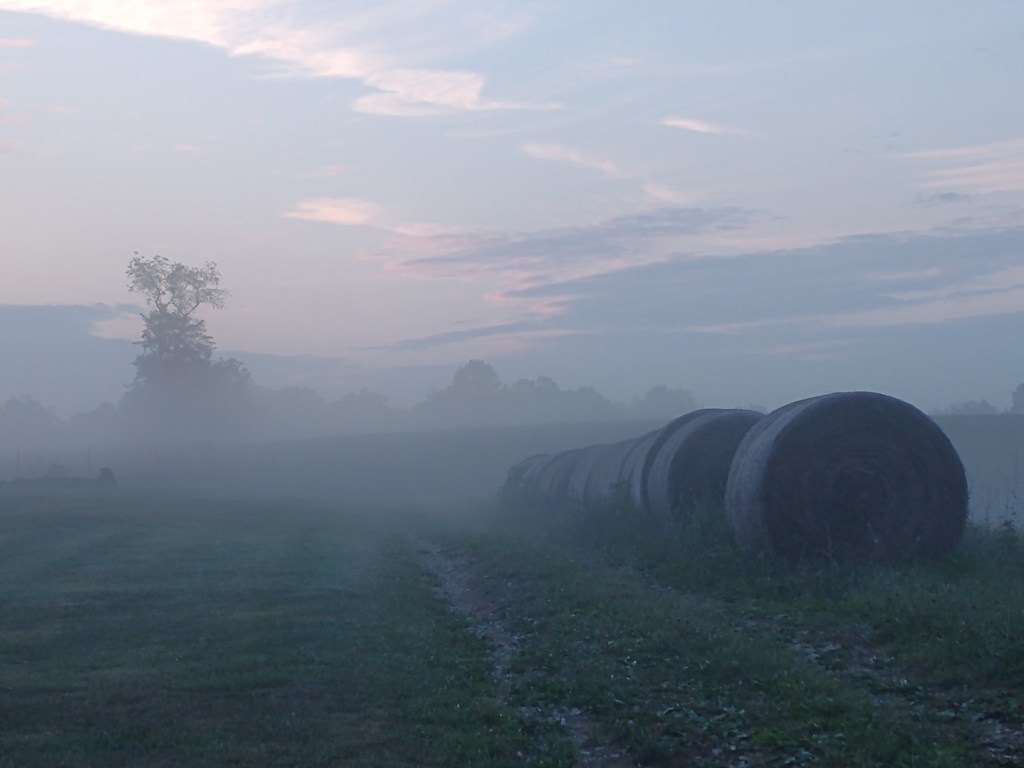
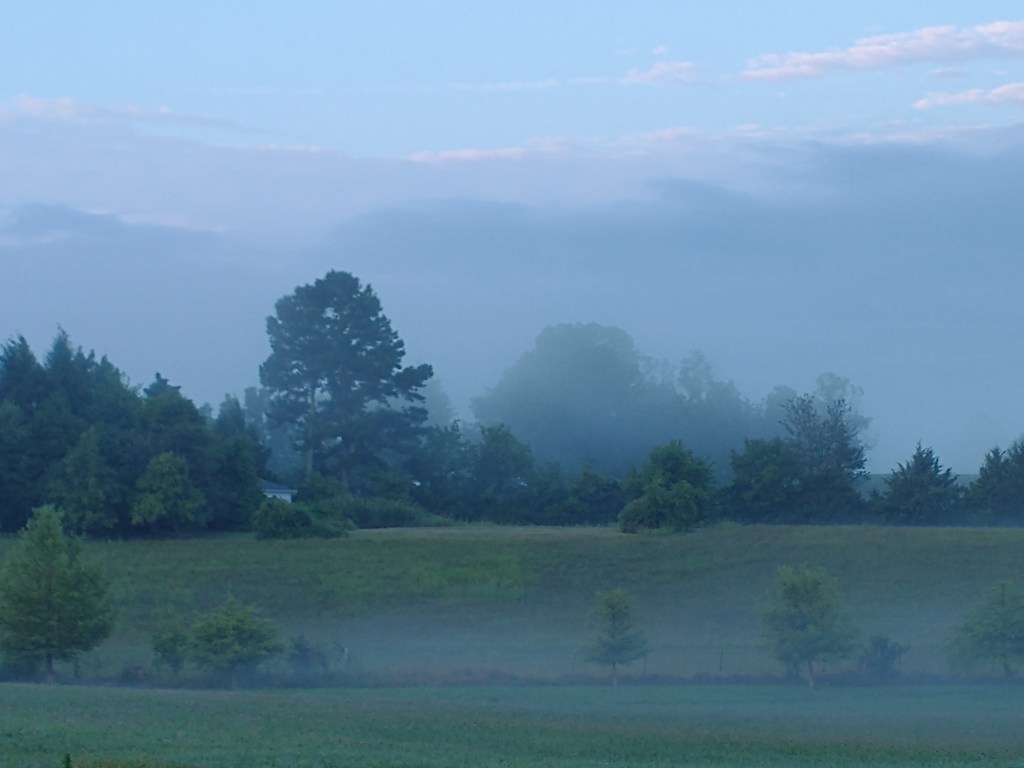
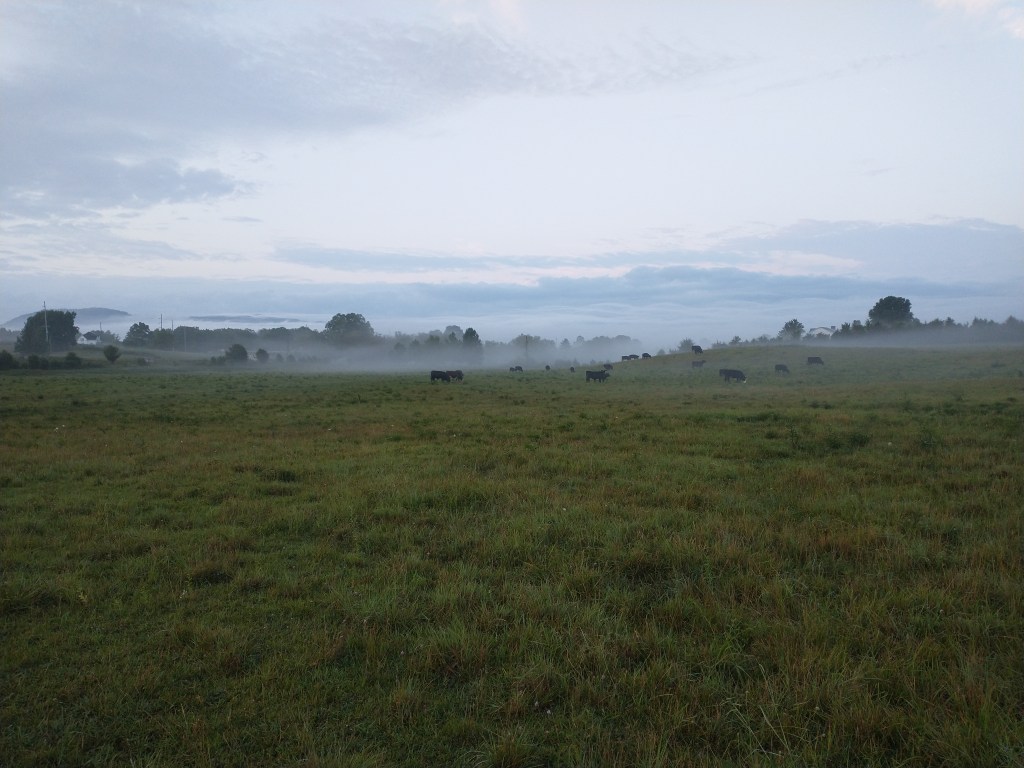
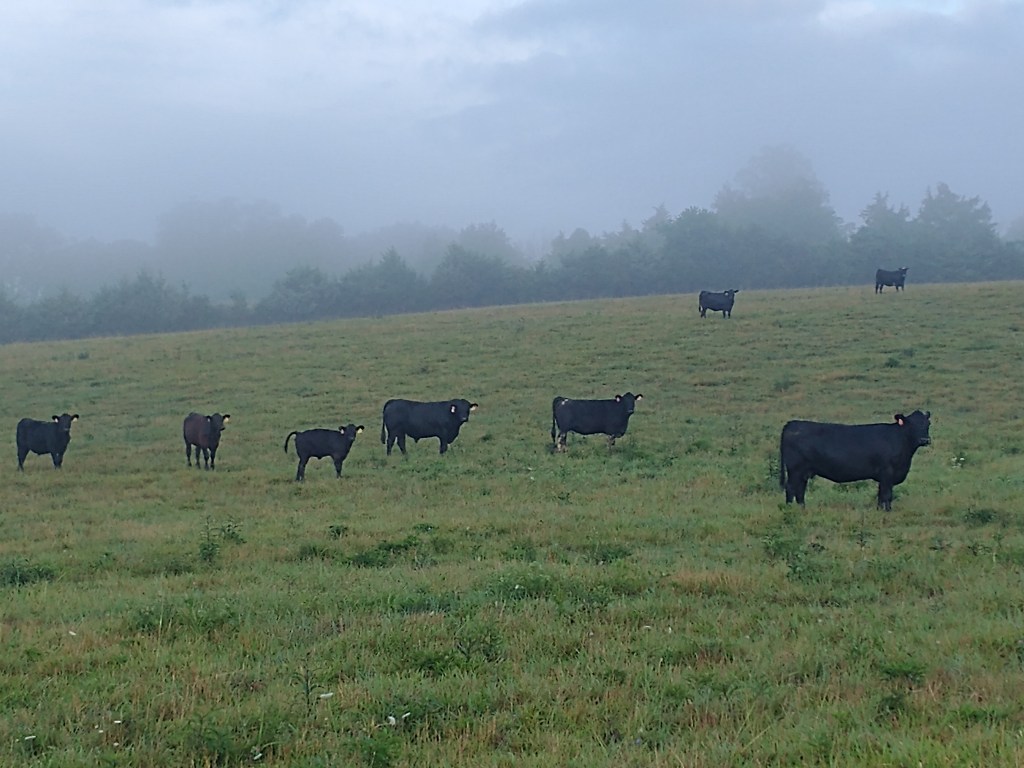
What it was in Corryton this morning was foggy and I’d like to share some pictures of the landscape surrounding this 55 and older condominium community. Sometimes I ask myself, “Do I have to go back?”



-
Day 33–Corryton, TN
July 18, 2021
I first heard the phrase Black Lives Matter identified as a movement in 2017 although, apparently, the phrase had already been around several years. I knew the organizers were on to something when I heard it.
For too long the anti police-violence movement tried to appeal to people with just a list of names and faces that were often times difficult to make a case for. A lot of supposedly upstanding white citizens, deep down, just didn’t have a problem with instant justice meted out by the police. When it came down to it, black lives just didn’t matter enough to dicker over whether accosting a store clerk and stealing a pack of cigarillos deserved an old west death sentence.
It’s why justice was denied for the murder of a teenage boy from up north who, way back in 1955, had the audacity to whistle at a white woman. The thought of him doing such a thing scraped a sulfur-tipped match across sandpaper and lit a bright flame of hatred in the heart of many white southerners. That hatred was stoked and encouraged to burn bright and long and remained undamped by the image of Emmet Till’s bloated body dragged like hanging meat from the Tallahatchie River. Provocation was provocation. After all if such behavior was allowed, where would it end?
Barack Obama picked a good title for his book when he chose The Audacity of Hope. Black folk, black men especially, were not allowed to have audacity. It was a rare thing and it was mostly only associated with bad things.
When I first moved to Mississippi my first friends were black boys my age—Emmet Till’s age. I was 13. My parent’s had bought that big house on Main Street which represented the dividing line between the races. Almost without exception everything on the south side of Main Street was white. Everything on the other side, on the north side of Main, across the railroad tracks, were black homes. This was the quarters–or Goula as Elijah called his old neighborhood.
I did not know until recently, talking to Elijah, that Hawkins Junior High had started out as a white school. The year he went there, 1967, was just the second year of integration in Hattiesburg. Elijah could have stayed at an all black school in the quarter but he believed he’d be better off at Hawkins. Already on the chunky side, he thought life would be easier there than at the all black middle school where he’d be mercilessly teased.
Ten years later, when I went to Hawkins, most of the white families had fled to the majority white junior high across town. Elijah had helped bring in the black kids that the whites ran from. Two long blocks from my house, Hawkins was now an 80% black majority and 20% white even though the neighborhood itself was still white.
There were no other races at Hawkins—no Asians (generically known as Chinese) or Latinos. If anyone had a race that was not black or white they hid it well.
Wait, I’m forgetting Regina! She arrived in the ninth grade from Venezuela. Tall, well-built and beautiful, she immediately had every teen age boy forgetting whatever derogatory name they’d ever heard concerning people south of the border. I have no idea what brought such an exotic teenager to Hattiesburg in 1978. But she was an exception.
Hawkins retained the mascot of the “Fighting Irish” though the football team was 90% black. The cheerleading team was opposite. There was one black girl on a squad of eight. Beauty, a requirement for cheerleaders, was still firmly entrenched as the domain of the white race.
Children can usually get away with being audacious—at least with each other. If they are confronted by it they can sometimes claim ignorance. Emmitt Till’s crime, committed among adults, was apparently too big for this.
One of the ways we black and white boys pushed the socially constructed, racial envelope, two decades after Till’s murder, was to play, what I’ve since heard called, the dozens.
Mostly it involved insulting someone else’s momma—as in “your mama is so ugly….” I was never very good at it and only made it through a round or two. I usually had to stop after my go-to insult which was, “That’s not what your mamma said last night when she came scratchin’ on my window.”
I came to Hattiesburg, friendless, the summer before eighth grade. I found a couple of boys to play basketball with soon after arriving in my neighborhood. After the first or second game one of the kids brazenly said the basketball was his and took it home. The next day I went to his house and he gave it back smiling, pleased, I think, that he had created this worry in a white boy.
One of my draws to entice kids to my house was telling them I had a pool table. I mentioned in an earlier write that I’d bought a regulation size, Sears Brunswick, table our last year in Texas. I saved up paper route money to get it. My generous parents shared space with it in the living room, with their bed, at the Londonderry Lane apartments. Now, in the big, old southern bungalow house on Main Street, it fit in my house-wide room at the back with enough space around it to make a short stick obsolete.
James was one of the kids I attracted with the lure of the pool table. He had an open, mischievous look in his eyes and a diagonal scar line that went across his thick, upper lip and pointed to a front tooth with a large chip. He usually held his mouth slightly open revealing the tooth. The corners of his mouth always looked ready to smile. I’d say he had a good dose of what my grandmother called “The Devil” in him. The Devil got in me fairly often too, so I knew the telltale signs.
James always came to our back door which I thought was strange, but my parents told me a lot of black folks had been taught that this is the way you came to a white person’s house.
It didn’t seem like a good way to go under the radar to me. James had to go through a gate in the back to get there. Coming to the front door would be far less suspicious.
I went to James’ house once. It wasn’t behind the railroad tracks but on a far side of town I’d never seen. We walked there in the heat of the day, the world quiet and different in the way it is when you are with a new friend.
His house was a small 12 by 18 foot box sitting on brick piers with a triangular roof. Steep wooden steps led to the door. It was the kind of house kids draw to represent “house” in Kindergarten. He lived with an aunt. It was dark inside and piled with furnishings and clothes. Nobody was home and we didn’t stay long. Mostly James came to me.
One day after some pool games James went over to my mirrored bureau. I followed him there and watched him look around then pick up my wallet.
“Give it back,” I said.
“No, this wallet is mine,” he said smiling.
“No, it’s not. Give it back!”
“What? This is mine,” he insisted playfully.
My mother passing through the hall must have heard the commotion.
“What’s going on?” she asked appearing in the doorway.
James stuck the wallet behind him. We both said nutin’ at the same time. When she left he handed it over and said he was just kidding. The next few times James came to my house I made some excuse not to play with him.
Another black kid came over enticed with the pool table. He even had dinner with my family one night. He had not bathed in a while and the smell elicited raised eyebrows among my family. Mom tried to make him feel comfortable as he drew into himself to eat. This kid was less openly devilish than James, but in private, he too seemed to play on some insecurity of mine which led to a less than satisfactory friendship.
This type of joking wasn’t something I could get used to. These kids were picking up on some inherent distrust on my part or playing on a stereotype they’d been labeled with. Either way, it was too much for me to deal with.
At some point while I was in junior high I made friends with a light-skinned, mixed race boy named Marcus who lived a few blocks away. He would joke with me but not in a way to make me feel uncomfortable. There was something more sophisticated in his humor—irony or sarcasm. I met his mother who was raising him by herself. He’d had a step-father that he told me a horrible, sad story about involving a kitten. I won’t share it because it still disturbs me.
Marcus was a Jehovah’s Witness. It was my first taste of this religion—or at least, he was the first representative of it that I met. Perhaps because I liked him, I have always had a willingness to engage with Witnesses. Eventually I came to believe that many of their ideas are ludicrous, but I always maintained a respect for the followers and knew they were on to something by the fact that, of all religions, they seemed to have the most mixed race congregation I knew of.
There was a time in San Francisco when I was a regular reader of their magazine, Awake. I’d get it from an African American woman who stood at my morning bus stop on the corner of Market and 8th where I’d wait in the dark to ride out to Hunter’s Point Naval Shipyard. I drove a truck delivering sandwiches from a company based out of a cooperative kitchen there. The woman’s greeting was always welcoming and we had many pleasant chats. I only took Awake from her which had practical articles and advice. Watchtower, the other JW magazine was evangelical and uninteresting to me.
While Marcus and I were friends—I’d even say confidants—we never had sleepovers or spent time going places together. We mostly hung out at school. Occasionally I’d drop by his house. I don’t think he ever came to mine.
Between fifth and tenth grade I had pretty much failed to grow. I was the shortest boy in 10th grade. That year I met the person that would become my best friend for the remainder of high school and my first year of college. Chris was gay but not out of the closet then. He was pasty white with red hair and not athletic at all. Despite being short I retained some pride in my own, largely unrecognized, athleticism.
Somehow Chris and I became good friends. He would call me “little boy” in a very disdainful way but it always ended with a twinkle in his eye that I picked up on and by eleventh grade I was regularly going to his upscale, middle class brick house where his sophisticated, older parents greeted me from the living room where they usually sat quietly reading.
His father who was then in his sixties had remarried late in life and had Chris and his younger brother. Chris’ mom, thin and a head taller than his father, had a stern look but a friendly enough smile. She wore women’s business suits and had her black hair in a tight bun that seemed to pull back her face and further accentuate her high cheek bones and thin cheeks.
The family drank out of short but wide glass tumblers instead of the tall, more narrow kitchen glasses typical at my house. I had often felt my family more sophisticated than other families I’d meet—if not in home decor, at least on an intellectual level. However, Chris’ family seemed to have us beat all around.
The “little boy” disdain he had for me must not have been all an act.
At around this time Chris introduced me to a friend who lived around the corner from him. Sande was the only African American kid I knew in Hattiesburg who lived in one of the modern, suburban neighborhoods beyond the center of town. His mother was a professor at the University of Southern Mississippi like my dad and also the dean of her department.
Sande was something of a boy wonder. He placed in the National Science fair for several years in a row. When I knew him he was building robots. He had a Hewlett Packard computer he’d won in his first national fair which he programmed to control a robotic arm he built. I’d watch the indecipherable green letters of code scroll upward on his HP as he did test runs on new commands.
He had milk-chocolate skin with tight, kinky hair. He wore glasses, had a high vocabulary and had earned his nerd card a thousand times over. But he was unique in that he was also socially adept. He didn’t act like or present as a nerd—just a put-together kid. As I got to know him more I learned he even had girlfriends!
The first time I hung out with Sande alone he asked if I’d like to spend the night. We were having a good time.
“Really?” I said with a level of enthusiasm that must have revealed my surprise and excitement.
“Why not?” Sande said. “I enjoy your company.”
I had never had someone be so frank with me and reveal that they liked me. It was an eye opening experience. In retrospect, maybe it was the way his scientific brain worked. Cause and effect; like and hang out. It struck me as rather revolutionary that a person could actually have enough confidence in himself to say what he felt! My normal experience with testosterone driven boys my age was to keep all feelings hidden and only share tough thoughts. Sande and Chris were a shift for me toward a kinder, more thoughtful world. Not surprisingly I suddenly started caring more about school and my grades started a sudden steep incline.
Sande quickly became my other best friend. Sometimes the three of us hung out together although mostly we were one on one. One of my favorite pictures is the three of us hanging out on my big front porch in Hattiesburg. We all are laughing and at ease and I must be in my senior year of high school or just beginning University for I am as tall as Chris and Sande and there is no way Chris could call me little boy anymore.
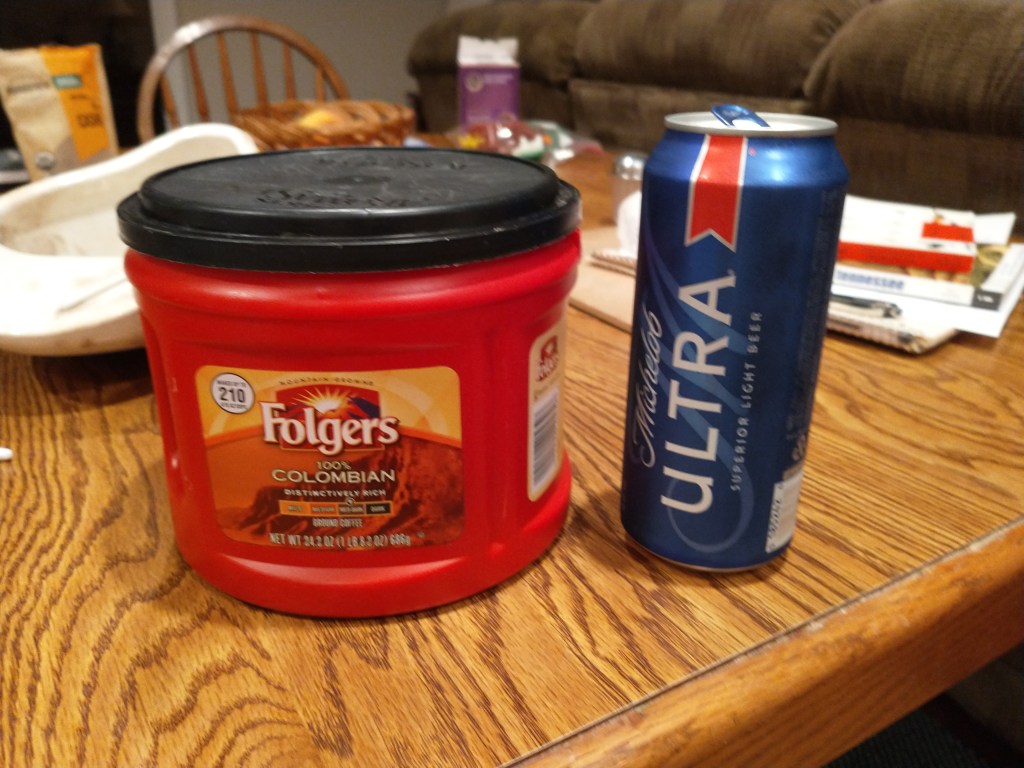
My tastes in gourmet coffees and craft beers are becoming simpler here in Corryton. Sometimes I really do feel like saying, “It’s not all that.” -
Days 31 and 32–Corryton, TN
July 17, 2021
I’m back in Corryton taking a short break from the writing while my step mom is here visiting from Raleigh, NC with her husband James.
I left Winchester Thursday and stayed over in Jasper with cousins. On my way out on Friday I stopped at the house of my mom’s oldest living cousin, Patsy. She is 89 and lives on the hill, which is what we always called the homestead in Jasper where Aunt Bernice and Uncle Hoyle, her parents, lived during the era of big family gatherings.
Aunt Bernice, the oldest of grandma’s ten siblings, was the main yardstick for my growth as a youth. She was short, my same height for many years and whenever I arrived at her door she would give me a big hug which was very much like hugging a big feather pillow. She smelled of the earth and the pillow, the old house and everything that grew there.
“My goodness you are shooting up like a pole bean,” she’d say. She knew a lot about pole beans because she always grew them in the garden with tomatoes and okra, corn and whatever else you can think of. In back was a sunken, cool, house for keeping row upon row of quart mason jars of canned vegetables.
I remember my stages of growth based on Aunt Bernice: looking up to her, being eye to eye (my favorite because I could really see the love) and then towering over her. Uncle Hoyle was 6’2’’. Next to her 4’8” they were an interesting looking couple.
When I arrived at their house on the hill I would sometimes see Uncle Hoyle in the field plowing with two mules that he walked behind in his blue overalls. Uncle Hoyle smelled of and chewed Red Ox tobacco which he cut from a coil. I had a hard time understanding anything he said except “Come over here boy,” which sounded like “Cumor hur boa.” His lips barely moved when he spoke. The words were a mule-talking mystery to me. I was afraid of him. I remember he once put me on his tall knee after I “came over there” and I immediately squirmed and slid down.
Mom gave him blanket permission to whip my butt if I started being a bad boy and so I always gave him a wide berth. He never did give me a whippin’ but he did once get up from the slider on the front porch, walk down under the big, shade tree and say, “Cumor hur boa”.
I’m not sure what kind of nonsense I’d been involved in, but it must have been annoying to a man who moved with the slow deliberation of early shudder photographs meant to show human motion.
He pointed to a limb high above my head and said, “See that limb?”.
I was aided in understanding him by the fact that it was a short sentence and he was pointing directly at the object. I nodded yes.
“Grab a hold of it,” he said.
He lifted my little body above his head. I grabbed the limb. Then he let go and walked away. The ground was very far below.

This all that is left of the tree where I was left to ponder distance and gravity. Correction: The favorite tree I showed in my post two days ago is a redbud not a rosebud. Specifically, it is called a Rising Sun Redbud.
-
Day 30–Estill Springs, TN—five miles outside Winchester
July 15, 2021
There was a spider incursion last night…oh, and another visit from a police officer—the third now. As for the spiders they were like daddy longlegs but not as big and their bodies, instead of being pea shaped were more like husks of rice. I had just laid back with my headlamp on and looked up on the ceiling and there were about five. Then when I started looking around I saw about 20 more and some little ones of a different species. It took a while to get them out as they could drop on a thread or run fast and I was trying to gather them with a hand towel and flick them out the back window. Of course, after re-securing my camper and thinking I was rid of them I found more. Oh well. Sleep with the spiders.
I’m leaving Winchester today but as is the case with most of the places I’ve visited the thread is pulled tight and the material of stories are bunched. It will be difficult to smooth them down and give them the time and space they deserve.
I suppose it was my intention to leave a cliff hanger the other day as a friend pointed out when she sent me a simple email that went like this: Dun dun duuunnnn. I can only blame too many forensic files back in Corryton. Now it simply seems like too much work to keep the cliff hanger going.
Yes, I was visited by the police here two nights ago. Yes, there was another incident in the cemetery when I first arrived. And yes, I was awakened again last night at 12:30 a.m. by a police officer in the same city park. But if that is all you knew…and that I had run into a large, new confederate memorial in my grandmother’s cemetery you would have a skewed view of my hometown and might be apt to have conspiracy theories about proud boys, the KKK and other fringe groups…just as I courted earlier in the week.
I wanted to keep the fear narrative going because fear is the expectation I ran into so much in the past when I talked with people in college (and later in life) who had never visited the South and probably weren’t going to because of everything they’d heard. I wanted to keep that fear idea going because I wanted to lambast that expectation into oblivion which all my other interactions were showing me was the right thing to do. Then I was visited by the police again last night.
Okay, that deserves another Dun dun duuunnnn…….
I was just beginning to fall off to sleep when I heard car wheels churn in the gravel near my truck. The wheels stopped and I heard a car door shut and footsteps. A flashlight moved across the curtains which I had chosen to close after the incident from the previous night. I heard the scratchy break of a police radio and indistinguishable jabber. The light explored the curtains further looking for a gap. Then I heard the scratchy radio go silent and a thick southern voice just outside my window screen—“There doesn’t appear to be anyone here….”
“Hello!” I called out before anymore theorizing could get thrown about.
If I was incredulous the night before I was honestly worried this time. Two nights in a row!!! What the hell was the problem with these people? Is the safety patrol the wake patrol?
“I have a camping permit hanging from my rear view!” I called with a bit of exasperation.
“Did you know your two doors are wide open?” the officer said back to me.
I peaked out the window to the drivers side then popped across the mattress to look out the window to the other.
“Oh my god!” I called out. “I am such an idiot!”
It was also an exhalation of relief. There was a reason for the officer to be here and this time it was my fault!
I find it funny that the picture I posted yesterday of the permit tag on my rearview also shows the state I left my truck in last night when I climbed in the shell to go to bed. A whole day had passed of writing at two different locations, taking pictures, and searching for the last house on my list. But the picture the police officer saw sometime after midnight, in the darkness of a thin waxing moon, appeared as something possibly sinister.
“We’ve had cars abandoned down here” he said. “I just spent the last half hour searching the perimeter. When you come across a vehicle with both doors open you wonder where the occupants went.”
Wow! A cop that explains things before he starts in on the third degree! That’s different. I immediately felt like this was someone I could talk to and I began to explain myself and what I was doing in Winchester searching for home and how much I wanted to defend what I loved about the South.
“Yes, I’ve tried to fight that narrative myself,” Greg said with his thick southern voice. “What you’re doing is good because you’re telling the truth about what you see. We need more of that message getting out. There are too many who try to sensationalize things. But the truth is also that there still are things to fear.”
I was speaking to the police officer through the screen of the open window on my truck. Several times I had to add pillows under my arm to get comfortable. We were alone. He had an automatic handgun on his holster, a yellow stun gun closer to his chest and who knows what other apparatus on his work belt. The bulk of several box-like soft structures made a shelf where he sometimes rested his arms.
“The Ku Klux Klan burned a cross in my mothers yard just back in 2002 when she befriended a black man where she worked. Her friend said he wouldn’t step foot in her town because the stars and bars were flying right at the entrance. She convinced him it wasn’t like that, then, when he finally did come to visit, the next night she had a cross burning in her front yard.”
Greg is a handsome, mid-thirties man with narrow unframed window glasses which he would occasionally adjust with two fingers at the temple. I would have guessed he was in his twenties but when I did the math it added up to more. He was a former marine stationed in southern California fifteen years ago. He had not seen a same sex couple until then. He had not had a black friend until he joined the marines. Now, he was not only a cop, but a trainer of cops.
We talked about the repercussions of the George Floyd case which he had followed closely. His police department now has a duty to intervene policy after Governor Lee recommended departments review their procedures. The Republican governor introduced the duty to intervene idea just a month after the George Floyd incident. It is now required in many large Tennessee metropolises and state agencies for officers to intervene when they see a fellow cop engaged in an unreasonable use of force.
Greg brought up the Rodney King case also. He had watched the recording —that was likely made around the time he was in Kindergarten—numerous times. He talked about how there is a moment on the flickering VHS when another police officer walks toward the scene, stops, sees what is going on and quietly backs out of the frame. Greg says that guy knew he could be held responsible for what was happening.
I told him about my participation in the Rodney King protests that turned into a riot in San Francisco. I was standing at the window of Layne’s Jewelry on Market Street when the plate glass was smashed and gold watches and jewels were flung everywhere on the sidewalk for the taking.
I told him how at the top of Knob Hill a long white limousine had been overrun by the crowd. People were on top of it stomping on the roof. I was at the back door when an African American youth, barely a teenager, pulled open the door and started reaching for a white man with impeccably coiffed hair and a picnic basket on the floor behind the passenger seat. The man was stomping on the basket to get to the opposite side as the teen reached for him with a gleeful look in his eyes.
I put my hand on the teens arm and said, “Hey man, what are you doing?”
It was enough to wake him from whatever dark fantasy he had fallen into.
“See that would never happen in Tennessee,” Greg said. “Too many people carry guns. No one would try that here.”
It was an endorsement of firearms and then he said a few more favorable things before adding that the permissiveness of firearms in the South also made it the most likely place for an officer to be killed. Then he lamented that the constitutional carry law just went into effect July first in Tennessee. That law allows anyone in the state to carry a firearm without a permit. He said that before this law, he could stop anyone carrying a fire arm and ask to see their permit and if they didn’t have one it gave him permission to do a further search. Now he is not legally able to do that and bank robbers and murderers can openly carry guns.
“We got a call the first day constitutional carry became law. A man had walked in to the Dollar General with three guns strapped to him. Now who needs that. He was just doing it because he could. We went there, but we couldn’t do anything about it. We couldn’t even question him. That’s his right now.”
“People have this idea that everything should be like it was during the wild west,” he continued. “But these are different times. Back then if someone stole your possession it might be months before you could get another of whatever it was. There were harsher punishments for a reason. It was about survival.”
Our conversation continued ranging from affordable housing, the role of police in community policing and ultimately what we wished for the world. It was over an hour before we were done.
I started to get the idea that Estill Springs wasn’t as rough as the cases of prostitution, drug dealing and car theft might have led me to think. If he hadn’t been whisked away on a call by then, things couldn’t be that bad.
Greg said he hated the confederate flag.
“It represents nothing but hate and violence. It’s the same thing as people flying the Nazi flag,” he said.
“Yeah,” I said, “and it seems to me there are so many better ways to celebrate your history if that’s what you want to do.”
“Most of the people who fly it don’t even know who in their family fought in the war or which great, great, grandfather it was.”
Greg made some interesting points about the confederate flag and its use as a military flag. As a former marine he had a different perspective.
“As wrong as that flag is I can understand how it might fit in with a military cemetery. It’s the flag that was draped over those people’s coffins.”
At some point earlier in the conversation I had asked if there was an African American officer on his police force.
“Yes there is,” he said.
“I just wanted to confirm,” I said. “It was a black man who shined the light in my eyes and wouldn’t take it down until his partner finally saw my permit.”
This fact I was going to keep from you, dear reader, while I played out my little cliff hanger, because as my mind had started to work a little conspiracy theory earlier in the week about colluding police forces, unnamed white nationalist groups, and community spies, it was not until I saw that it was a black man that shined the light in my eyes that I pretty much gave up that idea.
The flashlight shining officer had a very country voice with zero black patois and when for the briefest moment his light had gone across his right arm I was able to relax a bit—even though I hated the way he handled the situation. My already dubious mind just couldn’t go the distance of a black officer conspiring with white nationalist, although in this world, anything is possible and it has probably happened.
I’m just not important enough for anyone to bother with that kind of thing.
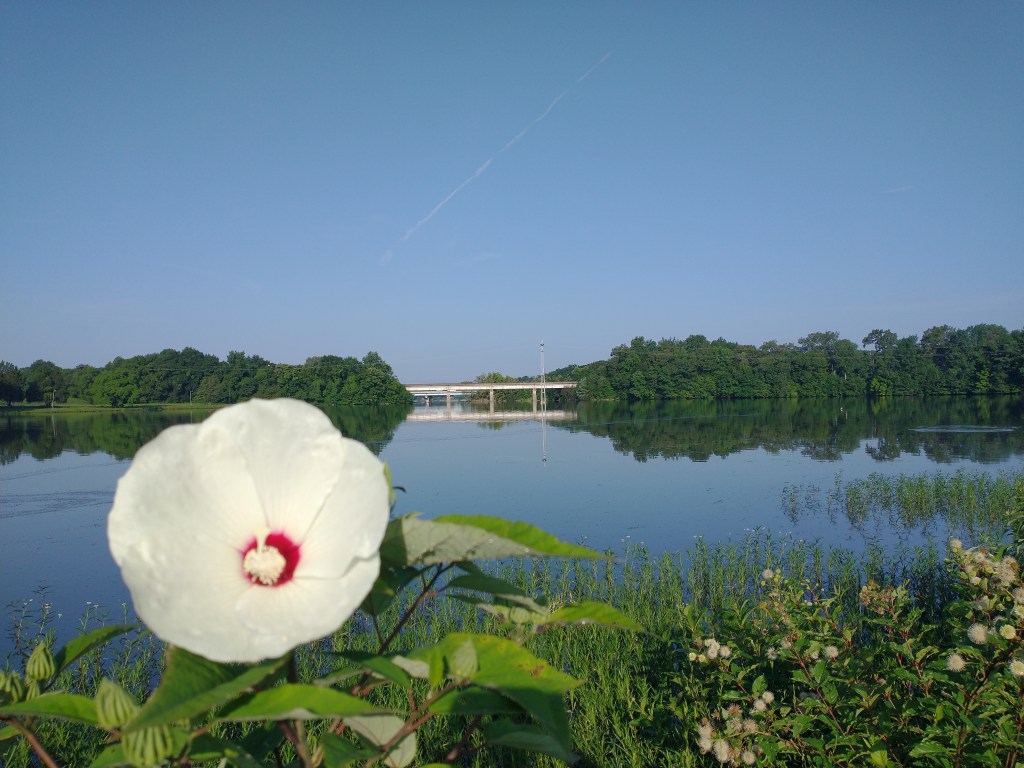
A view of the train trestle across from my camp. Three or four trains came through each night. I just noticed all these large blossoming flowers this morning. 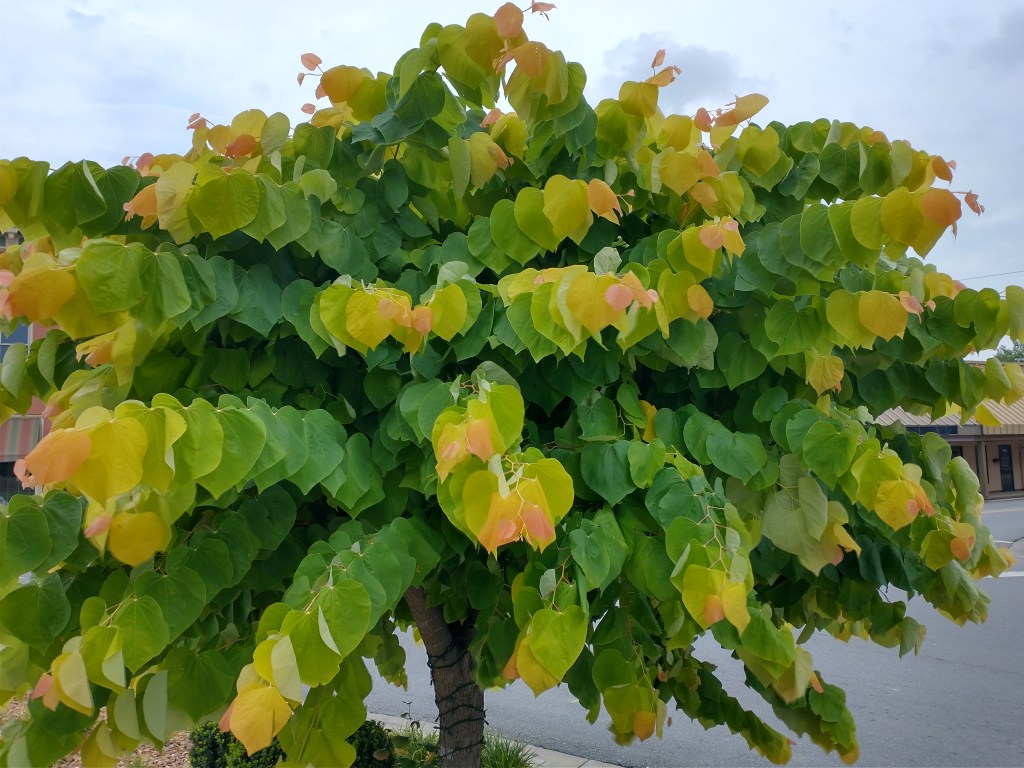
Another redbud—one of my favorite trees. 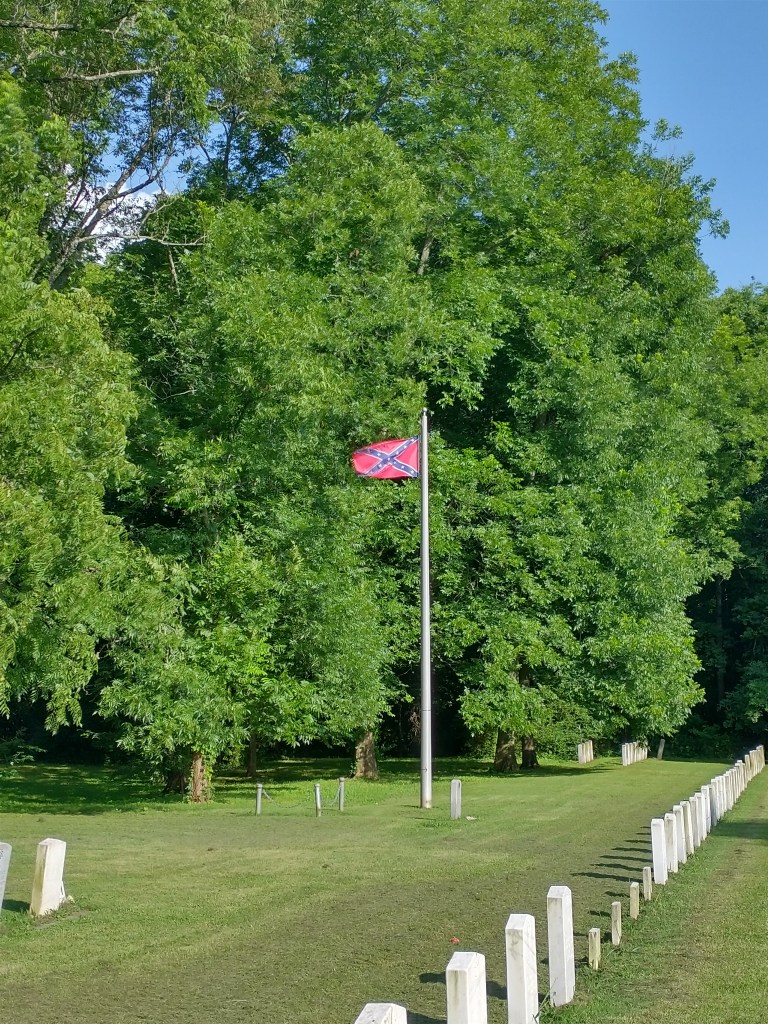
I hated seeing this flag in a portion of the City Cemetery. 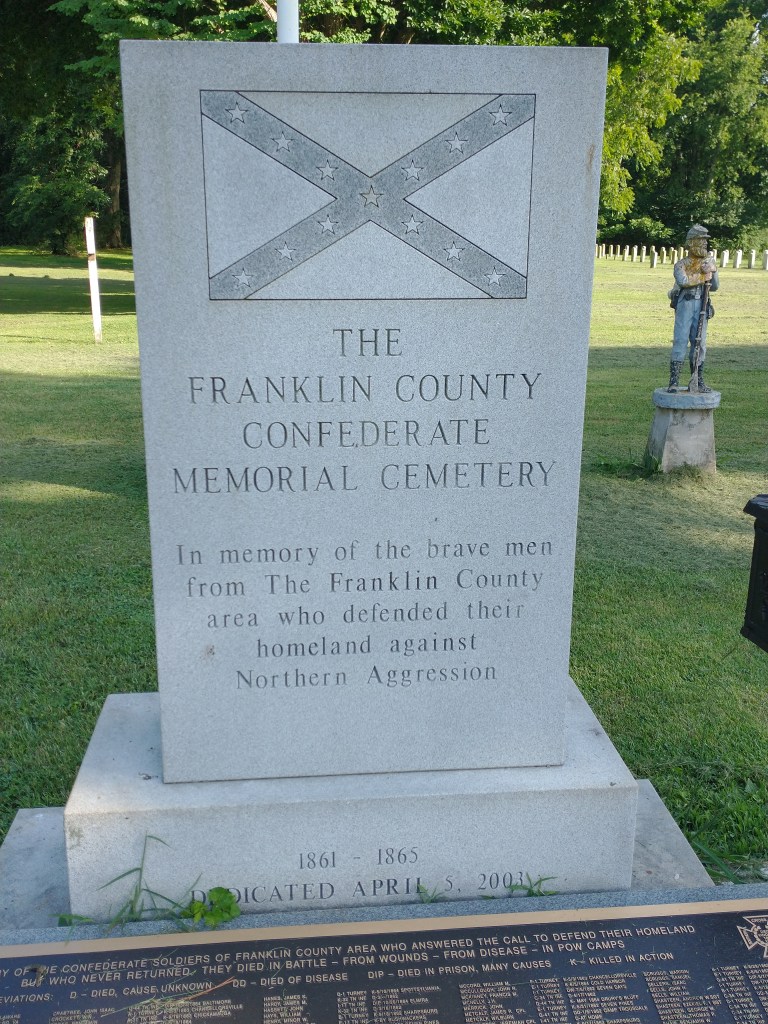
This monument was erected in 2003 and the brass plate beneath it was added in 2007. I don’t understand why people want to celebrate their ancestor’s mistakes instead of letting that part of their history die. Great, great grandpa’s corn whiskey recipe or the story of his best milk cow would be such a better way to honor him. I was approached by a police officer in the cemetary when I was back at my grandparent’s grave. Already shaken by this monument to the confederacy I may have linked the officers appearance. Not a good place to start my trip to Winchester. I may go into the details of that encounter at another time. -
Day 29–Winchester, TN
July 14, 2021,
I’ve had two interactions with police now in Winchester. Why is it that the place I’ve felt least welcome is my hometown?
I’ll start with the most recent incident and work toward the first that happened soon after I arrived. That one was more disturbing because of extenuating circumstances and I don’t feel ready to describe it because of tiredness not emotional fragility. Also, the sun is about to go down and I’d like to get back to camp before it is dark.
Last night I woke up from a solid sleep with a flash light in my face. “Come out of there,” I heard a voice say.
“Huh? What? Who is it?”
I hadn’t bothered to put my curtains up. After all, I wasn’t boondocking. I paid ten bucks to the town of Estill Springs for each of the two nights I’ve now stayed in the City Park.
“It’s the police. Now come out of there.”
“I can’t see who it is with that light in my face. Can you show me who you are?” I asked.
“I’m not taking the light off you. I don’t know what you have in there,” the voice came back.
A little jolt of fear came into me for the first time. I waited for a laugh. That would tell me I was really in trouble.
The city park is off highway 41A. You turn over train tracks and pass by the town little league field before you hit a dog-bone shape of land that pokes out into Tims Ford Lake. The campsites are at the far bulb end. I’ve seen people fishing and swimming during the day, but mostly I’ve seen people that drive out and just sit in their truck or car. It’s a beautiful spot. The lake is a sprawling fissure that covers a number of towns and communities. It’s fed by the Elk River in the northeast near my campsite and empties on the southwest end about ten miles away.
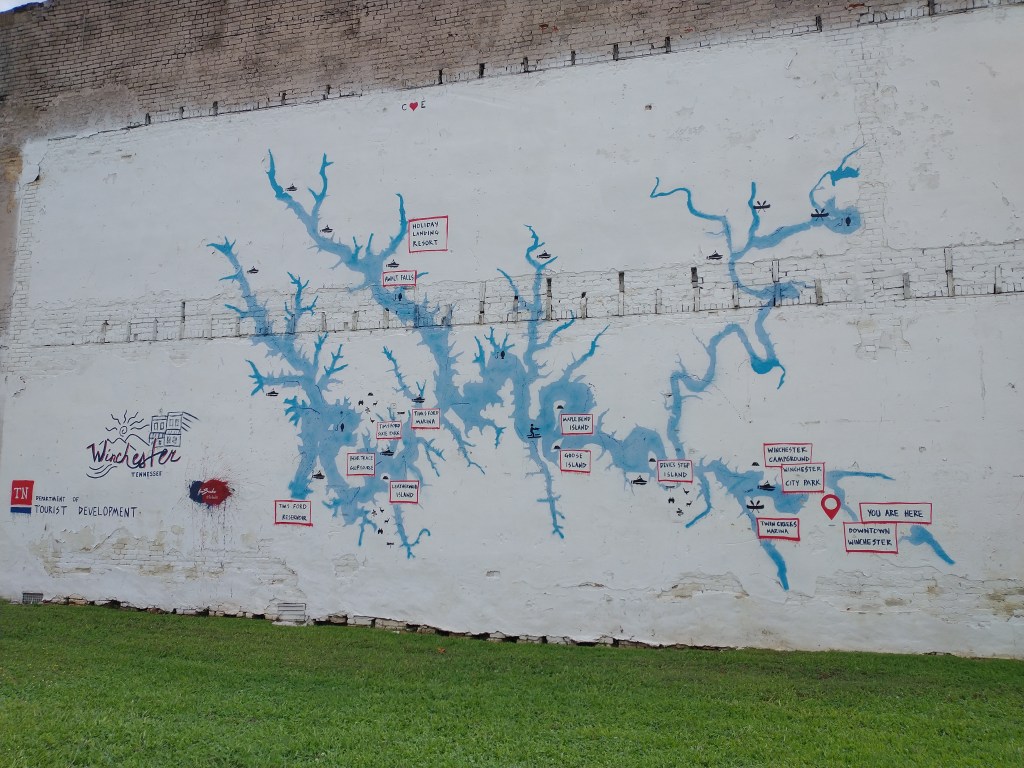
mural of Tims Ford The first night, a newer model, black sedan was parked overnight. That was it. A man got out in the morning, pulled out a fishing pole, and made a few casts in the lake before leaving.
Last night when I came back from eating in a restaurant on the Winchester town square there was a truck and a car parked together with a tent set up nearby.
“What are you doing; just passing through?” I heard the voice ask.
“I’m from here,” I said. “Why do you want me to come out of my truck?” I asked the voice hidden behind the bright beam.
“This is a paid camping spot. You’ve got to move.”
I was incredulous. I had a big yellow tag given to me by the friendly woman at the one room, carpeted town hall with two service windows—one for Fines, Taxes, Licenses, and Permits and the other for Utility Bills.
“I’ve got a permit. It’s up there on my dash.”
Dazed, I couldn’t think of the more exact words to describe it hanging from the rearview mirror. In front of your damn face if you had bothered to look, I wanted to say. I’d parked facing the road after all.
“Oh you do?”
For the first time the light came down for a second long enough from me to see half a uniform and a partner nearby with POLICE written in big yellow letters across a windbreaker.
“Do I need to move? Am I in the wrong spot?” I asked, still trying to understand. There are assigned spots but no numbers to clarify so I had just guessed. It didn’t seem to matter since the park was all but empty. I started taking off the vice grips that keep someone from opening the flip up window while I’m inside.
I heard the partner mumble something. “No you are alright.”
Then with sudden powers of investigation that were somehow absent when it came to looking for the camping permit the officer asked, “How did you get hurt? Did you do that yourself?”
My wrist that had a big white gauze taped to it, came into view when I was taking off the left vice grip.
“Oh I did something stupid trying to climb a cliff over there in the lake.”
“Okay. Well have a goodnight,” the voice said. The light went off and they left. I laid there for a long time thinking WTF?
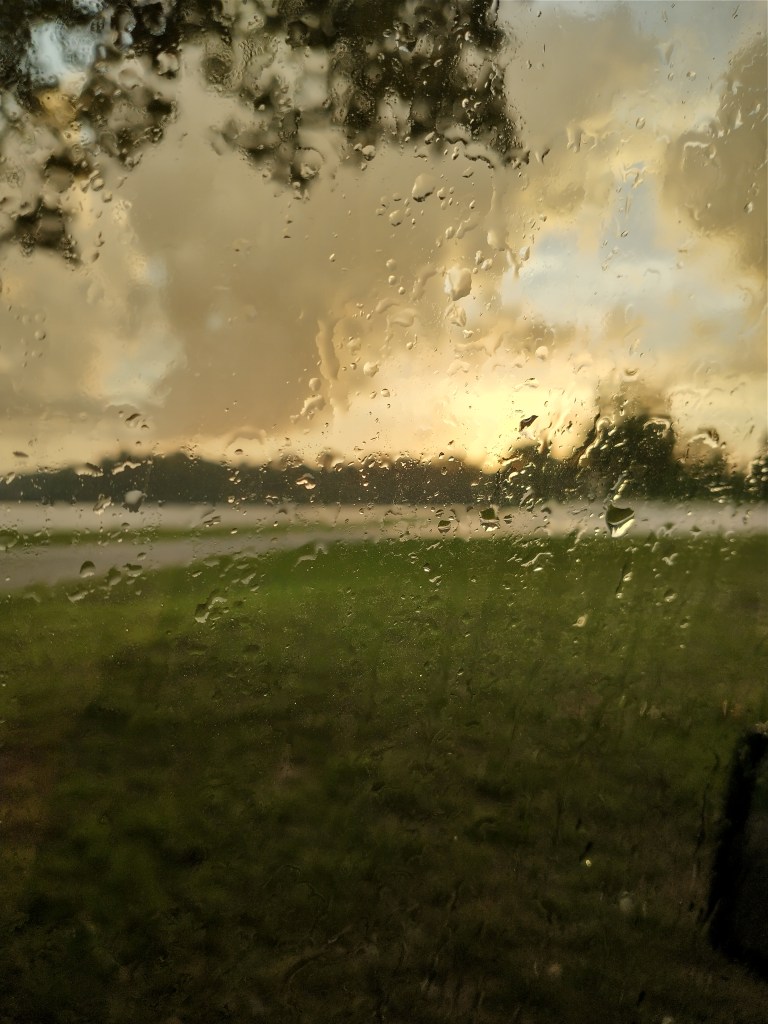
There was rain again last night before bed. 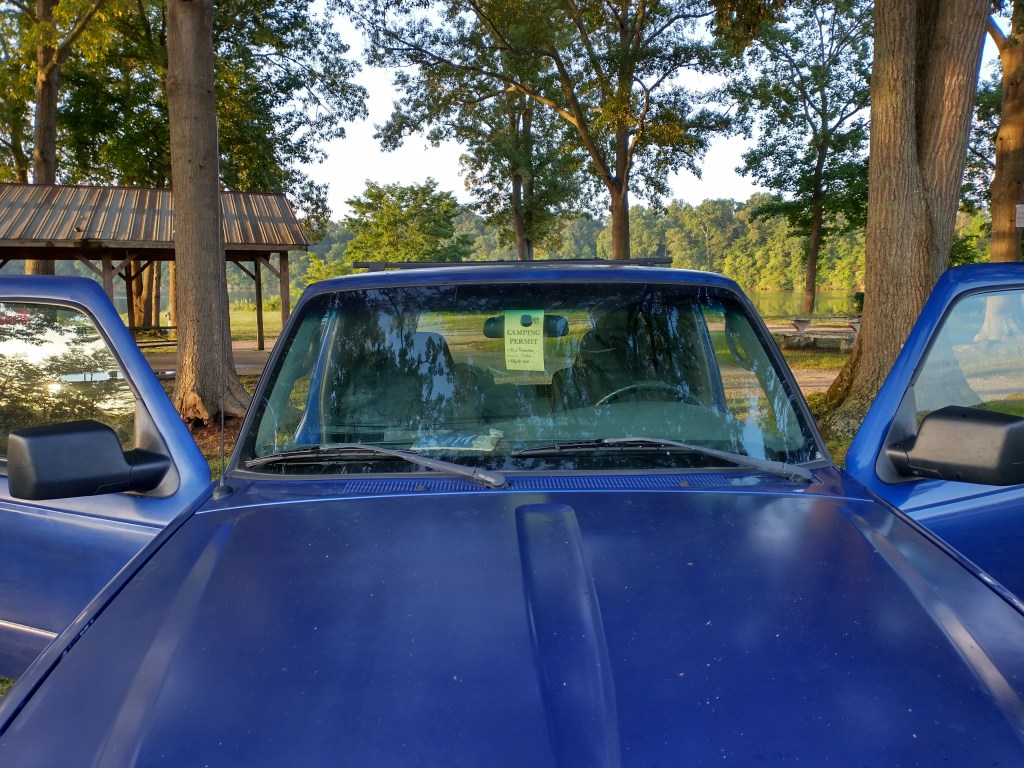
For police that supposedly patrol this park every night you’d think they would look first for the required permit before waking up occupants. This morning the city clerk told me the legitimate campers are usually in pull campers not so much in single vehicles. Still, she had told the police day crew that I was there. Sounds like the night crew didn’t get the message. It was 11:20 when they woke me up. Fortunately I wasn’t shot while reaching for my glasses. She said there have been problems with drug dealing and prostitution at this park. 
The lake at 6:15 this morning. 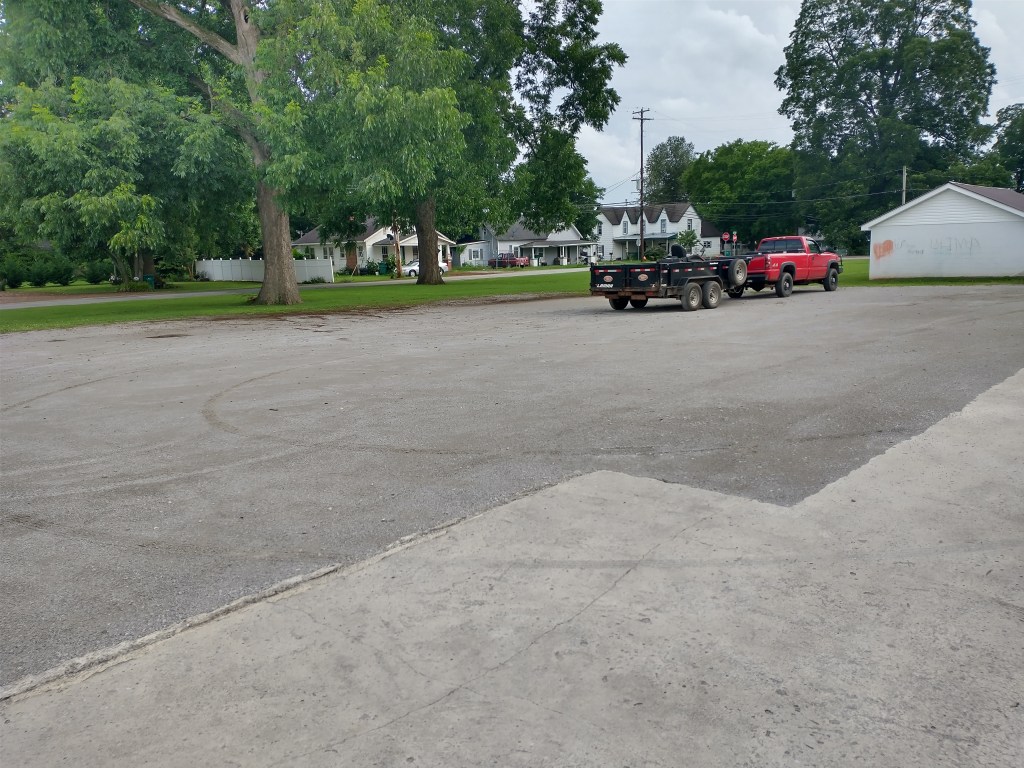
I was born in this parking lot. Actually there was a roof over my head and it was a small Winchester hospital. 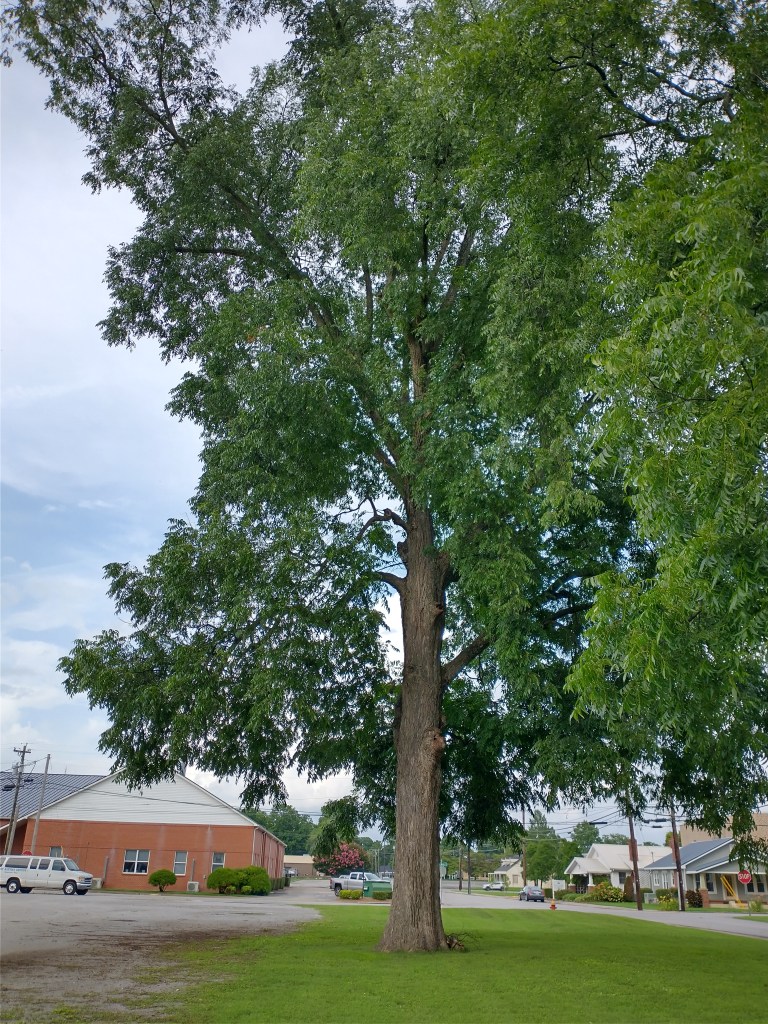
From pictures of the hospital I got from the library I surmised that this large pecan tree is about four or five years older than me. One thing that has surprised me from this trip is how huge trees can get in 56 years. -
Day 28 and 1/2
Tuesday, July 13, 2021, Winchester, TN
Disturbing findings threaten to burst my bubble of strongly felt sentimental feelings for my birthplace. I’m tough though right? I can handle it.
In 2002, I moved from San Francisco’s downtown Tenderloin to the tony Rockridge district of Oakland. I was immediately in culture shock. I don’t think it was the racial difference that put me in shock though Rockridge lacked the more equal parts Southeast Asian, African American, East/West European American, Mexican/Central American, Middle Eastern American—okay, just about every corner of the world American you can think of.
Rockridge did seem very white to me, but that wasn’t what shocked me. It’s the fact that no one was spitting out expletives or having a morning tourette’s attack. No one was asking me what choo need? or lookin? There was no chance a high-as-fuck prostitute would follow me into my building, get on the elevator with me and hound me to my front door insisting that I wanted a date. I wasn’t going to see a seven-year-old Vietnamese child skip down the sidewalk and hop over a passed out drunk like he was just a pile of backpacks on the playground. No longer an iron building gate slamming behind me, when I gently closed the front door on my new shared apartment I didn’t need to push the superhero button that shot up an invisible suit of armor to protect me from countless assaults to my humanity.
At the same time I didn’t have to worry too much about some saintly homeless person opening their face to me with a smile that lowered the superhero armor in reverse order, folded it, put it in a piece of ancient luggage stamped with every country of the world and tossed it airwise into a portal that made it disappear with a Hollywood sound effect of ploop. There was a magic in the Tenderloin that, when it appeared, came with a force equal to or greater than all the builtup hardship.
If nothing else, I could always look up at the flocks of pigeons that flew in circles against a pure blue sky that cleaned all excrement from the soul. Those were my buddha beads. For a Catholic it might have been my equivalent of counting the rosary.
Rockridge was affluent, educated, hip, tasty and tasteful. I didn’t wonder where all the crazy people were, I just wondered why they all kept it inside—too much like me. I wasn’t evolved enough to be happy around people like myself.
But more than the obvious differences of neighborhood I felt a greater loss at no longer being able to call myself a San Franciscan. For a brief period I sang in a short-lived St. Anthony’s Foundation choir made up of a rag tag crew of ministers and workers. St. Anthony’s along with Glide Memorial Church were the two largest non-governmental social service providers in the city. Our little 7 or 8 person choir performed at a few senior centers, homeless shelters and at Foundation Events. On our song list was San Francisco
Open your Golden Gates
You let nobody wait outside your door.
Performing that to a group of mostly non-plussed, bedraggled and tired homeless men sitting in metal, fold-out chairs seemed to be the peak of irony. Yet the truth of San Francisco was, as a city, it would take in anyone—queer, drug-addicted, angry, outrageous, forlorn, desperate—even insanely happy. Yes, you might have to sleep on the street because a room is $500/night and a studio apartment is $3000/month, but nonetheless WELCOME!
That I was no longer living in that city—that I couldn’t say I live in San Francisco—-felt like a huge loss.
But, you know, I can still blow that bubble. I can still watch the oil cascades gather like a swirling galaxy moving across that sphere. I can dream myself there long enough to remember the beauty before the accumulated weight of that galaxy sinks to the south side of that bubble and pulls it apart into a thousand droplets that sink at my feet.
I’ll be able to do the same with Winchester—the place where living beyond the womb first happened—the place where I lived out an actual Norman Rockwell trope, crying during my first haircut inside a barbershop with a twirling red, white and blue pole outside the front door. I’ll be able to survive. I don’t know if Winchester will.
I left Corryton yesterday thinking I’d pick up my mother’s memorial from my Uncle’s barn in Jasper on the way. It just didn’t work out. I had hoped to see some cousins for a quick visit, but the timing was wrong and honestly, I’ve worried about getting caught up in too much socializing and loosing the thread of this whole project which simply put is about writing about the places and photographing the actual abodes where I lived. So when they weren’t available I was actually kind of glad because I need to make this business-first. I can visit with them on the way back to Corryton and pick up the stone then. After all, I’ve already decided I’m not planting it next to my grandparents grave in Winchester.
As perhaps a consolation I decided to take the last exit to Jasper and eat lunch at the Cracker Barrel there. Sure, there are better places for three and a meat, but Cracker Barrel actually does a pretty good job imitating southern, downhome cooking and they have enough veggie sides where I can skip the meat altogether and feel quite satisfied. Oh, and I was happy to see at least two separate people of color—one eating alone and another as part of a larger group. Seems like Cracker Barrel isn’t as cracker as it used to be!
More than halfway through my meal I looked up and saw a familiar figure turned with his back to me.
“Chuck!” I called out.
Yep! Another cousin! (Not related to the murderous Chuck I spoke of earlier). Well if this isn’t the kind of homecoming I’ve always dreamed of, I don’t know what is—having enough cousins that I actually ran into one without trying!!! And I was going to call Chuck too.
Chuck had just had lunch with an 87 year old former Church minister of his who was just back from a four-year-long mission in another state which, I won’t name but, apparently, needs ministering more than Tennessee. Chuck, who is an accomplished photographer, couldn’t join me at that moment but needed to finish up his conversation with the preacher who is interested in photography and wanted to know about Chuck’s camera. I finished my meal and was waiting in line to pay at the register when he came back.
“Let’s meet out on the front porch,” I said to Chuck, a little shocked that I had just called the concrete slab of a publicly stock-traded, billion-dollar company a front porch. But it does have a long line of rocking chairs, and sitting down in one—next to Chuck who had chosen a bench—it was easy enough to ignore the cable that runs through all the rockers to keep them from being stolen.
“That guy is the greatest guy,” Chuck started out enthusiastically endorsing his close-to-ninety year old friend.
Chuck almost always has a sunny disposition and will look for the best in people—not that he had to look for it in the preacher who did sound like an amazing individual full of energy.
For a while now—I’d say for the last ten years or so I’ve been nurturing a secret writerly association with Chuck. Though I’ve really not read any of his professional work, Chuck was a sports reporter for the newspaper of a nearby town for many years. He also, despite being born in Jasper and living in the area for most of his 54 years is particularly worldly. He knows about writers and artists and likes talking about them. And he knows tons of history—like the fact that Tennessee was a split state in the Civil War and that the dividing line was pretty much right around where we sat—at least, nearby Chattanooga. I think of him as a southern intellectual—like Bill Moyers—a person who defies the stereotype that places anyone with a southern accent in the category of ignorant.
Did you know that the first newspaper dedicated solely to the abolition of slavery was published in Jonesborough, TN? Eastern Tennessee had a heavy contingent of Union soldiers. In fact, I have a number of relatives on this side of the family who died fighting for the union. On my father’s side, which was rooted in Albemarle county Virginia, there were relatives that died fighting for the confederates.
Anyway, you will see why I bring this up soon, if today’s write doesn’t trail off into oblivion.
In the course of my conversation with Chuck we rambled through a number of topics from the loss of affordable housing to the depression era WPA on to Chuck’s absolute amazement that an effective Covid vaccine was brought to market in less than a year.
Chuck and I are pretty much on the same page about everything and so, as can be expected, our conversations are filled with the easy pleasure that comes with speaking with the like-minded.
We moved it to the parking lot for me to show him my rig and explain some of the trials and tribulations of getting the camper shell ready for this trip. Coincidentally, out of all the places in the parking lot he could have parked he had parked his 2003 red Tacoma pickup next to my blue 2006 Ranger. I hung my arm in the back of his truck as we talked. We were just two guys next to their trucks in the parking lot of a Cracker Barrel in Jasper, TN. Who would have thought we were talking about Diego Rivera murals and the 1930s labor movement?
“You know I wasn’t going to send you my email writings about this trip,” I said. “I wasn’t going to include any family. I didn’t want to complicate things and I wanted the freedom to say things that people might not like, but then somehow Aunt Linda found out I was writing about the trip and asked to get the emails and Uncle John and others wanted them too and well, I figured, I don’t want to write anything that is going to offend anyone anyway and if I thought it might then I need to figure out a way to make the writing better.”
Chuck listened and then explained that he doesn’t take offense to things he may disagree with if they have been presented thoughtfully. Basically he confirmed what I had already anguished over and concluded but it felt good to hear him say it. It’s not really like I’m pushing the envelope here anyway—or haven’t yet. The relatives that have made it onto my email list are all Obama Democrats, as far as I know. If I was going to challenge anyone’s way of thinking I’d have to get some of my Republican relatives to read this. Most of them wouldn’t’ though. Can Republicans even read? Okay, cheap shot there.
Anyway, it looks like I’m not going to get to what has upset me so much about my hometown Winchester. It will have to wait for tomorrow. I guess everything I’ve written so far is some sort of attempt to give you context for what I’ll show you tomorrow—the thing that makes it harder for me to make the little bubble world of Winchester that I cherish so much.
Let me just settle with a few pictures here that came at a small cost. Below is the one place that I’ve ever been tempted to call home. It became clear to me many years ago that home truly is where the heart is. Home is a memory. It is a feeling that you can never loose and that no one can ever take from you. Home is not a place.
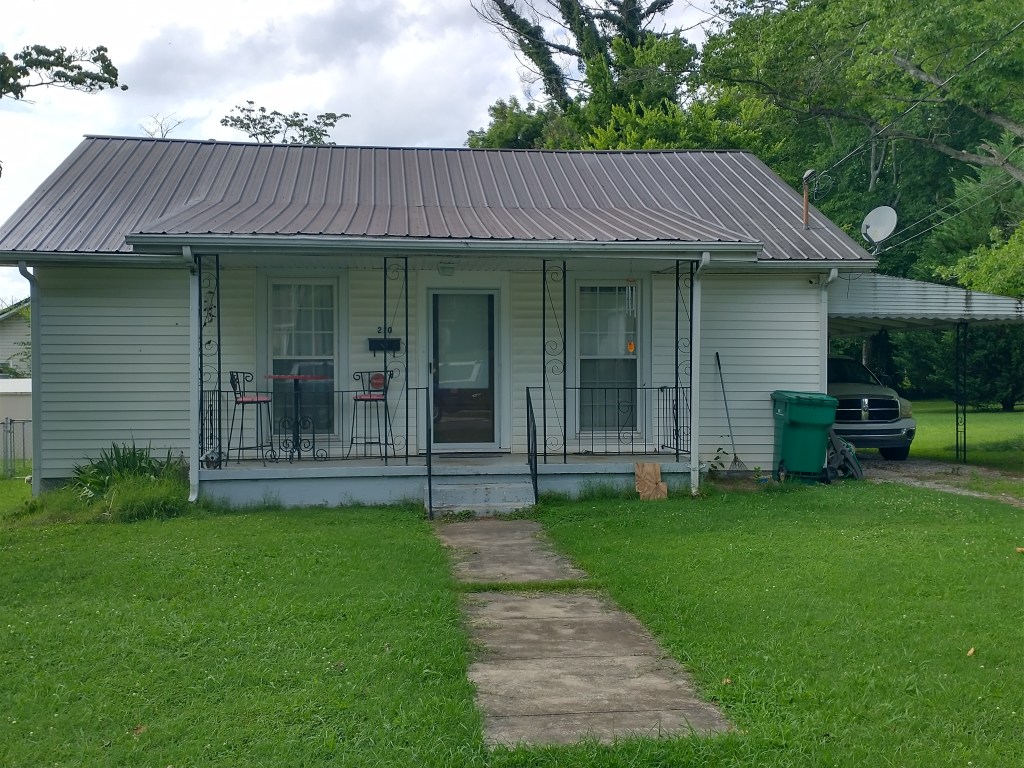
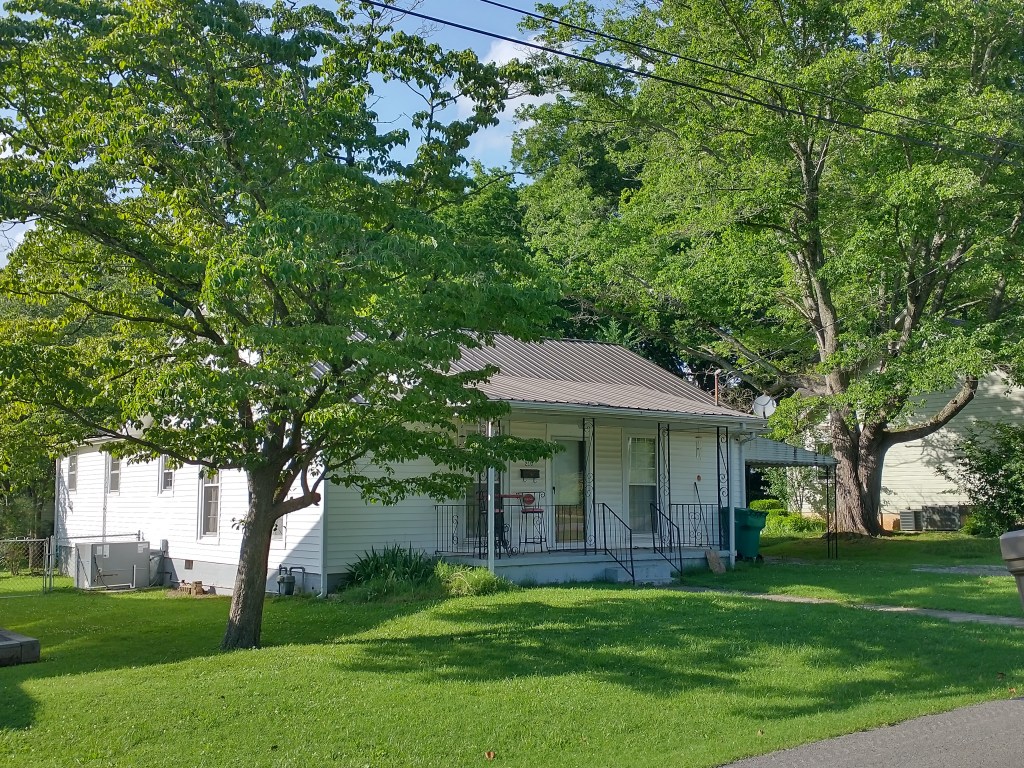
It was a small home but bigger than it looked from the front. This was my first home and the one I came back to for 35 years until my grandmother moved into a retirement community in Chattanooga. 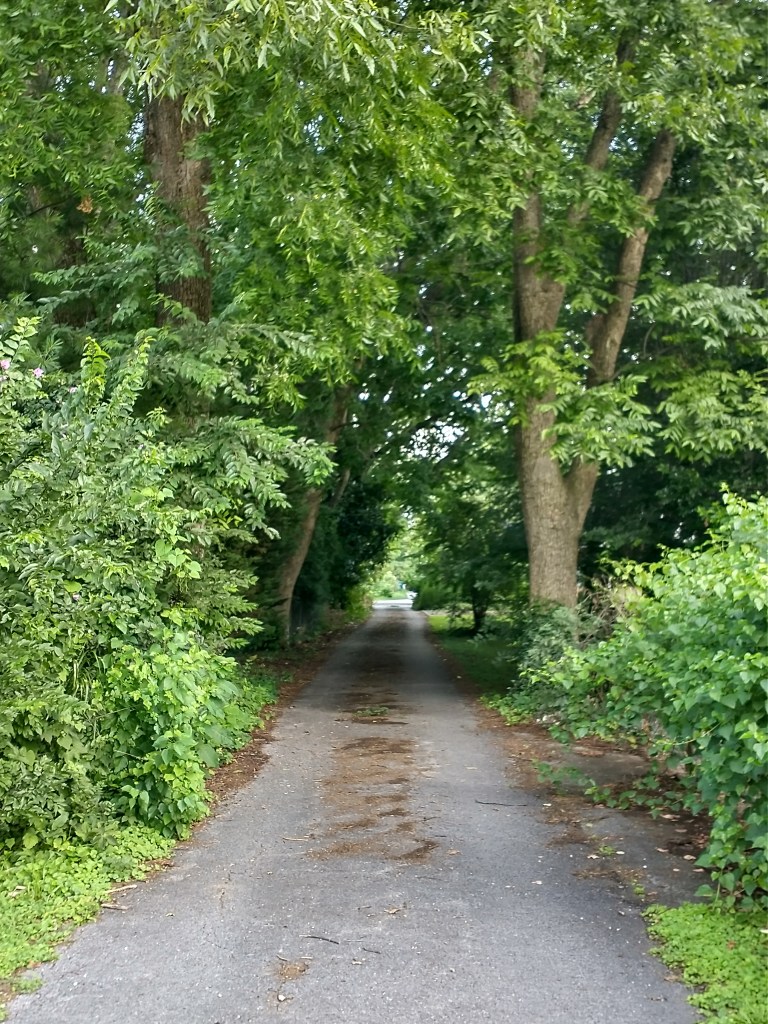
This is what an alley looks like in Winchester. 
An old woman lived in this house at the end of grandma’s street. We thought she was crazy. It looks like it never made it through her curse. There are broken windows and a big hole in the roof. When I was a kid, all she had to do was see us to yell, “Hey, what are you doing around here! Get out of here!” Say it again with your best old lady scary voice. 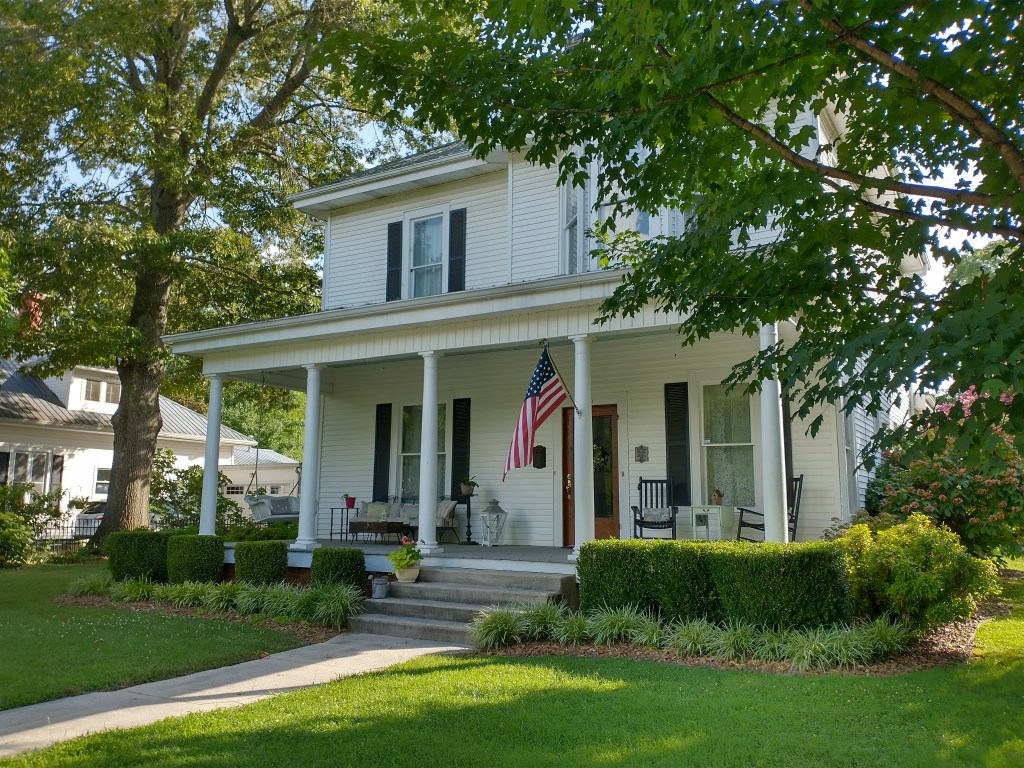
There were big old homes in the neighborhood too. Most didn’t have fences and still don’t. 
This was the childhood home of billionaire investor John Templeton. Small and large houses occupy my grandmother’s old neighborhood. Blue collar and white collar live(d) side by side. 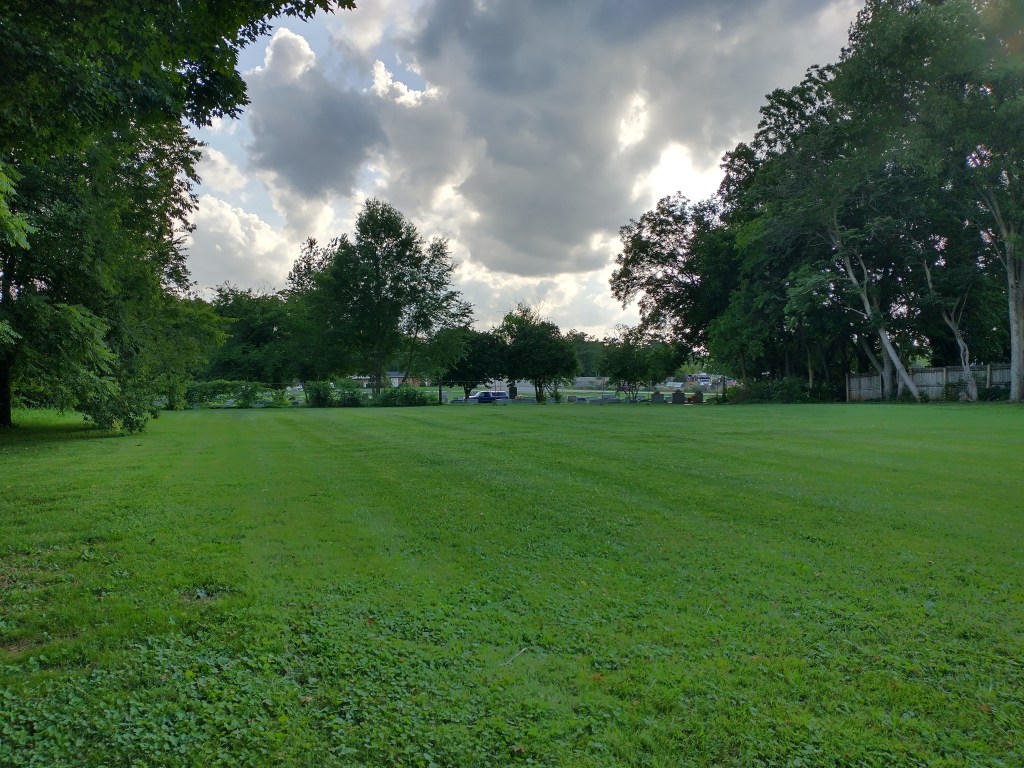
When grandpa was alive he set off a Roman Candle every July 4th on his birthday. His gravestone is just a few steps beyond that backline. I walked many times through this field to clean his stone and place flowers there with my grandmother. Now her carapace lies in a fiberglass encapsulation beside his. 
I disagree. If Jesus is coming you don’t need to be warned. He won’t be carrying an assault weapon but an olive branch. 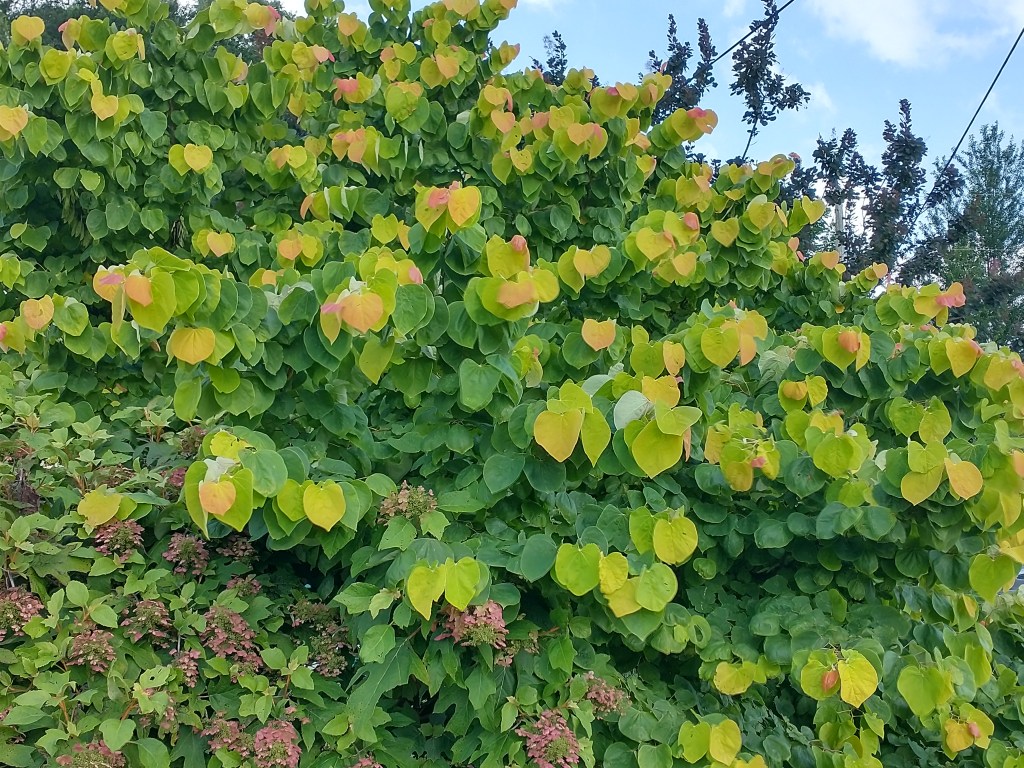
I love these redbud trees and they are all over Winchester. 
June bugs getting it on. I watched that third one crawl all the way up that stem to try to get in on the action. I left them to their privacy before I could find out what happened. 
This is the proper ratio of smoked oysters to can. 
A storm blew in on Tims Ford Lake as I was getting ready to settle in for the night at a city park in Estill Springs about 5 miles outside of town. $10 a night. Water. Port-a-potties. 
Nothing to do but watch the rain. -
Day 28 – Blaine, TN
July 13, 2021 – The Land, Shed and Gravestones
I’m staying at my mom’s cousin in Corryton, TN, but just a few miles down the road is the family land where my father spent summers as a child. It is a happy coincidence that my mom’s cousin who I’m close to lives near the family land on my dad’s side.
In 1936, my father’s father, Judson H. Robertson, bought land in Blaine, Tennessee as a summer farm retreat from Knoxville. The farmland was sold by my grandmother when he died, but there are two pieces of woodland left. The flatter piece contains the “Sheridan Cabin” named after a family that lived there.
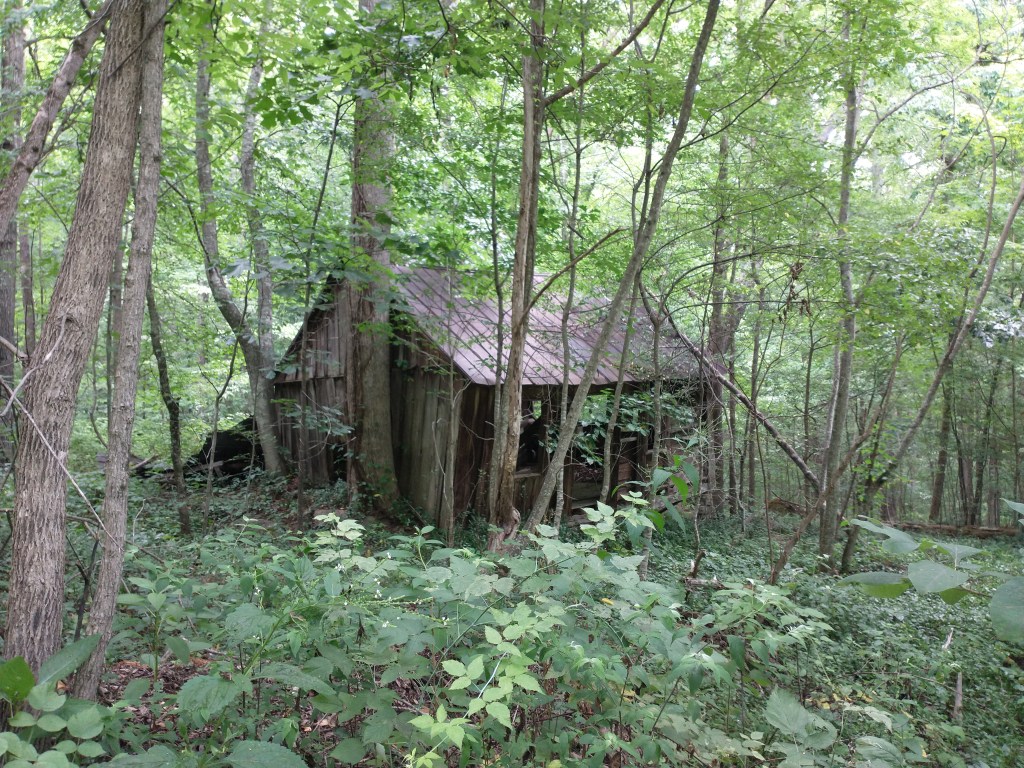
The Sheridan Cabin It was rumored that some mafiosos from Chicago would come to Tennessee and stay in this cabin on occasion after the Sheridans left. Ticks and poison ivy are very bad in these woods though this time I didn’t run into any ticks. Lots of poison ivy though.
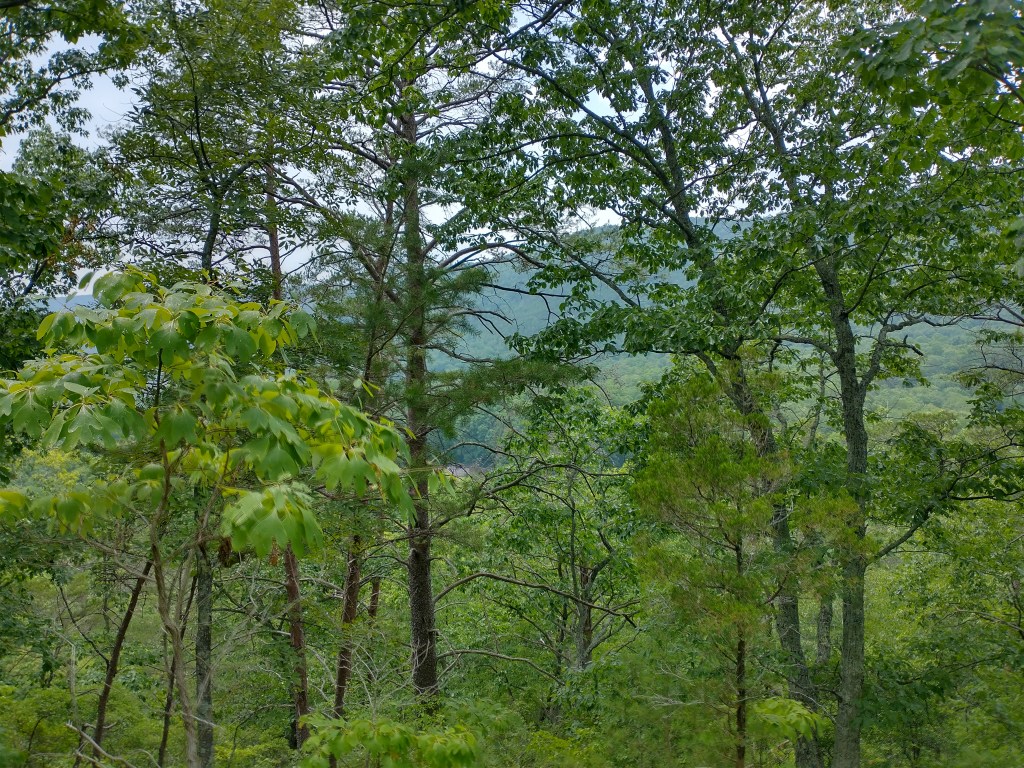
The other piece of land is knobby. Here is a picture I took from the highest knob:
The knobby piece of land holds the memorial markers for my grandfather, grandmother and dad’s brother Clifton. My grandfather died in 1962, three years before I was born. He was head of the chemistry department at the University of Tennessee where he was a professor for 42 years from 1920 to 1962. Dad’s brother died young at 54 in 1985. My grandmother died in 1996. She is the person who placed these markers. A huge genealogist, Grandma put slab markers in various locations in Virginia, North Carolina and Tennessee commemorating distant relatives and places. It is ironic that her death date is blank on the slab having placed it here before she died—the remaining Robertsons being negligent. It is something perhaps we will correct by getting a stone etcher to the location.
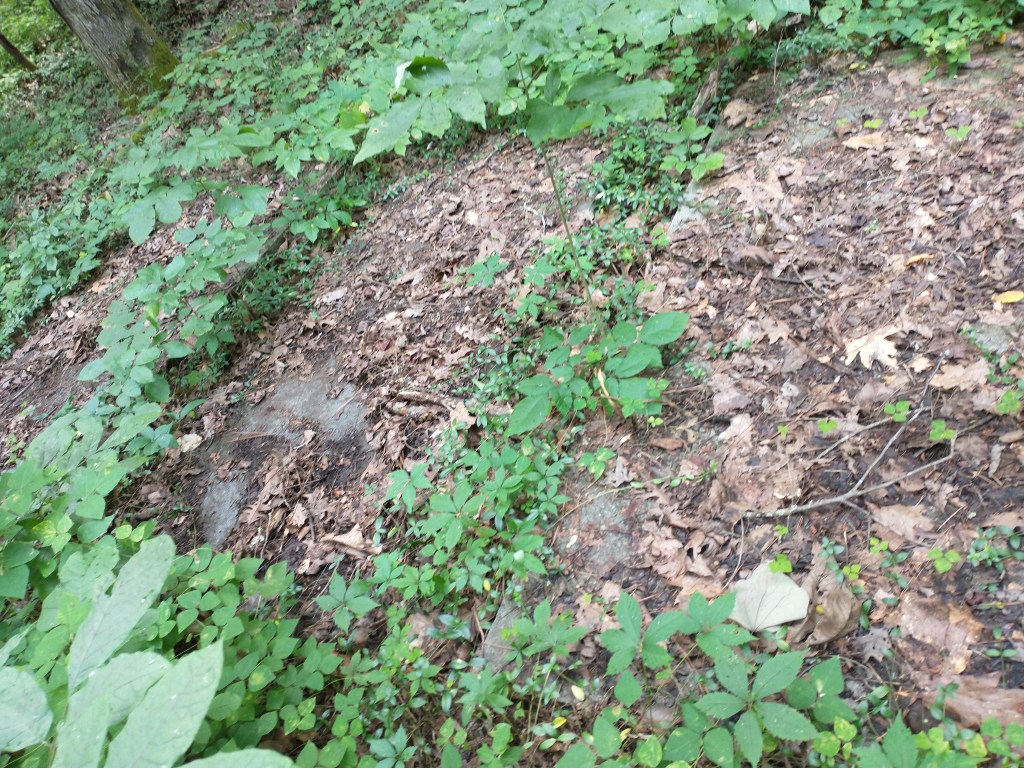
Markers covered in leaf litter 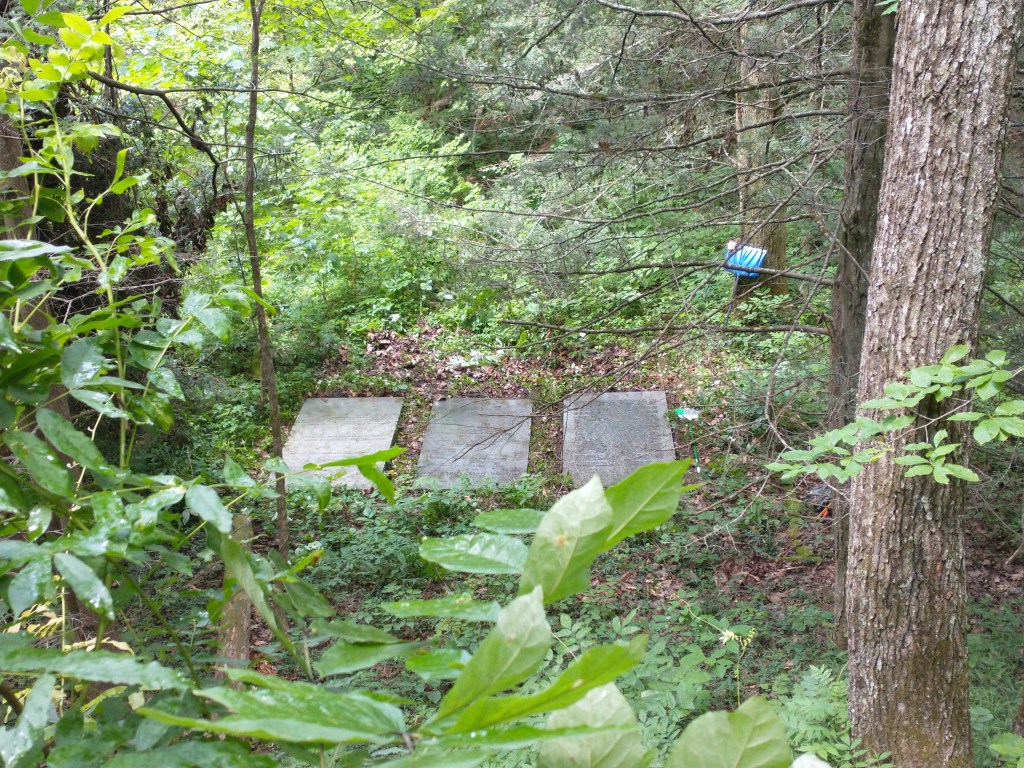
Markers after clearing. I need to return and use something that will get rid of lichen and moss. 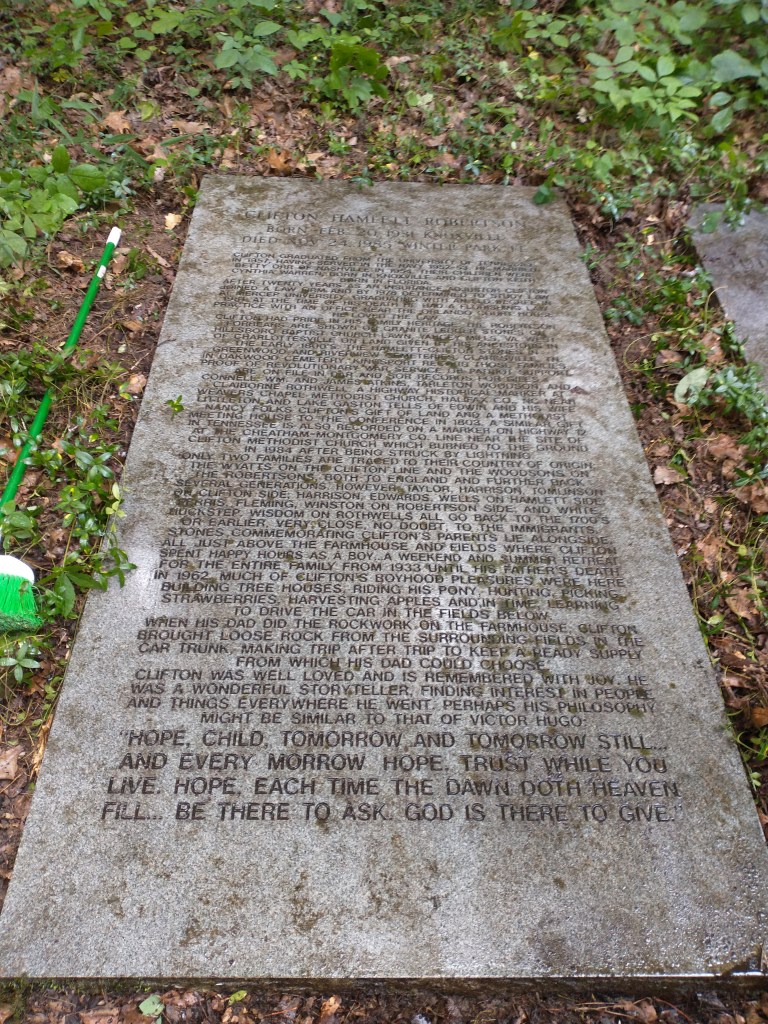
Grandma may have been a little overzealous with genealogical information. The broom on left gives the size of these slabs. The farmhouse that later burned down was sold to a family who still lives nearby. The son is my age and he told me a funny story that his bedroom was painted pink until he entered high school and finally repainted it. Grandma had found some cheap reject paint at the local hardware store and painted a number of rooms that color. When grandma Robbie was alive she paid this man to keep a path cut through the forest to the markers. The day before I cleaned them off he led me through the forest to find them. I was very thankful. It would have likely taken me a whole day just to locate them. At his suggestion I left a blue shovel pointed up so I could more easily find the stones when I returned.

Grandma Robbie introduced mountain laurel to the area around the gravestones. It has taken off through the forest mixed with poison ivy and other ground cover. 
This old storage shed is also on the knobby property across the road from where the old farm house was. I spent a few hours looking through the three wooden chests and boxes inside. 
I really wanted these shoes to be salvageable, but I think the leather was too far gone. Mice were living inside the shoes and wooden crate. Chewed up paper made voluminous nests. One of the mice came out looking at me with his tender eyes and then leapt from the box. 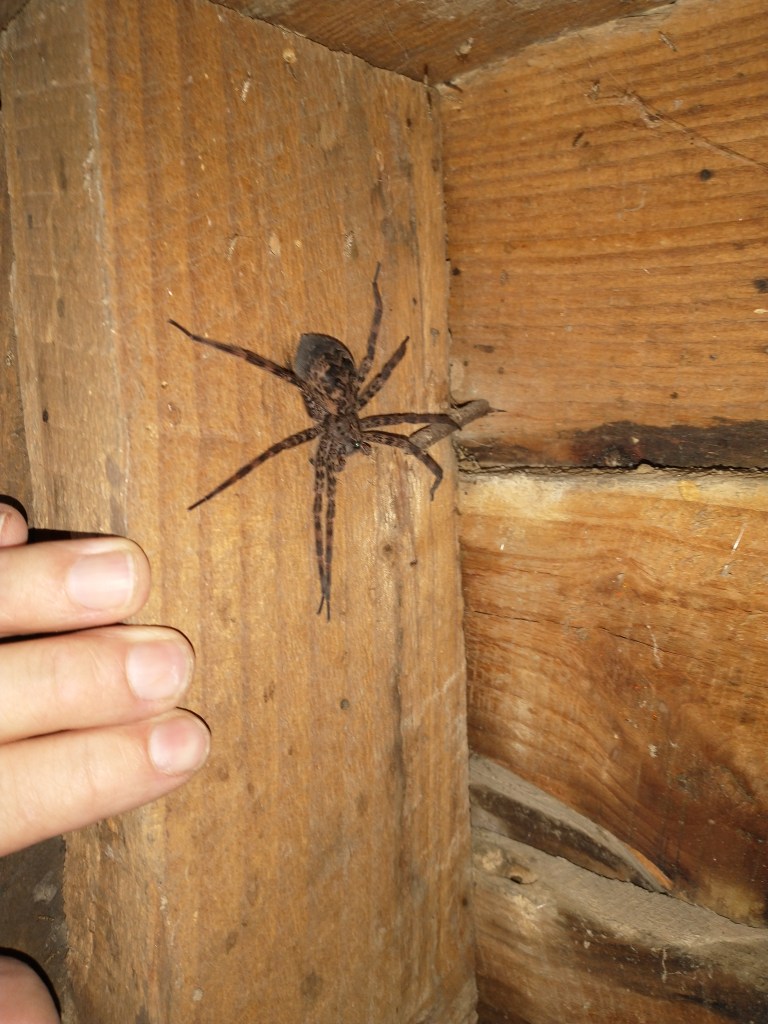
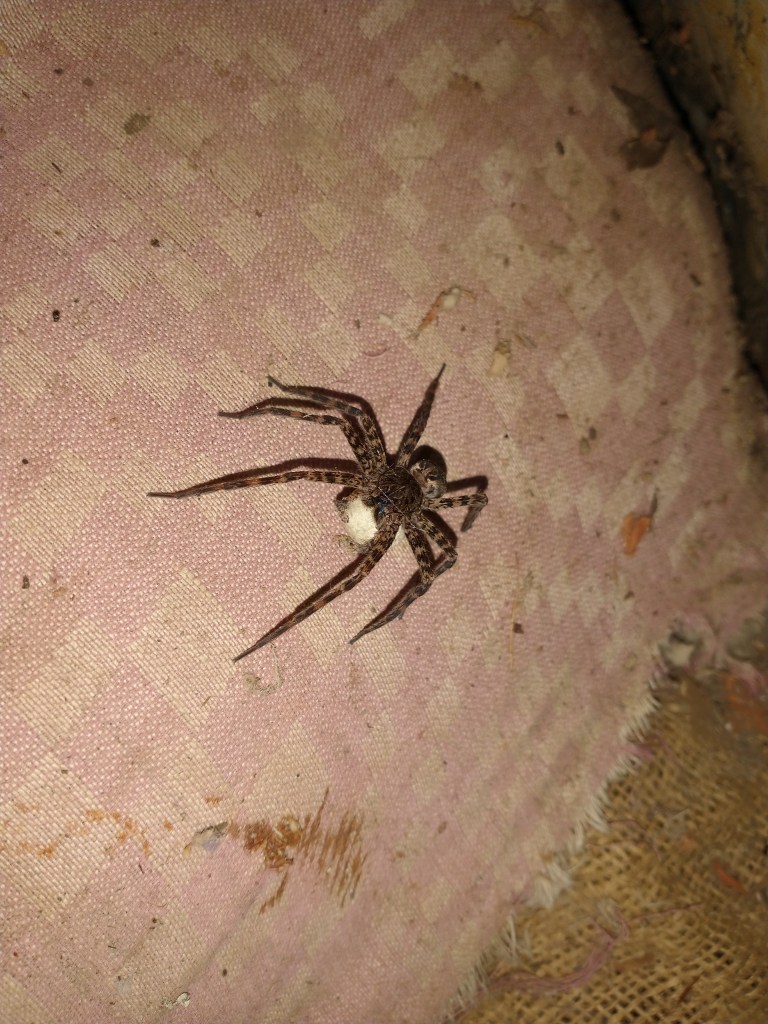
These two very large spiders were in the shed. I thought of the one on the left as pappa spider and the one on the right as mama spider because she had a sack of eggs under her. I was never able to separate her from the mattress she is on. When I took it to the dump she disappeared into a hole on the backside. 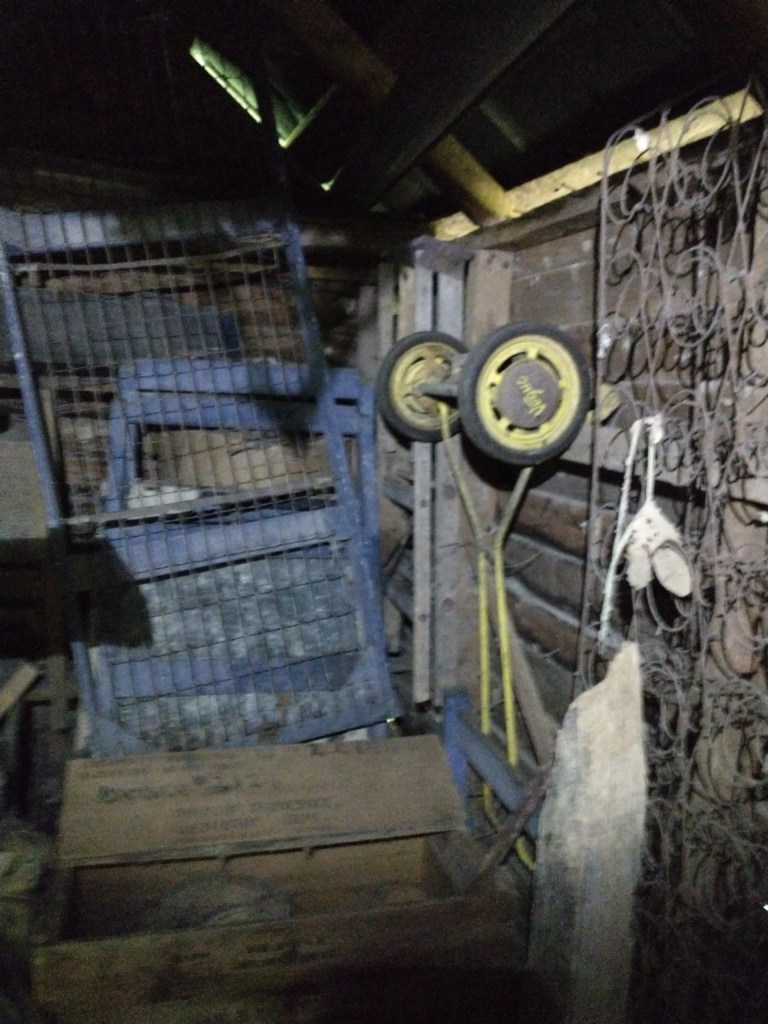
Bed springs and mattresses occupied most of the shed. The mattresses were chewed through and offered more material for the mice. 
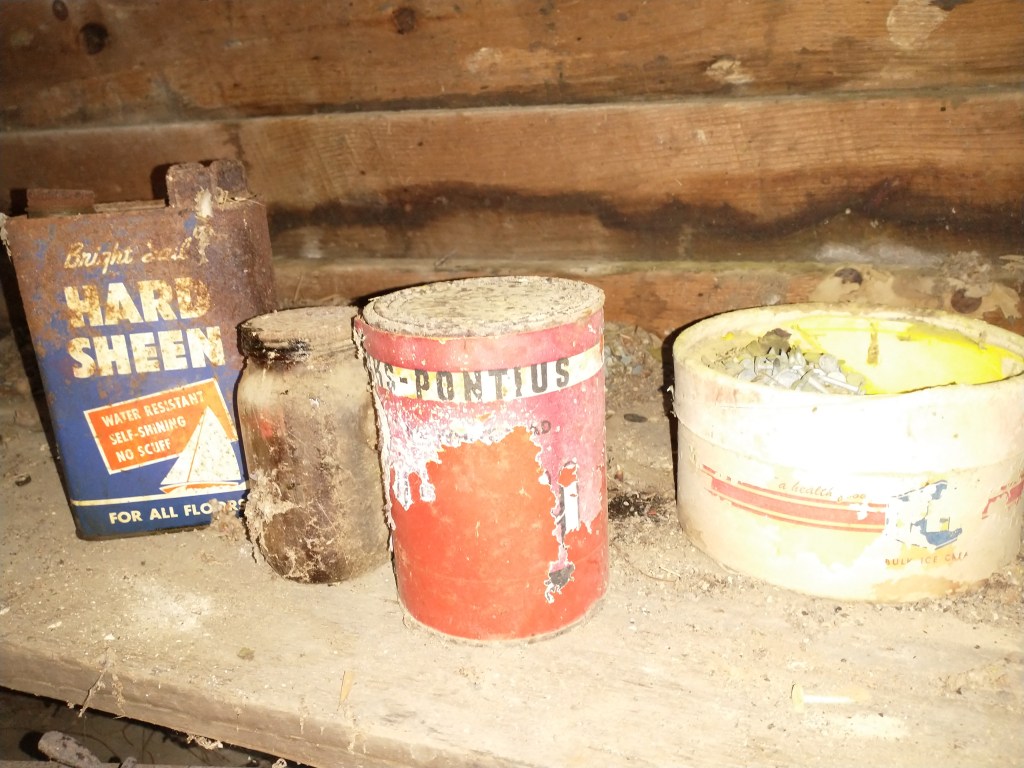
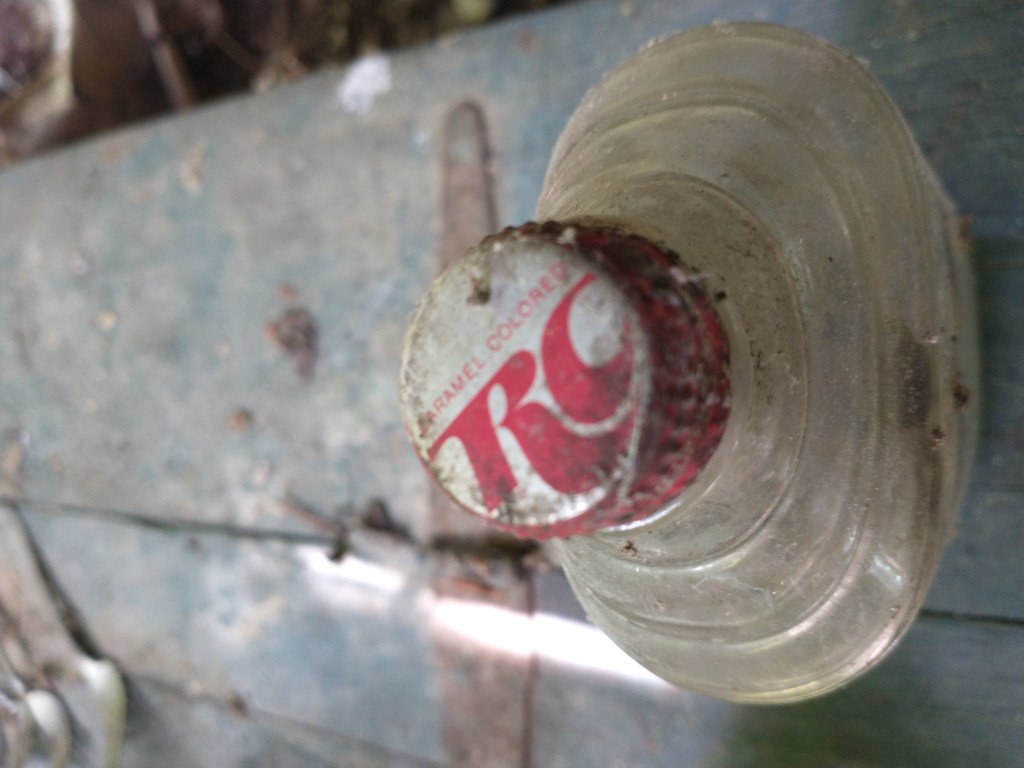
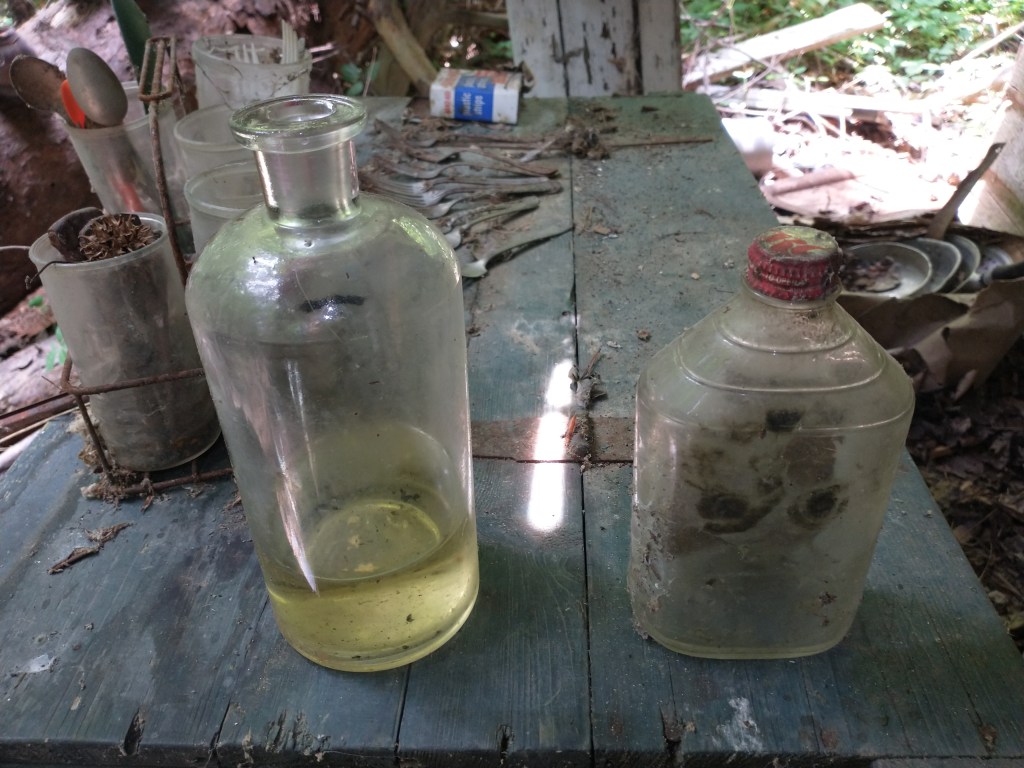
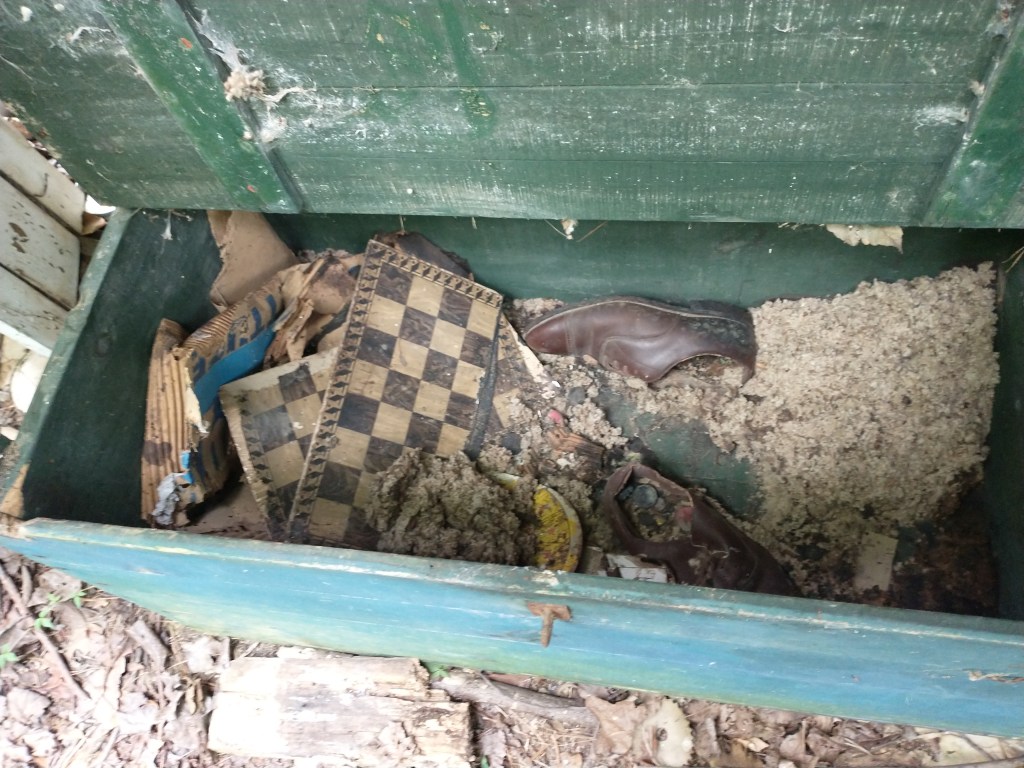
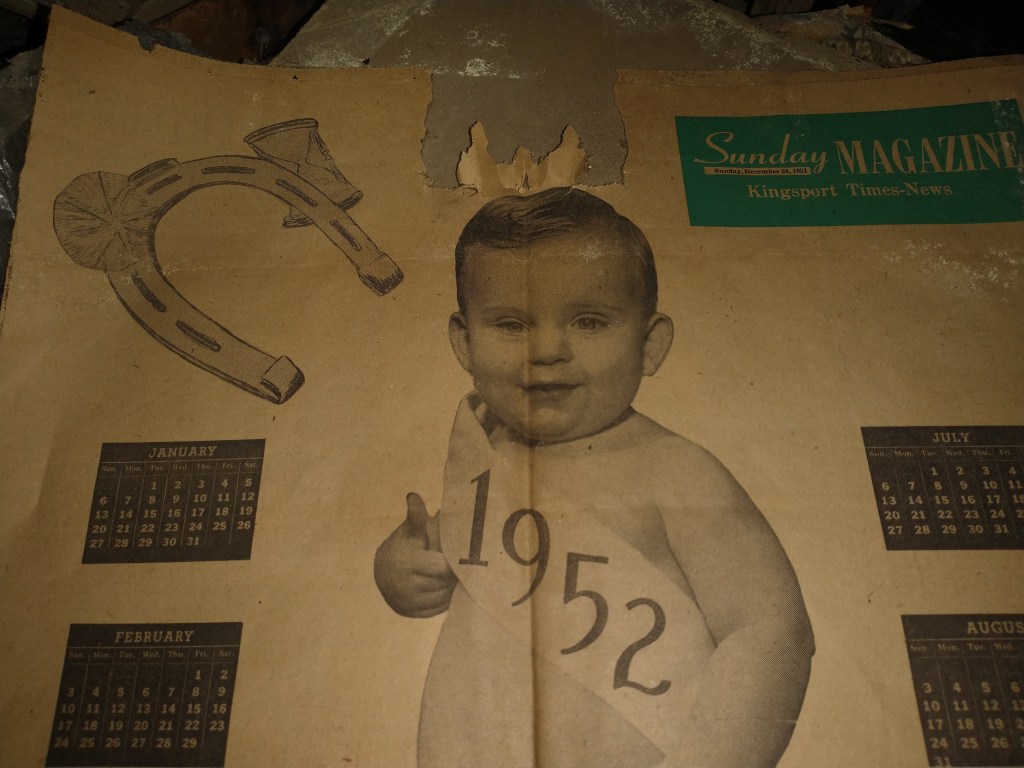
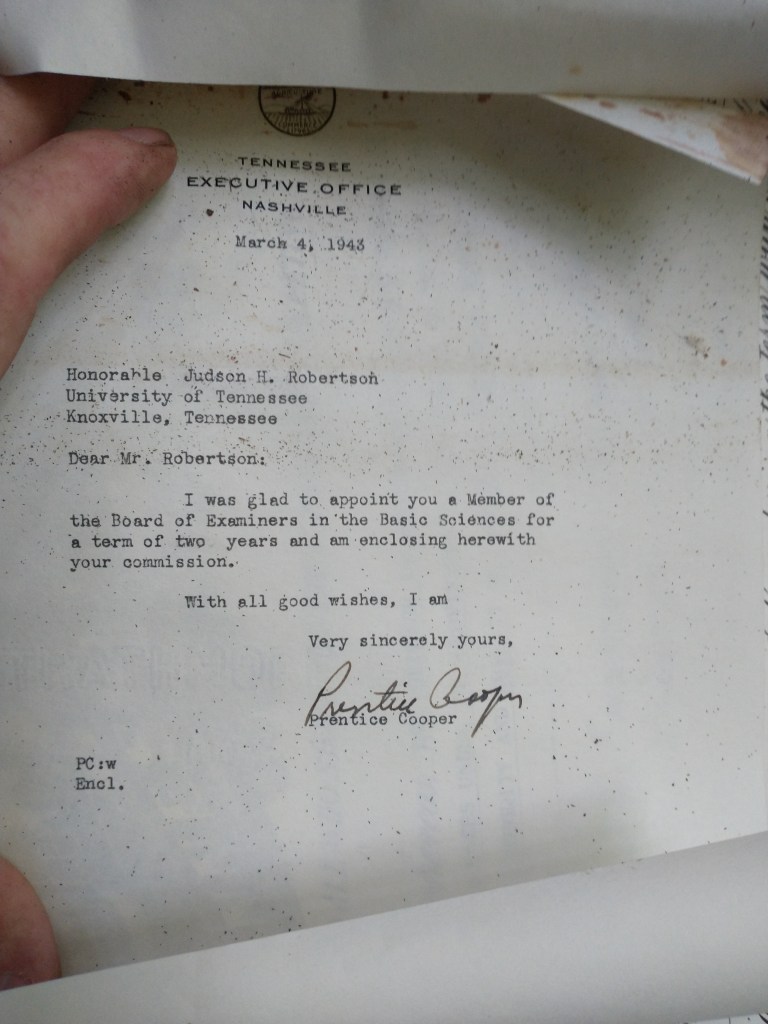
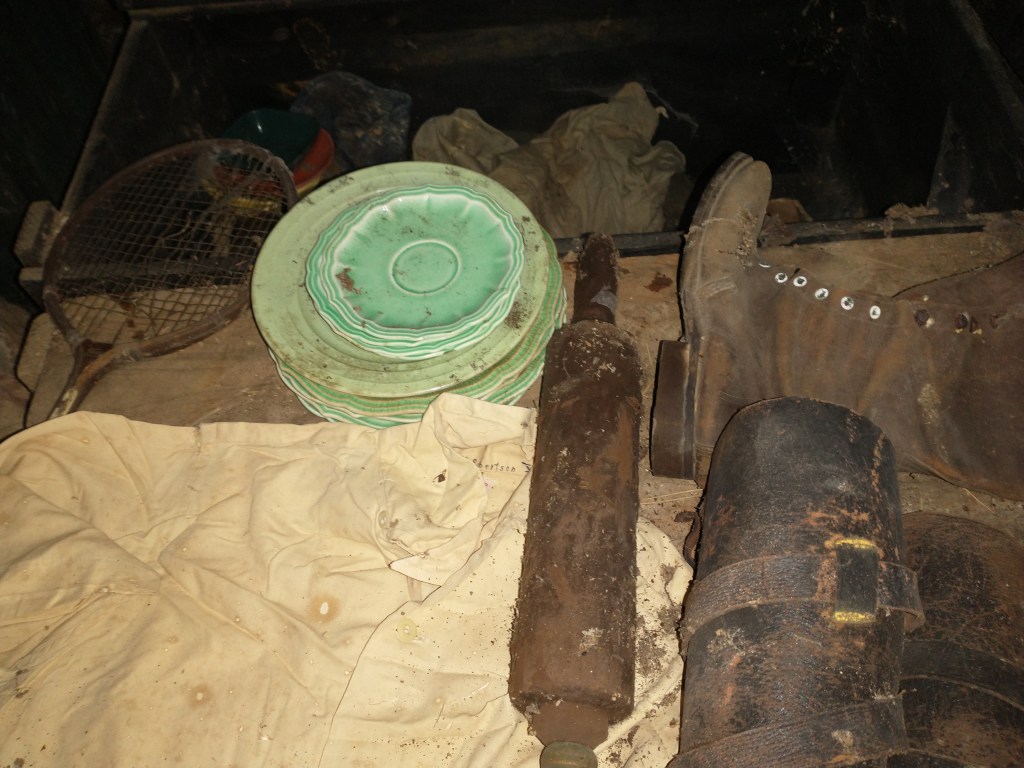
Random books, paint and oil tins, bottles, games, clothes, pictures, calendars, utensils, cups, pictures, awards and honorariums all made up the mouse-eaten, aged and spoiled treasures. The shed was a time capsule to the days my family existed before me, offering clues to their lives.
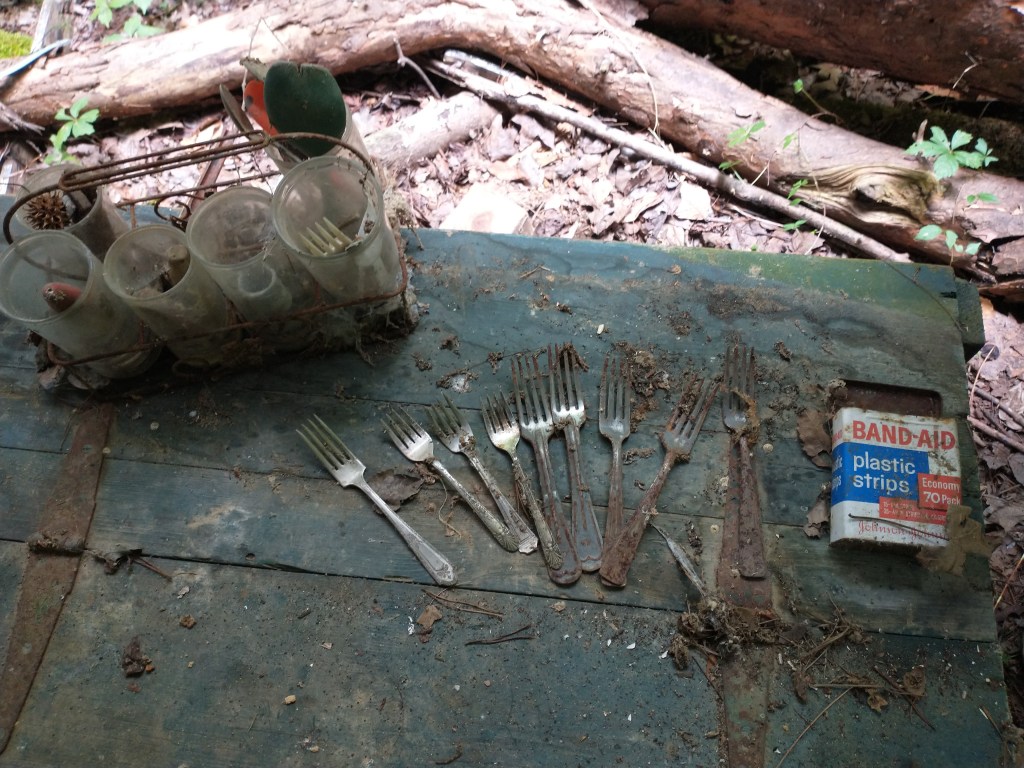

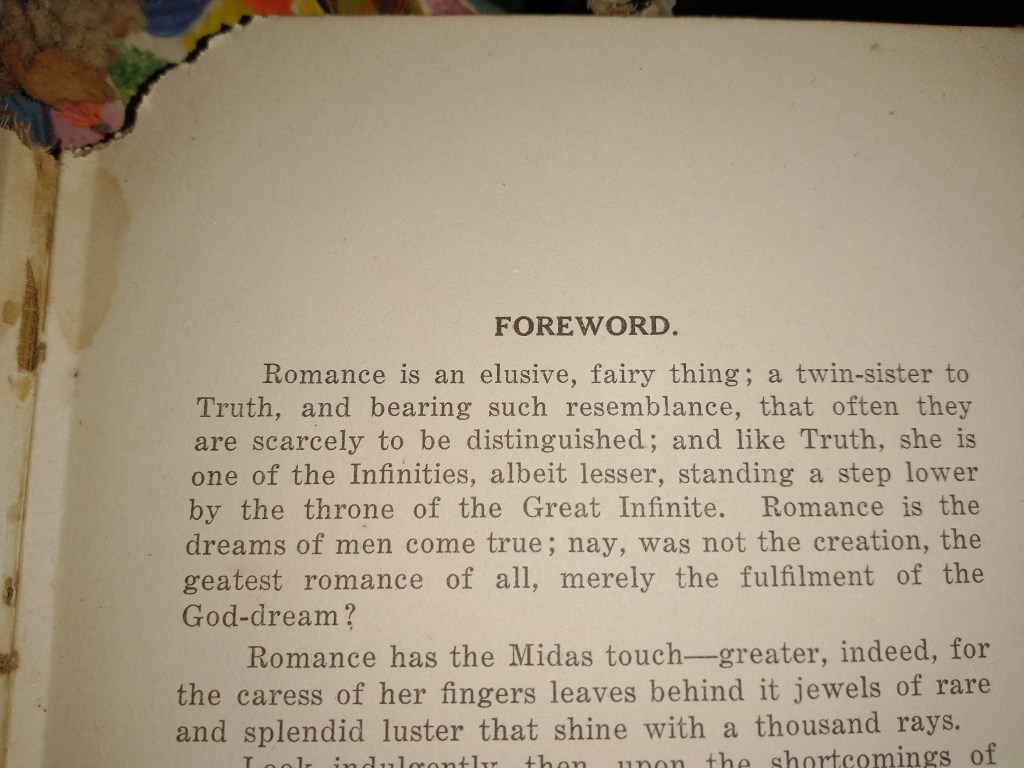
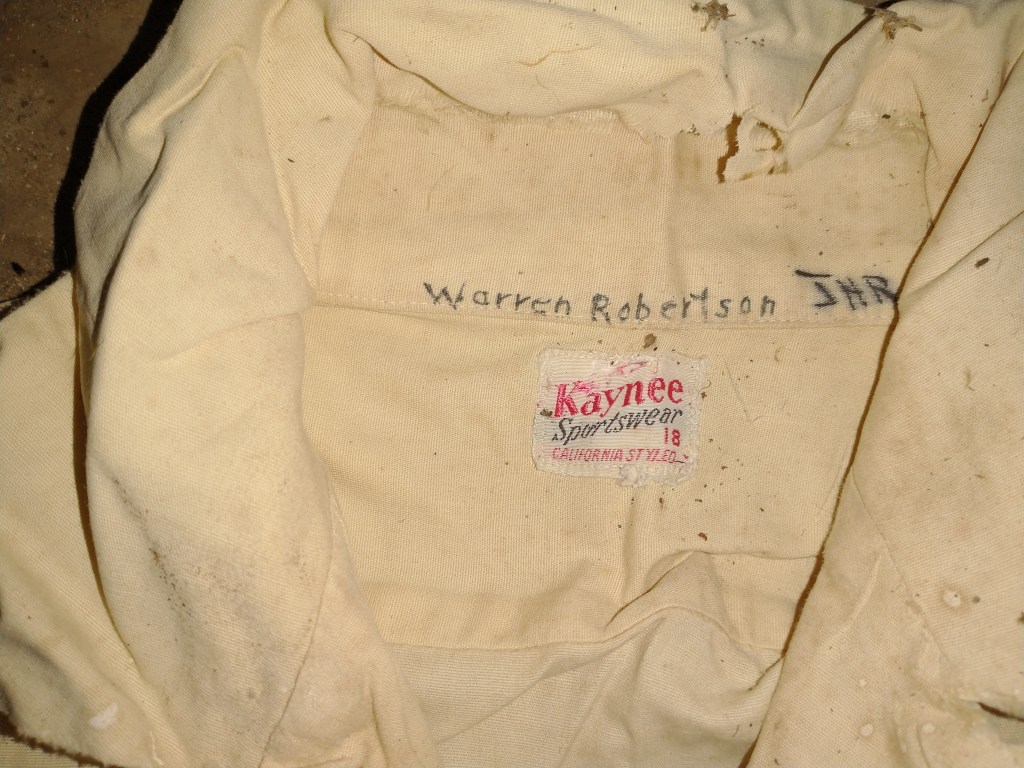
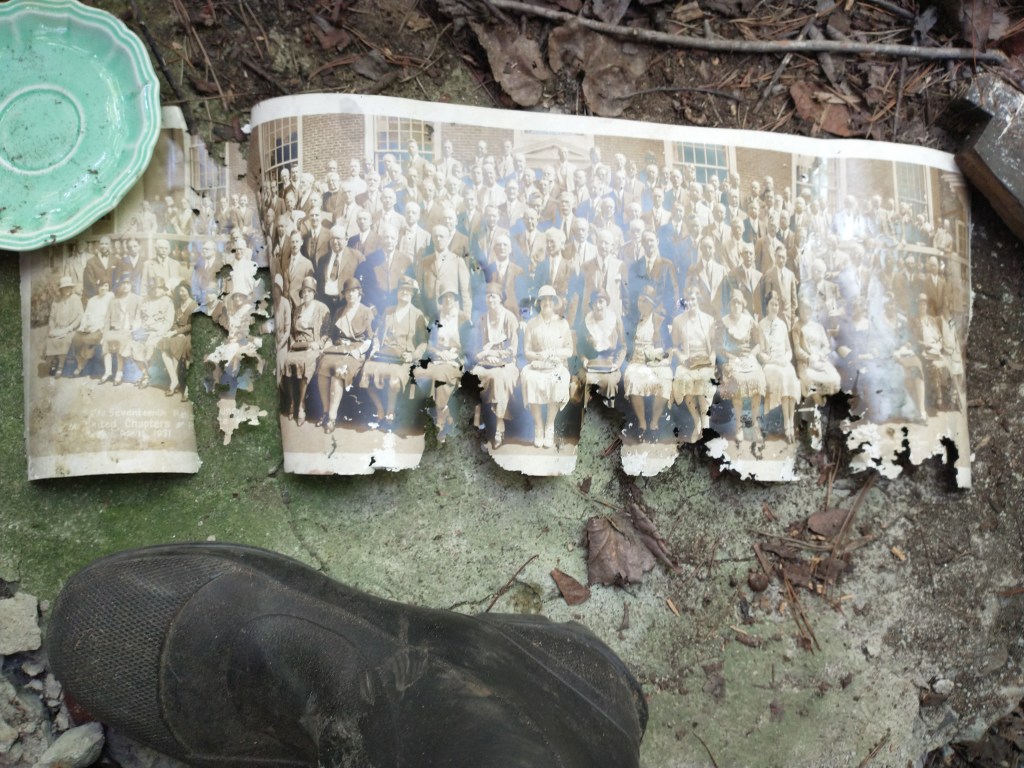


This portrait of my grandfather was salvaged from the shed. He looks to be about 18 so it is circa 1910. (Born 1892.) I looked up men’s clothing styles and that decade 1910 to 1920 styles were very similar to today. -
Days 26 and 27 – Corryton, TN
July 12, 2021
The last place my mother wanted to be buried was next to her mother and father in the city cemetery of Winchester, TN. I think it had something to do with her being an only child and what that might look like. Her mother who lived to be 99 knew mom’s feelings on this. Nevertheless she insisted on buying a third plot to go with her and grandpa’s grave. His remains have been there since 1972.
“Well, I’m gonna get you this plot. You don’t know what might happen. You need a place to be buried,” granma said with that ending note of finality that she was famous for.
It must have been sometime after my parent’s divorce that she decided on this course. My grandmother was not one to be dissuaded by what people wanted. She was ruled by practicality. The third cemetery plot was a theme repeated by Flora less often than commentary on the weather but on par with the importance of church.
Mom never asked for a memorial stone either. Nevertheless, when mom died I got together with Uncle John to purchase a small 6 x 12 inch granite memorial which he placed on the property of his house on the Tennessee River. (Linda and John are really mom’s first cousins, but felt like siblings to mom.)
John’s river house was a cherished meeting place for the cousins and other family for over a decade. Now most of those people are gone and John recently sold the property and removed mom’s memorial along with several other stones he had placed there. Tomorrow, on my way to my birthplace I will stop in Jasper, TN to pick up the memorial stone Uncle John has stored in a barn.
————
I guess there is something to be said for the power of reflective writing. Before I began this journal entry today I had planned on placing mom’s stone in the city cemetery in Winchester next to her parents. Somehow it seemed appropriate. I couldn’t be accused of going against her wishes. If you remember, I scattered her remains in the Tennessee River—the flakes of white bone sparkling in the sunlight amidst a milky way cloud of ash. So technically she wouldn’t be buried next to her parents. Furthermore, though she had an adversarial relationship with her mother it was also a fidelitous bond of love. Surely she wouldn’t be opposed to having a marker there.
Now I’m rethinking the whole thing. Mom would have shot down my technicality defense. How many dying wishes of my mother can I deny?
It was also her deathbed wish that I take care of her partner Marrietta. I ignored that. Marrietta and I’d had the verbal equivalent of a knock-down, drag-out fight a week before my mom finally succumbed to lung cancer in 2010. I hadn’t spoken to her since.
Mom kept secret a large part of her life from her mother. When she had a lobe of her lung removed in 2005 I was instructed to run interference from California and tell granma that mom had severe laryngitis and could not talk. But granma knew something was up.
About mom’s homosexuality she said, “I know what they are doing.” That is the extent of any conversation I ever had with her regarding my mother’s 14-year relationship with Marrietta. Granma knew Marrietta, who was often present during visits. But whatever mom and Marrietta’s relationship was, it wasn’t discussed.
Three years ago I learned on Facebook that Marrietta had died a few months earlier. I thought it had been a lingering illness. A few days ago I learned that she’d fallen backwards off a porch and had not been discovered for a few hours, yelling for help with a broken back. So much for looking after her. I still don’t know the whole story.
Now, at the very least, I need to do some follow up work. If there is a way to show mom and Marrietta’s relationship in death, I need to do that. Whatever my own difficulties were with Marrietta, my mother had a partner she loved.
I’m hoping to enlist my nephew Anthony on a little investigative work to Clyde, North Carolina where Marrietta died. It’s an extra task in this trip and I’ll have the extra weight of a twenty-five pound rock, but at least I can mark off tracking down a Mr. Napper, the Head of Public Works in Winchester. He is the person with the cemetery map and would know which side, granma’s or granpa’s, that third plot would be on.
—————
Driving through the Oakes Day Lily display garden the other day I saw a small bird chasing a hawk at low altitude, parallel to my truck. The hawk, in its escape, disappeared behind some bushes with the little bird fast on its tail. When the hawk reappeared it was coming straight at me, aimed toward my grill. It just had time to veer out of my path. Maybe this helped me to change direction on my memorial placement ideas.
Incidentally, I was on my way to borrow a machete to help hack my way to another memorial site—one on my father’s side. So you can see I’m up to my eyeballs in memorial thoughts.
I may post some pictures of that excursion which included an exciting treasure hunt inside a shed that no one has been inside in sixty years.
Dad often said that he came from a long line of cold, distant and aloof people. It may have been an exaggeration—but witness me—perhaps the only person left who cares enough to hack through a Tennessee rainforest to find some lost memorial slabs.
-
Days 24 and 25 – Corryton, TN
July 9, 2021
There is a danger as I get close to my place of origin that these writes could slip out of control. I suppose there are at least two ways to view the past. One—and this is my natural instinct—is to look at it like this swirling black hole with tentacles that can grab and pull me down. Just from a writing standpoint there is a lot of material there. I’m talking about the past that comes before me—those pieces that fused together to make me—the sperm and egg and everything that led to that which now seems small simply because of distance.
When I was a child visiting Winchester, my grandmother would take me into Hammer’s Five and Dime on the town square. The place smelled like an old wooden building—because that’s what it was. Indeed it had thousands of feet of wood floor that creaked just like an old house. This was the precursor to the modern department store—the evolutionary link between frontier trading post and hardware store.
At the back of Hammer’s were some dressing rooms and one of those alcoves of mirrors where you could see all sides of yourself and where the mirrors that faced each other made an infinite hallway that it seemed possible to walk down. Standing there felt like being in a frozen snapshot of traveling at light speed. If the camera backed out far enough I knew I was just a spec in a vast hole of darkness.
The other way to view the past—and this is just a notion I’m having now—is that it is the seeds in the center of a flower and that we are the petals spinning forward. I’m not sure I can elaborate much more except to say this vision has a more upbeat kind of feel than my natural inclination which is to sink inward. I’m thinking of my self sitting on one of those flower petals with my toes dipping in the center where the seeds are. The seeds are black but they are covered in water and the water is moving. The movement is part of what keeps my reflection from just being a hall of mirrors. If I turn my body to the outside of the flower I’m still sitting on the petal but now my feet hang into air. The sun is shining. There are infinite unknown possibilities.
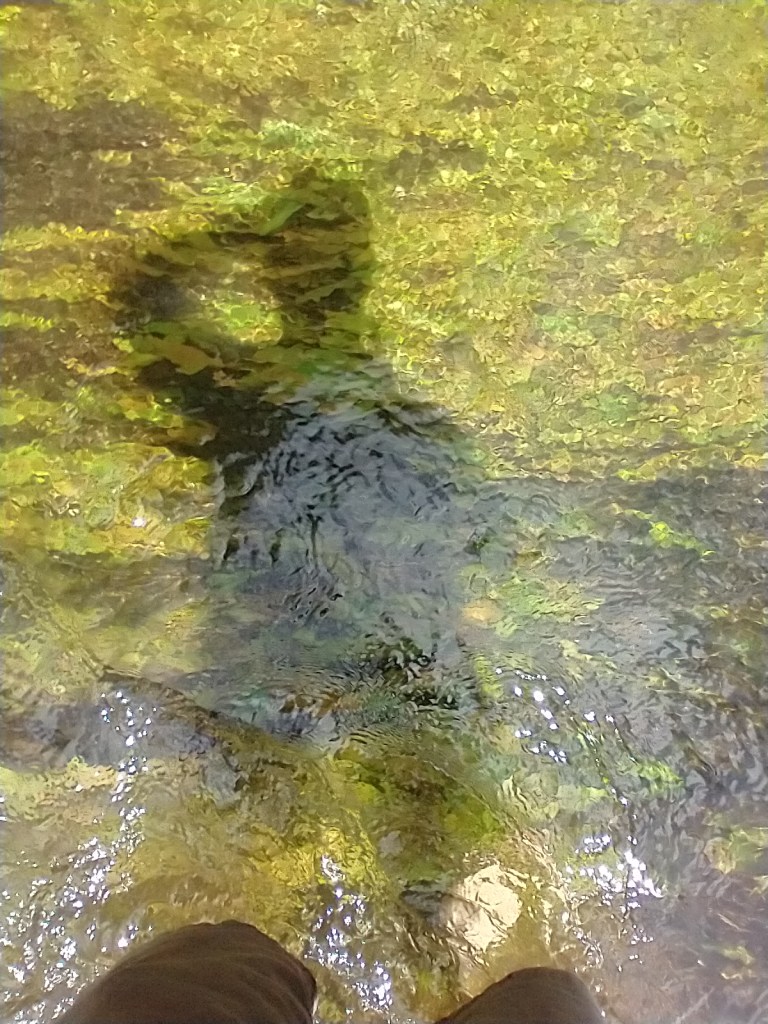
(I’m standing in a shallow branch of the Holston River which joins the French Broad River in Knoxville to become the Tennessee River.)
-
Subscribe
Subscribed
Already have a WordPress.com account? Log in now.
 Spotty West Goes East